
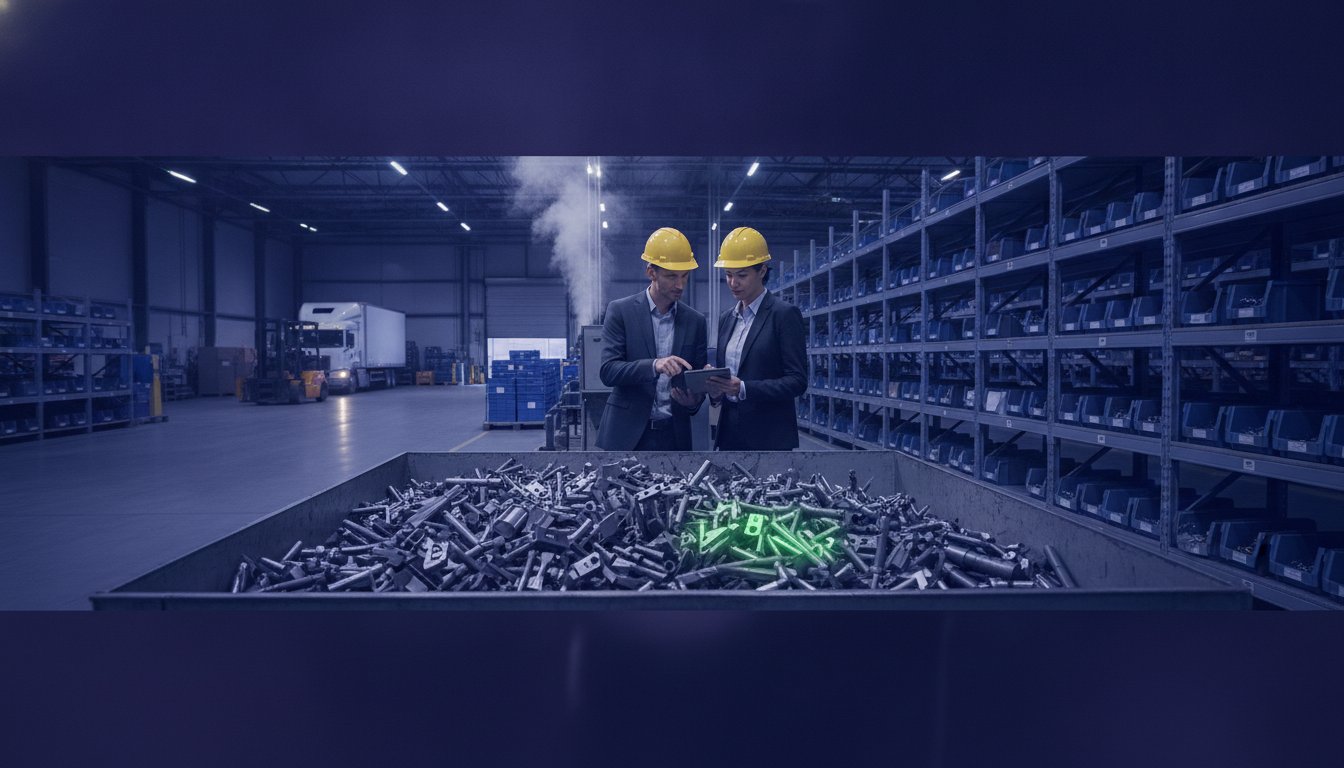
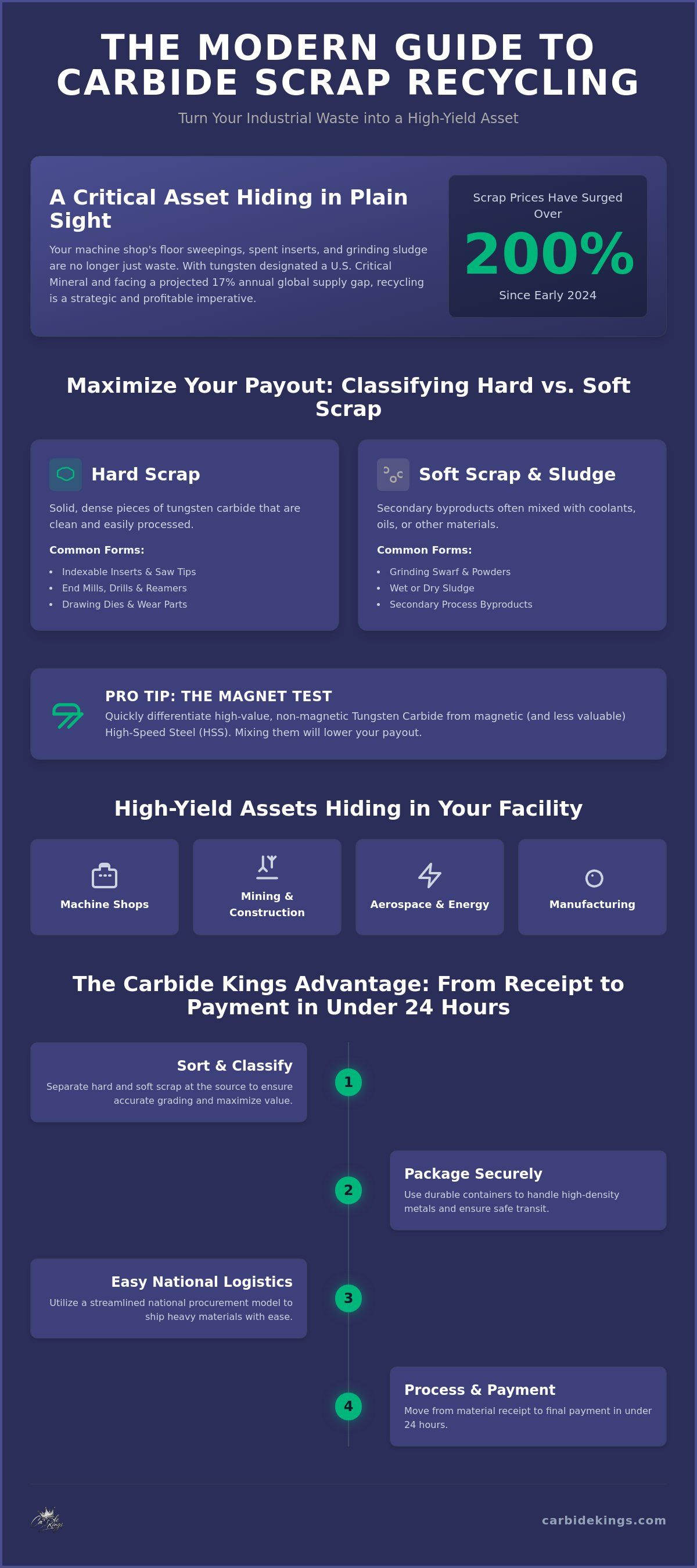
With tungsten carbide scrap prices surging over 200% since early 2024, your machine shop's floor sweepings are no longer just waste; they're a high-yield asset. You likely already know that your spent inserts and grinding sludge hold significant value, but the traditional process of carbide scrap recycling is often more trouble than it's worth. Between opaque pricing models and the logistical nightmare of shipping heavy materials, many industrial professionals let potential profit sit in bins for months because the payout doesn't seem to justify the headache.
We understand that your time is better spent on production than on chasing down scrap dealers. You deserve a process that's as efficient as your own assembly line. This guide will show you how to turn your industrial waste into a streamlined revenue stream using a national procurement model designed for the 2026 market. We'll explain how to secure high-value quotes, handle logistics with ease, and move from material processing to final payment in under 24 hours.
Key Takeaways
- Understand the global supply factors that have turned tungsten scrap into one of the most lucrative industrial waste streams available today.
- Differentiate between hard and soft scrap to ensure your materials are graded correctly for maximum value.
- Master the 2026 pricing model to understand how purity and volume impact your final quote.
- Learn how to simplify national logistics using secure packaging methods for high-density metals.
- Streamline your carbide scrap recycling workflow by following a proven process that moves from material receipt to final payment in under 24 hours.
What is Carbide Scrap Recycling and Why Does it Matter?
Carbide scrap recycling is the professional recovery of tungsten and cobalt from spent industrial tools. It's a specialized industrial process that breaks down used materials to reclaim pure refractory metals. In a market where tungsten is designated on the 2025 U.S. List of Critical Minerals, this isn't just about cleaning up your shop. It's a strategic move to secure a domestic supply chain. Experts project a 17% annual global supply-demand gap for tungsten through 2028, making every pound of recovered material vital to the manufacturing sector.
Choosing to prioritize carbide scrap recycling offers immediate economic relief. Dull tools that once sat in buckets are actually dormant working capital. By selling these materials, you inject cash back into your operations. Beyond the balance sheet, recycling has a massive environmental impact. Reclaiming tungsten requires significantly less energy than mining new ore. It keeps heavy, non-biodegradable metals out of landfills and reduces the ecological footprint of your production line.
The Composition of High-Value Carbide
To maximize your revenue, you must understand what you're selling. Most industrial tooling consists of Tungsten carbide (WC) particles "cemented" together with a cobalt (Co) binder. This cemented carbide is far more valuable than standard tool steel because of its density and heat resistance. While the WC-Co mix is the standard, some high-performance grades include additives like Titanium Carbide (TiC) or Tantalum Carbide (TaC). These elements are used to enhance specific properties like crater resistance. The exact ratio of these minerals determines the final valuation of your scrap.
Common Industrial Sources of Scrap
Identify the high-yield assets in your facility. Value is often hiding in plain sight across several departments. Common sources include:
- Machine Shops: Indexable inserts, end mills, drills, reamers, and taps.
- Mining and Construction: Spent drill bits, road milling teeth, and tunnel boring cutters.
- Aerospace and Energy: Turbine blades, specialized wear parts, and high-temp alloy components.
- Manufacturing: Wire drawing dies, punching tools, and cold heading dies.
Each of these items represents a different grade and purity. Sorting them correctly at the source is the first step toward a higher payout. It's the difference between a generic quote and a high-yield transaction. To reinvest your recycling profits into new professional-grade equipment, newlocaltools.uk provides a comprehensive selection of tools from leading manufacturers to keep your shop running efficiently.
Classifying Your Material: Hard Scrap vs. Soft Scrap
Classification is the foundation of a high-yield transaction. If you mix your materials, you're leaving money on the table. Professional buyers use specific grading criteria to determine the value of your shipment. Because tungsten is featured on the 2022 List of Critical Minerals, industrial demand for precisely sorted materials remains at an all-time high. Accurate carbide scrap recycling starts with a clear understanding of what you have in your bins. Separating solids from sludge isn't just a logistics step; it's a financial strategy that ensures you receive the highest possible quote for your specific material grade.
Beyond the primary categories of carbide, you should also identify tungsten alloys as a separate, high-value category. These materials often come from counterweights, radiation shielding, or specialized aerospace components. While they differ from cemented carbide in composition, they are highly sought after by procurement teams. Keeping these alloys separate from your standard tooling prevents grade dilution and protects your revenue.
Tungsten Hard Scrap: The Industry Standard
Hard scrap consists of solid, dense pieces of material. This includes broken end mills, spent indexable inserts, saw tips, and drawing dies. Most tungsten hard scrap buyers prefer clean, sorted solids because they require less intensive initial processing than powders. To identify high-grade carbide, look for materials that are significantly heavier than steel and non-magnetic. High-speed steel (HSS) is often confused with carbide, but HSS is lighter and typically magnetic. Mixing HSS into your carbide bins will lower your overall price per pound, so keep a magnet handy during the sorting process.
Tungsten Soft Scrap and Sludge
Soft scrap includes the secondary byproducts of tool manufacturing and sharpening. This category covers grinding swarf, powders, and wet or dry sludge. Because these materials are often mixed with coolants or oils, tungsten soft scrap buyers use specialized chemical processes to reclaim the tungsten. It's vital to store sludge in sealed, leak-proof containers to prevent environmental contamination and preserve the metal content. Avoid mixing different types of sludge; keeping your "wet" swarf separate from dry powders makes the refining process more efficient and your payout more predictable. If you have questions about your material's grade, you can contact a procurement specialist for a professional assessment.
Efficient carbide scrap recycling relies on these distinctions. By handling your hard and soft scrap as distinct assets, you simplify the buyer's job and accelerate your own payment timeline. It's a no-nonsense approach to industrial waste management that prioritizes your bottom line.
How Carbide Scrap Prices are Calculated in 2026
Industrial buyers operate on a transparent "Price per Pound" model. It's the most effective way to value dense materials like tungsten. Your payout isn't a guess; it's a calculation. This figure is determined by three primary variables: current global market rates, material purity, and the total weight of the shipment. While tungsten is the main driver, the cobalt binder also plays a critical role in the final offer. Cobalt is a high-value metal in its own right. Its market performance often fluctuates alongside tungsten, and we track these secondary metal markets to ensure every element of your tool is accounted for in the quote.
To get the most out of your carbide scrap recycling, you should stay informed on these shifts. Monitoring a professional tungsten carbide scrap price guide allows you to time your sales for peak market conditions. This proactive approach ensures you aren't just dumping waste, but trading a high-demand commodity at its highest value. It's a no-nonsense strategy for any shop looking to maximize its annual recovery revenue.
The Role of Purity and Grade
Purity is where most machine shops lose money. Standard cemented carbide usually contains between 80% and 95% tungsten. If your bins are contaminated with high-speed steel, ceramic inserts, or heavy dirt, the price per pound will drop significantly. Buyers look for "clean" material to minimize processing costs. This alignment with a Sustainable Recycling and Circular Economy model means that the higher the purity, the more efficiently the material can be returned to the production cycle. In 2026, professional material analysis using X-ray fluorescence (XRF) technology is the standard for verifying these grades. Contamination doesn't just lower the price; it can lead to load rejections if the impurities are non-recyclable. Stick to a strict sorting protocol in your shop to keep your "carbide only" bins pristine.
Market Volatility and Wolfram Prices
The 2026 market is defined by volatility and strategic scarcity. China's recent export controls on tungsten as a "dual-use item" have tightened global supply significantly. This directly impacts the price of Wolfram ore, which in turn drives up the value of recycled carbide. You're essentially holding a refined version of the ore that's ready for immediate processing. With a projected 17% global supply gap through 2028, domestic scrap has become a premium asset. Holding onto material in hopes of a massive price spike is often risky. Current 2026 conditions already offer historically high returns that favor immediate liquidation over long-term stockpiling. Selling now allows you to reinvest that capital back into your core operations immediately.
National Logistics: Sorting, Packaging, and Shipping
Efficient logistics are the bridge between your scrap bin and your bank account. Many shops hesitate to participate in carbide scrap recycling because they fear the high cost of shipping heavy metals across the country. We've eliminated that friction. Our process is designed to handle the heavy lifting, ensuring your materials arrive safely and are weighed with precision. Successful national procurement relies on a methodical approach to preparation. Follow these steps to secure your assets and guarantee a smooth, professional transaction.
We provide comprehensive support throughout the shipping journey. From providing pre-paid shipping labels to assisting with final weight verification, our team ensures you aren't guessing at the logistics. If you're ready to move your material now, get a shipping quote from Carbide Kings to see how simple the process can be. We handle the coordination so you can stay focused on your production schedule.
Best Practices for Sorting and Cleaning
Purity is the primary driver of value. To get the highest quote, you must remove non-carbide attachments. Steel shanks on end mills or braze material on saw tips should be removed whenever possible. This simple step prevents your load from being graded as a lower-value "mix." Use a high-strength magnet to verify your materials. If it sticks, it isn't carbide. Separating different tool types, such as keeping inserts away from drills, also speeds up the grading process. Clean, dry material is always preferred. For those shipping soft scrap, ensure the sludge is drained of excess coolant to prevent weight discrepancies and shipping leaks. This distinction between hard and soft scrap handling is vital for accurate valuation.
Secure Shipping for Heavy Metal
Density is your biggest challenge. Tungsten is incredibly heavy, and standard cardboard boxes often fail under the stress of transit. For loads under 50 pounds, use heavy-duty, double-walled boxes. We recommend the "double-box" technique: place your material in a sealed container, then place that container inside a larger box with ample padding. For larger shipments, five-gallon plastic buckets are the industry standard. Ensure the lids are reinforced with heavy-duty tape or metal rings. If you're shipping over 500 pounds, move to a palletized crate system. We offer access to our corporate shipping accounts, which often provides significant savings compared to standard retail rates. Proper labeling is the final step. Every container must clearly display your documentation to ensure immediate processing upon arrival.
Required Documentation Checklist:
- Packing List: Include a detailed count of containers and estimated weights.
- Material Grade: Clearly mark boxes as "Hard Scrap," "Soft Scrap," or "Tungsten Alloys."
- Contact Information: Ensure your company name and return address are legible.
- Weight Verification: Note the gross weight on the outside of every individual package.
The Carbide Kings Advantage: 24-Hour Processing
Speed is the ultimate differentiator in the industrial sector. While traditional dealers might leave your material sitting in a warehouse for weeks, we operate at the pace of your production line. Our carbide scrap recycling process is engineered for transparency and high-speed execution. We don't just promise efficiency; we deliver it through a strict 24-hour turnaround commitment for material weighing and grading. This means you move from shipping to payment in a fraction of the time required by local scrap yards.
The process is simple and direct. Once your shipment arrives, it's immediately logged and moved to our inspection area. We provide every seller with a transparent report that details the gross weight, tare weight, and material grade of the load. There's no guesswork and no opaque pricing. Once the grading is finalized, we initiate payment through your preferred method. We offer immediate wire transfers for shops that need instant liquidity, or business checks for those who prefer traditional accounting trails. It's a professional, no-nonsense approach to procurement that respects your time and your bottom line.
Professional Procurement Nationwide
We serve industrial clients across the United States from a centralized hub designed for high-volume processing. Working with a specialized tungsten dealer provides a significant advantage over general scrap yards. We understand the specific value of tungsten carbide hard scrap, soft scrap, and alloys. General recyclers often lack the specialized analysis tools to distinguish between grades, which usually results in a lower offer for you. Our expertise allows us to remove the administrative hurdles and unnecessary paperwork that often stall industrial transactions. We act as a proactive partner, handling the heavy lifting so you can stay focused on your core operations.
Getting Your Quote Today
Securing a high-value quote shouldn't be a multi-day ordeal. Our online tools are designed to provide fast, competitive estimates based on current 2026 market trends. To get started, simply have your estimated weight and material type ready. Whether you're clearing out a small machine shop or managing the waste stream of a large manufacturing plant, our team is equipped to handle the volume. Don't let your valuable assets sit idle in a bin. Get your competitive carbide scrap quote now and experience a streamlined approach to carbide scrap recycling that prioritizes your revenue.
Maximize Your Industrial Recovery Revenue Today
The 2026 market presents a unique opportunity to transform your shop's waste into significant working capital. You've seen how precise sorting and an understanding of material purity can dramatically shift your bottom line. By treating your spent tools as a commodity rather than trash, you position your business for better financial resilience. We handle the heavy lifting, from national logistics support to specialized material grading. Our 24-hour processing guarantee ensures you don't wait weeks for your funds. You receive a direct, transparent transaction every time.
Working with specialized tungsten experts removes the traditional barriers of opaque pricing and complex shipping. It's time to stop letting high-value assets gather dust in your bins. Take the final step toward a more efficient carbide scrap recycling program and secure the revenue your operations deserve. Success in the industrial sector relies on speed and precision; our process offers both without the administrative headache. Reach out now to finalize your material recovery and move your business forward. For those who value quality in every aspect of their professional and personal life, you can visit King of Cotton to find premium linens for your home or hospitality needs.
Turn Your Carbide Scrap into Cash – Get a Quote in Minutes
Frequently Asked Questions
What is the current carbide scrap price per pound in 2026?
Prices for carbide scrap recycling fluctuate daily based on global market indices and the current demand for tungsten and cobalt. While prices have seen a significant 200% increase since early 2024, the exact value depends on your material's purity and volume. We provide real-time quotes that reflect the most recent market data. Contact our procurement team with your estimated weight to receive a precise, high-value offer tailored to the 2026 market conditions.
Do you buy carbide grinding sludge and soft scrap?
Yes, we are active buyers of tungsten soft scrap including grinding swarf, powders, and sludge. These materials require specialized chemical refining compared to hard scrap. We provide the necessary containers and guidance to ensure these byproducts are handled safely and priced accurately. Storing your sludge in leak-proof containers is essential for maintaining its value and meeting environmental shipping standards. We help you turn these often-overlooked materials into a steady revenue stream.
How do I tell the difference between tungsten carbide and tool steel?
Density and magnetism are the most reliable ways to distinguish carbide from tool steel. Tungsten carbide is nearly twice as dense as steel; it will feel significantly heavier in your hand. Most carbide grades are also non-magnetic. If a magnet sticks firmly to the material, it is likely high-speed steel (HSS). Using these simple tests in your shop prevents grade dilution and ensures your carbide bins remain high-purity for maximum payout.
Is there a minimum weight requirement for national shipping?
We recommend a minimum shipment of 50 pounds to ensure the logistics costs don't eat into your profits. Because tungsten is a dense, heavy metal, shipping costs can be high for very small quantities. Consolidating your spent inserts, end mills, and drills until you hit this 50-pound threshold is a smart financial strategy. For bulk shipments exceeding 500 pounds, we offer enhanced logistics support to handle the increased weight and volume efficiently.
How quickly will I receive payment after you receive my carbide scrap?
You'll receive payment within 24 hours of your material being weighed and graded at our facility. Our streamlined carbide scrap recycling process is designed for speed and transparency. Once we verify the weight and purity of your shipment, we issue a detailed report for your approval. As soon as you sign off, we release the funds immediately. This fast turnaround keeps your working capital fluid and removes the long waiting periods common with traditional dealers.
Can I sell carbide inserts that are still attached to steel tool holders?
We accept carbide inserts still attached to holders, but we strongly advise removing them to maximize your revenue. Any steel attached to the carbide will lower the overall purity grade of the load, resulting in a lower price per pound. To get the highest possible quote, take the time to strip away steel shanks or braze material. This ensures your shipment is graded as clean, high-value carbide rather than a lower-tier mixed material.
Do you provide shipping labels or logistics support for bulk shipments?
Yes, we provide pre-paid shipping labels and full logistics coordination for all national shipments. For large-scale industrial cleanouts or high-volume shops, we arrange specialized freight pick-ups to handle palletized loads. We manage the paperwork and carrier scheduling so your team doesn't have to navigate complex heavy-metal shipping regulations. This professional support ensures your material moves from your floor to our facility without any logistical friction or hidden costs.
What payment methods are available for industrial sellers?
We offer payment via secure wire transfer or corporate check to suit your business's accounting needs. Wire transfers are the preferred method for most industrial clients because they provide immediate access to funds. If your facility requires a paper trail, we can issue a business check sent via tracked mail. Every payment is accompanied by a full grading report and weight verification to ensure your records are accurate and professional for audit purposes.


