
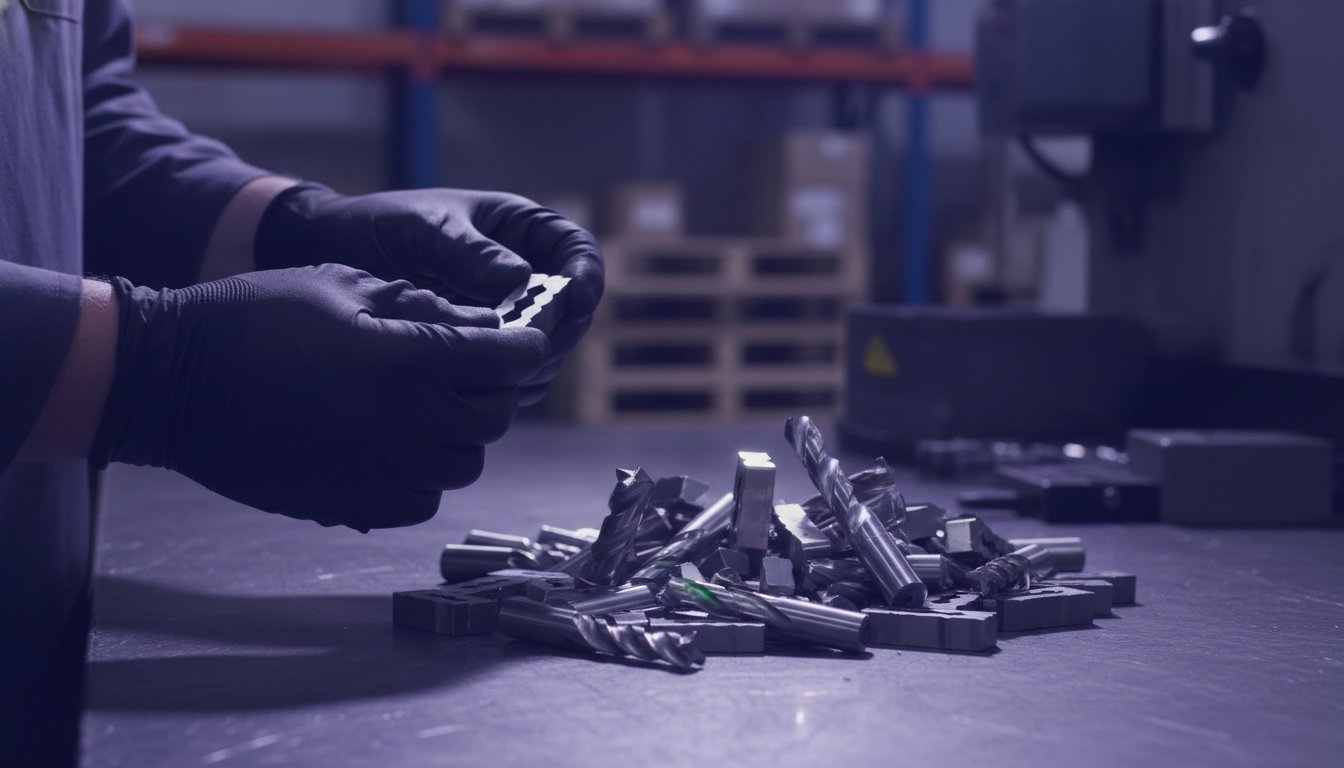
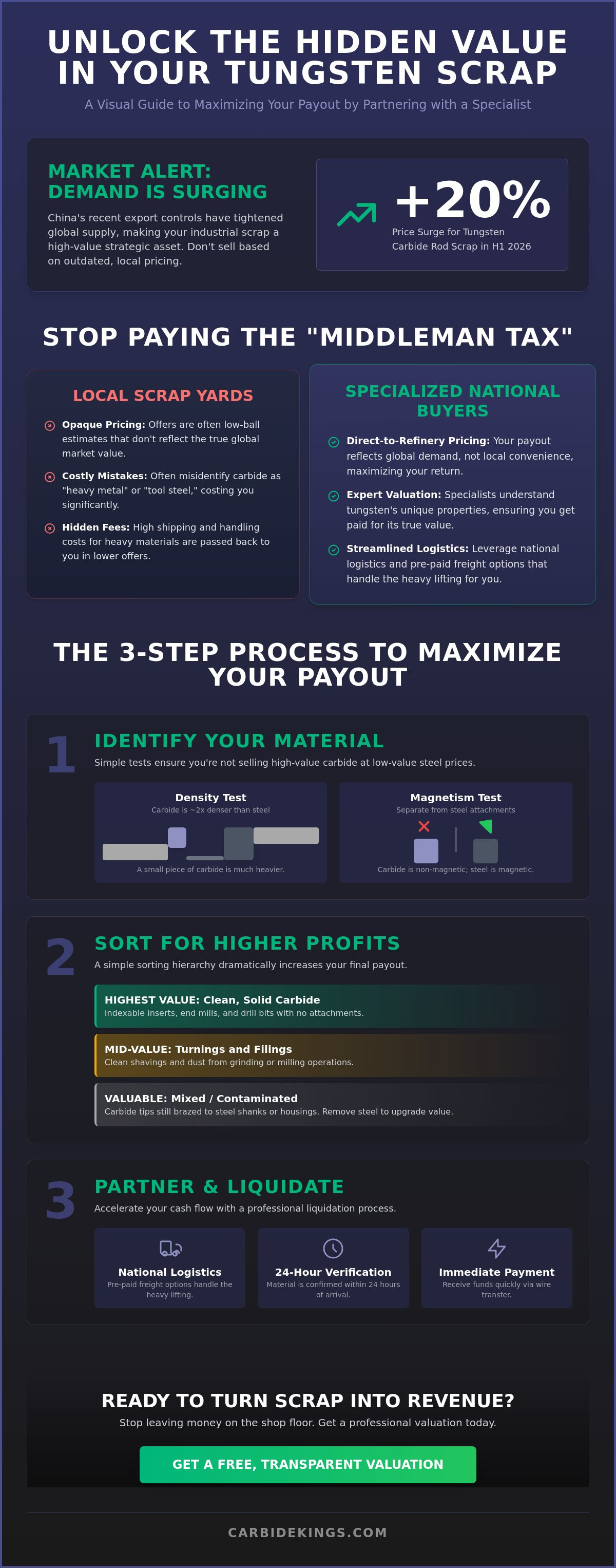
Did you know that the price of tungsten carbide rod scrap surged by 20% in the first half of 2026? With China's recent export controls tightening the global supply, your industrial waste is more valuable than it's ever been. You probably realize that selling to a local dealer often leads to opaque pricing and low-ball offers. It's frustrating to deal with high shipping costs or struggle to separate high-value carbide from basic steel. You deserve a transparent valuation that reflects the current market reality.
Finding the right tungsten hard scrap buyers is the difference between a mediocre check and a significant industrial payout. This guide teaches you the systematic process to identify, sort, and ship your tungsten scrap efficiently. We'll show you how to utilize national logistics to eliminate middleman fees and secure fast payment via wire transfer. You'll learn exactly how to package your materials to prevent damage and meet weight requirements. Stop leaving money on the shop floor and start treating your scrap like the strategic asset it's become.
Key Takeaways
- Master simple identification techniques using density and magnetism to ensure you never sell high-value carbide at low-value steel prices.
- Increase your profit margins by following a specific sorting hierarchy that separates solid scrap from turnings and removes steel shanks.
- Leverage national logistics support and pre-paid freight options by partnering with specialized tungsten hard scrap buyers who handle the heavy lifting.
- Accelerate your cash flow with a professional liquidation process that guarantees 24-hour material verification and immediate payment via wire transfer.
Finding the Best Price for Carbide Scrap in 2026
The global market for tungsten has entered a period of structural repricing. As of early 2026, China's implementation of the "Catalogue of Dual-Use Items" has restricted exports, creating a tighter supply chain for primary materials. This shift makes your existing inventory of tungsten carbide a high-value strategic asset. For industrial sellers, the goal isn't just to move material; it's to capture the full market value that has surged since the beginning of the year. Relying on local scrap yards often means leaving money on the table because these generalists lack the specialized knowledge to price rare refractory metals accurately.
Working with dedicated tungsten hard scrap buyers allows you to bypass the traditional "middleman tax." National buyers operate on a refinery-direct model. Instead of selling your scrap to a dealer who then sells it to a processor, you're dealing with a partner who understands the material's industrial utility. This direct connection ensures your payout reflects global demand rather than local convenience. It's a more professional, transparent way to handle industrial liquidation.
Why Market Volatility Affects Your Payout
Global supply chain factors are the primary drivers of tungsten prices this year. With China controlling over 80% of production, any shift in their export policy sends shockwaves through the market. When primary ore becomes harder to source, the demand for high-quality scrap recycling skyrockets. This creates a direct correlation: as mining costs and export restrictions rise, the value of your used end mills and inserts increases. Timing your sale to align with these peak market cycles is crucial. Don't wait for a local buyer to catch up to global trends. Move your material when the market is hot to maximize your return.
The Middleman Tax: Avoiding Local Scrap Yard Pitfalls
General recyclers often categorize carbide as generic "heavy metal" or "tool steel." This is a costly mistake for the seller. Because tungsten is nearly twice as dense as standard steel, a small bucket of carbide is worth significantly more than a similar volume of common scrap. Local yards often undervalue this density to protect their own margins. They also lack the logistics to ship heavy materials efficiently, passing those hidden costs back to you in the form of lower offers. By choosing specialized tungsten hard scrap buyers, you eliminate these inefficiencies. You get a partner who provides the right scales, the right logistics, and the right price for the specific chemistry of your scrap.
Evaluating Your Tungsten Hard Scrap Inventory
Identifying your material is the first step toward a successful industrial liquidation. Tungsten is exceptionally dense. It weighs nearly twice as much as lead and is significantly heavier than standard steel. This physical mass is your first clue. Before reaching out to tungsten hard scrap buyers, you must verify that your inventory isn't just mixed tool steel. Proper identifying tungsten carbide scrap ensures your initial quote is accurate and prevents delays during the weighing process. According to the USGS Mineral Commodity Summary for Tungsten, recycling remains a vital component of the domestic supply chain. This makes clean, well-identified scrap highly desirable for industrial processors who need reliable secondary sources.
You must also distinguish between clean scrap and contaminated assemblies. Clean scrap consists of solid carbide items with no attachments. Contaminated scrap includes carbide tips brazed onto steel shanks or housings. While both have value, clean solids command the highest rates because they require less processing. If you're unsure about your specific materials, you can always request a preliminary valuation to see where your inventory stands. Taking the time to audit your shop floor now prevents financial surprises later.
Common High-Value Carbide Sources
Most machine shops and manufacturing facilities sit on a gold mine of untapped revenue. To maximize your payout, focus on collecting these primary drivers:
- Indexable Inserts: Used in turning and milling operations. These are the most common and valuable scrap items.
- End Mills and Drill Bits: Solid carbide tools that offer high purity levels.
- Mining Bits and Wear Parts: Heavy-duty components from the energy and construction sectors.
- Pure Tungsten vs. Alloys: Pure carbide is the goal. While alloys containing nickel or cobalt are valuable, they're processed differently than clean solids.
The Spark Test and Magnet Test
The magnet test is your fastest field tool. Most tungsten carbide is non-magnetic or only weakly magnetic. If a magnet sticks firmly to the metal, it's likely high-speed steel (HSS) or common carbon steel. This simple check saves you from shipping low-value material to tungsten hard scrap buyers.
The spark test provides definitive proof for questionable items. Hold the metal against a bench grinder for a moment. Steel produces long, white, branching sparks that travel far from the wheel. Tungsten carbide produces very short, dull orange sparks that don't branch. Never mix HSS with your carbide loads. Even a small amount of steel contamination can lower the grade of your entire shipment. Separating these materials yourself ensures you get paid for the exact weight of your high-value inventory.
Sorting Strategies to Maximize Your Payout
Organization is the fastest way to increase your per-pound return. When you send a mixed bin of material to tungsten hard scrap buyers, the valuation often defaults to the lowest-grade item in the container. Professionals use a "Clean vs. Dirty" classification system to categorize inventory. Clean scrap consists of 100% tungsten carbide, while dirty scrap contains attachments like steel shanks, plastic coatings, or brazing material. Understanding the tungsten carbide scrap price hierarchy allows you to prioritize your labor. Focus your efforts on the highest-purity solids first.
Don't let your high-value material get lost in a sea of generic shop waste. The density of tungsten means that even a small volume of sorted solids carries significant financial weight. By presenting a well-organized shipment, you demonstrate professional oversight, which often leads to faster verification and settlement. It's a straightforward process that rewards precision.
Separating Solids, Inserts, and Rounds
Efficiency begins at the source. Keeping your end mills separate from your indexable inserts simplifies the verification process once the material reaches the facility. While both are high-value solids, they often carry different market premiums based on their cobalt content. Intact surplus tooling might even command a higher rate than broken bits. If you have mixed "junk" bins, take thirty minutes to pull out the largest solid pieces. This simple act of recovery prevents high-density carbide from being buried under lower-value turnings. You want to ensure every ounce of weight is accounted for at its maximum potential.
Dealing with Brazed Tools and Assemblies
Brazed tools present a unique challenge for sellers. These items feature a carbide tip bonded to a steel body. Because the steel adds significant weight without adding significant value, buyers apply an "attachment" deduction to the total weight. This accounts for the labor and energy required to strip the carbide from the steel. You've got to decide if it's worth stripping the steel yourself. For large mining bits or heavy assemblies, the labor cost often outweighs the gain. However, for smaller tools, removing the steel can significantly boost your net payout. Tungsten hard scrap buyers provide transparent quotes that detail these deductions. You'll know exactly what you're being paid for before the transaction is finalized. Clear sorting isn't just about tidiness; it's a direct investment in your bottom line.
Streamlining Logistics: Shipping Heavy Metal Nationally
The weight of tungsten carbide is its greatest asset and its biggest logistical hurdle. Many shop owners hesitate to sell nationally because they assume shipping costs will eat their profits. This is a misconception. Specialized tungsten hard scrap buyers have developed streamlined logistics networks that make national shipping both affordable and simple. By moving large volumes, these buyers access bulk freight rates that individual shops can't match. In many cases, for significant loads, buyers provide pre-paid freight labels or arrange for LTL (Less Than Truckload) pickups at no cost to you. This ensures the tungsten carbide scrap price per pound you're quoted remains your net payout.
Safety is paramount when moving such dense material. A small box of carbide can easily weigh 60 pounds, which is enough to burst through standard single-walled cardboard. You must follow industrial packaging standards to ensure your shipment arrives intact and ready for weighing. If a box fails in transit, you lose both material and money. Proactive logistics support ensures your high-value inventory is protected from the shop floor to the refinery.
Packaging for Protection and Accuracy
Don't cut corners on your containers. Use double-walled boxes or reinforced plastic buckets for all shipments. Industry best practices recommend limiting the weight of each box to 40-50 pounds to prevent breakage during transit. Fill any empty space with heavy-duty packing material. There should be absolutely no movement within the package. If the contents shift, they act like a hammer against the box walls. Double-boxing is highly recommended for added security. Finally, include a clear manifest inside the box and label the exterior with your company name. This allows for rapid processing the moment your material hits the dock.
Freight vs. Small Parcel: Choosing the Right Method
The weight of your inventory determines your shipping strategy. Small parcel carriers are ideal for loads under 200 pounds. Once you exceed this threshold, LTL freight becomes the more profitable choice. Palletizing bulk carbide is the industry standard for large-scale liquidations. Secure your material in barrels or crates, then strap them to a pallet using steel or heavy-duty poly straps. Tungsten hard scrap buyers often manage this entire process for you. They can schedule the truck, provide the bill of lading, and track the shipment from your shop to the facility. This support removes the administrative burden from your team and ensures a smooth transaction.
Ready to move your inventory without the logistical headache? Schedule your freight pickup today and let our logistics experts handle the heavy lifting for you.
The Carbide Kings Process: 24-Hour Liquidation
Efficiency is the final step in your recycling journey. Professional tungsten hard scrap buyers understand that your time is as valuable as the metal you're selling. Once you've identified and sorted your material, the liquidation process should be fast and frictionless. We've refined our workflow to ensure that your industrial waste is converted into capital in the shortest timeframe possible. There's no waiting for weeks on assay results or dealing with delayed shipping updates. Every stage is designed for speed and professional clarity.
Transparency is the foundation of our service. You receive a detailed settlement report that accounts for every pound of material received. This report breaks down the weights and grades, providing you with a clear audit trail for your records. It's a straightforward approach that eliminates the guesswork often associated with local scrap yards. By choosing a partner that prioritizes precision, you ensure that your shop's bottom line is protected by data, not estimates.
From Quote to Cash: The Timeline
The process begins before you even ship your material. You can provide photos of your inventory for a rapid initial estimate. This allows you to gauge the value of your load without any upfront commitment. Once your shipment arrives at the facility, the 24-hour verification clock starts. We use advanced XRF (X-ray fluorescence) technology to analyze the chemical composition of your scrap. This non-destructive testing provides an instant, accurate reading of the tungsten content. We don't guess; we verify. As soon as the weight and purity are confirmed, the final valuation is issued. Payment follows immediately through your choice of wire transfer, check, or immediate settlement. It's a professional liquidation that keeps your cash flow moving.
Why Industrial Professionals Choose Carbide Kings
Machine shop managers and procurement officers value our process because it removes administrative hurdles. We handle the paperwork and the logistics so your team can stay focused on production. Our goal is to be a proactive partner rather than a distant service provider. For recurring scrap generators, this relationship offers long-term benefits, including predictable scheduling and consistent market-leading rates. We've stripped away the unnecessary complexity of traditional metal recycling to provide a modern, streamlined alternative. You get the satisfaction of a fair, fast transaction every time you clear your floor.
Don't let your valuable carbide sit in a bin gathering dust. Contact us today for the best price for carbide scrap and experience a liquidation process that respects your time and your inventory.
Maximize Your Shop's Revenue Today
Securing the best price for your carbide scrap is a result of a systematic approach to sorting and partnering with the right experts. You've learned how to identify high-density material and bypass local dealers who add unnecessary middleman fees. By focusing on clean solids and utilizing bulk logistics; you turn industrial waste into a reliable revenue stream. Partnering with specialized tungsten hard scrap buyers ensures you receive refinery-direct pricing that reflects the true value of your inventory in 2026.
Our process removes the administrative burden from your team. We provide national shipping and logistics support to simplify every shipment. With our 24-hour processing guarantee; you'll have your weight verified and payment initiated before the next shift begins. Stop letting your valuable inventory gather dust on the shop floor. Get Your Custom Carbide Scrap Quote Now and start capturing the full value of your materials today. Your shop is sitting on a strategic asset; it's time to cash in.
Frequently Asked Questions
What is the current best price for carbide scrap per pound?
Market rates for carbide scrap are determined by global supply and demand indices. In 2026, prices have seen a structural increase; for instance, rod scrap prices surged by 20% in the first half of the year due to new export controls. While specific rates change daily, solid rod scrap and drill bits currently command a premium. You should request a real-time quote to ensure your payout reflects the most recent market surge.
Do I need to clean my carbide end mills before selling them?
You don't need to perform any industrial cleaning or polishing on your used tooling. It's helpful to shake off excess coolant or heavy sludge to ensure the weight of the metal is as accurate as possible. Specialized tungsten hard scrap buyers handle the final processing and refining. Focus your energy on sorting by grade rather than cleaning individual pieces to maximize your efficiency.
How do I distinguish between tungsten carbide and high-speed steel?
Density and spark testing are the most reliable methods for identification. Tungsten carbide is nearly twice as heavy as steel; a small bucket of carbide will feel significantly heavier than a similar bucket of steel. When held to a grinder, steel produces long, white, branching sparks. Carbide produces very short, dull orange sparks that don't branch or travel far from the wheel.
Is there a minimum weight requirement to sell tungsten scrap?
Minimum requirements vary, but selling in bulk is always more profitable. Most national logistics programs become highly efficient at 50 pounds for small parcels and over 200 pounds for LTL freight. Consolidating your scrap into larger loads allows you to take advantage of pre-paid shipping options. This ensures that logistical costs don't cut into your final payout during the liquidation process.
How long does it take to receive payment after shipping my scrap?
Professional buyers typically initiate payment within 24 hours of material verification. Once your shipment arrives at the facility, it's weighed and analyzed using XRF technology to confirm purity. You'll receive a settlement report detailing the final weights and values. Most sellers choose wire transfers for immediate access to funds, though checks and other settlements are also available to fit your shop's needs.
Can I sell carbide inserts that are still attached to steel shanks?
Yes, you can sell brazed tools and assemblies. These items are classified as "dirty" scrap because they require extra labor to separate the carbide from the steel body. Buyers apply an attachment deduction to account for the weight of the steel and the processing costs. For the best return, consider stripping the steel from larger pieces if your shop has the capacity to do so efficiently.
What is the difference between hard scrap and soft scrap in terms of value?
Hard scrap refers to solid items like inserts, end mills, and drill bits; soft scrap includes powders and grinding sludge. Solids generally fetch a higher price because they're easier to verify and refine. Soft scrap requires more intensive chemical processing to remove contaminants like oil or moisture. Both materials are valuable components of the tungsten recycling loop and should be collected in separate containers.
Does the price of tungsten change daily like gold or silver?
Tungsten prices do fluctuate based on global market conditions and geopolitical shifts. As a designated critical mineral, its value is sensitive to supply chain disruptions and export regulations. China's 2026 dual-use item restrictions have made daily monitoring even more important for industrial sellers. Working with tungsten hard scrap buyers who track these indices ensures your quote is always competitive and reflects the current market reality.


