

Did you know China currently controls over 80% of global tungsten production, and prices for carbide powder have surged over 200% since early 2024? If you're managing industrial waste, you've likely noticed that the market is undergoing a massive structural repricing. You shouldn't have to guess if you're getting a fair deal when negotiating tungsten carbide scrap prices with general dealers who might not understand the true value of your high-grade material. It's time to stop leaving money on the table because of market confusion or logistical hurdles.
We understand the frustration of fluctuating quotes and the heavy lifting involved in moving dense metals. This guide provides the exact strategies you need to maximize your revenue by understanding current market drivers and mastering the professional negotiation process. You'll learn how to sort your Tungsten Hard Scrap and Tungsten Soft Scrap to reduce a dealer's processing risk. We'll also provide a repeatable process for getting the best quotes and ensuring fast, reliable payment for your Tungsten Alloys. Let's turn your scrap inventory into a streamlined source of profit.
Key Takeaways
- Identify how global market indicators and specific binder materials like cobalt directly influence your final scrap payout.
- Increase your net weight value by properly separating carbide from high-speed steel and removing steel shanks before shipping.
- Master the strategy of negotiating tungsten carbide scrap prices by using volume benchmarks and frequent seller status to lock in higher floor rates.
- Look beyond the per-pound quote to calculate total value, including the impact of shipping logistics and hidden processing fees.
- Simplify your industrial recycling with a transparent 24-hour verification and payment process that removes administrative hurdles.
The Factors Driving Tungsten Carbide Scrap Prices in 2026
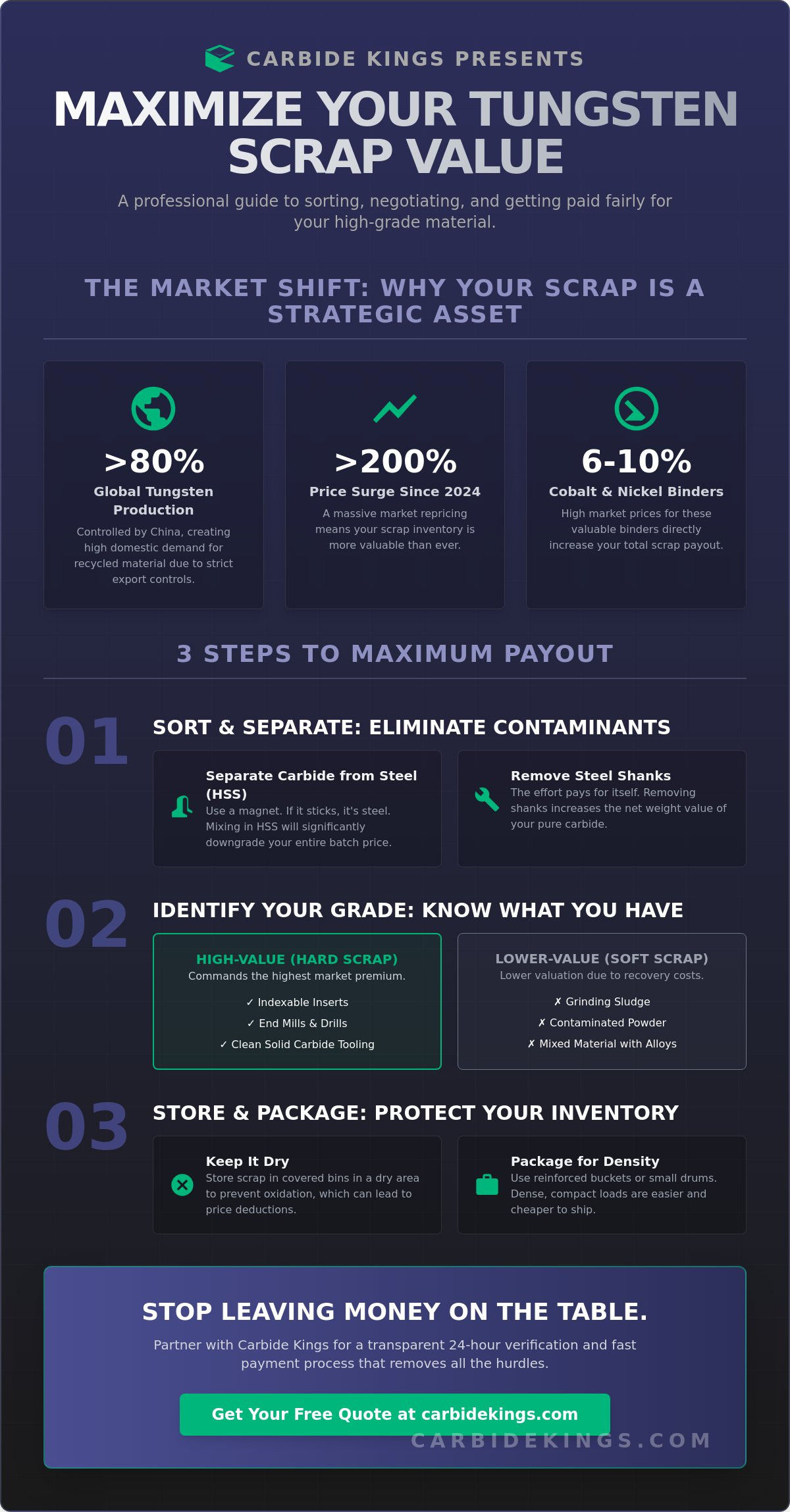
Understanding the floor price of your material is the first step toward negotiating tungsten carbide scrap prices effectively. While general scrap rates for steel or aluminum fluctuate wildly based on local demand, Tungsten carbide maintains a higher level of price stability. This resilience stems from its status as a critical strategic mineral. The London Metal Exchange (LME) serves as a primary benchmark for raw elements, but your final scrap value also depends heavily on the concentration of binders. Most industrial carbide contains 6% to 10% cobalt or nickel. When the market price for these binders spikes, the value of your scrap often follows suit because the recovery process yields multiple valuable metals.
Global supply chain shifts have fundamentally altered domestic demand in 2026. China currently controls over 80% of global tungsten production and has implemented strict export controls on tungsten oxides and carbides. These restrictions have forced domestic manufacturers to rely more heavily on recycled streams to keep their production lines moving. This scarcity creates a premium for high-purity scrap that simply didn't exist in previous market cycles. You aren't just selling waste; you're providing a vital resource for the domestic supply chain.
As global supply chains for strategic minerals become increasingly complex, working with specialized international recycling firms like 億鑫鴻景電子 (Yixin Hongjing Electronics) can provide a competitive edge in material recovery; read more about their expertise in high-value electronic component recycling.
Global Market Trends and Material Demand
Increased domestic manufacturing in the aerospace, defense, and energy sectors is driving a massive push for recycled carbide. Mining disruptions and geopolitical tensions have made primary tungsten harder to acquire. The 2026 outlook confirms tungsten as a high-priority industrial mineral. This means that negotiating tungsten carbide scrap prices is now about leveraging the strategic importance of your inventory. Shops that can provide consistent, clean material are finding themselves in a much stronger position than those selling mixed batches to general dealers, just as those who discover Richmond Stone find that high-quality materials are essential for luxury architectural projects.
Identifying High-Value vs. Low-Grade Scrap
Not all material is created equal in the eyes of a professional dealer. Clean solids, such as indexable inserts and end mills, command the highest market premium because they require minimal processing. Contaminated grinding sludge or "soft scrap" typically sees a lower valuation due to the intensive costs of filtration and chemical recovery. Tungsten Hard Scrap remains the gold standard for immediate, high-value payout. While pure carbide consists of tungsten and carbon, Tungsten Alloys are blended with other metals like iron or copper to achieve specific industrial properties. Knowing exactly which category your material falls into prevents you from accepting a lowballed "mixed" rate, and for those interested in the architectural application of high-grade metals, you can read more about how Copper Gutter Supply Company utilizes these materials for premium gutter systems.
How to Prepare Your Carbide Scrap for Maximum Value
Most machine shops lose money by tossing all their tool waste into a single bucket. This "mixed" approach forces dealers to quote for the lowest common denominator to protect their margins. When you're negotiating tungsten carbide scrap prices, your strongest weapon is a clean, sorted shipment. Start by separating your carbide from High-Speed Steel (HSS). A simple magnet test is your best friend here; if it sticks, it's likely steel and should be binned separately. Mixing even a small amount of HSS into a carbide load can result in a significant price downgrade for the entire batch.
Removing steel shanks from carbide-tipped tools is another high-impact move. While it takes some effort, the increase in net weight value for the carbide portion often pays for the labor several times over. According to the Tungsten Statistics and Information provided by the USGS, tungsten is a dense, high-value commodity that doesn't benefit from being diluted by cheap ferrous metals. Refineries prefer "clean" loads because they reduce processing time and energy costs.
Storage matters just as much as sorting. Tungsten Soft Scrap, such as grinding sludge or powder, is susceptible to oxidation if left in damp environments. Oxidation can complicate the chemical recovery process at the refinery, potentially leading to price deductions. Keep your bins covered and in a dry area. For packaging, aim for density. Heavy, compact loads in reinforced buckets or small drums are easier for logistics partners to handle. You might want to check with a professional buyer to see if your current collection method is optimized for the best possible quote.
Sorting Inserts, End Mills, and Tooling
Divide your inventory into "Hard Solids" and "Mixed Tooling" before you ask for a quote. Hard solids like indexable inserts are the easiest to verify and command the fastest payouts. If you still have the original packaging or manufacturer labels, keep them with the scrap. This documentation speeds up the verification process and confirms the material grade immediately. To keep your shop's records and material logs organized and protected, Custom Binding Products offers durable solutions for industrial documentation. Focus on these common items:
- Indexable turning and milling inserts
- Solid carbide end mills and drill bits
- PCB micro-drills
- Carbide wear parts and dies
Dealing with Contaminants and Coatings
Many professionals worry that Titanium Nitride (TiN) or TiAlN coatings will lower their scrap value. In reality, these coatings are so thin that they rarely impact the recycling process for Tungsten Hard Scrap. Brazed tools are a different story. Since the carbide is joined with silver solder or copper, dealers must account for the separation cost. For grinding sludge, ensure no trash, floor sweepings, or aluminum chips mix with the material. Pure sludge is a lucrative asset; contaminated sludge is often treated as an environmental liability. Negotiating tungsten carbide scrap prices becomes much simpler when you can guarantee the purity of your material from the start.
Negotiation Tactics: How to Get a Better Quote from Dealers
Stop treating your scrap sales like a basic retail transaction. Professional recycling is a business-to-business deal where the terms are often more flexible than they appear on a website. When you're negotiating tungsten carbide scrap prices, you're not just selling metal; you're selling a predictable, high-quality feedstock for a refinery. Dealers value reliability and volume because it reduces their own operational overhead. If you can provide either, you have the leverage to move beyond standard list prices.
Timing your liquidation is equally critical. You don't need to be a day-trader, but you should keep an eye on USGS tungsten market data to understand broader supply trends. If global production is tightening, holding your inventory for an extra month might yield a better return. However, don't hold indefinitely. Market volatility can swing both ways, and the cost of storing heavy material often outweighs the benefit of waiting for a minor price peak.
Leveraging Volume for Better Rates
The "Volume Premium" is the most direct way to increase your payout. It's much cheaper for a dealer to process one 500 lb pallet than ten 50 lb boxes. Freight costs, administrative paperwork, and assaying time stay relatively flat regardless of the weight. You should use this efficiency to your advantage. Ask the dealer about tiered pricing structures. If you're close to a weight milestone, like 500 or 1,000 pounds, negotiate a price "kickback" or a per-pound bonus for hitting that target. Establishing a "Frequent Seller" status is another way to lock in higher floor prices, as dealers will pay a premium for a guaranteed, clean supply they don't have to hunt for.
Comparing Quotes Without Burning Bridges
Transparency is your best tool when talking to multiple buyers. Be wary of "teaser" quotes that seem significantly higher than the market average. These are often red flags for dealers who drop the price upon receipt by claiming excessive moisture or "hidden" contamination. To get an accurate, binding quote, provide clear photos of your sorted material and an estimated weight. Mentioning that you're looking for a long-term recycling partner can often lead to better terms than a one-off transaction. Reading The Ultimate Guide to Tungsten Hard Scrap Recycling in 2026 will help you understand exactly what information professional buyers need to see to give you their most aggressive offer. Negotiating tungsten carbide scrap prices is about building a relationship based on mutual profit, not just chasing a single high number.
Evaluating the Total Value: Shipping and Payment Terms
A high per-pound quote looks great on paper, but it doesn't always lead to the biggest check. When you're negotiating tungsten carbide scrap prices, you must look at the net value after all deductions. Many general scrap dealers offer an aggressive top-line price only to claw back profits through hidden "processing fees" or "assay charges." These costs can quietly eat 5% to 10% of your total revenue. Always demand a transparent breakdown of every charge before you commit to a shipment. If a dealer can't provide a flat rate without hidden surcharges, it's a major red flag for your bottom line.
Transparency extends to the scale as well. Accurate weight is the foundation of a fair deal. Professional industrial buyers should provide certified weight certificates upon receipt of your material. If you're shipping large quantities of Tungsten Hard Scrap, consider weighing your containers before they leave your facility. This documentation gives you leverage if there's a discrepancy during the receiving process. A dealer who values your business will welcome this level of professionalism because it simplifies the verification stage for both parties.
Reducing Logistics Costs to Protect Margins
Shipping dense, heavy metal is expensive. A slightly lower per-pound quote that includes free shipping or dealer-provided freight labels often beats a higher price where you pay the freight. For smaller shipments under 50 pounds, ask about utilizing flat-rate shipping options. These provide a predictable cost regardless of weight. For high-volume industrial accounts, you should negotiate for free onsite pickup. Professional buyers have access to deep freight discounts that you likely can't match on your own. Leveraging their logistics network is one of the easiest ways to increase your final payout without changing how you sort your material.
Why Immediate Payment is a Negotiation Point
Cash flow is the lifeblood of any industrial operation. Waiting 30 days for a check to clear isn't just an inconvenience; it's a cost. You should treat payment speed as a core part of your negotiation. Some dealers try to push "consignment" selling, where they pay you only after they've resold the material. This is incredibly risky in a volatile tungsten market. If prices drop while your metal is sitting in their warehouse, you're the one who loses.
Prioritize partners who offer rapid verification and settlement. Carbide Kings prioritizes rapid wire transfers to ensure you have your funds within 24 hours of material approval. This speed eliminates market risk and puts capital back into your business immediately. If you're ready to see how a streamlined process impacts your returns, request a transparent quote today and stop waiting weeks for your money.
Partnering with Carbide Kings for Streamlined Recycling
Choosing the right partner is the final piece of the puzzle when negotiating tungsten carbide scrap prices. Many general dealers act as middle-men, taking a cut of your profit before selling the material to a specialized processor. We eliminate that barrier. By working directly with us, you capture the full industrial value of your Tungsten Hard Scrap and Tungsten Alloys. Our rates reflect real-time market data, ensuring you receive a quote that's both competitive and transparent. We don't believe in teaser rates or hidden fees. We believe in building long-term relationships through reliability and professional integrity.
The traditional scrap process is often slow and manual. It involves phone tag, vague quotes, and weeks of waiting for a check to arrive in the mail. We've modernized this workflow to match the speed of your manufacturing operations. Our system removes the administrative hurdles that typically make industrial recycling a chore. You focus on your core production; we handle the recovery of your metal assets. Efficiency is our standard, not just a goal.
The 24-Hour Quote-to-Payment Process
Our workflow is designed for maximum efficiency. You've already done the hard work of sorting and preparing your material, so the final step should be the easiest part of your week. Follow these three steps to turn your inventory into capital:
- Request your quote online: Provide basic details about your material type and estimated weight to get started.
- Receive your shipping instructions: We provide prepaid shipping labels for smaller loads and full freight coordination for larger industrial shipments of Tungsten Soft Scrap.
- Get paid: Once your material is verified at our facility, we issue payment within 24 hours. We prioritize wire transfers because we know you value immediate cash flow over a pending check.
National Logistics Support for Industrial Sellers
We serve machine shops and manufacturers across the entire United States. Whether you have a single bucket of inserts or a warehouse full of used tooling, our logistics network is equipped to handle the move. We remove the logistical headaches of shipping heavy metal by managing every detail of the transport. There's no complex paperwork or carrier negotiation for you to manage. Our goal is a seamless, professional transaction that respects your time and maximizes your return. Negotiating tungsten carbide scrap prices doesn't have to be a struggle when you have a partner that handles the heavy lifting. Get your competitive carbide scrap quote from Carbide Kings today and experience the industry's most streamlined recycling process.
Maximize Your Industrial Scrap Revenue Today
Mastering the art of negotiating tungsten carbide scrap prices effectively requires a combination of market awareness and meticulous material preparation. You've learned that separating your solids from sludge and removing steel shanks aren't just chores; they're direct investments in your final payout. A high per-pound quote from a general dealer often vanishes once shipping fees and assay charges are applied. True value comes from a transparent partnership that respects your time and your bottom line. This commitment to quality is a value shared by other premium service providers; for example, if you're looking to upgrade your professional or personal space, NY Cabinets provides premier custom cabinetry and home solutions that reflect the same level of precision you bring to your business.
Carbide Kings eliminates the traditional friction of industrial recycling. Our specialized tungsten carbide experts provide national shipping logistics and handle all the heavy lifting for your facility. We don't make you wait weeks for your money. Instead, we offer 24-hour payment processing once your material is verified. It's time to stop settling for the confusing rates offered by local yards and move to a streamlined, professional system that rewards your efficiency.
Get a Fast Quote for Your Carbide Scrap
You've built a successful operation by focusing on precision. Let us apply that same precision to your scrap recovery so you can get back to what you do best with the capital you've earned.
Frequently Asked Questions
How much is tungsten carbide scrap worth per pound in 2026?
Market prices for carbide in 2026 fluctuate daily based on global supply constraints and current London Metal Exchange (LME) benchmarks. Clean solids and indexable inserts command the highest premium because they require the least amount of processing at the refinery. To ensure you have an accurate valuation, you should always request a real-time quote that reflects the current strategic importance of tungsten.
Can I negotiate a better price if I have a large volume of carbide?
Yes, you can leverage higher volumes to secure a more competitive per-pound rate. Dealers often provide tiered pricing structures or volume bonuses because processing a single large shipment is more cost-effective than handling several small ones. If you're managing 500 pounds or more, ask about bulk incentives to maximize your total revenue from the transaction.
Does the coating on carbide inserts affect the scrap price?
Standard industrial coatings like TiN or TiAlN typically don't decrease the value of your scrap inserts. These layers are microscopic and don't interfere with the chemical recovery process used during recycling. You'll see a much larger impact on your price by focusing on removing steel shanks or brazing material, as these contaminants require more intensive separation at the facility.
What is the minimum amount of carbide scrap I can sell?
Most professional buyers prefer shipments of at least 50 pounds to offset the costs of logistics and verification. While smaller amounts are accepted, the shipping costs can significantly eat into your profit margins. Consolidating your material until you hit a weight milestone is the best strategy when negotiating tungsten carbide scrap prices for maximum net profit.
How do I distinguish between carbide and high-speed steel?
A simple magnet test is the most reliable way to tell the difference in a shop environment. Tungsten carbide is generally non-magnetic or only slightly magnetic, while High-Speed Steel (HSS) will stick firmly to a magnet. Additionally, carbide is significantly heavier than steel. If a tool feels surprisingly dense for its size, it's likely a carbide component rather than steel.
How long does it take to get paid after I ship my carbide scrap?
You'll typically receive payment within 24 hours of the material being verified at our facility. We prioritize fast settlement through wire transfers to help you maintain your business's cash flow without unnecessary delays. Avoid dealers who insist on long holding periods or consignment terms, as these expose you to market volatility while your metal sits in a warehouse.
Why is the price of carbide so much higher than regular scrap metal?
Tungsten is a rare and strategic mineral with unique physical properties that make it essential for high-performance tooling and defense applications. Regular ferrous metals like steel are abundant and easily mined, but tungsten is difficult to extract and refine. This scarcity, combined with the energy-intensive process of creating carbide, gives recycled material a much higher market floor than common metals.
Are there extra fees for shipping or processing my scrap?
You should look for a partner that provides transparent, all-inclusive quotes without hidden processing or assay fees. Some dealers use high top-line numbers but then subtract "handling charges" after they receive your material. When negotiating tungsten carbide scrap prices, always confirm that your quote includes national logistics support and that no surprise deductions will appear on your final settlement statement.


