
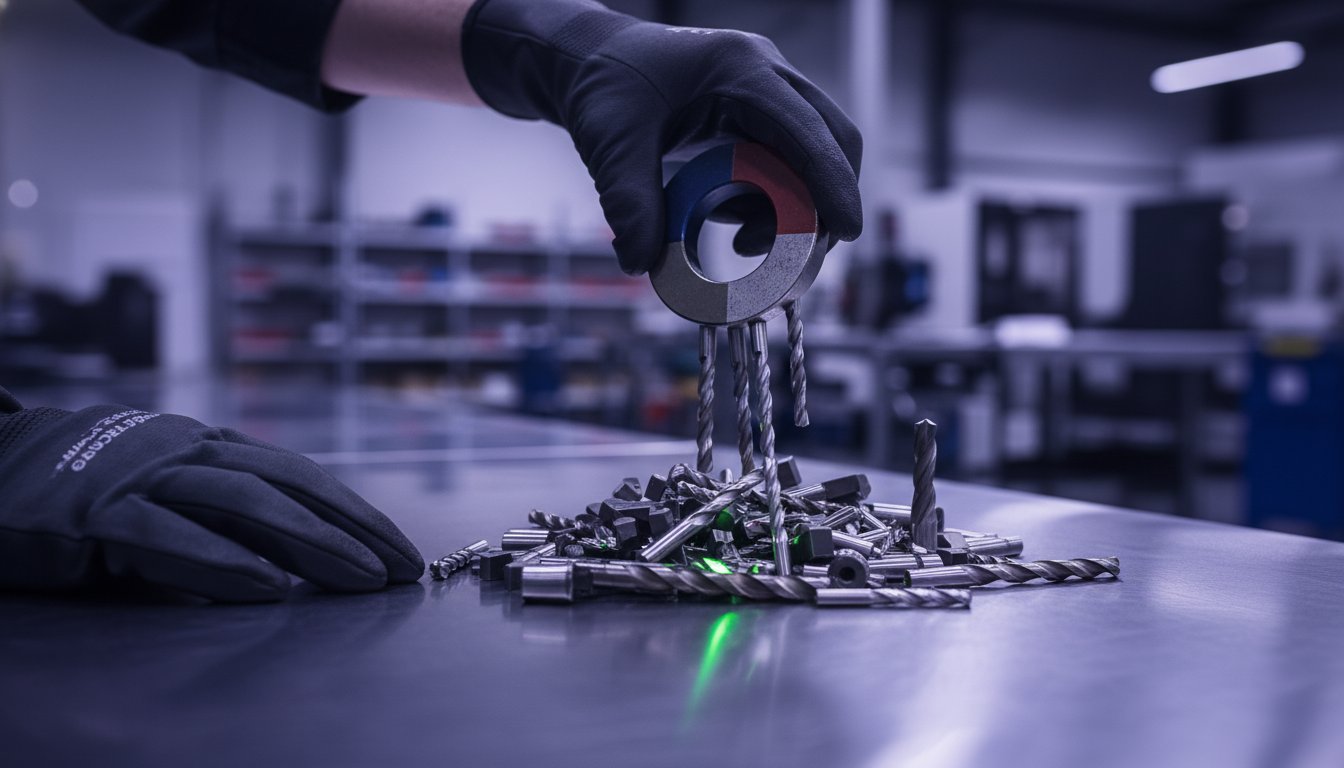
Every time a shop worker tosses a worn carbide insert into the general steel bin, they're essentially throwing away twenty times the value of that metal. In a 2026 market where tungsten is a strictly controlled critical mineral, these sorting errors are more expensive than ever. You probably know the frustration of staring at a pile of dull end mills and wondering if they're high-speed steel or high-value carbide. Without expensive lab equipment, it's easy to second-guess your sorting and leave money on the floor.
Learning how to identify tungsten carbide scrap is a fundamental skill for maximizing your industrial waste revenue. We promise to show you the exact physical tests and visual cues professionals use to distinguish these materials with absolute certainty. This guide covers a methodical, step-by-step process involving density checks, spark testing, and magnetic reactions. By the end, you'll have a standardized sorting routine that ensures every pound of tungsten hard scrap or alloy in your shop is accounted for and valued correctly. It's time to stop guessing and start capturing the full value of your materials.
Key Takeaways
- Leverage the extreme density of tungsten carbide to perform fast, reliable bulk sorting without specialized equipment.
- Utilize a simple magnet test to detect the weak magnetic pull of cobalt binders, effectively separating carbide from common steel.
- Master the grinder spark test to learn how to identify tungsten carbide scrap with total confidence, distinguishing it from lower-value high-speed steel.
- Locate high-value tungsten hard scrap in common industrial tools like CNC inserts, end mills, and specialized metal forming dies.
- Standardize your shop floor's sorting process to eliminate contamination and maximize the revenue from every pound of material you ship.
What is Tungsten Carbide? Physical Properties and Value
Knowing how to identify tungsten carbide scrap starts with understanding its unique physical makeup. Tungsten carbide isn't a pure metal. It's a "cemented" composite created by bonding tungsten particles with a metallic binder, usually cobalt. This combination creates a material of extreme hardness, ranking between 9 and 9.5 on the Mohs scale. For comparison, a diamond is a 10. This structural integrity makes it indispensable for industrial cutting, drilling, and wear resistance.
The value gap between carbide and common shop metals is massive. While high-speed steel (HSS) is a reliable workhorse, it lacks the rare mineral content and performance of carbide. In the 2026 market, tungsten's status as a critical mineral has driven its scrap value significantly higher than traditional alloys. If you mix these materials in your scrap bins, you're effectively diluting your profits. High-speed steel contains mostly iron, while carbide is dense with high-value tungsten. Sorting them correctly is the fastest way to increase your shop's bottom line.
The 'Heft' Test: Understanding Specific Gravity
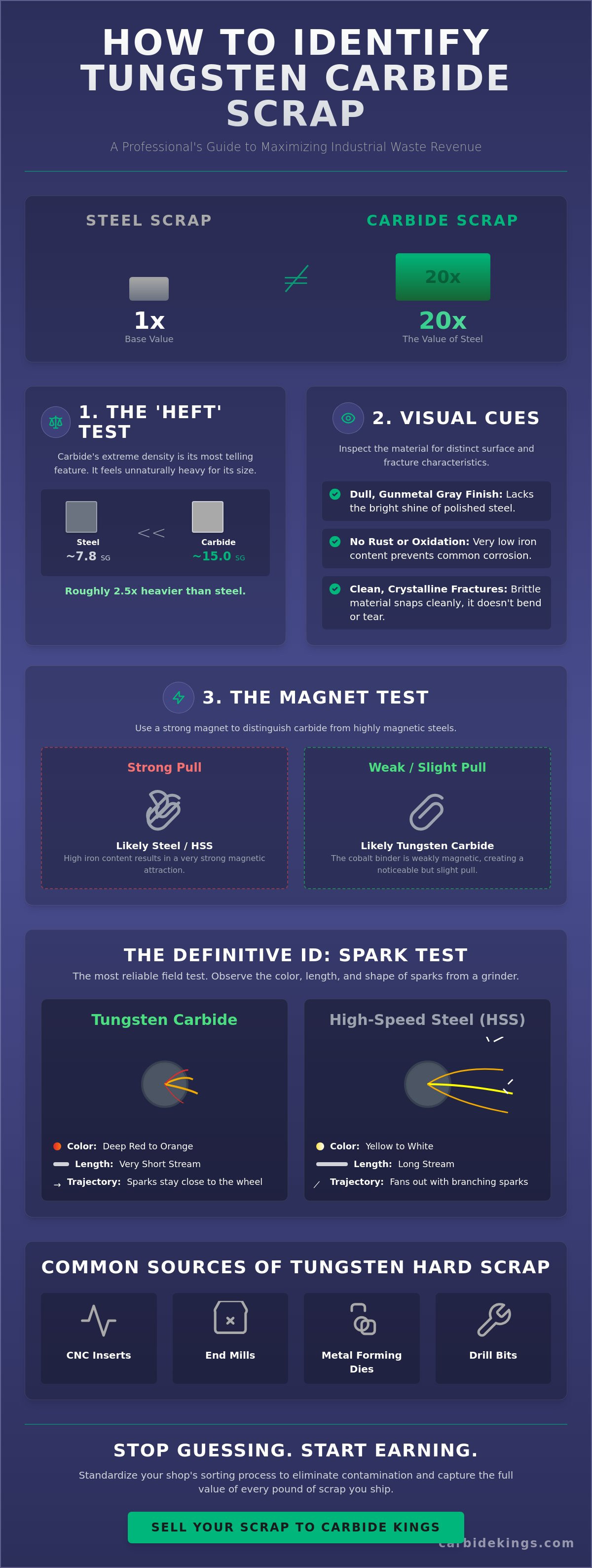
Density is the most reliable physical differentiator. Tungsten carbide is incredibly heavy; it's nearly twice as dense as lead and roughly 2.5 times heavier than standard steel. This is the first step in how to identify tungsten carbide scrap without relying on a laboratory. When you pick up a carbide end mill, it feels unnaturally heavy for its size. A steel drill bit of the same dimensions will feel light and hollow by comparison.
To verify this in the shop, consider the specific gravity. Common C2 grade carbide typically has a specific gravity between 14.5 and 15.0. Lead sits at 11.3, while iron is only 7.8. If a piece of scrap feels "bottom-heavy" or has a weight that surprises you, it's likely carbide. This tactile sensation is a professional's first line of defense against misidentified scrap.
Visual Cues: Color and Luster
Visual inspection provides the next set of clues. Unpolished carbide has a distinct "dull gray" or "gunmetal" finish. It lacks the bright, reflective shine often seen on polished steel tools. Because it contains very little iron, carbide doesn't rust or oxidize. If you find a tool that has been sitting in a damp environment for months but shows no signs of orange rust, you're likely looking at carbide or a high-grade alloy.
Watch for the fracture pattern. Carbide is extremely brittle compared to steel. It won't bend, twist, or deform under pressure; it simply snaps. Professional sorters look for these specific characteristics:
- Clean Fractures: Look for sharp, crystalline edges at the break point rather than jagged, torn metal.
- Lack of Oxidation: Check for the absence of surface rust or pitting common in carbon steels.
- Weight-to-Volume Ratio: Confirm that the small item carries the "dead weight" feel of a much larger metal object.
These physical markers allow you to process bins quickly. Once you recognize the color and weight, the sorting process becomes second nature.
Five Ways to Identify Tungsten Carbide Scrap Without Lab Equipment
Efficient sorting requires a systematic shop floor workflow. You don't need a mass spectrometer to separate high-value materials. By following a logical sequence of elimination, you can process bins quickly and accurately. This approach ensures you never leave money on the table by mislabeling your inventory. Here is how to identify tungsten carbide scrap using basic tools found in any industrial environment.
Start with the weight. As established, carbide is significantly heavier than steel. This is your primary filter for bulk scrap. If a piece feels light or "normal," set it aside for further testing as potential high-speed steel. Once you have your heavy candidates, verify their chemical composition through their physical reactions. For those looking for detailed data on these reactions, the Tungsten Carbide Physical Properties database provides a deep dive into why these materials behave the way they do under stress.
The Magnet Test Nuance
Grab a strong magnet and check the pull. Most people assume carbide is entirely non-magnetic, but that's a common misconception. Most industrial carbide uses a cobalt binder, which is a ferromagnetic material. You'll often feel a "slight pull" or a weak attraction. Contrast this with carbon steel or HSS, which will snap to the magnet with force. Be careful with stainless steel, though. Some grades of stainless are non-magnetic and can mimic carbide's lack of pull. Always cross-reference the magnet results with the weight test to avoid false positives.
The Scratch Test: Glass and Ceramic
Carbide's extreme hardness makes the scratch test a definitive proof of identity. Take the scrap piece and try to scratch a glass bottle or the unglazed bottom of a ceramic tile. Carbide will bite into the surface and leave a deep, permanent white mark with very little pressure. High-speed steel might leave a faint streak, but it won't gouge the material. This test is non-destructive for the scrap and takes only seconds to perform. It's a foolproof way to confirm you're holding a high-value item.
Finally, listen to the metal. If you drop a small carbide insert onto a concrete floor or a steel anvil, it produces a high-pitched, musical "clink." Steel produces a duller, lower-frequency "thud." This sound test is a favorite among veteran machinists for rapid-fire sorting. Once you've confirmed your materials using these shop-floor methods, you can confidently prepare your tungsten hard scrap for shipment to ensure you receive the highest possible payout.
The final and most decisive method for how to identify tungsten carbide scrap is the spark test. This requires a bench grinder and a steady hand, which we'll cover in detail in the next section.
The Spark Test: How to Tell Carbide from High-Speed Steel (HSS)
The spark test is the most reliable shop-floor method for sorting tools. It removes the guesswork from your workflow. You don't need expensive sensors to get an answer. A simple bench grinder or a handheld angle grinder is all that's required to confirm the material's identity. This test is especially useful when dealing with coated tools where visual cues like color are hidden by a layer of TiN or AlTiN.
When you apply a tool to the grinding wheel, the resulting spark stream tells a story. High-speed steel (HSS) creates long, energetic streamers. These sparks are bright orange-to-white and finish with multiple "explosions" or bursts. It looks like a miniature fireworks display. This reaction is caused by the carbon content in the steel reacting with the air during the grind.
Tungsten carbide reacts differently. The sparks are short and move slowly. They appear as dull orange-to-red droplets. Most importantly, there are almost no bursts at the end of the stream. If you see a "dying ember" pattern instead of a firework show, you've found your high-value carbide. Understanding these visual profiles is the final step in how to identify tungsten carbide scrap with absolute certainty.
Visualizing the Spark Pattern
Think of HSS as fireworks and carbide as dying embers. The lack of carbon in carbide means the sparks don't have the fuel to "pop" at the end of their flight. This visual distinction is a primary factor in how to identify tungsten carbide scrap. The duller, redder color of the carbide spark is a direct result of the material's heat resistance and chemical composition.
Always prioritize safety in the shop. Grinding generates intense heat and flying debris. Wear ANSI-rated safety glasses and heavy-duty work gloves. Perform these tests in a well-ventilated area away from flammable liquids or oily rags to prevent accidental fires.
HSS vs. Carbide: Side-by-Side Comparison
The difference in "feel" is just as telling as the visual pattern. Consider the act of grinding a 1/2-inch HSS drill bit versus a 1/2-inch carbide end mill. The HSS bit will yield to the wheel, shedding metal quickly. You'll notice a familiar metallic scent as the steel wears down. It's a smooth, predictable process.
Carbide is a different beast. It is incredibly resistant to the abrasive wheel. You'll feel a significant amount of friction and "pushback" against your hand. The tool won't wear down nearly as fast, and the smell is more acrid and chemical than steel. Knowing these physical sensations helps you standardize your sorting process. For more information on the various tool types you might encounter, read The Complete Guide to Tungsten Hard Scrap Recycling in 2026. Once you master the spark test, you've mastered the professional way to sort your bins.
Common Industrial Sources for Tungsten Carbide Hard Scrap
Knowing how to identify tungsten carbide scrap is only half the battle. You also need to know where it hides in your shop. High-value tungsten is rarely found in residential waste. It's a professional material used in environments that demand extreme heat resistance and durability. CNC machining centers are the most common starting point. Look for solid carbide end mills, reamers, and specialized drills. These tools carry the characteristic weight you've already learned to recognize.
Metal forming and fabrication shops are another goldmine. Cold heading dies, drawing dies, and heavy-duty punches often consist of massive carbide cores. In mining and construction, look for road milling teeth and the small, rounded "buttons" on the ends of large drill bits. Even woodworking shops, like the specialized studio Bourbon Bigfoot Woodworking, contribute to the supply through carbide-tipped saw blades, router bits, and planer knives. Identifying these sources allows you to capture material that others might overlook.
Beyond identifying scrap, if your business requires high-precision part fabrication from various materials, you can learn more about CNC Cut to Size for professional material processing and 3D printing services tailored for wood, acrylic, and composites.
The Value of 'Indexable Inserts'
Indexable inserts are the most frequent form of high-value scrap you'll encounter. These small, replaceable tips are the "teeth" of modern machining. You can identify them by their distinct geometric shapes, such as triangles, squares, circles, and rhombs. They often feature a hole in the center for mounting. Because these inserts are almost always 100% cemented carbide, they represent the cleanest and most profitable form of scrap. They require minimal processing and are easy to sort into dedicated bins. If you have a collection of these tips, you can quickly convert your tungsten hard scrap into a significant revenue stream.
Hidden Carbide in Wear Parts
Don't limit your search to cutting tools. Many industrial wear parts rely on carbide to survive abrasive environments. Sandblasting nozzles, mechanical seal faces, and high-precision ball bearings are prime candidates. Any component that must resist extreme friction or chemical erosion likely contains tungsten alloys.
Be careful with "brazed" parts. These are items where a small carbide tip is welded or brazed onto a steel body, like a masonry drill bit or a large circular saw blade. In these cases, the carbide is only a fraction of the total weight. You must decide if the effort to remove the tip is worth the payoff. For most shops, keeping these separate from solid carbide tools is the best way to maintain the purity of your high-value bins. Once you recognize these common shapes and sources, the sorting process becomes a fast, profitable routine.
For larger industrial projects, partnering with experienced demolition contractors charleston sc can streamline the identification and recovery of high-value alloys during complex site clearances and structural teardowns.
Sorting and Shipping Your Scrap for the Best National Payout
You've mastered how to identify tungsten carbide scrap using density, magnets, and spark tests. Now you need to turn that knowledge into a check. The most common mistake shops make is laziness during the final sort. Mixing high-speed steel (HSS) with your carbide doesn't just complicate the process; it lowers the price of the entire load. Buyers pay for purity. If your bin is contaminated with steel, you'll likely receive a lower steel-alloy rate rather than the premium carbide price you deserve.
Efficiency on the shop floor should extend to your scrap management. Standardize your bins and label them clearly. When your team knows exactly where each tool belongs, the sorting happens in real time. This proactive approach eliminates the need for a massive, time-consuming sort at the end of the month. It ensures your inventory is always ready for a fast, lucrative transaction.
The 'Clean Sort' Advantage
Maximizing your payout requires a few extra minutes of preparation. If you have brazed tools, remove the steel shanks whenever possible. This increases the "clean" weight of your shipment and secures a higher valuation. Keep your materials categorized into three distinct groups to ensure an accurate quote:
- Tungsten Hard Scrap: Solid inserts, end mills, and dies.
- Tungsten Soft Scrap: Sludge, grindings, and powders.
- Tungsten Alloys: Specialized heavy metals or composites.
We buy all three categories nationally. Keeping "soft scrap" like grindings separate from "hard scrap" tools is vital. Sludge often requires different processing than solid inserts, and mixing them can lead to weight discrepancies during the melt. Clear separation is the hallmark of a professional shop.
Ready to Sell? The Final Step
Once you've applied your skills in how to identify tungsten carbide scrap and organized your bins, the shipping process is straightforward. Carbide is incredibly dense. A small box can easily weigh 60 pounds or more. If you use standard cardboard, the bottom will likely fail during transit. Always use double-walled boxes or heavy-duty plastic buckets for smaller loads. For bulk shipments, secure your material in reinforced crates and tape every seam twice. Professional packing prevents loss and ensures your material arrives exactly as you intended.
Our processing flow is designed for speed. We verify the weight and material type within 24 hours of receiving your shipment. You won't deal with long wait times or administrative hurdles. We provide a no-hassle shipping process that handles the logistical heavy lifting for you. It's a transparent, results-oriented system that respects your time and your bottom line. Turn your identified carbide scrap into cash today.
Maximize Your Shop Revenue Today
You now have a professional framework for maximizing your industrial waste revenue. By mastering how to identify tungsten carbide scrap through density, spark, and hardness tests, you've removed the guesswork from your shop floor. Every clean bin of sorted inserts or wear parts represents recovered capital that would otherwise be lost to the steel pile. Standardizing this process ensures your team captures the full value of every tool they retire.
Just as you look for ways to maximize the value of your shop materials, you might also look for ways to increase the value of your home through professional services. If you're in the market for a kitchen upgrade, check out Cabinet refinishing Denver to see how specialized refinishing can transform your space.
It's time to put your sorted inventory to work. We provide top market rates for tungsten hard scrap, soft scrap, and alloys with a process built for industrial speed. Our team handles the heavy lifting with national shipping support and 24-hour processing and payment once your material arrives. You stay focused on your core operations while we ensure your scrap is valued accurately and paid out fast. Don't let high-value minerals sit in your bins another day.
Get a Fast Quote for Your Carbide Scrap and experience the satisfaction of a fair, transparent transaction. Your shop floor is more lucrative than you think. Get started today and turn your waste into a streamlined profit center.
Frequently Asked Questions
How can I tell the difference between tungsten and steel?
Weight and spark patterns are the most effective ways to separate these metals. Tungsten carbide is nearly 2.5 times heavier than steel, giving it a distinctive "dead weight" feel. When you apply it to a grinder, steel produces long, bright white streamers with many bursts. Tungsten creates very short, dull orange sparks that look like small droplets. This physical testing is the standard for how to identify tungsten carbide scrap on the shop floor.
Is all tungsten carbide non-magnetic?
Most industrial carbide scrap is slightly magnetic because it contains a cobalt binder. While pure tungsten is non-magnetic, the cobalt used to "cement" the particles together creates a weak pull when tested with a strong magnet. This is a key differentiator from carbon steel or high-speed steel, which will snap to a magnet with much greater force. If you feel a faint, sluggish attraction, you likely have carbide.
What does the spark from tungsten carbide look like?
The spark from carbide looks like a short, dying ember. It travels a very short distance from the grinding wheel and appears as a dull orange or reddish droplet. Unlike steel, it lacks the carbon fuel required to create "explosions" or branching bursts at the end of the spark stream. Mastering this visual cue is essential for how to identify tungsten carbide scrap when sorting through mixed bins of dull cutting tools.
Can I use a file to identify tungsten carbide?
Yes, a standard steel file is an excellent tool for a hardness check. Because carbide ranks between 9 and 9.5 on the Mohs scale, it's significantly harder than any steel file. If you try to file the edge of a carbide insert, the file will simply slide across the surface without leaving a mark or "biting" into the metal. If the file removes material, the item is likely high-speed steel or an alloy.
Why is tungsten carbide so much heavier than steel?
The extreme weight is due to the high atomic density of tungsten. It has a specific gravity of approximately 15.0, while common steel sits at only 7.8. This means that a small carbide tool contains nearly twice as much mass as a steel tool of the identical size. This density is a natural property of the material and serves as the most reliable first step in any professional sorting process.
What are the most common items made of tungsten carbide?
The most common sources are CNC cutting tools like indexable inserts, end mills, and drills. You'll also find it in high-wear industrial components such as sandblasting nozzles, mechanical seal faces, and cold heading dies. In the construction and mining sectors, carbide is used for the "buttons" on drill bits and the teeth on road milling machines. These items are designed for environments where steel would fail.
Does tungsten carbide rust or corrode?
Tungsten carbide is highly resistant to rust and corrosion because it contains almost no iron. While carbon steel tools will quickly develop orange oxidation in damp environments, carbide maintains its characteristic dull gray or gunmetal luster. If you find a pile of scrap tools that have been exposed to moisture but show no signs of pitting or rust, they're likely carbide or a high-grade non-ferrous alloy.
How do I ship heavy carbide scrap safely?
Always use reinforced, double-walled boxes or heavy-duty plastic buckets to prevent the container from bursting. Because carbide is so dense, a small volume of material can easily exceed 60 pounds. Secure all seams with multiple layers of industrial-strength tape and ensure there's no room for the material to shift during transit. Proper packaging ensures your high-value scrap arrives safely and is processed quickly for your payout.


