

Did you know that tossing a single bucket of dull inserts into your steel bin could cost your shop more than a thousand dollars in lost revenue? Many operators treat all heavy metal as general waste, but the carbide scrap vs steel scrap price gap has reached an all-time high in 2026. While steel prices remain relatively flat, global supply constraints and new export controls have turned tungsten into a critical industrial asset. You already know that every cent counts in a high-precision environment, yet mixing these materials remains the most common financial leak in the industry.
It's time to stop leaving money on the shop floor. This guide will show you exactly how to identify your high-value materials and maximize your recovery revenue with minimal effort. We'll break down the massive price multiplier for carbide, explain simple sorting methods to keep your bins clean, and provide a streamlined path to turn your tungsten hard scrap and alloys into fast payment. Your machine shop waste is a goldmine; we're here to help you cash in on it.
Key Takeaways
- Stop the "invisible" revenue leak by learning why mixing high-value tungsten with general steel devalues your most profitable machine shop waste.
- Understand the global supply chain factors and tungsten rarity that keep carbide prices significantly higher than common iron-based metals.
- Get a clear breakdown of the carbide scrap vs steel scrap price gap to see how a small bucket of inserts can outperform a full drum of steel.
- Master reliable identification techniques like the spark test to distinguish between high-speed steel and tungsten carbide with confidence.
- Learn how to streamline your industrial recovery process for faster processing and rapid payment on your tungsten hard and soft scrap.
The "Invisible" Revenue Leak: Why Mixing Carbide with Steel Scrap Costs You Money
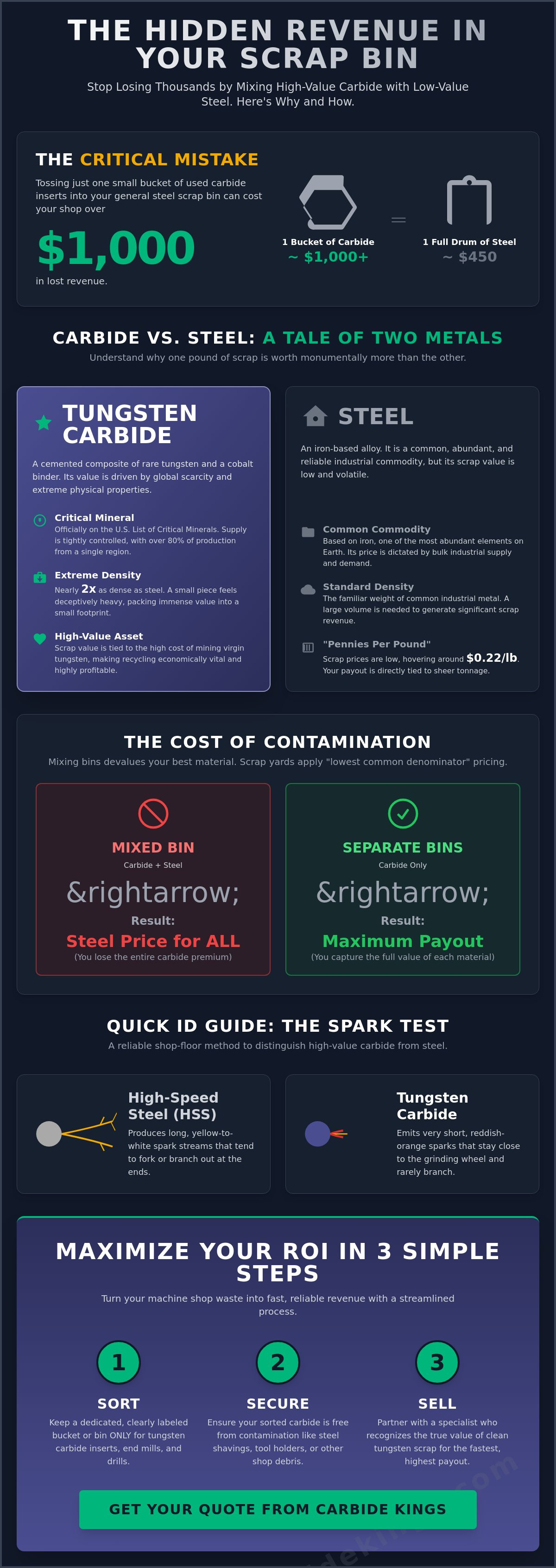
Every machine shop owner knows the frustration of watching steel prices fluctuate while operational overhead continues to climb. As of May 2026, steel scrap indices hover between $399 and $450 per ton. While that sounds like a significant volume, it boils down to pennies per pound. If you're tossing your worn-out inserts, end mills, and drills into the same bin as your general steel turnings, you're essentially throwing away high-denomination bills. The massive carbide scrap vs steel scrap price gap exists because these materials belong to entirely different economic worlds. Mixing them doesn't just create a mess; it creates a massive "invisible" revenue leak that drains your shop's profitability every time the scrap truck pulls away.
The economic reality of 2026 has intensified this issue. With the U.S. Department of Commerce and industry coalitions pushing for tighter domestic supply chains, tungsten has officially solidified its spot on the U.S. List of Critical Minerals. Global supply is tightening. China, which controls over 80% of global production, implemented strict dual-use export controls in January 2026. This has made your existing shop waste more valuable than ever before, provided you keep it separate from low-value iron alloys.
Defining the Players: Tool Steel vs. Cemented Carbide
To stop the leak, you have to understand what's actually in your bins. High-Speed Steel (HSS) is a robust, iron-based alloy. It's common, reliable, and priced as a commodity. It's great for certain applications, but its scrap value is tied to the volatile bulk steel market.
In contrast, Tungsten carbide is not a steel at all. It's a "cemented" metal composed of tungsten particles held together by a cobalt binder. This chemical makeup is the primary driver of its value. Because tungsten is rare and increasingly difficult to source due to 2026 trade restrictions, its scrap value is tied to global scarcity. When you mix the two, you aren't just adding weight; you're devaluing a critical mineral by diluting it with common iron.
The Problem with the "Mixed Bin" Approach
When you ship a mixed load to a standard yard, they don't spend hours meticulously picking through your bin to find the "gold." They apply "lowest common denominator" pricing. If your bin is contaminated with steel, you'll often receive the steel rate for the entire weight of the load. You lose the premium value of the tungsten immediately.
The labor-to-value ratio here is undeniable. Spending ten minutes a day to ensure your tungsten hard scrap and alloys go into a dedicated, labeled bucket pays for itself many times over. Modern scrap yards aren't looking for more work; they're looking for clean, predictable streams of material. Your final payout is directly proportional to the cleanliness and concentration of the tungsten within your shipment.
The Science of Value: Why Tungsten Carbide Prices Dwarf Steel
Pick up a standard carbide insert and a similarly sized high-speed steel tool. The first thing you'll notice is the weight. Tungsten carbide is nearly twice as dense as steel, packing a massive amount of atomic mass into a small footprint. This physical density is the first clue into the carbide scrap vs steel scrap price disparity. While steel is an abundant commodity based on iron, tungsten is a rare, strategic element with physical properties that are nearly impossible to replicate. It's the "gold" of the industrial world, and its value is dictated by global scarcity rather than local surplus.
The economic incentive to recycle is also much higher for carbide than for steel. Mining virgin tungsten is an energy-intensive, expensive process. According to the U.S. Geological Survey tungsten report, cemented carbide parts account for approximately 60% of global tungsten consumption. Because the United States hasn't commercially mined tungsten since 2015, refineries rely heavily on scrap to meet domestic demand. This creates a high-floor value for your waste that steel simply cannot match.
Tungsten: The "Gold" of the Machine Shop
Tungsten boasts the highest melting point of all metals at 3,422 degrees Celsius. This extreme heat resistance and diamond-like hardness drive its demand in aerospace, defense, and high-precision machining. In 2026, geopolitical factors have pushed these prices even higher. China currently controls over 80% of global production. Their recent implementation of strict export controls on dual-use tungsten products has tightened the market significantly. Refineries now prefer recycled tungsten hard scrap over raw ore because it requires less energy to process and bypasses many international trade hurdles. This shift directly increases the payout for shops that maintain clean, unmixed scrap streams.
The Cobalt Multiplier
Tungsten doesn't work alone. To create a cutting tool, manufacturers use cobalt as a metallic binder to "cement" the tungsten grains together. Most standard inserts contain between 6% and 10% cobalt. Cobalt is another critical mineral with its own volatile market. When cobalt prices spike, the value of your carbide scrap often follows suit.
This value extends beyond solid tools. Your "soft scrap," such as grinding sludge and dust, contains high concentrations of both tungsten and cobalt. Don't let these materials wash down the drain. Even in powder form, the chemistry of the material remains valuable. Properly capturing and selling your tungsten soft scrap ensures you're recovering every possible cent from your procurement spend. It's a simple way to turn a messy byproduct into a predictable revenue stream.
Head-to-Head: Carbide Scrap vs. Steel Scrap Economics
Visualizing the difference in value between these two materials requires a shift in perspective. Imagine a standard 55-gallon drum filled to the brim with #1 steel scrap. In May 2026, that drum represents a significant amount of floor space but only holds a market value of roughly $450 per ton. Now, place a small 5-gallon bucket of used carbide inserts next to it. Despite the massive difference in volume, that small bucket often holds more financial value than the entire drum of steel. This is the core of the carbide scrap vs steel scrap price reality. One is a bulk commodity; the other is a high-value industrial asset.
The "Weight Factor" also plays a critical role in your returns. Tungsten carbide has a specific gravity of approximately 15.6, making it nearly twice as dense as standard steel. This means your shipping containers reach weight limits much faster. While this requires careful logistics, it also means your return per cubic foot of storage is exponentially higher. During market downturns, steel prices often crater due to oversupply in the construction sector. Carbide holds its value much better because its price is tied to the scarcity of tungsten and cobalt, making it a "blue chip" scrap material for any machine shop.
Price Per Pound Comparison (2026 Estimates)
To understand the massive multiplier at play, look at the current market rates. While steel is priced by the gross ton, carbide is always priced by the pound. This distinction alone highlights the value gap.
- Mild Steel: ~$0.20 – $0.23 per lb ($399 – $450 per ton)
- High-Speed Steel (HSS): ~$0.60 – $1.25 per lb
- Tungsten Carbide: $10.00 – $24.00 per lb
High-quality carbide inserts currently fetch the highest premiums, often exceeding the price of steel by a factor of 100. Even lower-grade carbide pieces or drills significantly outperform the best tool steels. If you aren't separating these materials, you're effectively selling a premium product at a clearance-bin price.
The ROI of Sorting Your Scrap
Setting up a low-friction sorting system at the machine is the fastest way to increase your shop's bottom line. You don't need a complex laboratory. A simple dedicated bucket at every CNC station ensures that 100% of your carbide stays out of the steel bins. Consider the hourly "wage" of this task. If a shop hand spends 15 minutes a day ensuring 10 pounds of carbide is properly binned rather than tossed with steel, they've just captured an extra $230 in value. That equates to an internal "wage" of $920 per hour in recovered revenue.
For a deeper dive into logistics and grading, see The Complete Guide to Tungsten Hard Scrap Recycling in 2026. Once you've separated your materials, the process of turning that weight into cash becomes a simple matter of logistics rather than a guessing game at the local yard.
How to Identify and Separate Carbide from Steel in 2026
Capturing the premium carbide scrap vs steel scrap price requires accurate sorting at the source. If you rely solely on a magnet, you'll likely leave money on the table. While steel is always magnetic, tungsten carbide often exhibits a weak magnetic pull because of its cobalt binder. This similarity causes many shops to accidentally dump "gold" into their iron bins. To ensure you aren't throwing away profit, use a multi-step verification process that relies on physical properties rather than just magnetic attraction.
The 3-Step Shop Floor Identification Process
Train your team to follow this simple sequence for every piece of scrap tooling. It takes seconds but saves thousands of dollars over a production year.
- Step 1: The Scratch Test. Carbide is significantly harder than any tool steel. Try to scratch the mystery metal with a known piece of carbide. If it leaves a mark, the material is steel. If it doesn't, you've likely found tungsten.
- Step 2: The Spark Stream. Touch the material to a grinder for a split second. Carbide produces short, deep-orange sparks that stay close to the wheel. High-speed steel (HSS) creates long, white, branching sparks that fly much further. This is the most definitive way to distinguish between the two when markings are worn off.
- Step 3: Identification Markings. Look for laser-etched markings. Many manufacturers use "C" or "K" grade designations (such as C2 or K30) to denote specific tungsten carbide compositions. If you see these, bin it separately immediately.
Common Sources of Confusion
Brazed tools are a frequent point of failure in sorting. These consist of a carbide tip joined to a steel shank. Don't toss the whole tool into the steel bin. While the shank is low-value, the tip is high-value tungsten. For maximum ROI, you should separate the tips or sell them as a specific grade of brazed scrap.
Coated inserts also confuse many operators. Whether the insert is gold (Titanium Nitride) or black (Titanium Aluminum Nitride), the paper-thin coating doesn't change the underlying material value. The core is still tungsten carbide. Similarly, be on the lookout for "Heavy Metal" shanks used in boring bars. These feel significantly heavier than steel because they are tungsten-based alloys designed for vibration dampening. Once you've identified your materials, get a quote for your sorted tungsten scrap to ensure you're paid for the weight you've worked hard to recover. Separating these materials is the single most effective way to protect your shop's bottom line.
Maximizing Your ROI: The Streamlined Carbide Kings Recovery Process
Identifying your material and understanding the massive carbide scrap vs steel scrap price gap is only the first step. The real challenge for most machine shops is finding a reliable way to move that weight and get paid fairly. Local scrap yards often lack the specialized equipment or the global connections required to offer true market value for tungsten. This is where Carbide Kings changes the math. We've refined our recovery process to remove every traditional barrier, from shipping logistics to payment delays. We handle the heavy lifting so you can stay focused on your spindles.
Transparency is our baseline. When you send us your tungsten hard scrap or alloys, we provide a clear, weight-based quote with no hidden fees or middleman markdowns. We use calibrated industrial scales to ensure every pound is accounted for. Because we specialize exclusively in tungsten products, our pricing reflects the actual global demand for these critical minerals in 2026. You get the benefit of a national network with the personal service of a dedicated industrial partner.
National Logistics Made Simple
Shipping heavy scrap shouldn't be a logistical nightmare. We assist with the heavy lifting by coordinating freight for bulk shipments across the country. Our national reach ensures that your location doesn't limit your payout. Whether you're a small job shop or a high-volume production facility, we provide the support you need to move material efficiently. This national perspective allows us to maintain the most competitive rates regardless of local market dips.
Safety and security are paramount when shipping dense materials. To ensure your carbide arrives safely, we recommend using reinforced plastic pails or double-walled corrugated boxes for smaller loads. For shipments over 200 pounds, securing your containers to a standard pallet is the best practice. These simple steps prevent transit damage and ensure your material is processed the moment it hits our dock. Our streamlined workflow is designed to move your inventory from your floor to our facility with zero friction.
Turn Your Tooling into Immediate Cash Flow
We know that cash flow is the lifeblood of your shop. That's why we offer a 24-hour processing guarantee. Once your shipment is received and verified, we finalize your payment within one business day. There's no waiting for weeks or chasing down paperwork. You can start the process in seconds; just text or email a photo of your material for a preliminary estimate. We offer flexible payment options including wire transfers, checks, and instant settlements to fit your accounting needs.
Machine shops across the country trust our speed and reliability. We've eliminated the administrative hurdles that make traditional scrap selling a chore. Don't let your high-value waste sit in a corner collecting dust. Get your competitive carbide scrap quote from Carbide Kings today and turn your machine shop waste into a liquid asset. It's time to get paid what your material is actually worth.
Stop Leaving Money on the Shop Floor
The data is clear. The massive carbide scrap vs steel scrap price gap represents a significant revenue opportunity for any precision machine shop. By implementing simple sorting protocols and using physical identification tests, you prevent high-value tungsten from being devalued in a bulk steel bin. You've worked hard to procure these materials. You should get the maximum return when they reach the end of their tool life.
Partnering with specialized tungsten experts ensures you receive the most competitive national pricing without the traditional logistical headaches. We back our process with a 24-hour processing guarantee, moving your material from receipt to payment with professional efficiency. It's time to stop treating your carbide as "heavy steel" and start treating it like the strategic asset it is.
Get a Fast Quote for Your Carbide Scrap and start maximizing your industrial recovery revenue today. Your shop floor is a goldmine; let's help you cash in.
Frequently Asked Questions
Is carbide scrap really worth more than steel?
Yes, carbide scrap is significantly more valuable than steel because it contains rare elements like tungsten and cobalt. While steel is an abundant commodity, tungsten is classified as a critical mineral with a high global demand. This rarity creates a price gap that allows a single bucket of carbide to outperform an entire drum of steel scrap. It's essentially the difference between common waste and industrial gold.
How much is carbide scrap worth per pound in 2026?
Market prices for tungsten carbide vary based on current global supply and industrial demand. In 2026, prices have remained high due to international export controls on raw tungsten. Because these values change daily, it's best to request a direct quote to see how the current carbide scrap vs steel scrap price affects your specific inventory. This ensures you receive the most accurate valuation for your material.
Can I mix carbide inserts with steel end mills in the same bin?
You should never mix carbide inserts with steel tools in the same container. Most scrap yards will pay you the lower steel rate for the entire load if they see contamination. Separating your tungsten hard scrap from iron-based metals is the simplest way to protect your shop's revenue and ensure a fair transaction. This small step turns a potential loss into a significant financial gain.
How do I tell the difference between high-speed steel (HSS) and carbide?
The most reliable shop-floor method is the spark test. Touch the tool to a grinder; carbide creates short, orange sparks while high-speed steel (HSS) throws long, white sparks. You can also check for laser-etched "C" or "K" grades on the tooling. Carbide's extreme density also makes it feel much heavier than steel of the same size, which is an immediate giveaway during sorting.
Does the coating on a carbide insert affect its recycling price?
Coatings like Titanium Nitride do not impact the scrap value of your inserts. Refineries are interested in the tungsten carbide core, and the thin surface layer is removed during the recycling process. Whether your inserts are gold, black, or grey, the payout is determined by the weight and purity of the underlying tungsten alloy. Don't let a colorful coating fool you into thinking the material is less valuable.
What is the minimum amount of carbide scrap I can sell?
We accept shipments of all sizes, though larger volumes typically offer better logistics efficiency. If you're a smaller shop, wait until you've filled a standard 5-gallon pail to maximize your shipping ROI. We specialize in tungsten hard scrap and alloys, providing the same professional service whether you're sending a few pounds or a full pallet. We make it easy for shops of any scale to sell and get paid.
How do I ship heavy carbide scrap safely?
Secure your scrap in reinforced containers like heavy-duty plastic buckets or double-walled boxes. Because carbide is exceptionally dense, standard packaging can fail under the weight during transit. For larger shipments, palletizing your containers is the best way to ensure your material reaches the refinery safely and stays organized for fast weighing and processing. This prevents lost revenue from damaged or spilled shipments.
How quickly will I get paid for my carbide scrap?
You'll receive payment within 24 hours of your material being processed at our facility. We prioritize speed and transparency to ensure your cash flow remains steady. Once we verify the carbide scrap vs steel scrap price for your load, we issue payment via your preferred method, including wire transfers or checks. This streamlined process removes the typical waiting period found at local scrap yards.


