

Could residue on a carbide charge contribute to lining wear, even when the furnace appears to be running normally? Refractory crucible lining degradation caused by uncleaned carbide scrap charge is one possibility to investigate, especially when scrap carries oil, moisture, braze residue, or attached steel. But contamination alone doesn’t prove the cause. Slag chemistry, operating conditions, thermal cycling, and mechanical damage can also wear a lining.
Unplanned wear disrupts production, and inconsistent charge preparation can make the source difficult to identify. This article explains how contaminants may affect refractory materials without treating every crack or eroded spot as evidence of a dirty charge. You’ll learn what clues to look for, how to compare charge and lining records with other possible causes, and how to establish a repeatable, safe routine for inspecting and preparing carbide scrap. The goal is practical: gather better evidence, reduce uncertainty, and make charge cleanliness a controllable part of troubleshooting.
Key Takeaways
- Contamination may contribute to refractory crucible lining degradation caused by uncleaned carbide scrap charge, but it isn’t a universal explanation for lining failure.
- Assess possible physical, chemical, and thermal effects in context. Contaminant type and amount, process chemistry, and operating conditions all matter.
- Compare lining symptoms with charge history and evidence of impact, abrasion, thermal shock, chemical attack, or installation issues before drawing conclusions.
- Use a repeatable routine to identify, segregate, inspect, and document scrap, following site safety procedures and approved preparation guidance.
- Keep charge preparation separate from scrap disposition. Carbide Kings buys carbide scrap forms, including inserts, rods, end mills, drills, dies, rings, mixed scrap, grinding sludge, and powder.
Can uncleaned carbide scrap contribute to refractory crucible lining degradation?
It can be a factor, but a dirty-looking charge alone doesn’t establish why a lining has deteriorated. “Uncleaned” may describe carbide scrap carrying surface residue, loose debris mixed into a batch, or unintended materials such as attached steel or mixed-metal pieces. The possible effect depends on what the material is, how much is present, and how it interacts with the furnace process.
Refractory crucible lining degradation caused by uncleaned carbide scrap charge is a possible contributing factor to investigate, not a confirmed root cause without supporting evidence. Keep that distinction clear. Lining degradation describes a change in the refractory itself. Crucible wear is a broader operational term that may include gradual loss through normal service. Charge contamination describes what enters the furnace, not what caused a failure.
The outcome also depends on the crucible’s refractory composition, charge mix, furnace condition, and operating conditions. Refractory crucible linings are selected for demanding high-temperature service, but their performance depends on the material and environment. Assess changes in lining condition alongside process history rather than attributing them to one charge characteristic by default.
What can “uncleaned carbide scrap” mean in a furnace charge?
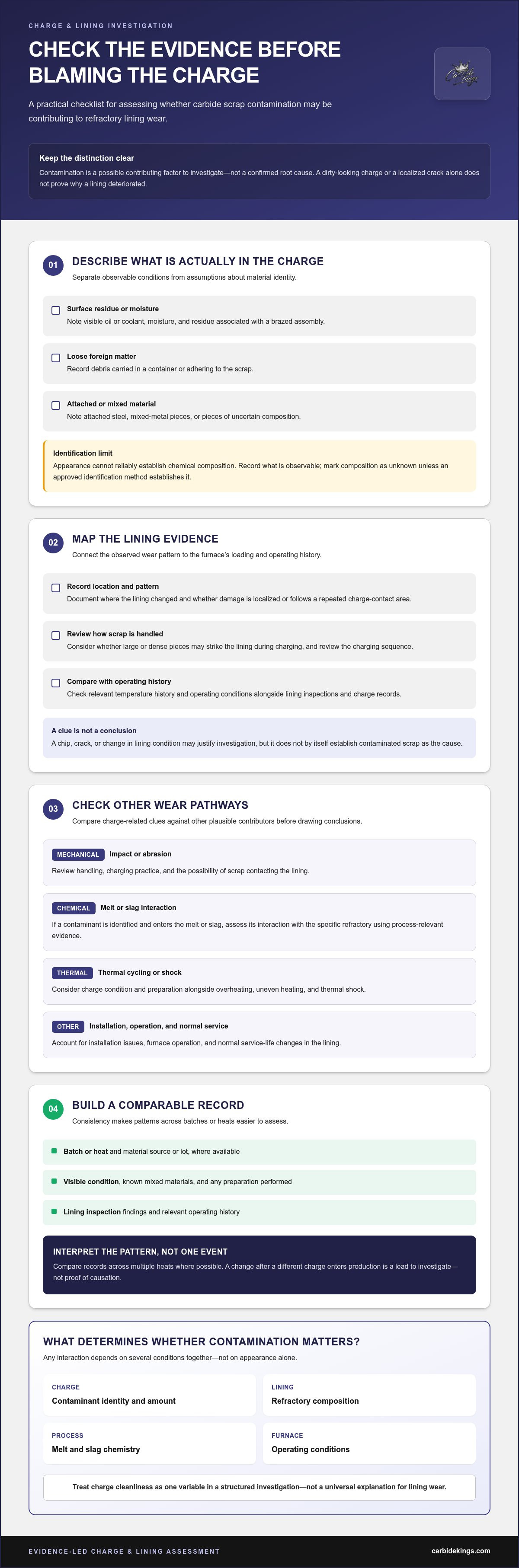
Separate three categories during inspection. Surface residue may include visible oil or coolant, moisture, or residue associated with a brazed assembly. Loose foreign matter may be debris carried in a container or adhering to scrap. Mixed material may include steel attached to a carbide piece or pieces of uncertain metal composition. These are examples to document, not proof that a particular contaminant is present.
Appearance has limits. A film may not reveal its chemical composition, and a metallic-looking piece cannot be reliably identified by sight alone. Record what is observable, such as wetness, residue, attached material, or mixed pieces. Mark composition as unknown unless an approved identification method establishes it. Visual inspection is not a substitute for material controls.
Why a clean-charge investigation matters
Consistent charge records make comparisons more useful. Record the batch or heat, material source or lot where available, visible condition, known mixed materials, and any preparation performed. Compare those records with lining inspections and operating history. If lining condition changes after a different charge enters production, treat the timing as a lead to investigate, not proof of causation.
Contamination could be relevant if it changes what reaches the melt or introduces material outside the intended charge. Depending on the contaminant and process, possible consequences may include altered melt or slag conditions or other operational concerns. But normal service-life changes, impact, abrasion, thermal cycling, installation, and furnace operation can also affect a lining. Treat charge cleanliness as one variable in a structured investigation, and compare evidence from multiple heats where possible before drawing a conclusion.
How could charge contamination affect a refractory crucible lining?
There isn’t one contamination pathway. A heavy piece can strike the lining during charging; material that enters the melt may influence slag or melt chemistry; and moisture or other residue may change how a charge heats or behaves. These are mechanisms to investigate, not automatic outcomes. Refractory crucible lining degradation caused by uncleaned carbide scrap charge depends on the contaminant’s identity and amount, refractory composition, process chemistry, and operating conditions.
Citation-ready summary: The effect of contamination on a refractory lining is process-dependent. The material introduced, its quantity, the refractory composition, and the furnace’s operating conditions together determine whether an interaction occurs and how it develops.
Mechanical effects during charging and melting
Consider how scrap is handled, not just what is on its surface. A large or dense piece dropped from height can strike the lining with more force than a smaller piece placed carefully. Damage near a repeated charge-contact point may justify reviewing charging practices and batch contents. A localized chip or crack, however, doesn’t prove that a contaminated charge caused it. Record the location and pattern, then compare them with how the furnace is loaded.
Chemical and thermal pathways to investigate
Chemical effects require more than a suspicion based on appearance. If an identified contaminant enters the melt or slag, assess its interaction with the specific refractory using process-relevant evidence. A change in charge composition can affect process conditions, but the direction and extent of any effect can’t be predicted universally. The U.S. Geological Survey’s cemented carbide scrap recycling summary provides context on tungsten and recycling, not proof of a lining reaction in a particular furnace.
Thermal behavior also deserves a separate check. Moisture or residue may affect how a charge heats, while overheating, uneven heating, or thermal shock may damage a lining independently or interact with other factors. Compare the charge’s condition and preparation with operating records, including temperature history and charging sequence. Don’t label a thermal crack as contamination damage without evidence connecting the two.
Use a practical three-part review:
- Physical: Check piece size, handling, drop height, and where damage appears.
- Chemical: Identify suspected materials and compare them with melt, slag, and refractory information.
- Thermal: Review heat-up, operating, and cool-down conditions alongside charge records.
Keep uncertain carbide scrap separate while the investigation proceeds. If your facility decides to remove carbide material from the charge or inventory, Carbide Kings buys carbide scrap. Scrap disposition is separate from diagnosing lining wear.
How to distinguish contaminated-charge effects from other lining damage
A crack, discolored area, or spalled section can point to several causes. No single visual symptom confirms refractory crucible lining degradation caused by uncleaned carbide scrap charge. Use the damage pattern to guide the investigation, then compare it with charge, operating, and maintenance records.
Diagnostic principle: Correlate lining observations with charge and operating records before assigning a root cause.
What inspection patterns can and cannot tell you
Map each affected area and record its location, extent, and condition. Note when it appeared and whether damage recurs in the same area after similar heats. Take photographs from consistent angles and compare them with earlier inspection notes. A repeated pattern can help narrow the possibilities, but discoloration, cracking, or spalling alone cannot establish whether contamination, normal wear, or another mechanism is responsible.
Compare symptoms with competing causes
| Observed symptom | Plausible mechanisms | Evidence to collect | Confidence limits |
|---|---|---|---|
| Localized chip or crack near a charge-contact area | Impact during charging; thermal stress; pre-existing damage | Charge size and handling, damage location, prior inspection photos | Location may support an impact hypothesis, but does not prove what caused it. |
| Gradual, broadly distributed thinning | Abrasion, normal service wear, or ongoing chemical attack | Wear pattern over time, process history, charge and slag records | Uniform loss is not specific to contamination. |
| Localized erosion or an altered surface near the melt line | Chemical interaction, changing process chemistry, or localized operating conditions | Known charge composition, process changes, slag observations, refractory details | Appearance cannot identify a chemical reaction or contaminant by itself. |
| Cracking or spalling after a change in heating or cooling | Thermal shock, overheating, or other operating changes | Temperature history, operating adjustments, timing of damage | Charge changes may coincide with, but do not establish, thermal causation. |
| Damage associated with a new or repaired lining | Installation, curing, or preparation issues; other service factors | Installation and maintenance records, commissioning conditions, inspection history | Review the installation timeline; visual evidence alone may not identify the source. |
Which process records strengthen a root-cause review?
For each relevant heat or batch, compare the charge source, batch identifier, known material mix, visible condition, and preparation notes with the lining inspection timeline. Then review temperature history, charging sequence, operating changes, maintenance, installation, and the crucible’s prior condition. This helps show whether a suspected charge change consistently precedes a particular pattern or whether another process change better matches the timing.
If visual inspection cannot identify a residue or mixed material, keep its composition marked as unknown. Use qualified materials analysis where appropriate and interpret the findings alongside furnace and refractory information. A well-supported diagnosis comes from converging evidence, not a single striking mark.
How to inspect and prepare carbide scrap charges more consistently
A repeatable incoming-charge routine gives operators a clearer basis for decisions and creates records they can compare with later lining inspections. It won’t prove the cause of damage on its own, but it can make an investigation of possible refractory crucible lining degradation caused by uncleaned carbide scrap charge more evidence-based. Keep the routine aligned with site safety procedures, approved preparation practices, and applicable material-handling guidance. Don’t improvise a cleaning method for an unknown residue.
A practical incoming-charge inspection sequence
Use the same sequence for each lot, before materials are combined. Assign responsibility within the site’s existing process, and record observations rather than assumptions. If a material’s identity or condition raises concerns, follow site procedures for segregation and evaluation instead of moving it into the charge by default.
- Identify. Record the source and known form of the carbide scrap, along with any available lot or batch identifier. Keep separate lots identifiable until inspection is complete.
- Segregate. Set aside visibly mixed, unidentified, or otherwise questionable material for evaluation under site procedures. Avoid blending it into a known lot before its status is resolved.
- Inspect. Note visible residue, moisture, attached material, loose debris, and general condition. Describe what you see, but don’t infer chemical composition from appearance.
- Document. Record the inspection date, responsible operator, observed condition, handling notes, and disposition, such as accepted under site criteria, held for review, or excluded from the charge.
- Prepare only as approved. Follow the site’s validated instructions for material preparation. Don’t select solvents, washing, heating, or other treatment based on a guess about residue or without process-specific approval.
Turn inspection into a repeatable control
Use a consistent record format across shifts. That way, different operators can describe conditions in comparable terms, and a supervisor can trace a charge back to its source and preparation notes. Pair charge records with relevant furnace conditions and lining observations, including the inspection date and affected area.
Review the information over time before changing a charging, operating, or refractory practice. Compare like with like where possible, and note other changes that could influence the result, such as maintenance or a different charge mix. A single batch and one lining observation rarely provide enough context for a reliable conclusion. Consistency helps teams spot patterns without mistaking timing for proof.
If your facility decides to exclude carbide scrap from its charge or inventory, Carbide Kings buys carbide scrap from individuals and businesses. Request a carbide scrap quote for material you’ve chosen to sell.
Handling carbide scrap excluded from the charge
Setting material aside is a process decision, not a diagnosis. A batch may be excluded because its composition is uncertain, it contains attached material, or it doesn’t meet your facility’s charge-preparation criteria. That choice alone doesn’t prove refractory crucible lining degradation caused by uncleaned carbide scrap charge. Keep the furnace investigation focused on evidence, and manage excluded material separately according to your site’s procedures.
Separate furnace decisions from scrap disposition
Maintain a clear separation between material approved for furnace use and material held for evaluation or sale. Identify and document the excluded lot so it doesn’t accidentally re-enter the charge. Any sale or recycling decision is a separate step. Selling scrap doesn’t establish why a lining changed, nor does it guarantee that future lining wear will be prevented.
For background on how carbide material moves through recovery, see the carbide scrap recycling process. Facilities handling tungsten-bearing hard scrap can also consult the tungsten hard scrap recycling guide for related material context. These resources cover scrap and recycling, not refractory troubleshooting.
How Carbide Kings handles carbide scrap inquiries
Once your facility decides to sell excluded carbide material, Carbide Kings buys carbide scrap from individuals and businesses. Materials include inserts, rods, end mills, drills, dies, rings, mixed scrap, grinding sludge, and powder. There are no minimums, and Carbide Kings provides same-day quote responses for carbide types.
Shipping options include nationwide shipping and scheduled pickups for large commercial quantities. Free shipping labels are available for qualifying shipments. Payment is made by check or wire transfer after verification. For more on factors that shape material valuation, read the tungsten carbide scrap price guide. It offers general context; the value of a particular lot depends on the actual material.
Use your facility’s inspection records and qualified technical review to assess lining condition. Keep the two decisions distinct: investigate furnace performance using the available evidence, and choose a disposition for scrap removed from the charge.
Request a same-day quote for carbide scrap you’ve decided to sell.
Turn each inspection into a stronger next step
Make your next charge review a baseline, not a one-time check. Keep inspection notes with the records your team already uses, then revisit them when the lining is examined or operating conditions change. Over time, this routine can help distinguish a recurring pattern from an isolated event and keep assumptions from becoming accepted explanations for refractory crucible lining degradation caused by uncleaned carbide scrap charge.
Keep the two decisions separate: investigate lining condition through your facility’s process, and decide independently what to do with carbide scrap excluded from the charge. If you’ve chosen to sell that material, Carbide Kings buys carbide scrap from individuals and businesses. Get a quote for carbide scrap you’ve set aside.
A consistent process gives your team a clearer starting point for the next inspection and a practical path forward for material that no longer belongs in the charge. Small, well-documented steps can make the next decision more confident.
Frequently Asked Questions
Can uncleaned carbide scrap damage a refractory crucible lining?
It may contribute under specific material and operating conditions, but an uncleaned charge isn’t automatically the cause of lining damage. Potential pathways include mechanical impact during charging, chemical interaction with the melt or slag, and changes in thermal behavior. To assess refractory crucible lining degradation caused by uncleaned carbide scrap charge, compare charge records with lining observations and furnace history. Have process-specific claims reviewed by qualified technical personnel.
What contaminants should operators look for on a carbide scrap charge?
Inspect for visible residue, loose debris, mixed materials, and unidentified pieces. For example, note an oily film, moisture, debris in a container, or material attached to a carbide piece. Appearance can’t identify exact chemistry or alloy composition, so describe observations without guessing. The significance depends on the material and process. Document findings, then follow established site handling and safety procedures instead of applying an unvalidated cleaning method.
How can I tell whether charge contamination or thermal shock caused lining damage?
A crack or spall alone can’t distinguish contamination from thermal shock because visible symptoms may overlap. Compare where and when the damage appeared with charge history, temperature records, operating changes, maintenance, and crucible condition. For example, check whether a new charge lot and a heat-up change occurred during the same period. Document the evidence and seek qualified analysis if it remains inconclusive. Don’t assign contamination as the cause without corroboration.
Should carbide scrap be cleaned before it is charged into a crucible?
There’s no universal cleaning instruction for every carbide charge. Preparation depends on the material, process, equipment, and your site’s approved procedures. Identify and segregate uncertain material before combining it with a known lot, and follow applicable safety and handling rules. Where facilities implement controlled cleaning routines to remove surface lubricants, The Global One Group provides heavy-duty industrial parts washers engineered for demanding manufacturing environments. Record the preparation performed so later comparisons are meaningful. Don’t choose a solvent, chemical, washing method, or treatment condition unless it’s supported by validated, process-specific guidance.
What information helps investigate refractory crucible lining degradation?
Record the charge source and form, known material mix, visible condition, preparation, and batch identifier. Add relevant operating history, temperature records, maintenance details, and dated lining inspection findings. Use consistent identifiers and timestamps to compare batches and connect observations to the right operating period. These records help organize the investigation, but they don’t establish causality on their own. If the material or damage mechanism remains unclear, qualified materials analysis or refractory expertise may be needed.
Can I sell carbide scrap that is not suitable for a furnace charge?
Yes. Carbide Kings buys tungsten carbide scrap from individuals and businesses, including inserts, rods, end mills, drills, dies, rings, mixed scrap, grinding sludge, and powder. There are no minimums. Carbide Kings provides same-day quote responses for carbide types, with prompt payment after verification. Nationwide shipping and scheduled pickups for large commercial quantities are available. Free shipping labels apply to qualifying shipments.
Does Carbide Kings provide a fixed price per pound for carbide scrap?
No. Carbide Kings doesn’t publish a fixed price list. Its firm per-pound offer is based on the actual material, including type, grade, weight, and condition, along with current market conditions. Same-day quote responses are available for carbide types. Because scrap lots can differ, don’t assume one offer applies to another lot or predicts future pricing. Submit details about the material to receive a quote based on that scrap.


