

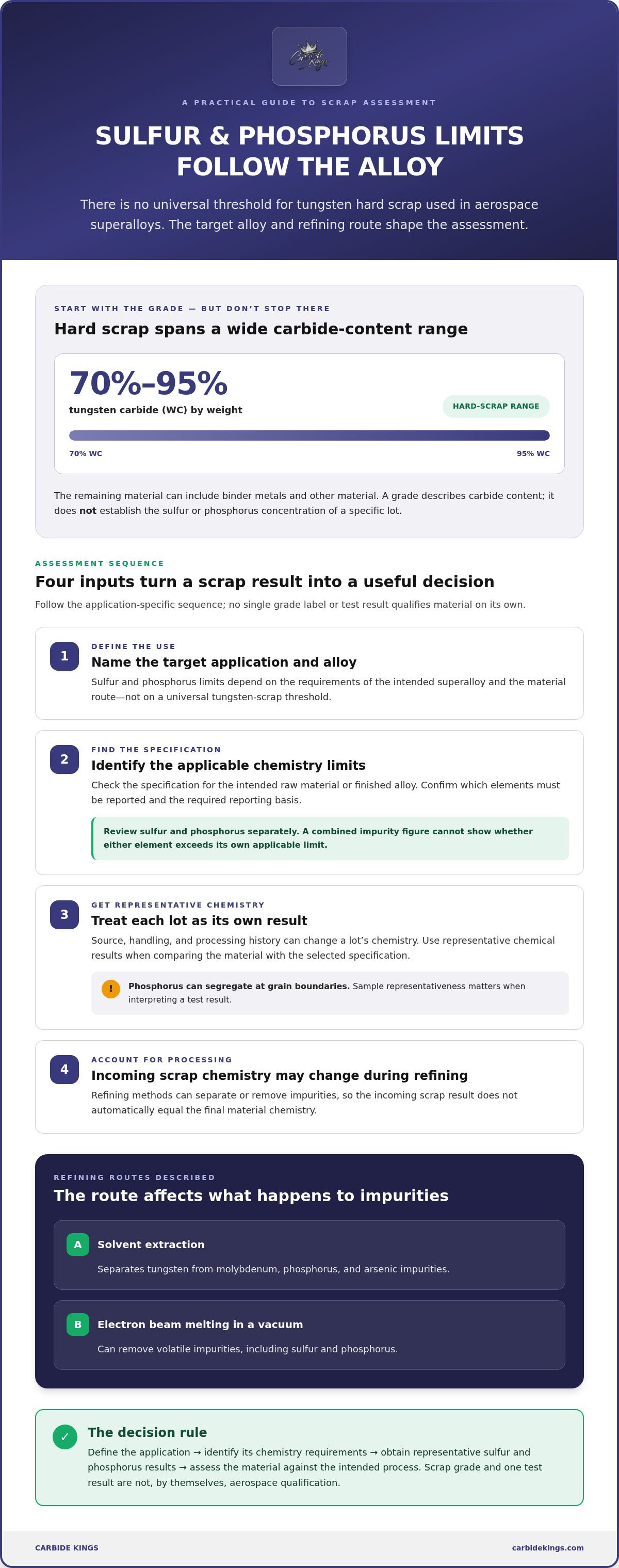
There is no universal sulfur or phosphorus threshold for tungsten hard scrap used in aerospace superalloys. The applicable limits depend on the target alloy’s requirements and the refining route used to produce usable material. Scrap grade alone cannot establish the final alloy chemistry.
This distinction matters when even small amounts of contamination could affect how material is sorted, processed, or evaluated. This article explains how hard-scrap grades relate to tungsten carbide content, why sulfur and phosphorus matter, and how phosphorus segregation can complicate representative testing. It also covers what identification and analysis can reveal, and where their limits lie. The result is a clearer way to assess scrap suitability without treating one test result or grade label as complete aerospace qualification.
Key Takeaways
- Hard scrap can range from 70% to 95% tungsten carbide by weight, so grade and contamination both matter when assessing its potential use.
- There isn’t one universal sulfur or phosphorus threshold for every aerospace superalloy; the target alloy and processing route shape the limits.
- Phosphorus can segregate at grain boundaries, making sample representativeness important when interpreting test results.
- Magnetic response and spark appearance can help distinguish tungsten carbide from steel, but these checks don’t replace chemical analysis.
- Learn what scrap characteristics and testing considerations help determine whether a material is suitable for further evaluation.
Hard scrap grades and contamination
Tungsten hard scrap is not one uniform feedstock. Hard scrap assets range from 70% to 95% WC by weight, so a grade can describe material with meaningfully different carbide content. WC means tungsten carbide, a compound containing tungsten and carbon. The balance can include binder metals and other material. That range helps frame sorting, but it does not establish the sulfur or phosphorus content of a particular lot.
Separate scrap where it is generated. Segregating material at the source helps prevent contamination with high-speed steel. For example, keep worn carbide inserts apart from steel tooling instead of putting them in the same container. High-speed steel adds a different metal composition to the feedstock. Once mixed, the pieces may look similar in a bulk load, making identification and processing more difficult.
Contamination can come from the scrap itself or from handling. A container might hold carbide pieces alongside steel fragments, grinding residue, or material from another alloy stream. The mixture no longer represents a single, clearly defined grade. Store distinct material types in separate, labeled containers, and keep unknown shop returns out of known lots. These steps preserve traceability and help processors select an appropriate recovery route.
Grade and cleanliness affect how scrap can be processed. Clean hard scrap can go through the zinc process, while contaminated scrap and sludge can be processed chemically. This distinction matters because a mixed lot may need different treatment from clean carbide solids. Sorting before processing supports a more predictable material flow and prevents a carbide-rich grade label from being mistaken for proof of low contamination.
In the United States, the U.S. Geological Survey says seven companies can convert tungsten concentrates, ammonium paratungstate, tungsten oxide, and scrap into tungsten metal powder, tungsten carbide powder, or related products. That conversion capacity connects scrap sorting to domestic material supply. For aerospace-related evaluation, however, a recycled feedstock’s potential economic value does not equal approval for a specific superalloy. Its tungsten content, carbon-bearing carbide form, other metals, and contamination profile all shape the next processing decision. Keep lot identity intact from collection through assessment.
Soft scrap also needs a distinct route. Because of contamination, it is unsuitable for the direct zinc process and must undergo chemical roasting and leaching. This reinforces why feedstock condition matters alongside carbide content: soft scrap should not be treated as interchangeable with clean hard scrap when considering processing options.
Boeing and Alcoa committed to recycling more than 8 million pounds of high-grade aluminum scrap annually for aerospace use. That commitment concerns aluminum scrap, a different material stream from tungsten hard scrap. Keeping the materials and their stated uses distinct helps avoid suggesting that a recycling commitment for one feedstock establishes a processing route or aerospace qualification for another.
Impurity thresholds for targeted applications
No single sulfur or phosphorus level applies to every tungsten hard-scrap lot or aerospace superalloy. Typical levels vary with the scrap’s source, handling, and processing history, so a grade label alone cannot establish the concentration of either element.
Phosphorus Limits for Aerospace Use
A phosphorus limit is the maximum concentration permitted by the specification for a particular alloy or feedstock. The sulfur and phosphorus limits for tungsten hard scrap used in aerospace superalloys therefore depend on the target application and material route, not on a universal scrap threshold. Compare a scrap result with the requirements for its intended use; the result alone does not determine aerospace acceptance.
Typical Sulfur and Phosphorus Levels
There is no single reliable figure for typical sulfur and phosphorus levels across all tungsten hard scrap. A lot from one production stream may differ from material exposed to other metals, residues, or processing conditions. Treat each lot’s chemistry as a separate input. A broad grade description does not reveal the measured concentration of either element.
For an application-specific assessment, start with the specification governing the intended raw material or finished alloy. Identify the permitted elements and required reporting basis, then compare those limits with representative chemical results. Review sulfur and phosphorus separately. A combined impurity figure cannot show whether either element individually exceeds its applicable limit.
The processing route matters, too. Tungsten refining methods can separate or remove impurities, so incoming scrap composition does not automatically match the final material chemistry. Solvent extraction separates tungsten from molybdenum, phosphorus, and arsenic impurities. Electron beam melting in a vacuum can remove volatile impurities, including sulfur and phosphorus. Each route affects how incoming contamination should inform feedstock decisions.
Supply-chain conditions may make recycled raw material an economic alternative to newly mined input, but application requirements still determine suitability. A manufacturer evaluating tungsten for a cutting-related alloy, for example, needs to know the target chemistry and intended process before setting acceptance criteria. Environmental benefits or supply availability cannot replace composition control. Assess the material against the specific alloy requirements, then decide whether additional refining is appropriate.
Keep the decision sequence clear: define the application, identify its chemistry requirements, obtain representative sulfur and phosphorus results, and assess the material against the intended process. This connects scrap composition to alloy performance without treating a general threshold as a universal rule.
Phosphorus grain-boundary segregation
Phosphorus grain-boundary segregation occurs when phosphorus concentrates at the interfaces between metal grains. In aerospace superalloys, that local concentration matters because grain boundaries help determine how components withstand stress, heat, and manufacturing. Sulfur can also affect processing and mechanical behavior, especially when it forms inclusions. Consider both elements in light of the alloy’s intended use.
During melting and solidification, dissolved phosphorus may redistribute as the alloy’s grains form. Some phosphorus can collect at grain boundaries instead of remaining evenly distributed within each grain. A bulk chemical result describes the sampled material overall; it does not show exactly where phosphorus is located in the microstructure. That distinction explains why a low overall reading alone cannot describe every local condition.
Grain boundaries matter in high-temperature service. If phosphorus weakens boundary cohesion, stress may increase the likelihood of cracking or reduced ductility. This does not mean every phosphorus-bearing alloy will fail. Rather, concentration and distribution, alloy chemistry, heat treatment, and service conditions can combine to affect component performance. A turbine component and a general-purpose metal part may therefore require different evaluation criteria.
Sulfur presents a related but distinct concern. In nickel-based superalloys, sulfur can affect grain-boundary strength and contribute to hot cracking during production. Sulfur-bearing inclusions can also interfere with forming or machining. These effects depend on composition and processing conditions, so evaluate sulfur and phosphorus separately rather than combining them into one generic impurity figure.
For a practical assessment, connect the chemistry results to the manufacturing route:
- Identify the target alloy and the component’s service conditions.
- Review whether the route includes melting, remelting, or substantial thermal exposure.
- Compare measured chemistry with the applicable material specification.
- Use metallographic examination when the question concerns distribution at grain boundaries, not only overall concentration.
Each step answers a different question. Chemical analysis measures bulk composition, while metallography can reveal microstructural features in the sample examined. Neither result substitutes for the other. For example, finding phosphorus in a sample does not by itself establish grain-boundary enrichment or predict component life.
The sulfur and phosphorus limits for tungsten hard scrap used in aerospace superalloys must be interpreted in relation to the target alloy and downstream process. Tungsten-bearing feedstock may be refined before entering alloy production, changing its chemistry. Electron beam melting in a vacuum can remove volatile impurities, including sulfur and phosphorus. The key question is whether the processed material meets its intended specification and supports the required manufacturing route.
Scrap identification and testing
Aerospace quality depends on the applicable alloy specification, chemistry results, and traceable lot identity. Recycling does not automatically qualify scrap for aerospace use. Documented identification and processing must connect the recovered material to its intended application.
To reduce sulfur and phosphorus, sort and segregate feedstock first, then remove surface residues that could introduce contamination. Refining can address elements within the material: solvent extraction separates tungsten from phosphorus, while electron beam melting in a vacuum can remove volatile sulfur and phosphorus.
Start identification with the material’s source and physical form. Record whether the lot contains cemented carbide pieces, sludge, or another tungsten-bearing material. Keep these streams separate during collection and storage. Clear lot identification preserves information through recovery, where a mixed or untraceable batch can complicate processing choices and later chemical review.
A magnet offers a quick screening clue, not a definitive grade. Tungsten carbide has weak magnetic attraction because of its cobalt binder, while high-speed steel is strongly ferromagnetic. A spark test offers another comparison: carbide produces minimal orange-red, straight sparks; steel produces bright, branching sparks with visible bursts. Use these observations to flag possible mixing, not to certify composition.
Testing should answer two different questions. Chemical analysis measures the elements present in a sample, while material examination identifies the physical structure or inclusions under review. The sample must be representative: one clean fragment may not reflect an entire lot. Compare results with the target application’s material requirements, including separate sulfur and phosphorus values where relevant.
Keep the verification sequence practical:
- Separate material by source, physical form, and visible composition.
- Screen for likely steel mixing with magnetic response and spark appearance.
- Remove external residues before sampling, and preserve lot identity.
- Use chemical testing for elemental composition, then compare results with the intended specification.
- Select recovery based on feedstock condition: clean hard scrap can use the zinc process, while contaminated scrap and sludge can use the chemical process.
This distinction supports better recycling decisions. A clean, identifiable lot can follow a different recovery route from mixed material. Refining also has specific roles: solvent extraction separates tungsten from phosphorus, while electron beam melting in a vacuum can remove volatile impurities, including sulfur and phosphorus. Neither sorting nor a screening test replaces these processes.
Global tungsten supply depends on mining and secondary sources, so reliable scrap identification helps direct recovered material to appropriate uses. For an aerospace application, traceability, representative testing, and a suitable recovery route work together. Keep records connected from the original scrap source through the processed material rather than treating one test result as proof of final qualification.
What phosphorus limits apply to tungsten hard scrap used in aerospace superalloys?
No single phosphorus limit applies to every tungsten hard-scrap lot used in aerospace superalloys. The applicable limit comes from the target alloy’s chemistry requirements and the material’s intended processing route, not from a universal scrap-grade threshold.
This distinction separates scrap acceptance from final alloy qualification. A scrap assay describes the feedstock sampled; it does not establish the chemistry of material after refining and melting. For example, assess a phosphorus result against the intended alloy specification and the production stage to which the result applies. A general carbide grade cannot replace that comparison.
Base the decision on the destination material. Identify the alloy and manufacturing route, then determine the phosphorus requirement governing the input or finished product. Keep the reporting basis consistent when comparing test results. A bulk chemical result shows how much phosphorus is measured overall, but not how it is distributed within the microstructure.
Processing can change the relevant chemistry. Solvent extraction separates tungsten from phosphorus, molybdenum, and arsenic impurities. Electron beam melting in a vacuum can remove volatile impurities, including phosphorus and sulfur. Distinguish incoming scrap chemistry from the composition achieved after recovery: a phosphorus reading in untreated feedstock is not automatically the final alloy’s reading.
A useful evaluation sequence is:
- Define the target alloy and the specification stage being assessed.
- Obtain a representative sample and record its lot identity.
- Measure phosphorus separately from other elements, including sulfur.
- Compare the result with the applicable chemistry requirement.
- Account for the selected refining and melting route before judging suitability.
This sequence also clarifies what testing can establish. Chemical analysis quantifies phosphorus in the sample, while metallographic examination can assess its distribution in the material examined. Neither method alone establishes whether the final superalloy meets its requirements. That determination depends on the test evidence, process route, and destination specification.
For recycled tungsten, the practical question is whether the material can be processed to meet the intended chemistry, not whether scrap carries one universal phosphorus ceiling. Keep the alloy requirement and processing route attached to the lot assessment. To review tungsten hard scrap options for a defined material need, use that information to guide the next step.
Carbide Kings: Tungsten Hard Scrap
Carbide Kings supplies tungsten hard scrap and tungsten alloys for industrial material needs. The sections above explain why phosphorus suitability depends on the target alloy, representative testing, and downstream refining. Use those criteria to define the material you need, then consider Carbide Kings’ offerings for your raw-material requirements.
For projects involving other tungsten-bearing feedstock, Carbide Kings also supplies tungsten soft scrap and carbide scrap. These are distinct material categories, so identify the type that matches your application before moving forward. Clear material requirements help align sourcing with the intended use.
Contact Carbide Kings or visit carbidekings.com to discuss your tungsten material needs.
Turn Material Requirements Into a Clear Next Step
Use sulfur and phosphorus limits for tungsten hard scrap in aerospace superalloys as a decision framework, not as a standalone pass-or-fail number. Define the intended alloy and the production stage at which its chemistry must meet requirements. Then align the material description, lot identity, and analytical evidence with that target. This gives procurement, quality, and materials teams a shared basis for evaluation before material moves forward.
A concise request can identify the material category, intended application, handling history, and available test records. Keeping those details together helps teams assess suitability without confusing a scrap description with approval of a finished alloy. Carbide Kings supplies tungsten hard scrap, tungsten soft scrap, and carbide scrap for industrial material needs.
Bring the alloy designation, required chemistry stage, and any lot-specific analytical records to the discussion. These details keep the sourcing conversation focused on your material requirements and intended use.
Contact Carbide Kings about tungsten scrap and take the next step with a clear material brief.
Frequently Asked Questions
What sulfur limits apply to tungsten hard scrap used in aerospace superalloys?
There is no single sulfur limit for all tungsten hard scrap intended for aerospace superalloys. The relevant requirement comes from the target alloy specification or the buyer’s feedstock criteria. For example, a sulfur result for incoming scrap describes that lot, not the chemistry of a superalloy produced after refining. Keep the test result tied to the material stage it represents.
Do aerospace superalloy specifications set limits for sulfur and phosphorus in tungsten-bearing scrap?
Aerospace alloy specifications define chemistry requirements for the alloy or product they cover; they do not create a universal limit for every tungsten-bearing scrap lot. Scrap acceptance is a separate purchasing decision, guided by feedstock requirements and the intended recovery route. For instance, a processor’s incoming-material criteria may differ from the finished alloy’s composition requirements. Identify which document applies to the material being evaluated.
What sulfur and phosphorus limits do aerospace alloy standards such as AMS specifications require?
AMS specifications do not establish one shared sulfur and phosphorus limit for all tungsten scrap or aerospace alloys. Requirements are specific to the applicable standard, alloy, and product form. Use the exact specification and revision named in the purchase or manufacturing documents, then compare its chemistry limits with relevant test results. A scrap assay alone does not establish compliance with a finished-product standard.
How are sulfur and phosphorus measured in tungsten hard scrap and recycled alloy feedstock?
Measure sulfur and phosphorus through chemical analysis of a representative sample. The report should identify the sample or lot, list the elements separately, and state the analytical basis and method. For mixed pieces, sample preparation matters: the tested portion must represent the material being assessed. If recycled feedstock is refined, distinguish incoming-scrap results from testing of the processed material.
How do sulfur and phosphorus acceptance limits vary by superalloy grade and scrap buyer?
Limits vary with the target superalloy’s chemistry requirements, product form, and intended processing route. Buyers also set feedstock criteria based on what they can process and the evidence they require. For example, scrap intended for further refining is assessed as input material, while a finished alloy must meet its own product requirements. Compare the buyer’s criteria with the exact alloy specification before assigning a lot to an application.


