

Refractory carbide fragments can persist in secondary tungsten melts when contaminated feedstock enters the charge or particles remain incompletely incorporated during melting. Titanium and tantalum carbide tramp inclusions can create local differences in the melt’s microstructure, while unmolten tungsten particles are a separate sign of incomplete melting. Inclusions and uneven structure may contribute to cracking.
When a melt shows defects, don’t assume every hard particle is the same kind of contamination. Identifying the particles and examining how they relate to the surrounding structure can help explain what is happening in the material.
This article explains how TiC and TaC inclusions can enter secondary tungsten melts, how they relate to microstructure and cracking, and how to distinguish them from unmolten tungsten particles. Use it as a reference for interpreting these features and understanding the role of recycled tungsten and carbide materials.
Key Takeaways
- Trace potential TiC and TaC contamination through incoming scrap, handling, and melt preparation to understand where inclusions may originate.
- Assess how carbide inclusions can disrupt microstructure and contribute to cracking, while separating those effects from unmolten tungsten particles.
- Use complementary analytical methods to identify inclusion composition and distribution, rather than relying on appearance alone.
- Focus on feedstock sorting and controlled melting practices to reduce the chance that unwanted particles carry into the finished material.
How do TiC and TaC inclusions enter recycled or secondary tungsten melts?
A secondary tungsten melt is molten metal made from recycled tungsten-bearing feedstock. TiC is titanium carbide, a hard compound of titanium and carbon. TaC is tantalum carbide, a hard compound of tantalum and carbon. A tramp inclusion is an unwanted foreign particle carried into the resulting material. These particles enter only when the incoming charge contains them or introduces them during preparation.
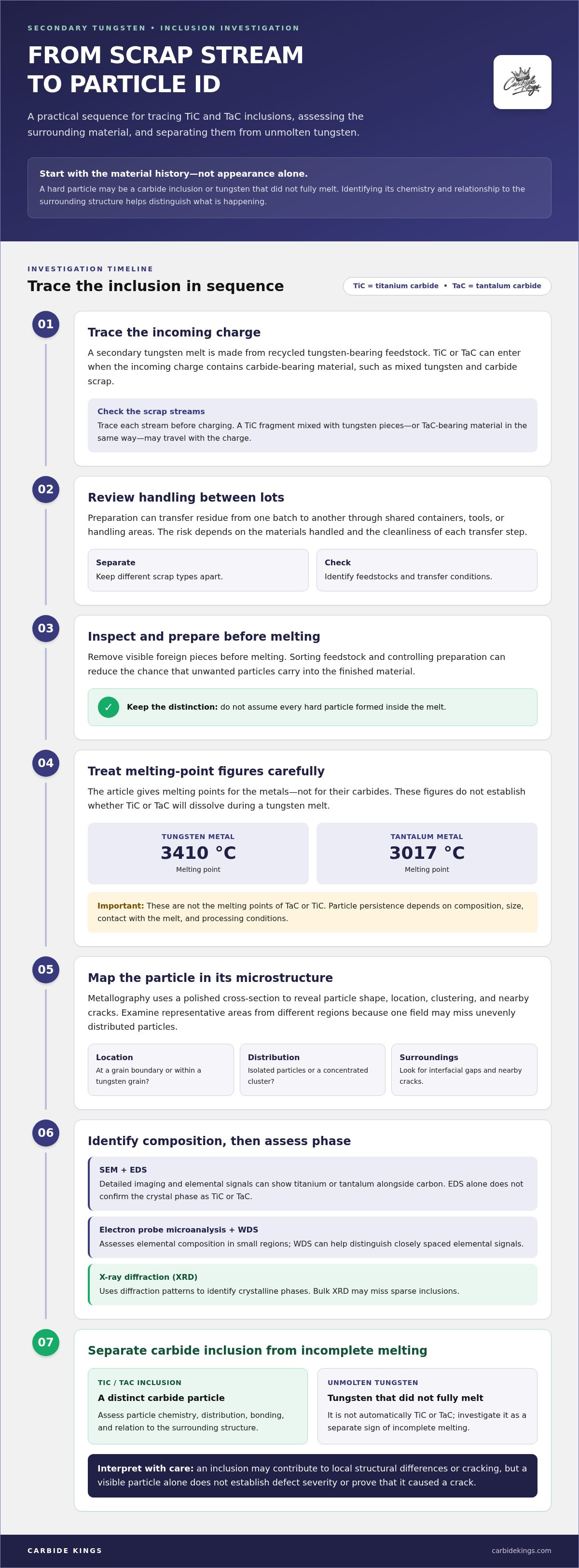
Mixed feedstock is one possible source. A batch combining tungsten-bearing material with carbide scrap can carry particles into the furnace if the materials are not separated first. For example, a TiC fragment mixed with tungsten pieces may travel with the charge. TaC can enter in the same way if tantalum carbide-bearing material is included. Trace each scrap stream before charging rather than assuming every hard particle formed inside the melt.
Preparation can also transfer contaminants between lots. Shared containers, tools, or handling areas may carry residue from one material batch to another. The risk depends on the materials handled and the cleanliness of each transfer step. Identify feedstocks, separate different scrap types, and remove visible foreign pieces before melting. These steps reduce cross-contamination without treating every particle as the same compound.
Refractory behavior helps explain why an inclusion may remain distinct. Tungsten melts at 3410 °C, while tantalum melts at 3017 °C. Those are the metals’ melting points, not the melting points of TaC or TiC. Don’t use them to infer that either carbide will dissolve during a tungsten melt. The resulting particle’s persistence depends on its composition, size, contact with the melt, and processing conditions.
Unmolten tungsten is tungsten that has not fully melted, not automatically TiC or TaC. Investigating titanium and tantalum carbide tramp inclusions in secondary tungsten melts therefore starts with feedstock history, followed by examination of particle chemistry. This distinction helps separate inherited contamination from incomplete melting and guides further investigation.
How do titanium carbide and tantalum carbide affect tungsten melt quality and downstream properties?
Tungsten melt quality describes how consistently the material forms a sound, usable structure. TiC and TaC can each persist as a distinct particle within a tungsten-based material. Their effects depend on particle size and distribution, bonding with the surrounding metal, and the intended application. A visible particle alone does not establish the severity of a defect.
An inclusion is a foreign or separate phase embedded in the surrounding material. If TiC or TaC is unevenly dispersed, nearby regions may differ in composition and structure, interrupting continuity through the metal. A concentrated cluster may matter more than isolated, well-dispersed particles because it creates a larger area of abrupt material change.
A stress concentrator is a feature where mechanical stress gathers locally. An inclusion and its boundary can act as one, particularly when the particle bonds poorly with the tungsten matrix. Under loading or thermal cycling, the interface may become a site for crack initiation or growth. This is a possible mechanism, not proof that every TiC or TaC particle causes cracking.
Downstream properties are the performance characteristics of finished material during later processing or use. An inclusion may affect local strength, ductility, or machining response if it disrupts the matrix or creates weak interfaces. The outcome depends on composition, particle distribution, bonding, and the finished part’s service conditions. Unmolten tungsten is different: it is tungsten that did not melt fully, not a carbide inclusion.
To assess a suspected defect, connect the observed particle with its location and the surrounding microstructure. Look for clustering, interfacial gaps, and cracks that begin near the particle. Then compare those observations with the material’s intended use and processing history. For planning around recycled material, consider the relevant secondary tungsten feedstock alongside the quality requirements of the finished component.
Which analytical methods detect and quantify TiC and TaC in tungsten melts?
Metallography is the preparation and examination of a polished material cross-section. Under a microscope, it reveals inclusion shape, location, clustering, and nearby cracks. For example, a particle at a grain boundary differs from one enclosed within a tungsten grain. Examine representative areas from different regions because a single field may miss unevenly distributed particles.
Scanning electron microscopy, or SEM, produces detailed images of a sample’s surface and cross-section. Pairing SEM with energy-dispersive X-ray spectroscopy, or EDS, shows which elements are present in a selected particle. Titanium or tantalum alongside carbon can indicate a carbide candidate. EDS identifies elemental composition, but that result alone does not confirm the crystal phase as TiC or TaC.
Electron probe microanalysis measures elemental composition in small material regions. Its wavelength-dispersive spectroscopy, or WDS, can help distinguish closely spaced elemental signals. Use it to assess whether a particle contains titanium or tantalum and compare its composition with the surrounding tungsten. The distinction matters: an elemental signal identifies constituents, while phase identification determines how they are combined.
X-ray diffraction, or XRD, identifies crystalline phases by measuring their diffraction patterns. Applied to a representative sample, it can help distinguish carbide phases from metallic constituents. Bulk XRD may miss sparse inclusions, so pair it with localized microscopy. Image analysis can then estimate particle area fraction and distribution across examined sections instead of focusing on one striking particle.
Quantification means measuring both composition and abundance using a defined sampling approach. A tantalum-tungsten study used 10 small-area EDS scans per sample; measured tungsten content ranged from 0.4 wt% in pure tantalum to 6.2 wt% in Ta-7.5W. Those readings illustrate localized analysis, not a direct TiC or TaC assay. For secondary tungsten, combine mapped particle chemistry, phase identification, and representative sampling. Keep unmolten tungsten particles distinct from carbide inclusions during classification.
How can TiC and TaC inclusions be removed or reduced during secondary tungsten melting
Feedstock sorting means separating incoming materials by type before furnace charging. Remove identifiable carbide pieces and keep tungsten-bearing lots apart from TiC- or TaC-bearing materials. For example, do not combine mixed carbide scrap with tungsten feed simply because both contain valuable metals. Segregation prevents avoidable carryover, but cannot remove particles already embedded in a prepared charge.
Screening separates particles by size using a mesh or equivalent barrier. Use it during feed preparation to catch loose fragments, then inspect the retained material before charging. Screening only works on particles that can pass through or remain on the chosen screen. It will not identify a small carbide fragment chemically or remove inclusions already trapped inside a larger tungsten piece.
Charge cleaning means removing loose residue from feedstock and handling equipment before melting. Clear containers and tools between different material streams, and keep cleaned lots covered during transfer. This targets cross-contamination, such as TaC residue left in a bin and carried into a tungsten batch. Record which feed groups share equipment so recurring contamination can be traced to a handling step.
Melt filtration passes liquid metal through a compatible barrier to intercept suspended particles. Its usefulness depends on whether the filter withstands the process and captures the inclusion sizes present. Do not assume filtration removes every TiC or TaC particle. Particle behavior also depends on size, density, wetting, and movement through the melt. Slag removal alone is not a dependable substitute for separating contaminated feed before melting.
Process control means managing charging and melting steps to limit defects and preserve batch traceability. Keep feed groups distinct, avoid adding untracked material, and link inspection findings to the relevant charge. Longer holding or reheating shouldn’t be treated as a removal method: refractory carbide particles may remain separate rather than dissolve. For feedstock planning, review tungsten hard scrap options alongside your material-separation process.
Carbide Kings: Tungsten Hard Scrap
Carbide Kings supplies Tungsten Hard Scrap for industrial users sourcing tungsten-bearing material for manufacturing and metallurgical processes. After considering how inclusions can affect secondary melts, select feedstock that fits your material needs and handling controls. Carbide Kings also offers Tungsten Soft Scrap, Carbide scrap, and Tungsten Alloys.
Use these material categories when planning incoming feedstock and keeping scrap streams identified. Clear separation supports traceability through preparation and charging, helping your team manage materials consistently. Carbide Kings supplies tungsten and carbide scrap for industrial use, not melt analysis or inclusion removal.
For tungsten and carbide scrap options for your operation, contact Carbide Kings.
Make Your Next Material Decision With Clarity
Use your findings to guide the next decision: define the material your process needs, keep incoming feedstock traceable, and make inspection results useful for future charge planning. Records connecting material source, observed particles, and processing outcomes can help your team identify recurring patterns and refine handling steps. That discipline matters when titanium and tantalum carbide tramp inclusions in secondary tungsten melts could affect a finished component.
Carbide Kings offers Tungsten Hard Scrap, Tungsten Soft Scrap, and Carbide scrap for industrial material needs. If you are planning a purchase, identify the category that fits your operation and keep it separate from unrelated feedstock during preparation. Contact Carbide Kings to discuss your material needs.
Contact Carbide Kings about your materials and move forward with a clearer plan for sourcing.
Frequently Asked Questions
What are titanium carbide and tantalum carbide tramp inclusions in secondary tungsten melts?
They are unwanted particles of titanium carbide (TiC) or tantalum carbide (TaC) in recycled tungsten material. “Tramp” means the particle is incidental contamination, not an intended constituent of the melt. The key distinction when assessing titanium and tantalum carbide tramp inclusions in secondary tungsten melts is particle identity: a tungsten-rich fragment that did not fully melt is not automatically TiC or TaC.
What are the typical sizes, concentrations, and compositions of TiC and TaC inclusions in secondary tungsten?
There is no single typical size or concentration for every secondary tungsten batch. Both depend on the incoming material, how it was sorted, and how inclusions are distributed. Useful characterization reports observed particle sizes, their area or abundance in sampled sections, and elemental composition. For example, a few large particles and many fine particles may point to different feedstock or processing conditions.
How do TiC and TaC compare with other common tramp inclusions in secondary tungsten?
TiC and TaC are carbide inclusions that may persist as distinct particles. Unmolten tungsten is tungsten that did not melt fully, not a carbide. The material provides no comparison with other common tramp inclusions.


