

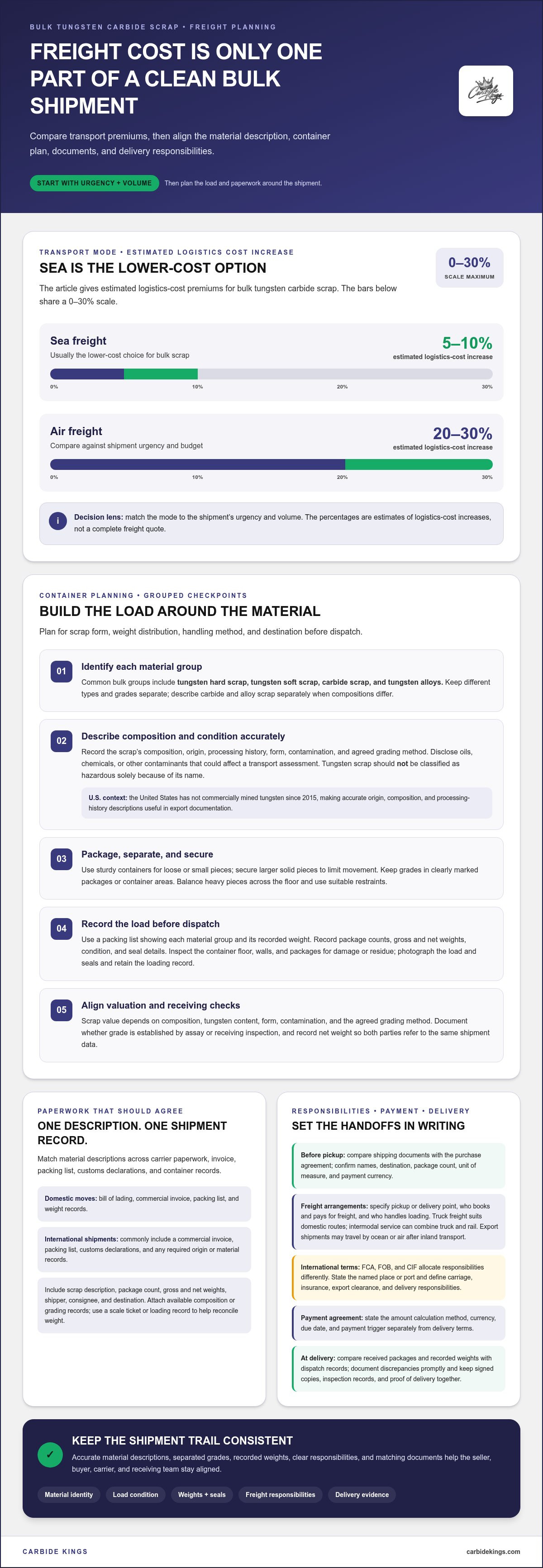
Sea freight is usually the lower-cost option for bulk tungsten carbide scrap, adding an estimated 5-10% to logistics costs; air freight adds an estimated 20-30%. Bulk tungsten scrap freight logistics therefore starts with choosing a transport mode that fits the shipment’s urgency and volume.
Moving a large scrap shipment involves more than booking freight. Container choice, scrap type, export paperwork, payment terms, supplier coordination, and delivery timing all affect how smoothly it reaches its destination.
This guide explains how container services work, when sea or air freight may suit a shipment, and what to settle before dispatch. You’ll also see how supplier capabilities and delivery timelines shape the process, so you can plan each step with fewer surprises.
Key Takeaways
- Match container planning to the scrap type, shipment volume, and destination so loading and handling are organized before dispatch.
- Set shipment details and payment terms clearly, including the agreed documentation, responsibilities, and payment timing.
- Compare transport modes against urgency and budget: estimated logistics costs rise 5-10% with sea freight and 20-30% with air freight.
- Use supplier thresholds to assess whether a shipment’s order size, quality requirements, and delivery schedule fit your export plan.
- Distinguish bulk export suppliers from smaller local collectors by their minimum order quantities and stated material specifications.
Container services for large scrap quantities
Plan a container around the scrap’s form, weight distribution, and destination. Separate material types before loading to simplify handling and receiving.
The U.S. Geological Survey reports that the United States has not commercially mined tungsten since 2015. That makes accurate descriptions of scrap origin, composition, and processing history useful in export documentation.
Transport Regulations and Hazardous-Material Rules
For U.S. transport, determine applicable requirements based on the shipment’s composition, condition, and transport mode. Tungsten scrap should not be classified as hazardous solely because of its name. Disclose oils, chemicals, or other contaminants that could affect the assessment, and keep the material description consistent across shipping papers and container records.
Common bulk shipments include tungsten hard scrap, tungsten soft scrap, carbide scrap, and tungsten alloys. Identify each category separately instead of combining different materials under a broad label.
Pricing and Freight Classification
Bulk scrap value depends on composition, tungsten content, form, contamination, and the agreed grading method. Document how the grade is established, such as through an assay or receiving inspection, and record net weight so both parties use the same shipment data. Freight classification and customs declarations also depend on the material and destination. Describe the scrap accurately rather than assuming one code applies to every form.
For example, describe carbide scrap and tungsten alloy scrap separately when their compositions differ. Clear descriptions help align the commercial grade, shipping paperwork, and receiving inspection.
Packaging and Loading Methods
Choose packaging that contains the scrap and suits its shape, weight, and handling method. Put loose or small pieces in sturdy containers; place larger, solid pieces securely to limit movement. Keep different grades in separate, clearly marked packages or container areas. Use a packing list that identifies each material group and its recorded weight.
Before closing the container, inspect the floor, walls, and packages for damage or residue. Photograph the load and seals, then retain the loading record with the shipment documents. A clear record helps resolve questions about condition or weight at delivery.
Transport Security and Insurance
Secure the load with suitable restraints and balance heavy pieces across the container floor. Record package counts, weights, condition, and seal details before dispatch. These steps help address theft, moisture exposure, contamination, and weight disputes in transit.
Review cargo insurance terms against the shipment’s declared value, route, and handling exposure. Keep the invoice, packing list, inspection evidence, and carrier documents together. At delivery, compare the received packages and recorded weights with the dispatch record, and document any discrepancy promptly.
Men’s wedding rings have often contained tungsten carbide in recent years. If a load includes ring-derived material, identify it as tungsten carbide only when its composition is confirmed, and keep it separate from other tungsten scrap until then. Record the basis for the description in the packing list and ensure package markings match the shipment records. This distinction supports consistent grading and receiving inspection when a container combines materials from different sources. Do not treat an item’s appearance or intended use as proof of its composition.
Including shipment and payment information
Clear shipping and payment details keep the seller, buyer, carrier, and receiving team aligned. Put the material description, responsibilities, and payment trigger in writing before pickup.
Shipment Documentation
For domestic moves, prepare a bill of lading, commercial invoice, packing list, and weight records. Include the scrap description, package count, gross and net weights, shipper, consignee, and destination. International shipments commonly require export documentation, including a commercial invoice and packing list, as well as customs declarations and any required origin or material records. Match descriptions across all documents.
Use one consistent material description on the invoice, packing list, and carrier paperwork. For example, identify carbide scrap separately from tungsten alloy scrap instead of using a generic “metal scrap” label. Attach available composition or grading records to support the transaction description. A scale ticket or loading record helps reconcile the declared weight with the quantity received.
Before dispatch, compare the shipping documents with the purchase agreement. Confirm the seller and buyer names, destination, package count, unit of measure, and payment currency. Correct discrepancies before the carrier takes possession. Keep signed copies, inspection records, and proof of delivery together to provide a clear transaction trail if the parties later dispute quantity or condition.
Delivery Terms and Freight Options
U.S. buyers and sellers commonly arrange pickup at the seller’s facility, delivery to the buyer, or carrier pickup with freight prepaid or collect. Truck freight suits domestic routes, while intermodal service can combine truck and rail. Export shipments may travel by ocean or air after inland transport. Name the delivery point and specify who books freight, pays charges, and handles loading.
For international sales, terms such as FCA, FOB, and CIF allocate responsibilities differently. State the named place or port alongside the term, then define who arranges carriage, insurance, export clearance, and delivery. Don’t rely on the term alone to explain payment timing or ownership transfer. Specify those points separately in the sales agreement.
Payment arrangements should state the amount calculation method, currency, due date, and event that triggers payment. Common structures include payment before dispatch, payment against shipping documents, and payment after receipt or inspection. Set out how final weight or grading affects the invoice. For example, specify whether it uses dispatch weight or receiving weight, and how the parties will resolve a mismatch.
Keep the quote, purchase order, invoice, and freight booking consistent. A mismatch between “net weight” on the invoice and “gross weight” on the carrier record can delay reconciliation. Use specific tungsten scrap categories in transaction records so material descriptions remain clear from sale through delivery.
Sea freight and air freight cost comparisons
Sea freight and air freight balance logistics costs against delivery urgency and routing. Compare them using the same shipment details, not headline rates alone.
How the cost estimates compare
For tungsten carbide scrap, sea freight adds an estimated 5-10% to logistics cost. Air freight adds an estimated 20-30%. These estimates help frame the mode decision, but the shipment’s route, dimensions, weight, handling needs, and service level affect the quote. A dense load may be priced differently from a bulky load with the same gross weight.
Sea freight can suit planned bulk exports when transit time allows for consolidation and port handling. Costs may include inland trucking, export handling, ocean carriage, terminal charges, and destination delivery. Ask for each component in the quote. A low ocean rate may not reflect the full door-to-door expense if inland transport or handling is listed separately.
What changes the total freight cost
Air freight can suit a time-sensitive shipment or smaller lot, but cargo weight and dimensions determine chargeable weight. Compare the carrier’s calculated chargeable weight with the shipment’s actual weight. Packaging matters too: a large container holding compact scrap may take up more space than its mass alone suggests. Provide accurate dimensions and weights when requesting quotes.
Route details matter for both modes. A shipment moving from a U.S. facility to an overseas buyer may require domestic pickup, export handling, international carriage, and delivery beyond the destination port or airport. Confirm which services the quote includes. Clarify who pays charges at each handoff, especially when the buyer and seller divide transport responsibilities.
Choose a mode for the shipment
Compare options consistently. First, specify the scrap form, packaging, weight, dimensions, origin, and destination. Next, request sea and air quotes with the same delivery scope. Then weigh the total logistics cost against the required arrival date and the consequences of delay. This avoids comparing a port-to-port sea quote with an air quote that includes delivery.
For example, sea freight may suit a scheduled bulk shipment when the receiving operation can plan around its arrival. Air freight may be worth evaluating for an urgent replacement lot, despite its higher estimated share of logistics costs. Neither mode is automatically best. The buyer’s inventory, production schedule, routing, and receiving capacity determine the practical choice.
Record the selected mode, included charges, handoff points, and delivery responsibilities in the shipment agreement. For bulk tungsten scrap freight logistics, this side-by-side comparison helps match transport to the shipment’s operational purpose instead of choosing on freight rate alone.
Supplier selection and delivery-time thresholds
Assess a tungsten scrap supplier based on order size, material consistency, documentation, and delivery schedule. Set those criteria before comparing quotes so the source fits the shipment and avoids last-minute changes.
Supplier selection thresholds cite a minimum order quantity range of 100-500 kilograms. Treat that range as a screening point, then compare it with the quantity your operation can receive and use. A supplier’s stated minimum should align with your purchase order, packaging plan, and available storage. For example, a buyer planning a 300-kilogram lot should confirm that the offered grade and shipment quantity match the intended order.
Quality criteria need to reflect the material being purchased. For tungsten carbide scrap, the supplier guide sets a chemical purity threshold of at least 99.8%. It also gives a density range of 14.5-15.0 grams per cubic centimeter and a maximum acceptable defect rate of 1%. Use these measures as specification checks, not as substitutes for clearly defining the agreed grade and inspection method. Ask for the same measurement basis across records, so the buyer and seller compare like with like.
Delivery time should be assessed against the production schedule and receiving capacity. The supplier selection guide sets a maximum delivery-time threshold of 15 days. Use that as a procurement screening benchmark, then account for order preparation, dispatch, transit, and receiving. A shipment arriving before the warehouse can unload it may create a different operational problem than one arriving after production needs the material. Write the required delivery date and receiving location into the purchase documents.
- Order fit: Compare the quoted quantity with the 100-500-kilogram minimum-order range.
- Material fit: Match the agreed grade to the purity, density, and defect criteria.
- Timing fit: Use the 15-day delivery threshold when screening suppliers against the operating schedule.
- Process fit: Confirm that purchase, dispatch, and receiving records describe the same material and quantity.
Certification can support supplier screening, but it should sit alongside material and delivery checks. The guide states that at least 90% of suppliers should have ISO certifications. Record which certification applies and compare its scope with the supplier’s process. Then review sample documentation, shipment records, and communication during the quotation stage. A supplier that responds clearly to a specification change can help prevent mismatched grades or incomplete dispatch details.
Use a scorecard to compare suppliers consistently. Give each the same order quantity, required grade, documentation expectations, and delivery date. Record whether each meets the stated thresholds, then resolve gaps before confirming the purchase. This creates a practical decision trail for procurement and logistics teams.
Supplier types and bulk export capabilities
To source carriers and recyclers for bulk tungsten scrap, first define the material, shipment size, origin, and destination. Then match those details to providers that handle industrial freight, scrap processing, and export shipments.
Supplier type affects minimum order quantity and material specification. Bulk export-oriented tungsten carbide scrap suppliers list a 1 ton minimum order quantity and a 92-95% purity level. Small-scale local collectors list a 50-kilogram minimum order quantity and 85-90% purity. These figures describe different supplier categories, not interchangeable grades or universal buying rules.
Use the figures as an initial fit check. A buyer seeking an export-scale lot can compare the order against the 1 ton threshold. A smaller local collection may better match a 50-kilogram minimum. Next, check that the supplier’s stated material and purity align with the purchase specification. Record the grade basis, quantity, and inspection method in the order documents.
- Bulk export supplier: Compare the 1 ton minimum and stated 92-95% purity with the purchase requirement.
- Local collector: Consider the 50-kilogram minimum and stated 85-90% purity for smaller lots.
- Freight carrier: Match route, load form, pickup arrangements, and destination handling to the shipment.
A freight carrier and a scrap supplier have different roles. The supplier provides the material and shipment details; the carrier moves the load between agreed locations. Request quotes using the same origin, destination, material description, package format, and weight for each carrier. Compare pickup, transport, and delivery responsibilities, not just the headline service description.
For export planning, ask suppliers for consistent commercial and shipping records. Match the invoice description to the packing list and the carrier’s freight description. If the load combines grades, request separate descriptions and weights for each group. This makes the shipment easier to reconcile at dispatch and receipt.
The U.S. Geological Survey reports that seven U.S. companies can convert tungsten concentrates, ammonium paratungstate, tungsten oxide, and scrap into tungsten products. This processing context can help buyers distinguish material suppliers from downstream converters. It does not mean every converter buys every scrap form, so define the material and quantity before comparing potential routes.
Build a shortlist with a simple sequence: specify the scrap, set the order quantity, identify the destination, and compare supplier and carrier capabilities against those requirements. For example, a 1 ton export lot needs a supplier whose bulk order terms fit, plus a carrier quote covering the intended route and delivery point. Keep each requirement in writing to align procurement and freight planning.
Set terms for documentation and compliance as well as logistics. Check suppliers' compliance with REACH in Europe and RoHS in electronics-focused markets. Tungsten prices rose to their highest level since 2013 as export curbs tightened supply, so confirm that quoted terms remain current when requesting offers.
Policy proposals also merit attention: a coalition led by AMERMIN asked the U.S. Department of Commerce to require export licenses for U.S. tungsten scrap bound for China, Russia, and other countries it considers adversarial. The U.S. critical minerals designation does not automatically impose export controls on tungsten. Treat these points as context when checking shipment requirements; a proposal alone does not change a supplier’s export authority.
Carbide Kings: Tungsten Hard Scrap
Carbide Kings supplies tungsten hard scrap, a practical option when your sourcing plan calls for this material. Its available categories also include tungsten soft scrap, carbide scrap, and tungsten alloys, giving industrial buyers options to match their material requirements.
Use the planning steps in this guide to define the scrap type, destination, quantity, and documentation for your purchase. Clear specifications help align the material order with freight arrangements and receiving procedures. Carbide Kings supplies tungsten and carbide scrap materials for industrial use.
For your next sourcing step, contact Carbide Kings or visit carbidekings.com.
Put Your Next Bulk Shipment in Motion
Turn your freight plan into a clear sourcing brief. Define the material you need, the destination, and the receiving requirements before coordinating the purchase. This gives your team a practical starting point for aligning procurement with shipment planning.
Carbide Kings supplies Tungsten Hard Scrap, Tungsten Soft Scrap, and Carbide scrap. If these materials fit your sourcing needs, use your shipment details to guide the next conversation. A defined material request keeps bulk tungsten scrap freight logistics connected to your purchasing goals.
Contact Carbide Kings about bulk shipment sourcing and take the next step with a focused material request. A well-prepared plan starts with knowing what you need.
Frequently Asked Questions
What are current freight costs for shipping bulk tungsten scrap by truck, rail, or ocean?
There isn’t one rate for every truck, rail, or ocean shipment. The quote depends on origin, destination, shipment weight and dimensions, packaging, handling needs, and delivery scope. For an accurate comparison, request quotes using identical shipment details and check which pickup, terminal, and final-delivery charges are included. Compare the total route cost, not just the base transport charge.
What are the weight, pallet, container, and truckload limits for tungsten scrap freight?
Limits depend on the equipment, route, packaging, and carrier’s allowable payload. Start with the scrap’s net weight, then add pallets, bins, and other packaging to calculate gross cargo weight. Compare the total with the carrier’s stated payload and container limits. Also consider pallet dimensions, stackability, and how the load is distributed across the floor. Dense tungsten scrap may reach a weight limit before filling the available space.


