
Deeper oxidation can shift tungsten from recoverable metal into oxide-bearing slag, while excessive heat can add volatilization losses. The impact of oxidation depth on tungsten hard scrap melt recovery yields depends on how far oxidation proceeds and how hot and long the material is treated: tungsten begins significant oxidation in air at 620°C, and tungsten trioxide begins to volatilize at 890°C.
It’s easy to assume that more oxidation means more tungsten is ready for recovery. In practice, oxidation state and processing conditions affect where tungsten ends up and how much can be captured.
This article explains how oxidation depth affects metal recovery and slag losses, why temperature and processing time matter, and how WO3 sublimation can reduce yield. You’ll also see how different recovery routes handle tungsten-bearing material, so you can better understand the trade-offs behind hard scrap melting.
Key Takeaways
- Match the recovery route to the scrap and target product; reported recovery rates apply to specific processes and feed materials, not every hard scrap melt.
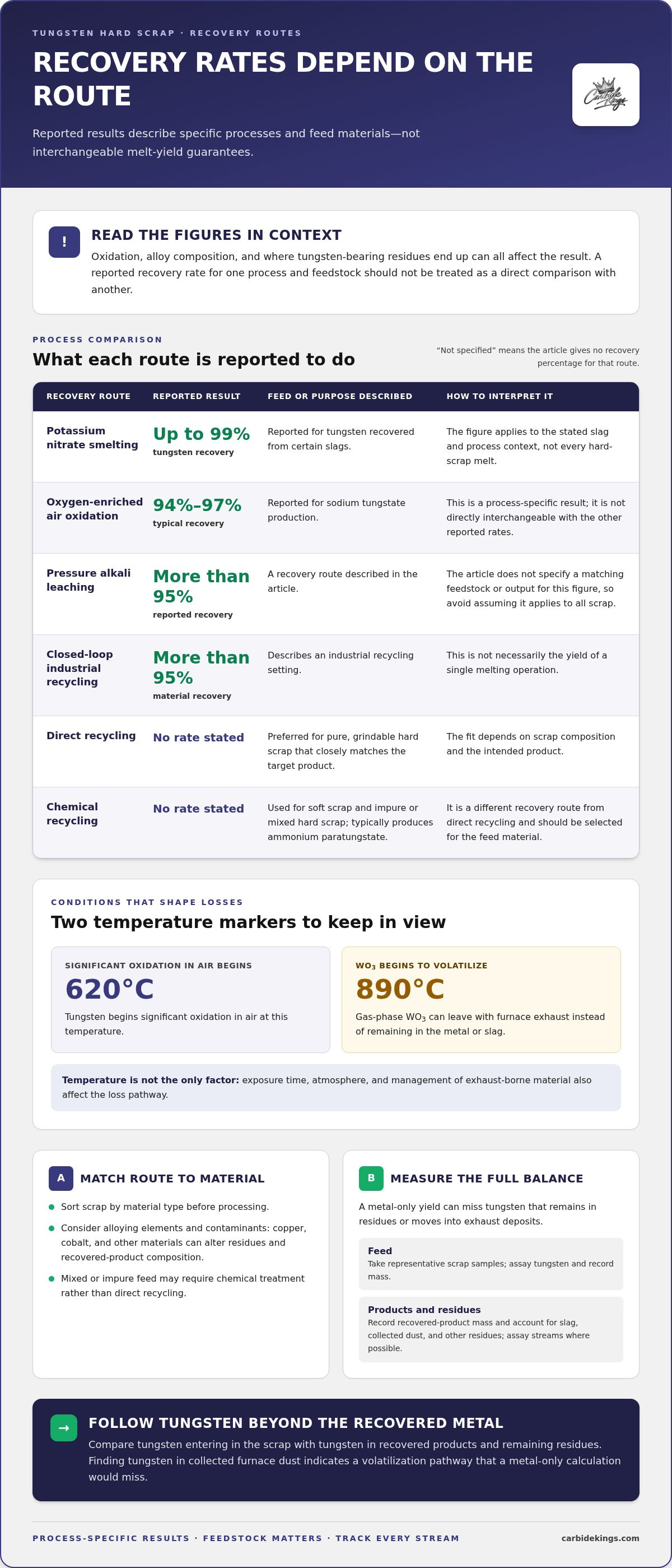
- Track both temperature and exposure time: tungsten begins significant oxidation in air at 620°C, while tungsten trioxide begins to volatilize at 890°C.
- Assess oxidation through the material’s oxide scale and oxygen content, since surface appearance alone may not show how oxidation affects the full batch.
- Follow where tungsten ends up after melting. Oxide formation can shift tungsten into slag, while volatilization can carry material out of the recovery stream.
Tungsten recovery rates
Reported recovery rates depend on the process and feed material, so they are not universal guarantees of melt yield. Oxidation, alloy composition, and the destination of tungsten-bearing residues all affect the result.
Several routes report strong recovery under specific conditions. Potassium nitrate smelting can recover up to 99% of tungsten from certain slags. Oxygen-enriched air oxidation typically achieves 94% to 97% recovery for sodium tungstate production. Pressure alkali leaching can exceed 95%. These figures describe different processes and feedstocks, not directly interchangeable results.
Closed-loop industrial tungsten recycling can exceed 95% material recovery. However, that rate describes a recycling setting, not necessarily one melting operation. For pure, grindable hard scrap that closely matches the target product, direct recycling is preferred. Chemical recycling is used for soft scrap and impure or mixed hard scrap, typically producing ammonium paratungstate.
Measuring Oxidation Depth
Oxidation depth describes how far oxygen has reacted into scrap, assessed through oxide-scale thickness and oxygen content. A surface layer alone may not represent the whole batch. Examine representative cross-sections to compare scale thickness across pieces, then use oxygen assay results to assess oxidation beyond the visible surface. Together, these measures help explain why nominal tungsten content may differ from recoverable metal.
Scrap Composition and Contamination
Scrap type, alloying elements, and contaminants determine which recovery route can separate tungsten effectively. Pure, grindable hard scrap with a composition close to the intended product is suited to direct recycling; mixed or impure hard scrap may require chemical treatment. Copper, cobalt, and other materials can alter the composition of residues and recovered products. Sorting by material type before processing helps avoid treating unlike feed as one consistent batch.
To determine payable tungsten recovery, take representative feed and product samples, assay their tungsten content, and record the mass of each stream. A mass balance compares tungsten entering in the scrap with tungsten recovered in products and remaining in residues. This distinguishes total feed grade from the tungsten actually recovered and supports a transparent settlement calculation.
WO3 sublimation losses
Tungsten trioxide, or WO3, begins to volatilize when heated to 890°C. Once WO3 enters the gas phase, it can leave the melt and travel with furnace exhaust rather than remain in the metal or slag. That movement reduces the tungsten available in the intended recovered product. The key issue is not temperature alone: exposure time, atmosphere, and how exhaust-borne material is managed also affect the loss pathway.
Oxidation and volatilization are linked but distinct. Oxidation converts tungsten at the surface into tungsten oxides; further heating can then volatilize WO3. A batch with oxidized surfaces may therefore lose tungsten through both oxide-bearing residues and vapor transport. If only the recovered metal is weighed, these streams can be mistaken for unexplained yield loss.
Reduce oxidation-related losses by controlling air exposure and avoiding unnecessary heating above process requirements. Keep time at high temperature to what the selected process needs, and account for dust or deposits collected from the furnace exhaust. These measures manage where tungsten goes; they do not make every oxide layer disappear.
Pretreatment depends on the scrap and its oxidation state. Mechanical removal can separate loose surface scale before melting, while alkali treatment converts tungsten oxides into water-soluble sodium tungstate, which can be separated from solid cobalt oxide. This is a chemical recovery route, not a direct melt pretreatment, so it changes how tungsten is recovered.
For a useful mass balance, weigh the incoming scrap and recovered metal, then account for slag, collected dust, and other residues. Assay tungsten in each stream where possible. Comparing the results shows whether tungsten remained in slag or moved into exhaust deposits. For example, measurable tungsten in collected furnace dust signals a volatilization pathway that a metal-only yield calculation would miss.
Understanding these loss streams helps distinguish oxidation control from material recovery. For a related look at tungsten hard scrap, consider how feed composition shapes the processing route.
How is oxidation depth measured in tungsten scrap, including oxide scale thickness and oxygen content?
Assess oxidation depth by examining oxide scale across a cut surface and measuring oxygen in representative scrap samples. These measurements answer different questions: a cross-section shows where the scale sits, while an oxygen assay estimates oxygen across the tested material. Using both gives a clearer picture than judging a batch by color or surface appearance alone.
Start with representative pieces from different parts of the lot. Cut a cross-section through each piece, prepare the surface, and inspect it under an optical microscope. Measure the oxide layer at several points around each section, since scale can vary across edges and faces. Record the locations and compare pieces rather than relying on a single visually striking sample.
For a closer look, scanning electron microscopy with energy-dispersive X-ray spectroscopy can map the scale and show how oxygen is distributed near the surface. Treat the map as a localized view, not a bulk oxygen result. A calibrated oxygen analyzer, such as an inert-gas-fusion instrument, measures oxygen in a prepared sample and provides a separate bulk value.
Keep sample identity intact from collection through analysis. For example, label oxidized pieces separately from cleaner-looking scrap, then compare their cross-sections and oxygen results. If mixed material is combined before sampling, the result can hide differences between pieces and misrepresent the lot. Preserve the link between each result and its source material.
Interpret both measurements together. A thick, localized scale with a lower bulk oxygen result suggests surface oxidation concentrated on part of the scrap. A higher oxygen result across the sample points to oxygen distributed beyond the visible layer. Neither measurement alone calculates recoverable tungsten; composition, process conditions, and where tungsten reports after treatment also matter.
For a useful process comparison, record oxide thickness, oxygen assay, scrap type, and sample location in one inspection log. Compare these records with recovered metal and residue assays after processing. This helps distinguish a surface-scale problem from oxygen distributed through the feed and gives operators a practical basis for sorting or routing material.
How do tungsten oxide formation and oxidation during melting affect metal recovery and slag losses?
At 620°C, tungsten begins significant oxidation in air. During melting, oxygen reacts at exposed surfaces and forms tungsten oxides rather than metallic tungsten. This changes where tungsten reports: material that could join the recovered metal phase may remain in oxide-bearing slag. The effect depends on oxide formation, slag chemistry, and whether the recovery route can separate tungsten from other materials.
Oxide formation doesn't always mean permanent loss. If tungsten-bearing slag is discarded, its tungsten leaves the metal yield. Potassium nitrate smelting can recover up to 99% of tungsten from certain slags, showing that some slag can serve as feed for another recovery stage. That rate applies to certain slags, not every melt or scrap type.
The processing route matters. Alkali treatment converts tungsten oxides into water-soluble sodium tungstate, which separates from solid cobalt oxide. The liquid stream retains tungsten for further processing, while the cobalt-bearing residue follows a separate recovery path. Direct recycling suits pure, grindable hard scrap when its composition closely matches the intended final product. Oxide-rich, mixed feed may need chemical recovery rather than direct remelting.
Air access also matters. Limiting unnecessary oxygen contact during melting reduces additional oxide formation. Separating slag from metal keeps oxide-bearing material from being mistaken for recovered metal. These controls support yield accounting and the selected recovery route.
A metal-only yield can hide tungsten left in slag, dust, or other residues. Compare the feed’s tungsten assay with assays of recovered metal and residue streams. For example, tungsten found in post-melt slag means the metal yield understates the amount still available for recovery. Counting that slag as finished metal, however, overstates product recovery.
For a practical feed decision, review tungsten scrap options alongside oxidation state and target product.
Melting metallurgy is also used to recycle tungsten-containing superalloys. Tungsten has a melting point of 3422°C. In FeCl3 digestion of W-Cu scrap in aqueous solution, tungsten oxide formed and was described as slightly soluble in aqueous media. Reducing the scrap particle size did not meaningfully alter tungsten affinity during that digestion.
Carbide Kings: Tungsten Hard Scrap
Carbide Kings is a practical source of tungsten and carbide scrap materials for industrial use. Understanding oxidation and slag losses helps clarify processing decisions; sourcing the right feed material is a separate part of the workflow.
Carbide Kings offers Tungsten Hard Scrap, Tungsten Soft Scrap, carbide scrap, and Tungsten Alloys for industrial applications, including manufacturing and metallurgical processes. If you’re planning a production run or comparing feed materials, choose the offering that best fits your material requirements.
For scrap sourcing, share your material needs with Carbide Kings. Contact Carbide Kings or visit carbidekings.com.
Make Your Next Scrap Decision With Clarity
Use oxidation assessment as part of a broader feed-planning decision, not as an isolated measurement. The impact of oxidation depth on tungsten hard scrap melt recovery yields becomes useful when it helps your team sort material, choose a processing route, and account for each output stream. That creates a clearer basis for deciding what to recover and what feed material your production plan needs next.
Carbide Kings offers Tungsten Hard Scrap, Tungsten Soft Scrap, and carbide scrap for industrial use. If you’re sourcing material for manufacturing or metallurgical processes, match the material category to your intended application before moving forward.
Take the next step with a focused conversation about your scrap material needs. Contact Carbide Kings about scrap recovery and keep your sourcing plans moving with confidence.
Frequently Asked Questions
How does oxidation depth affect tungsten hard scrap melting recovery yield?
Deeper oxidation can lower metal yield by moving more tungsten into oxide-bearing residues instead of recovered metal. The impact of oxidation depth on tungsten hard scrap melt recovery yields is clearest when yield is calculated against tungsten in the original feed, not simply total scrap weight. For example, reporting metal mass alone can obscure tungsten that remains in nonmetallic outputs.
What are typical tungsten recovery yields from clean hard scrap versus oxidized scrap?
There is no single comparable yield for clean and oxidized hard scrap because composition and processing route affect the result. Make a useful comparison by using the same yield basis for both batches: recovered tungsten divided by tungsten entering in the feed. Keep alloying materials and non-tungsten contaminants separate in the calculation, so differences in scrap composition are not mistaken for oxidation losses.


