

Lead is the clearest health concern in secondary tungsten alloy feedstock: according to the World Health Organization, there is no known safe blood lead concentration, and levels as low as 3.5 µg/dL may be associated with decreased intelligence, behavioral difficulties, and learning problems in children. Understanding bismuth and lead trace element risks in secondary tungsten alloy feedstock means distinguishing the presence of a metal in a material from the health risks of exposure to it.
A trace-element finding matters, but it does not tell the whole story. Metals can enter feedstock through material use, processing, and recycling, so composition is important when assessing potential exposure and suitability for recovery.
This article explains the health concerns associated with lead, what can be concluded about bismuth, and how industrial processes may introduce trace elements into recovered tungsten alloys. Identifying an element’s source and form helps put its presence in context.
Key Takeaways
- According to the World Health Organization, no blood lead concentration is known to be safe; even 3.5 µg/dL may be associated with learning and behavioral difficulties in children.
- Trace-element levels can vary between secondary tungsten feedstock. Learn why the material’s source and processing history matter when interpreting test results.
- Understand how bismuth and lead can influence alloy properties and processing, and why their effects depend on the material and its intended use.
- Impurity limits depend on the requirements for a specific tungsten heavy alloy. The article explains what factors shape those limits.
- Learn how to distinguish the presence of a metal in recycled material from the routes that can expose workers or communities to it.
Health risks of lead
Lead exposure can affect several body systems. The World Health Organization states that no blood lead concentration is known to be safe. Even levels as low as 3.5 µg/dL may be associated with decreased intelligence, behavioural difficulties, and learning problems in children. A low result is not proof of zero risk.
Children are particularly vulnerable to the developmental effects of lead exposure, according to the World Health Organization. Lead exposure can also cause kidney damage, cardiovascular problems, and stillbirth. These risks make exposure prevention important wherever lead-bearing material is handled, processed, or released as dust.
Do not rank impurities by concentration alone. Lead has documented health effects, while risks from other trace elements depend on their identity, chemical form, and exposure route. Bismuth and lead in secondary tungsten feedstock therefore require separate assessment, not a single judgment about “impurities.”
OSHA exposure limits address workplace conditions, not the overall composition or health risk of a scrap batch. Assess airborne exposure during specific tasks separately from the metal content of the feedstock. One measurement cannot answer both questions.
EPA requirements address environmental handling, including the management of waste and processing residues. Distinguish material retained for recovery from residues that require waste management. Lead content alone does not describe every handling obligation or establish a waste classification.
There is no single price effect that applies to bismuth or lead contamination. Acceptance depends on the buyer’s material requirements, measured composition, and whether the feedstock suits its intended use. Separating lots and providing clear analysis results can make the decision more direct.
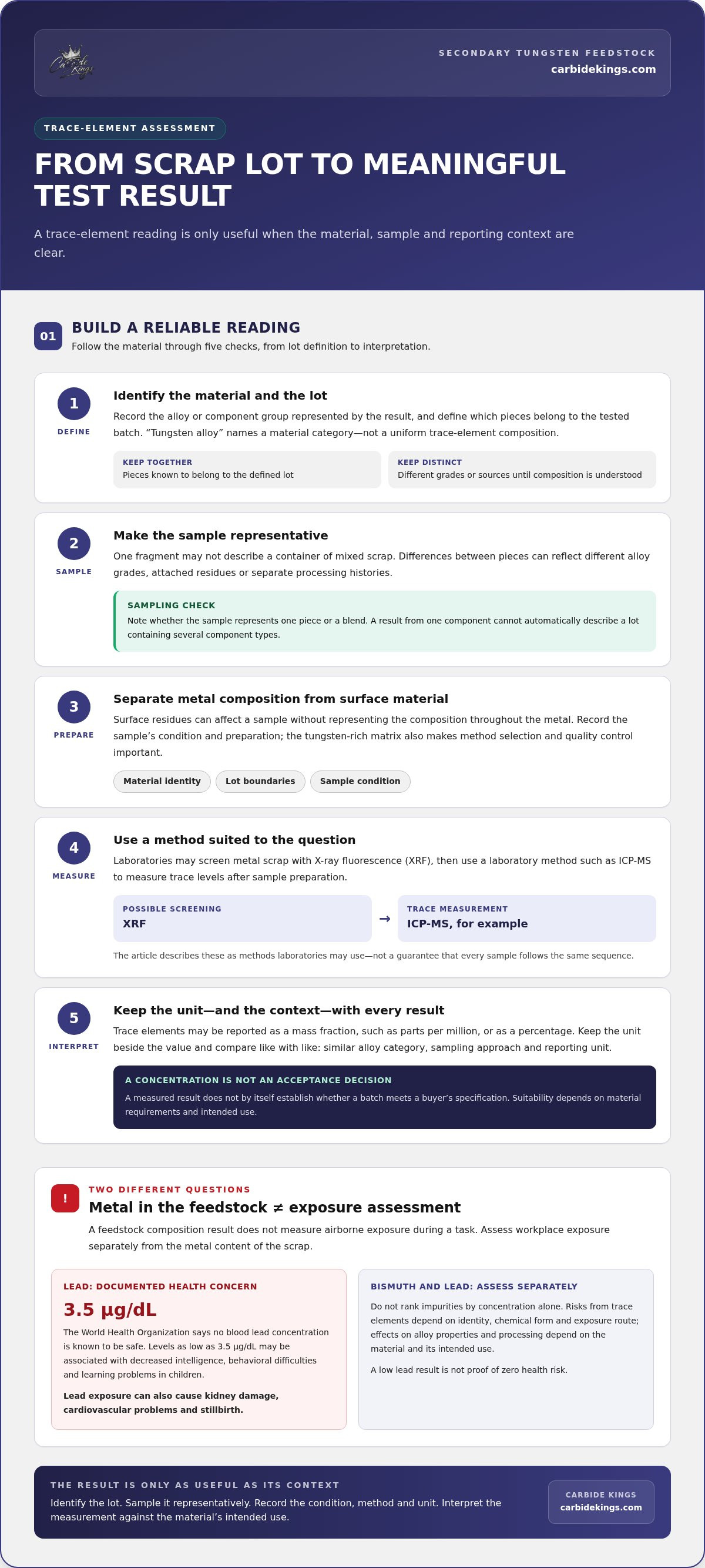
Laboratories may screen metal scrap with X-ray fluorescence, then use a laboratory method such as ICP-MS to measure trace levels after sample preparation. For detailed microstructural analysis and elemental mapping of scrap samples, instruments from suppliers like Electron Optics Instruments, LLC can help teams examine how trace elements are distributed. Representative sampling is essential: a result from one fragment may not describe a mixed lot. The tungsten-rich matrix also makes method selection and quality control important.
Recycling controls begin with keeping suspect lots separate and limiting dust spread during handling. Processors can then select separation or refining steps suited to the alloy and the form of contamination. Collect residues rather than letting them disperse, and manage them through the appropriate waste-handling pathway.
What levels of bismuth and lead are found in secondary tungsten alloy feedstock?
There is no single bismuth or lead concentration that describes all secondary tungsten alloy feedstock. Composition depends on the original alloy, the material’s history, and the scrap streams combined during recovery. The label “tungsten alloy” identifies a material category, not its trace-element composition. Assessing bismuth and lead trace element risks in secondary tungsten alloy feedstock starts with identifying the material represented by each result.
Consider two separate lots: one made from clean production offcuts and another assembled from mixed industrial components. Their tungsten content may be similar, while their bismuth and lead results differ. Surface residues can also affect a sample without representing the metal’s composition throughout. A result is meaningful only alongside information about the sample source and preparation.
Laboratory results commonly report trace elements as a mass fraction, such as parts per million, or as a percentage. These units describe concentration but do not establish whether a batch meets a buyer’s specification. Keep the unit beside every result. A figure without its unit, sampling description, and material identity can lead to incorrect comparisons.
Sampling is essential to interpreting results. One piece may not represent a container of mixed scrap. Differences between pieces can reflect distinct alloy grades, attached residues, or separate processing histories. A test of one component, for example, cannot automatically describe a lot containing several component types.
Review each result in context. Record the material identity, lot boundaries, and whether the sample represents one piece or a blend. Keep separate grades or sources apart until their composition is understood. This makes unexpected results easier to trace and prevents a mixed batch from being treated as uniform. These details also support a better assessment of bismuth and lead trace element risks in secondary tungsten alloy feedstock.
- Material identity: Identify the alloy or component group represented by the sample.
- Lot definition: Note which pieces belong to the tested batch.
- Sample condition: Distinguish metal composition from attached surface material.
- Result format: Keep the reported concentration and unit together.
These details explain why secondary feedstock lots can produce different results and make comparisons more useful. Compare like with like: the same alloy category, a similar sampling approach, and the same reporting unit. A changed result may reflect different source material or sampling, not a change in the metal itself.
For a buyer or processor, the question is not simply whether bismuth or lead is present. It is whether the measured composition suits the intended material requirements and processing route. That decision depends on representative results and a clearly identified lot, not an assumed concentration based on the word “secondary.”
How do bismuth and lead affect tungsten alloy properties and processing?
Bismuth and lead can matter because alloy performance depends on composition and processing conditions. Their effects cannot be inferred from an element’s name alone. The amount, distribution, and chemical form all help determine its role, so a trace result needs to be interpreted in relation to the alloy’s intended use.
Lead is dense, at 11.34 g/cm³, and melts at 621.4 degrees Fahrenheit (327.5 degrees Celsius). Bismuth is also dense, at 9.78 g/cm³, and melts at 520.5 degrees Fahrenheit (271.5 degrees Celsius). These values describe the pure metals, not their behavior inside every tungsten alloy. Still, they help explain why either element may respond differently from tungsten during heating or separation.
Processing temperature matters. When recycling heats material near a constituent’s melting range, that constituent may behave differently from the solid tungsten-rich structure. Actual behavior depends on alloy composition and process conditions. A furnace setting alone cannot predict the final material properties.
Bismuth is brittle in its pure form. If present in a material, its distribution and interaction with other constituents matter more than the word “bismuth” alone. Bismuth also alloys with gold to form maldonite below 373°C. That example shows how temperature and neighboring elements can influence metal phases, though it does not establish that maldonite occurs in tungsten feedstock.
For recovered alloy, the key concern is whether an impurity disrupts the required composition or processing route. A batch intended for remelting may be judged differently from material intended for another recovery pathway. Mixing unlike grades can also make feedstock less predictable. Keeping lots separate preserves clearer composition information.
- Composition: Identify the alloy constituents and measured trace elements.
- Distribution: Consider whether an element is uniform or concentrated in certain pieces.
- Thermal route: Compare process temperatures with the behavior of the material’s constituents.
- End use: Relate the result to the properties required in the finished alloy.
These steps help distinguish a measurable impurity from a processing problem. A result from one fragment, for example, may not represent a blended lot. Keep the sample description and batch definition with the analysis. This gives processors a more useful basis for deciding whether material can enter a specific melt or recovery stream.
Lead and bismuth do not automatically make every tungsten alloy unusable. Their significance depends on composition, distribution, and intended processing. A measured result becomes actionable when compared with product requirements and the planned thermal route. This supports more consistent decisions than relying on an element’s name alone.
Improving bismuth knowledge at exploration, resource and reserve reporting, and mineral-processing planning stages could improve understanding of bismuth-bearing mineral deportment and help reduce waste. This broader view complements batch-level composition checks and reinforces the value of considering bismuth across the stages named, rather than relying on a single observation. Keeping this knowledge in view can support mineral-processing planning informed by a clearer understanding of bismuth-bearing mineral deportment and help reduce waste.
What are typical bismuth and lead impurity limits for tungsten heavy alloys?
A usable impurity limit starts with the alloy specification, not a universal value. Tungsten heavy alloys differ in composition, manufacturing route, and required performance. A limit for one finished part may not suit another alloy or application. Treat each acceptance value as a requirement tied to a defined material and use.
For secondary feedstock, separate three questions: what the analysis measures, what the purchaser accepts, and what the finished alloy must meet. These values serve different purposes. A laboratory result describes the tested sample; a purchasing specification sets a feedstock criterion; and a finished-product requirement applies after processing. Confusing these stages can lead to the wrong acceptance decision.
Read lead and bismuth limits in the same units as the analysis. A report may express concentration as a mass fraction or percentage. Compare only matching units and material bases. For example, do not treat a scrap-sample result as a finished-alloy result without considering changes in composition during processing.
Requirements may distinguish total concentration from a specific form or source of contamination. Surface residue, attached material, and metal distributed through an alloy can create different processing concerns. A specification should identify the material tested and the sampling basis. Otherwise, parties may compare results that describe different things.
Base the acceptance decision on the intended route. A lot headed for remelting may have different criteria from feedstock used in another recovery process. The alloy grade, required end-use properties, and downstream process all shape the relevant threshold. The buyer’s and processor’s criteria should refer to the same material and manufacturing stage.
- Identify the material: Record the alloy grade or scrap category.
- Define the stage: State whether criteria apply to incoming scrap or finished alloy.
- Match the units: Compare reported values on the same basis.
- Set the sampling basis: Specify which lot or pieces the result represents.
For example, a mixed lot containing several tungsten alloy grades needs a clear acceptance basis before analysis can guide blending or processing. Separate lots can be evaluated against their respective requirements. Keep the specification, sample description, and laboratory result together so each decision refers to the same material.
When reviewing a reported limit, confirm what it controls: incoming material, a process step, or finished-product chemistry. Then compare the result with that criterion and its sampling basis. This keeps acceptance decisions consistent and prevents a limit written for one tungsten heavy alloy from being applied automatically to another.
There is no single typical limit. Acceptable bismuth and lead levels depend on the alloy grade, whether the material is feedstock or finished alloy, and the intended application and processing route.
What health risks arise from lead and bismuth exposure in tungsten alloy recycling
In tungsten alloy recycling, metal content and human exposure are separate questions. Lead in a solid alloy does not, by itself, show how a worker might encounter it. The task, material condition, and handling stage matter. Assess exposure separately from feedstock composition.
The World Health Organization classifies lead as toxic and states that no level of lead exposure is safe. Lead exposure can cause kidney damage, cardiovascular problems, and stillbirth. These outcomes make lead a serious concern for workers and communities around recycling activity. A trace result should prompt attention to exposure pathways, not assumptions based on concentration alone.
Assess bismuth separately from lead. Lead health findings cannot be applied to bismuth simply because both are metals. In a recycling operation, consider each material’s identity, chemical form, and potential contact routes. This avoids treating the two elements as if they have identical health effects.
Start by mapping the process. Identify when scrap is sorted, cut, heated, or handled alongside residues. Note where the material changes form and where workers could contact it. This task-based review is more useful than labeling an entire facility “safe” or “unsafe.” It also helps distinguish the alloy from dust or residue generated during work.
Next, tie material records to specific lots. Record the alloy identity, analysis results, and processing stage. If lead is detected, connect the result to the tasks involving that lot. A result from a solid piece does not automatically describe exposure during every recycling step. Similarly, a general facility assessment cannot replace material-specific information.
Use the findings to prioritize controls for the actual work. Keep suspect lots identifiable, prevent residues from spreading between work areas, and handle collected residues as a distinct material stream. Train workers to follow site procedures for each relevant task. These steps support a clearer response than treating the word “trace” as proof of negligible risk.
For bismuth-bearing material, use the same disciplined approach without assuming that lead’s health profile applies. Document the source and form, and assess the process in which the material is handled. For lead-bearing material, give particular attention to preventing exposure and containing residues. Both assessments should inform recycling decisions and worker protections.
Make the next decision from the material and task together. Review the composition, identify exposure points, and keep the resulting controls tied to the process. If you’re evaluating tungsten material for recovery, review tungsten material options as part of planning the next handling step.
One broader consideration is supply: developing more sustainable ways to recover bismuth from conventional mineral-processing circuits could create alternative sources. This is a potential opportunity, not evidence about bismuth’s health effects or exposure conditions at a recycling site. Keep it separate from task-level assessment of material identity, form, and contact routes. This distinction allows supply discussions to proceed without treating a possible recovery pathway as evidence of worker safety.
Carbide Kings: Tungsten Hard Scrap
Carbide Kings supplies Tungsten Hard Scrap for industrial operations sourcing tungsten-bearing feedstock. Choose this material when your operation needs tungsten hard scrap, rather than health or exposure assessments. Carbide Kings also supplies Tungsten Soft Scrap, Carbide scrap, and Tungsten Alloys.
Keep material identity and available composition records connected to each lot. This context helps your team assess how the material fits its intended manufacturing or metallurgical use. Carbide Kings supplies industrial tungsten and carbide scrap, giving buyers a direct source for these feedstock categories.
Contact Carbide Kings to discuss your material needs, or visit carbidekings.com.
Make Your Next Feedstock Decision with Confidence
Connect material choices with production needs and responsible handling during your next sourcing cycle. Understanding bismuth and lead trace element risks in secondary tungsten alloy feedstock can help your team make clearer decisions about how materials fit its process. Focus on the specific feedstock, its intended use, and the requirements that matter to your operation.
For industrial sourcing, Carbide Kings supplies Tungsten Hard Scrap, Tungsten Soft Scrap, and Carbide scrap. These material categories offer a practical starting point when planning manufacturing or metallurgical inputs. Choose the category that matches your material needs, then carry that clarity into your sourcing plan.
Explore tungsten feedstock options with Carbide Kings and take the next step with a clear material focus.
Frequently Asked Questions
How do trace bismuth and lead risks compare with other impurities in secondary tungsten feedstock?
Lead has documented health effects, while risks from bismuth and other trace elements depend on their identity, chemical form, and exposure route. Concentration alone is not enough. Assess each impurity separately and consider the material and exposure context.
What U.S. EPA rules govern lead-bearing tungsten alloy scrap and recycling residues?
EPA requirements address environmental handling, including the management of waste and processing residues. Material retained for recovery is distinct from residues requiring waste management. Lead content alone does not establish a waste classification.


