

Volatile binder evaporation hazards during secondary carbide furnace heating rise when gases form faster than they can escape, creating pressure that can crack, blister, or distort a part. Binder softening occurs before primary burnout, when much of the binder breaks down into volatile gases. Heating must allow gas to diffuse out, especially from thick parts, rather than trapping it inside.
It’s easy to focus on furnace temperature alone, but heating rate and atmosphere also shape the burnout process. This guide explains how volatile gas generation and internal pressure affect defects, why parts thicker than 1 cm need a slow, diffusion-limited ramp during primary burnout, and how atmosphere choices can protect non-oxide ceramics from oxidation. You’ll also see how the stages above 400°C help remove residual organics and char, and why a hold above 600°C may be needed. The result is a clearer way to understand the risks and the process variables that matter most.
Key Takeaways
- Match the heating profile to part thickness and gas-release behavior to reduce the chance of trapping decomposition products.
- Choose the furnace atmosphere with the ceramic material in mind; binder removal and oxidation risk need to be considered together.
- Understand how restricted gas escape can build internal pressure and contribute to cracking, blistering, or distortion.
- Follow the burnout stages to see when binder breakdown occurs and what may remain in the porous body afterward.
Heating-rate control
Heating rate affects whether binder gases escape as they form. A rapid temperature ramp can outpace diffusion through a compact, raising internal pressure and contributing to cracks, blisters, or distortion. During secondary carbide furnace heating, the earlier burnout profile still matters: trapped residue may release gas as the temperature rises.
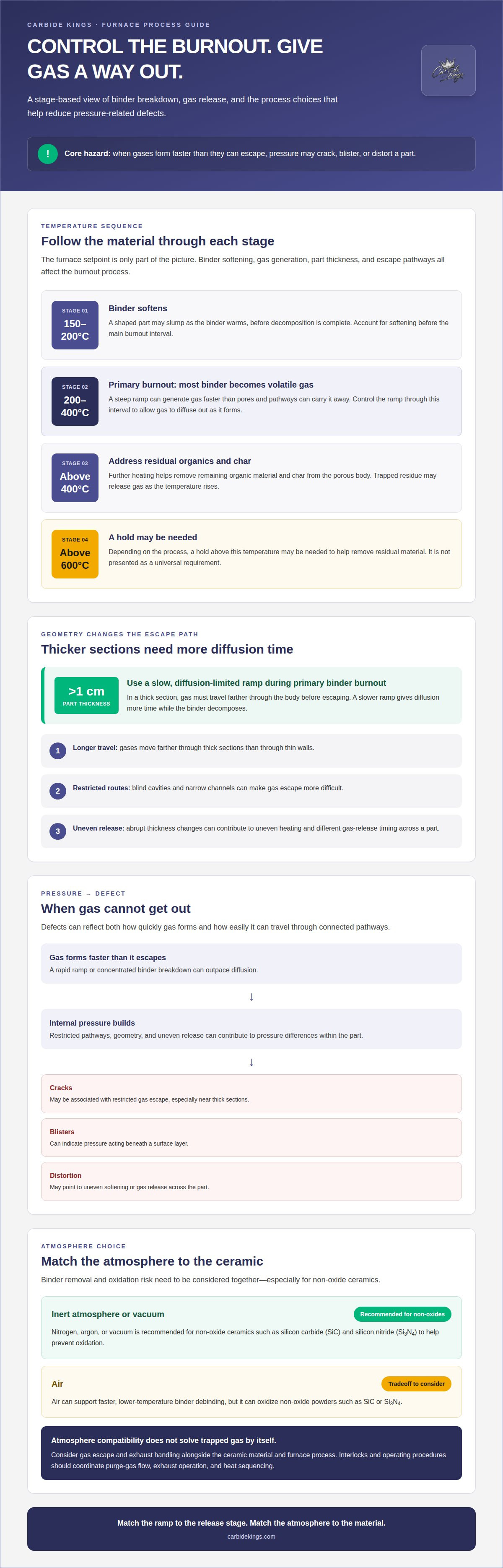
Track the material through thermal stages, not just the furnace setpoint. As the binder warms and softens, a shaped part may slump before decomposition is complete. From 200-400°C, primary burnout decomposes most binder into volatile gases. A steep ramp through this interval can generate gas faster than pores and escape paths can carry it away. Temperature differences across a load can also make its surface and core release binder at different rates.
Part geometry changes how quickly gases can travel out. For ceramic parts thicker than 1 cm, a slow, diffusion-limited heating ramp is advised during primary binder burnout. In a thick section, gases must move farther through the body before escaping. A slower ramp gives that diffusion more time as binder decomposes. The key is to consider thickness alongside the binder’s release stages, rather than applying one ramp blindly to every shape.
Read the furnace profile as a sequence. First, account for softening at 150-200°C. Next, control the ramp through primary burnout at 200-400°C, when most binder becomes volatile gas. Then consider whether the part’s thickness and internal pathways can release that gas at the same pace. This stage-based view helps explain why one heating rate may suit a small section but stress a thicker one.
Applicable OSHA, NFPA, and local requirements depend on the furnace, exhaust arrangement, vapor characteristics, and facility jurisdiction. The relevant provisions address combustible-vapor hazards and furnace exhaust as they apply to the specific process and location.
Inert versus oxidizing binder decomposition
Atmosphere choice affects both binder removal and ceramic powder condition. For non-oxide ceramics such as silicon carbide (SiC) and silicon nitride (Si3N4), an inert atmosphere such as nitrogen, argon, or vacuum is recommended to prevent oxidation. That makes atmosphere part of the burnout plan, not simply a furnace setting. The binder must decompose, while the surrounding conditions must suit the ceramic material.
Air can support faster, lower-temperature binder debinding. That may appear attractive when the process goal is to remove binder promptly. But air can oxidize non-oxide powders such as SiC or Si3N4. The tradeoff is direct: a faster debinding route can expose those materials to an oxidizing environment. Evaluate the powder and the desired atmosphere together, rather than choosing a cycle based on binder removal alone.
Inert processing changes the conditions around volatile products as they leave the part. Nitrogen and argon are examples of inert gases; vacuum is another recommended atmosphere for non-oxide ceramics. The right choice depends on the ceramic and furnace process. Whichever route is selected, consider the atmosphere alongside gas escape and exhaust handling. A compatible atmosphere does not, by itself, resolve trapped gases inside a dense or complex part.
To address ignition risk, furnace interlocks and operating procedures should coordinate purge-gas flow, exhaust operation, and heat sequencing. Nitrogen or argon may provide an inert atmosphere, but the furnace design and approved operating procedure determine how those controls work together.
Compare the two atmosphere options against the material at each stage. With SiC or Si3N4, preventing oxidation is a key reason to use nitrogen, argon, or vacuum. Air may enable faster, lower-temperature debinding, but it carries the stated oxidation risk for those powders. The choice is therefore a balance between binder-removal conditions and protecting the non-oxide ceramic. Keep that distinction clear when assessing volatile binder evaporation hazards during secondary carbide furnace heating.
Internal pressure and defect risks
Binder gases need connected pathways to escape a compact. If gas forms faster than it can leave, pressure can build inside the body. That stress may open cracks, lift surface layers, or cause blisters. Uneven pressure across a part’s walls can also cause distortion. These defects reflect both gas formation and the available release pathways.
Binder type affects both the gases released and the temperature profile at which they form. A rapidly decomposing binder can create a concentrated release, while a slower profile spreads gas generation over more time. Loading matters as well: a larger load can release more vapor into the furnace system, and closely arranged parts may restrict circulation around their surfaces.
Geometry determines the distance gases must travel to escape. They move farther through a thick section than through a thin wall. Blind cavities and narrow channels can restrict their path, while abrupt changes in section thickness can lead to uneven heating and gas release. For example, a dense central region may retain gas after a thinner edge has become more open. The resulting pressure difference can increase cracking risk.
If binder vapor leaks, a fire occurs, or furnace pressure becomes abnormal, follow the facility’s emergency response procedure, use shutdown controls only if trained, and clear the hazard area. Notify designated site responders and keep personnel away until the area is declared safe.
Use defect patterns as clues when reviewing the process. Cracks near thick sections can indicate restricted gas escape; blisters suggest pressure acted beneath the surface. Distortion may point to uneven softening or gas release across the part. Compare affected locations with the binder formulation, load arrangement, and compact geometry. This can help distinguish a local pathway problem from a broader furnace-cycle issue. Volatile binder evaporation hazards during secondary carbide furnace heating depend on how these factors combine, not on temperature alone.
Primary burnout and volatile gas generation
Burnout releases binder-derived gases in stages. The temperature window, ceramic type, and exhaust path all shape the process.
Binder Types and Burnout Approaches
Volatile binders are temporary organic materials in carbide powder compacts, removed during furnace heating. Their chemistry affects the gases released, so it matters for selecting compatible burnout conditions. Air burnout can support faster, lower-temperature debinding. For oxide ceramics, air may be considered when compatible with the material; with non-oxide powders such as SiC or Si3N4, air can cause oxidation.
Evaporation and Decomposition Temperatures
Binder softening occurs at 150-200°C, when viscosity drops and a part may slump. Primary burnout occurs at 200-400°C, when most binder decomposes into volatile gases. Above 400°C, trace removal begins as residual organics and char leave the porous body. A hold above 600°C may be needed to remove remaining organics and intermediate char. These stages help distinguish softening from decomposition and cleanup.
Off-Gassing Hazards
Binder off-gassing can create fire or explosion hazards if combustible vapors accumulate and encounter an ignition source. Depending on the binder chemistry and decomposition products, fumes may also pose toxicity concerns. Gas release can displace breathable air in an enclosed space, creating an asphyxiation risk. The specific hazard depends on the binder and process conditions, so treat unexpected vapor release, odor, or pressure changes as process abnormalities.
Ventilation and Exhaust Controls
Furnace exhaust should capture and remove gases released during burnout. Keep exhaust operation coordinated with the approved furnace procedure, and avoid relying on general room ventilation alone to manage process emissions. Monitoring should match the binder’s expected decomposition products; suitable gas instruments can detect combustible or toxic components in the exhaust or surrounding area. Review readings alongside furnace pressure and process behavior. For material needs beyond burnout, explore carbide scrap.
Air can provide faster, lower-temperature binder debinding, but it can oxidize non-oxide ceramic powders such as SiC or Si3N4. This tradeoff makes material compatibility a central consideration when choosing an atmosphere for binder removal. Burnout conditions should account for whether the powder can tolerate exposure to air, rather than treating air as universally suitable.
Carbide Kings: Tungsten Hard Scrap
Carbide Kings supplies Tungsten Hard Scrap for industrial buyers sourcing materials for manufacturing and metallurgical processes. If your production work calls for tungsten or carbide scrap inputs, this is the natural next step after reviewing how furnace heating affects carbide parts. Carbide Kings also offers Tungsten Soft Scrap, Carbide scrap, and Tungsten Alloys, giving buyers material categories suited to different industrial needs.
Turn to Carbide Kings when sourcing tungsten and carbide scrap as manufacturing inputs. Its inventory includes tungsten hard scrap, tungsten soft scrap, carbide scrap, and tungsten alloys. Choose the material category that fits your operation, then contact Carbide Kings to discuss your sourcing needs.
Turn Process Findings Into Your Next Move
Use each furnace run to improve how your team reviews materials, load arrangement, and process behavior. A recurring defect can prompt a focused review of where gas release or heat distribution may be affecting the part. Treating volatile binder evaporation hazards during secondary carbide furnace heating as a process-control concern keeps attention on prevention and practical learning, not just inspection after a defect appears.
When your next step is sourcing industrial scrap materials, Carbide Kings offers a relevant path for manufacturing and metallurgical needs. Choose the material category that fits your operation and discuss your requirements directly. Explore your material options with Carbide Kings, and move forward with a clearer plan for your production needs.
Frequently Asked Questions
What gases and vapors are released during binder evaporation in carbide furnaces?
Binder breakdown releases volatile gases and organic vapors, and the mixture depends on binder formulation and heating conditions. Because binder composition determines which decomposition products form, no single gas list applies to every carbide compact. For a specific process, use the binder’s safety and technical information to identify expected products, then match exhaust monitoring to those substances rather than relying on odor.
What heating rates and hold times reduce hazards during binder removal?
Use a slow, diffusion-limited ramp during primary burnout for ceramic parts thicker than 1 cm, allowing gases time to escape. Primary burnout occurs at 200-400°C; above 400°C, trace removal begins. A high-temperature hold above 600°C may be needed to remove residual organics and intermediate char. Choose the cycle around binder behavior, part thickness, and gas-release pathways.
What volatile binders are used in carbide powder compacts before secondary furnace heating?
Binders are temporary organic materials in carbide powder compacts that are removed during furnace heating. Their chemistry affects which gases are released.


