

A small grab sample can misrepresent a non-homogeneous drum of secondary tungsten scrap and shift the assay away from the lot’s true composition. Secondary tungsten scrap sampling bias in non-homogeneous drum shipments depends on how material is distributed and how much is sampled: fundamental sampling error increases with the cube of fragment diameter and decreases as sample mass increases. A larger sample can reduce error, but it must also capture the drum’s different material fractions.
It’s easy to treat an assay result as a precise description of a shipment. But when dense pieces, fines, or different scrap types are unevenly distributed, the result may reflect only what happened to be in the sample, not the whole lot.
This article explains how drum heterogeneity creates bias, why sample mass and fragment size matter, and how unreliable results can affect material qualification and settlement. It distinguishes a biased sample from ordinary sampling variability and explains why a representative sample is essential to making an assay useful for a commercial decision.
Key Takeaways
- Keep scrap fractions identifiable and protected from cross-contamination so collection and qualification decisions reflect the material being handled.
- Distinguish a consistently skewed assay from ordinary sample-to-sample variation; each can affect how a lot is evaluated.
- Trace how an assay difference can carry through to material acceptance and shipment settlement before relying on a single result.
- Assess sample mass alongside fragment size when judging whether a result represents coarse or mixed scrap.
Critical-mineral scrap collection, recovery, and product qualification
In the United States, recycling supplied the only domestic tungsten supply in 2025. Tungsten also appears on the 2025 U.S. List of Critical Minerals, making reliable scrap qualification relevant to processing and production.
Sampling Standards and Local Rules
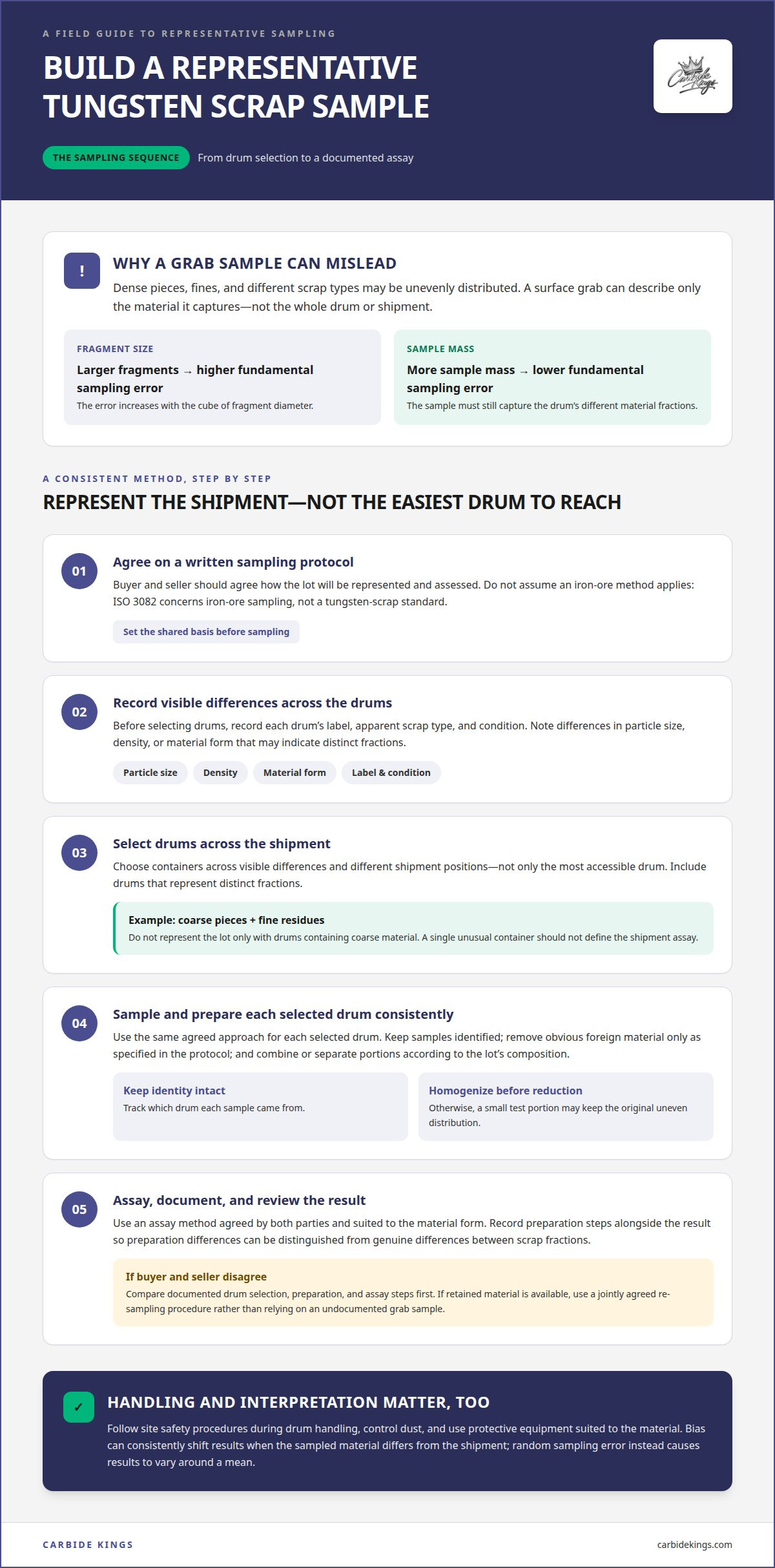
For tungsten scrap, use a written sampling protocol agreed by buyer and seller, rather than assuming an iron-ore method applies. ISO 3082 concerns iron-ore sampling, so it should not be treated as a tungsten-scrap standard. A clear protocol matters because both parties need to know how the lot will be represented and assessed.
State and local handling requirements can vary by location and material condition. Identify the requirements that apply to the shipment’s storage, movement, and handling, then document the agreed process. This gives both parties a consistent basis for managing the drums and discussing results. Facilities handling heavy drums and container shipments at scale can also look to packaging automation specialists such as Phoenix Handling Solutions Limited for palletising, de-palletising, and secure wrapping equipment.
Selecting Drums for Representative Samples
Representative drum selection means choosing containers across the shipment’s visible differences, rather than sampling only the easiest drum to reach. Before selection, record each drum’s label, apparent scrap type, and condition. Include drums that differ in particle size, density, or material form, since those differences may indicate distinct fractions.
For example, a lot containing coarse pieces and fine residues should not be represented only by drums containing coarse material. Select drums from different positions in the shipment, then sample each selected drum using the same agreed approach. This reduces the chance that one unusual container defines the assay for the whole lot.
Sample Preparation and Assay Methods
Sample preparation turns collected increments into material suitable for analysis. Keep each drum’s sample identified, remove obvious foreign material only as specified in the agreed protocol, and combine or separate portions according to the lot’s composition. Homogenize the prepared material before reducing it for assay. Otherwise, a small test portion may retain the original drum’s uneven distribution.
Determine tungsten content using an assay method agreed by both parties and suited to the material form. Record the preparation steps alongside the assay result. This helps distinguish differences caused by preparation from genuine differences between scrap fractions.
During drum handling, follow site safety procedures, control dust, and use protective equipment suited to the material. If buyer and seller disagree, first compare the documented drum selection, preparation, and assay steps. Then use a jointly agreed re-sampling procedure on retained material, if available, rather than relying on an undocumented grab sample.
Effects of bias on assay means and variability
Bias consistently shifts results when the sampled material differs from the shipment’s actual composition. Random sampling error, by contrast, causes results to vary around a mean.
Bias from Top-Layer Sampling
Top-layer sampling measures accessible material, not necessarily the whole drum. If coarse pieces settle below fines, a surface grab can overrepresent the fines and miss the composition of the lower layer.
This matters because the assay may then describe the sampled fraction rather than the shipment. For example, if manganese-bearing material is unevenly distributed, sampling only one layer could misstate its share. The direction of the error depends on which materials the selected layer contains.
Effects on Assay Means
Sampling bias moves the assay mean upward or downward when the collected material consistently overrepresents a fraction. An iron-ore illustration shows the potential scale: a 0.9x multiplicative bias combined with 10% sampling error reduced mean iron grade by 10.16%.
A multiplicative bias can shift the mean assay result, with the direction depending on which material the sample overrepresents. These are iron-ore examples, not tungsten assay predictions. For tungsten scrap, the economic effect likewise depends on which material enters the sample and how the assay result informs qualification or settlement.
Effects on Assay Variability
Bias can affect consistency as well as the average. In the iron-ore example, combining 10% sampling error with a 1.1x multiplicative bias increased assay standard deviation by 19.81%. This illustrates how a shifted sampling process can widen the spread of reported results.
For a tungsten drum, compare repeat results with the sampling locations and preparation records. If samples come from different fractions, the spread may reflect drum heterogeneity, not simply assay performance. An international buyer and seller can use a shared protocol to identify this pattern. Re-sampling is useful when the original selection or preparation cannot explain a disputed result.
Financial consequences of inaccurate sampling
An inaccurate assay can change how a shipment is classified, valued, or accepted. The financial effect begins with the measured composition: if the sample overstates tungsten-bearing material, buyer and seller may base settlement on a grade the full lot does not contain. An understated result can produce the opposite outcome. For a drum containing mixed fractions, document how the assay relates to qualification and payment terms.
A published iron-ore example illustrates how sampling error can translate into a difference in shipment value. That example concerns iron ore, not tungsten scrap, but it shows why sampling quality matters in large lots. The financial effect depends on the material’s agreed valuation method and how assay results inform the transaction.
For tungsten scrap, an assay can also affect whether material is accepted as one lot or separated into different grades or fractions. For example, a sample containing more cobalt-bearing material than the drum average may not represent the full shipment’s composition. This can lead to disputes over the assay basis, reprocessing decisions, or settlement adjustments. The key is not simply the assay number, but how well the sample represents the material being traded.
Keep the commercial record tied to the sampling record. Match each reported result to the drum selection, sample preparation, and agreed assay method. If the buyer’s and seller’s results differ, compare those steps before changing the settlement basis. This provides a clear path to resolve disagreements and helps prevent an isolated sample from driving a decision about an entire shipment.
Mining and processing operations rely on dependable feedstock decisions, while procurement teams must manage qualification and settlement together. A documented sampling procedure gives both sides a shared reference point. It cannot eliminate every source of variation, but it can help identify whether a difference comes from the material, the sampling approach, or the assay process.
Fundamental sampling error and sample mass
How does nonhomogeneous tungsten scrap create sampling bias? Different particle sizes, compositions, and densities can segregate inside drums, so a small sample may overrepresent one fraction. Secondary tungsten scrap sampling bias in non homogeneous drum shipments is more likely when the sampled portion misses distinct material layers. For heterogeneous shipments, collect increments across selected drums and material positions, then combine and prepare them consistently.
Bias in Heterogeneous Drum Scrap
Fundamental sampling error arises when selected particles fail to represent the lot’s composition. Gy’s relationship shows that error increases with the cube of fragment diameter and decreases as sample mass increases.
This matters for scrap containing coarse pieces and fine residues. A few large fragments can dominate a small sample, while fines may collect elsewhere. Increasing sample mass helps, but cannot correct a selection that consistently misses a distinct fraction. To control secondary tungsten scrap sampling bias in non homogeneous drum shipments, keep unlike material types identifiable until their composition is understood.
Methods for Heterogeneous Shipments
For heterogeneous shipments, use a structured increment approach: select drums across the lot, collect portions from different positions, and include each visible material fraction. Combine increments only when they represent the same defined lot. This gives the composite sample a stronger basis than a single grab from an accessible point.
Next, homogenize the composite before reducing it to the assay portion. Record which drums and fractions contributed, along with the preparation method. If a fraction is too distinct to be represented reliably in a composite, sample and assess it separately. This connects the reported result to the shipment’s actual makeup.
Sample mass should reflect particle size and heterogeneity. Larger fragments require more material to capture the lot’s variation. This matters when export, supply, or settlement decisions depend on the result. Do not automatically transfer a copper sampling example to tungsten, since material properties and lot composition differ. Government or industry procedures for another commodity may offer general context, but do not replace a protocol suited to tungsten-bearing material.
For a practical next step, discuss your tungsten scrap material needs alongside the lot’s composition and qualification requirements.
Carbide Kings: Tungsten Hard Scrap
Carbide Kings supplies tungsten and carbide scrap materials for industrial use. If your sourcing decision depends on separating material types, its offerings include Tungsten Hard Scrap, Tungsten Soft Scrap, Carbide scrap, and Tungsten Alloys.
Use your sampling and assay records to define the material category you need, then match that requirement to the relevant scrap type. Clear qualification information helps align procurement decisions with your production needs. Carbide Kings supplies these materials. Turn to the company when sourcing scrap, rather than seeking drum-sampling or on-site assay services.
Contact Carbide Kings to discuss your material needs, or visit carbidekings.com.
Make the Next Shipment Easier to Qualify
Turn the lessons from secondary tungsten scrap sampling bias in non-homogeneous drum shipments into a repeatable receiving standard. Define how each lot will be identified, sampled, and assessed before it reaches the qualification stage. A consistent record gives your team a clearer basis for comparing shipments and making procurement decisions.
Then connect that standard to your material requirements. Clear expectations about the scrap category and intended industrial use help keep sourcing discussions focused, without confusing material qualification with assay work. Carbide Kings supplies tungsten and carbide scrap materials for industrial needs.
When you’re ready to discuss your sourcing requirements, contact Carbide Kings. Take the next step with a clear view of the material your operation needs and the records that support its qualification.
Frequently Asked Questions
How many increments and samples should be taken from a tungsten scrap drum lot?
There’s no single increment count that suits every drum lot. Set the number in the sampling protocol based on lot size, visible variation, particle size, and the precision needed for the decision. For example, drums from different production batches may need separate assessment rather than one combined result. Define the plan before sampling so both parties use the same basis.
How do sampling bias and assay uncertainty affect tungsten scrap pricing and settlement?
Bias can systematically push a reported grade away from the lot’s actual composition, while assay uncertainty affects how confidently that result supports a settlement. The distinction matters most when the result is near a material qualification threshold. Agree on the basis in advance: specify the accepted assay result, how a disputed result will be reviewed, and whether a referee analysis can determine the final grade.


