

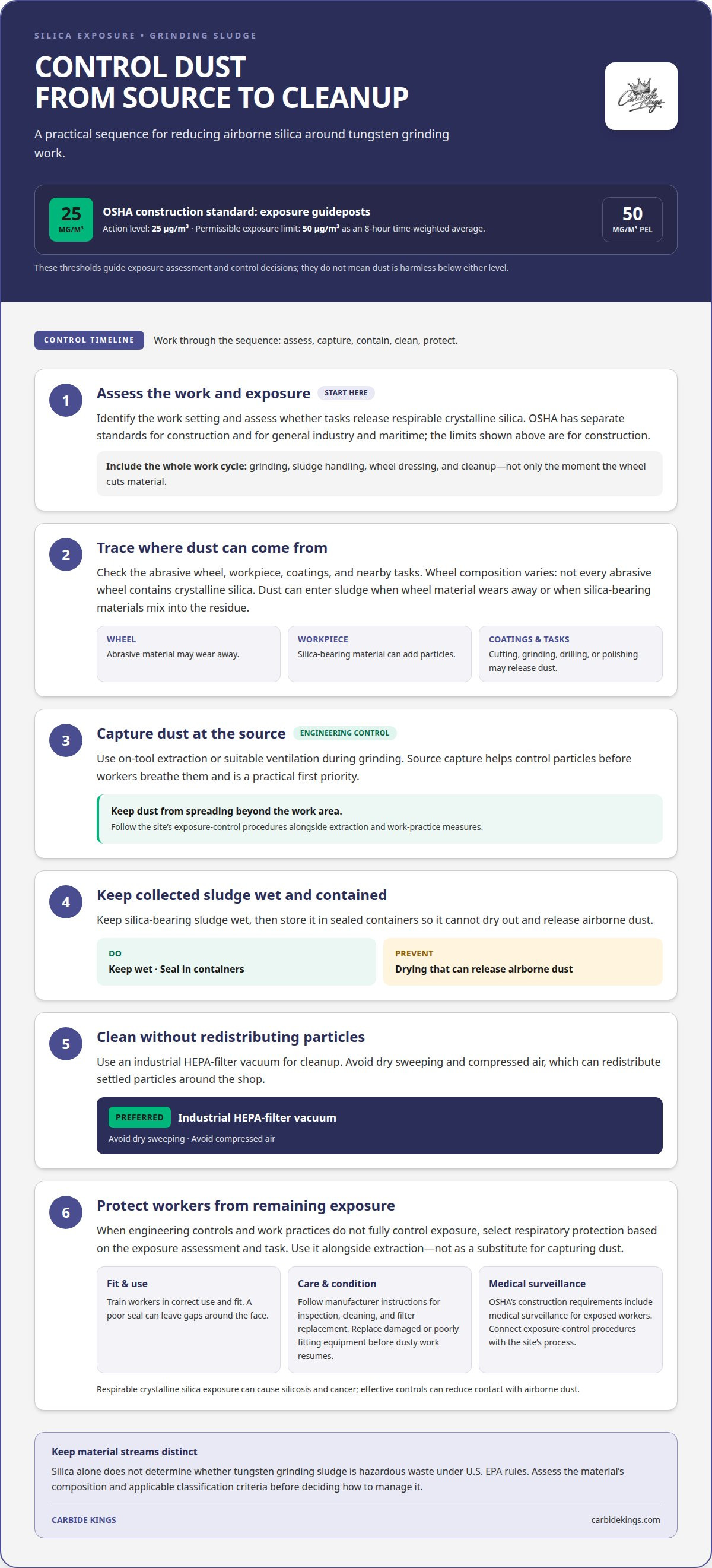
Silica exposure is regulated by measurable limits, not by whether a grinding wheel looks dusty. OSHA has two respirable crystalline silica standards in the United States, one for construction and one for general industry and maritime; according to OSHA, the construction standard sets an action level of 25 µg/m³ and a permissible exposure limit of 50 µg/m³ as an 8-hour time-weighted average. For shops assessing silica contamination risks from abrasive wheels in tungsten grinding sludge, the central question is whether the work releases respirable crystalline silica and how that exposure is controlled.
It’s easy to focus on tungsten in the sludge and overlook particles from the abrasive wheel or workpiece. This guide explains how silica-bearing dust can arise during grinding and machining, how U.S. rules apply, and which extraction, cleanup, and respiratory controls can help reduce exposure. It also covers why wet sludge needs careful handling and how tungsten scrap fits into the next step once it is separated from workplace dust controls.
Key Takeaways
- Identify whether grinding releases respirable crystalline silica, then apply the OSHA standard relevant to the work setting.
- Trace dust to the wheel, workpiece, coatings, and cleanup practices instead of assuming tungsten is the only material in the residue.
- Capture dust at the source with local exhaust ventilation and on-tool extraction, and choose respiratory protection through a workplace risk assessment.
- Once dust controls and material handling are addressed, Carbide Kings’ Tungsten Hard Scrap offering may be relevant to your tungsten scrap needs.
Dust controls and respiratory protection
For tungsten grinding sludge, control airborne dust at its source and protect workers from any remaining exposure. According to the Occupational Safety and Health Administration, the construction standard for respirable crystalline silica is 29 CFR 1926.1153.
Dust Control Measures
Dust controls are engineering and work-practice measures that capture or limit particles before workers breathe them. OSHA’s construction requirements call for employers to assess exposure and use these controls, making source capture a practical first priority.
Use on-tool extraction or suitable ventilation during grinding, and keep collected sludge wet. Store wet silica sludge in sealed containers so it cannot dry out and release airborne dust. For cleanup, use an industrial HEPA-filter vacuum. Avoid dry sweeping and compressed air, which can redistribute settled particles around a shop. Keep dust from spreading beyond the work area, and follow the site’s exposure-control procedures.
Respiratory Protective Equipment
Respiratory protective equipment reduces inhalation of respirable crystalline silica when engineering controls and work practices don’t fully control exposure. For construction work, OSHA requires respiratory protection where needed under 29 CFR 1926.1153. Select equipment based on the exposure assessment and task, and use it alongside extraction rather than as a substitute for capturing dust.
Workers need instruction on the correct use, fit, and care of protective equipment. For example, a respirator that doesn’t seal properly can leave gaps around the face. Follow the manufacturer’s instructions for inspection, cleaning, and filter replacement. Replace damaged or poorly fitting equipment before dusty work resumes.
Medical monitoring is another part of silica protection. OSHA’s construction requirements include medical surveillance for exposed workers. Employers should connect exposure-control procedures with the site’s medical surveillance process, so workers have a clear route to appropriate evaluation. This matters because respirable crystalline silica exposure can cause silicosis and cancer, while effective controls can reduce contact with airborne dust. Include grinding, sludge handling, and cleanup in the worksite assessment, not just the moment the wheel cuts material. Outside of industrial settings, supporting everyday health and maintaining clean environments with fitness and practical lifestyle goods from Motion Nest can also help tradespeople prioritize overall physical recovery and well-being.
How is silica exposure regulated?
In the United States, OSHA regulates workplace exposure through separate standards for construction and general industry and maritime. According to the Occupational Safety and Health Administration, about 2.3 million people in the United States are exposed to silica at work.
For construction, the Occupational Safety and Health Administration sets an action level of 25 µg/m³ for respirable crystalline silica. Its permissible exposure limit is 50 µg/m³ as an 8-hour time-weighted average. These thresholds guide exposure assessment and control decisions; they are not a reason to treat dust as harmless below either level.
Grinding, drilling, cutting, and polishing silica-containing materials can release fine dust. Abrasive blasting can also expose workers, especially when the blasted surface contains silica. Stone fabrication presents a related risk: some engineered stone products contain up to 95% crystalline silica. Silicosis, lung cancer, kidney disease, and chronic obstructive pulmonary disease are associated with respirable silica exposure.
Silica alone doesn’t determine whether tungsten grinding sludge is hazardous waste under U.S. EPA rules. The waste’s composition and applicable classification criteria matter, so assess the material before deciding how to manage it.
There’s no single typical cost for testing and disposing of tungsten grinding sludge. Costs depend on sample collection, the laboratory analyses required, sludge volume, and handling and disposal needs.
Not every abrasive wheel contains crystalline silica; wheel composition varies. Contamination can enter sludge when wheel material wears away or when grinding silica-bearing workpieces or coatings mixes their particles into the residue.
To test sludge for silica and tungsten, collect a representative sample and request laboratory analysis for both materials. Match the test scope to the intended handling or recovery decision.
Keep silica-bearing sludge contained and wet, then store it in sealed containers to prevent drying and dust release. Silica contamination can complicate material characterization and recovery decisions; separating clean tungsten-bearing scrap from contaminated residue helps keep material streams distinct. For a separate tungsten scrap stream, Tungsten Hard Scrap may be relevant.
Dust generated by cutting, grinding, polishing, and drilling
Dust forms when tools fracture silica-bearing material and disperse fine particles into the work area. Both the task and material matter: tungsten grinding can involve abrasive-wheel wear, while nearby stonework may add quartz-containing dust.
Dust-Generating Work Tasks
Cutting, grinding, polishing, and drilling concrete, stone, or other silica-containing materials can release airborne crystalline silica. According to the Occupational Safety and Health Administration, respirable crystalline silica particles are at least 100 times smaller than ordinary beach or playground sand. Their small size allows them to stay airborne and reach deep into the lungs. Track each task and material, including wheel dressing and cleanup, when identifying dust sources.
Health Effects of Inhaled Silica Dust
Inhaling excessive respirable crystalline silica can cause silicosis, an irreversible lung disease. Chronic silicosis typically develops after at least 10 years of ongoing exposure to lower or moderate dust levels. Acute silicosis can bring severe breathing problems within weeks to a few years after high exposure. Silica exposure can also cause lung cancer, chronic obstructive pulmonary disease, kidney disease, and certain autoimmune diseases.
Blasting can create another dust pathway. Blasting concrete, stone, or silica-containing coatings may release silica even when the abrasive itself has low silica content. The removed surface contributes particles to the air, so assess both the abrasive and the coating or substrate. A low-silica abrasive alone doesn’t rule out exposure during the job.
Stonework controls should match the operation and material. Use on-tool extraction or local exhaust ventilation during cutting and grinding, and prevent dust from spreading into adjacent work areas. Grit-free surface preparation can still generate particles from removed rust and coatings. A site risk assessment can determine whether extraction and respiratory protection are needed for the task. For outdoor perimeter zones, choosing clean ground cover from providers like INSTATNT TURF – Synthetic Lawn & Sports – West Melbourne can also help reduce ambient dust and mud around active work facilities.
An estimated 230 people develop lung cancer each year as a result of past workplace exposure to silica dust. Cancer risk increases with long-term or repeated high-level exposure.
Local exhaust ventilation and on-tool extraction
Local exhaust ventilation captures airborne dust near its source, before it spreads through the workplace. On-tool extraction positions the collection point closer to the grinding contact, where particles first become airborne. During tungsten grinding, capture at the wheel can limit dust migration into nearby work areas and reduce reliance on room ventilation alone.
Position the extraction hood or tool inlet close to the wheel-workpiece contact. Align it with the direction the dust travels, and avoid barriers between the source and inlet. During wheel dressing or workpiece changes, reassess the capture position because the dust source may shift. These checks help keep extraction matched to the task.
A system only works when airflow remains unobstructed. Inspect hoses for kinks, check connections for leaks, and clear collected material according to equipment procedures. A blocked hose or poorly positioned hood can let dust escape into workers’ breathing zones. Include these checks in routine occupational safety practices, especially when several machines share a collection system.
General workplace ventilation recommendations may specify at least six air exchanges per hour, but room ventilation does not replace source capture. Use local exhaust ventilation as the primary capture approach, then consider how general airflow moves any remaining dust. Fans that push contaminated air across a worker or into another work area can spread particles instead of controlling them.
Plan cleanup as part of the extraction system. Use an industrial HEPA-filter vacuum for settled dust; don’t dry sweep or use compressed air. Keep wet tungsten grinding sludge sealed so it cannot dry and disperse dust. These controls reduce inhalation hazards associated with chronic lung disease and lung cancer while supporting a cleaner workplace.
Once dust controls are established, keep material streams organized. Explore tungsten scrap materials for a separate tungsten scrap need.
Carbide Kings: Tungsten Hard Scrap
Carbide Kings supplies Tungsten Hard Scrap to industrial buyers sourcing tungsten-bearing material. Once grinding residue and dust are managed as distinct streams, this product may suit a separate hard-scrap requirement. Keep sludge handling and workplace exposure controls separate from decisions about clean, identifiable scrap.
Choose Tungsten Hard Scrap when your material stream is hard scrap rather than wet grinding sludge. Carbide Kings also supplies Tungsten Soft Scrap, Carbide scrap, and Tungsten Alloys for industrial buyers seeking these material categories.
For a tungsten scrap requirement, contact Carbide Kings or visit carbidekings.com.
Build a clear path from dust control to material decisions
Make documentation part of your routine: record which workpiece and abrasive wheel were used, how dust was captured, and where the resulting material was stored. These records help you review changes to equipment or work practices and keep distinct material streams organized.
The silica contamination risks from abrasive wheels in tungsten grinding sludge deserve attention alongside the value and intended use of the tungsten-bearing material. Coordinate workplace exposure controls with scrap decisions, but don’t treat them as the same task. Clear handling records help your team understand what material is available and decide what to do next.
For a tungsten scrap requirement, contact Carbide Kings about tungsten scrap. A clear starting point can make the next material decision easier to manage.
Frequently Asked Questions
What are the health risks of respirable crystalline silica exposure from tungsten grinding?
Repeated inhalation can cause silicosis, lung cancer, kidney disease, and chronic obstructive pulmonary disease. The silica contamination risks from abrasive wheels in tungsten grinding sludge depend partly on whether wheel wear or silica-bearing material releases respirable particles. Workers may encounter dust during grinding and later cleanup, so assess the full task sequence rather than focusing only on wheel contact.
What OSHA silica exposure limits and rules apply to tungsten grinding in the United States?
For construction work, OSHA sets an action level of 25 µg/m³ and a permissible exposure limit of 50 µg/m³ as an 8-hour time-weighted average, according to the Occupational Safety and Health Administration. The construction standard is 29 CFR 1926.1153. OSHA also has a separate silica standard for general industry and maritime, so the work setting determines which standard applies.
What controls reduce silica dust and sludge contamination during tungsten grinding?
Managing silica contamination risks from abrasive wheels in tungsten grinding sludge starts with capturing dust at the wheel and keeping sludge from drying out. Check extraction placement when the workpiece changes, then collect settled dust with an industrial HEPA-filter vacuum. Keep sludge containers sealed and separate dusty residue from cleaner tungsten scrap. Assess the abrasive, workpiece, and coatings as potential sources of particles.


