

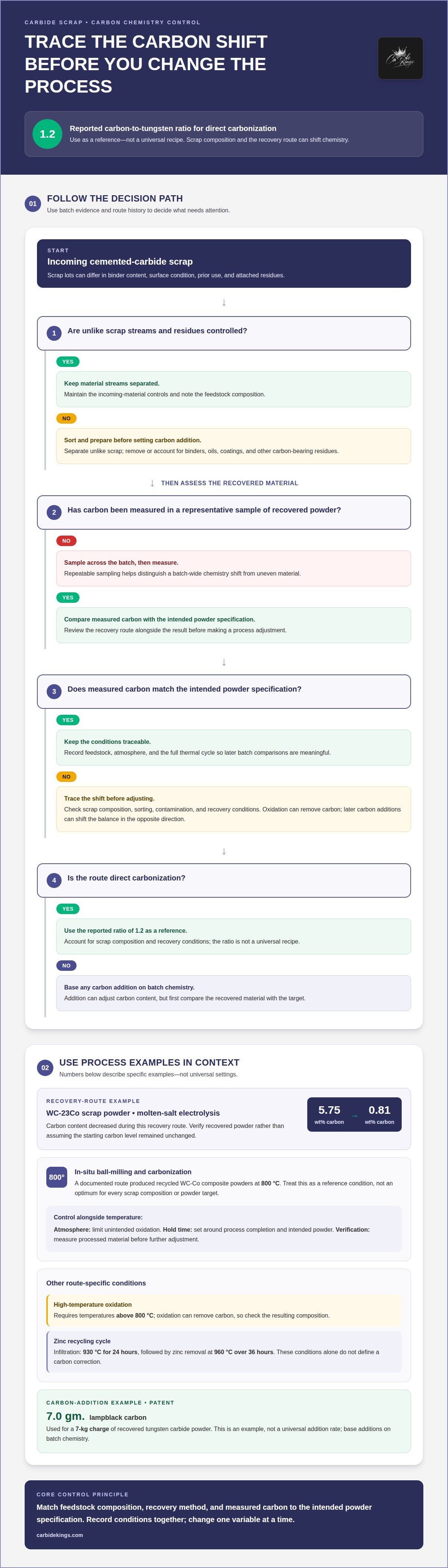
Carbon control starts with the ratio, not the furnace alone. A practical route to preventing carbon chemistry deviations when using cemented carbide scrap feedstock is to manage the carbon-to-tungsten ratio alongside the carbonization conditions. For direct carbonization of recycled scrap, the reported optimized ratio is 1.2.
That ratio is a useful reference, not a universal recipe. Scrap composition and the recovery or carbonization process can shift the chemistry, so assess the ratio alongside the thermal conditions.
This guide explains how carbon-to-tungsten ratios and carbonization temperatures affect chemistry control. It covers where deviations can arise, why feedstock selection matters, and how process examples can inform decisions.
Key Takeaways
- Use the reported carbon-to-tungsten ratio of 1.2 for direct carbonization as a reference, then account for the composition of the recovered scrap.
- Compare carbonization heat choices in context: temperature works alongside feedstock chemistry and the recycling route.
- Trace possible carbon shifts through scrap composition, sorting, and contamination before adjusting the process.
- Match your incoming material to your needs with Carbide Kings’ Tungsten Hard Scrap, Tungsten Soft Scrap, carbide scrap, and tungsten alloys.
Carbon-to-tungsten ratio optimization
For direct carbonization of recycled scrap, the reported optimized carbon-to-tungsten ratio is 1.2. Use it as a reference, then account for the feedstock and recovery route.
Scrap Sorting and Contamination Control
Sorting separates unlike scrap before blending, helping limit chemistry variation between batches. Binders, oils, and coatings can add carbon-bearing residues; remove or account for them before setting the carbon addition. Unlike ratio adjustment, sorting addresses variation at the incoming-material stage. Zinc recycling also has its own cycle: infiltration at 930 °C for 24 hours, followed by zinc removal at 960 °C over 36 hours.
Oxidation and Reduction Controls
Oxidation can remove carbon, while later carbon additions can shift the balance in the opposite direction. High-temperature oxidation of cemented-carbide scrap requires temperatures above 800 °C, so monitor the process route and resulting composition rather than assuming the starting carbon level remains unchanged. Zinc-process conditions alone don’t define a carbon correction. Compare the recovered material’s chemistry before deciding whether further adjustment is needed.
Carbon Measurement and Quality Tests
Use representative sampling across the batch, then measure carbon in the recovered powder before final adjustment. A useful warning comes from WC-23Co scrap powder: its carbon content decreased from 5.75 wt% to 0.81 wt% during molten-salt electrolysis. That result shows why the recovery route matters. Repeatable sampling and measurement distinguish a batch-wide shift from uneven material, unlike sorting, which prevents some variation upstream.
Carbon-Control Tradeoffs and Processing Rules
Direct carbonization provides a ratio reference, while added carbon allows adjustment; both require attention to batch composition. A patent example used 7.0 gm. of lampblack carbon for a 7-kg charge of recovered tungsten carbide powder. More measurement and process control take effort, but help identify deviations before downstream use. In the United States, applicable safety and environmental requirements depend on the process, materials, emissions, and residues; assess those factors for the operation.
| Option | Carbon-control role | Key consideration |
|---|---|---|
| Direct carbonization | Ratio reference | Optimized ratio: 1.2 |
| Carbon addition | Adjusts carbon content | Base addition on batch chemistry |
| Scrap sorting | Limits input variation | Separate material and residues |
| Measurement | Detects process shifts | Sample recovered powder |
Choose a route by matching the feedstock composition, recovery method, and measured carbon content to the intended powder specification.
Carbonization temperature
An in-situ ball-milling and carbonization route produced recycled WC-Co composite powders at 800 °C. Use an atmosphere that limits unintended oxidation, then set hold time around the process endpoint. Treat 800 °C as a documented process condition, not a universal optimum for every scrap composition or powder target.
Temperature affects the material during carbonization, but the furnace setting is only one control. Starting chemistry, particle condition, atmosphere, and time at temperature all influence the result. A schedule that works for one recovered powder may not suit another feedstock. Record these variables together so you can trace carbon shifts to process changes.
Use a controlled sequence instead of adjusting heat by guesswork. First, characterize the incoming material and define the target powder chemistry. Then maintain a consistent atmosphere and record the full thermal cycle, including heating, holding, and cooling. Finally, compare the processed powder with the target. If carbon changes, review the temperature history alongside the feedstock and atmosphere before adjusting the next run.
- Temperature: Use 800 °C as a reference from the in-situ ball-milling example, then assess the material and process objective.
- Atmosphere: Limit uncontrolled oxygen exposure that can alter carbon during heating.
- Hold time: Base duration on process completion and the intended powder, not on an unrelated cycle.
- Verification: Measure the processed material before applying a further chemistry adjustment.
These controls help distinguish temperature effects from changes in atmosphere or feedstock. They also make batch comparisons more meaningful: hold process conditions steady, change one variable at a time, and record the resulting chemistry. This supports preventing carbon chemistry deviations when using cemented carbide scrap feedstock without treating one furnace schedule as a universal recipe.
For teams assessing incoming material for recycling, recycled carbide feedstock is part of the process decision, alongside the selected carbonization conditions.
Use an atmosphere that limits uncontrolled oxygen exposure, treat 800 °C as a reference condition rather than a universal optimum, and set the hold time according to process completion and the intended powder. Verify the resulting chemistry, since the best conditions depend on the feedstock and process objective.
What causes carbon deviations when recycling cemented carbide scrap?
Carbon shifts can begin before processing, because scrap lots differ in binder content, surface condition, and prior use. Cemented carbide mining scrap in one study typically contained 8-12 wt% cobalt, requiring dilution to restore a batch to 6 wt% cobalt. That change affects batch composition, so carbon control must consider the full recovered material, not tungsten carbide alone.
Surface residues create another source of variation. Oils, coatings, and attached material can enter a charge with the carbide and affect its measured chemistry or later processing. Separate material by type, remove residues through the chosen preparation route, and keep unlike scrap streams apart. One electrolysis study acid-cleaned scrap with 2.5 mol/L HCl and alkaline-cleaned it with 5 mol/L NaOH before processing.
Recovery chemistry matters, too. A molten-salt reaction between cemented carbide scrap and sodium nitrate operates at 720 °C and releases 1,830 kJ of heat per kilogram of WC. That heat release makes process control important: local temperature changes can affect reaction conditions and the resulting material. Chromium can also be removed during molten-salt processing because chromium oxide has very low solubility in water, changing the recovered composition.
Electrolysis introduces its own process conditions. WC-23Co scrap was electrolyzed in a Na2WO4 electrolyte at 775 °C. Different cleaning and recovery steps mean that incoming and recovered powders should not be treated as chemically identical. Record scrap category, preparation, and processing route for each batch. Then compare the recovered chemistry with the intended composition before blending or further adjustment.
- Sort scrap streams before combining them.
- Record cleaning and recovery conditions alongside each batch.
- Assess binder and contaminant effects before carbon adjustment.
The acetic acid recycling plant operated at 80°C and atmospheric pressure, with an air flow rate of 120 litres per minute. The acetic acid recycling process was run for 21 days, and the plant maintained the pH below 4 to support cobalt extraction. These operating details form part of the recovery history to retain when comparing batches and assessing their chemistry.
A commercial zinc recycling process has also been used to reclaim cemented carbide scrap into fine powder. Record this route separately so its output can be assessed independently from material recovered through acetic acid processing.
Scrap Sorting, Contamination & Carbide Carbon Balance
Sorting controls which material enters each recycling batch, making it an upstream chemistry control rather than a furnace adjustment. Separate scrap by known grade, binder system, and source before blending. Different carbide compositions can have different carbon and binder balances. Mixing unlike pieces can obscure the starting chemistry and make later corrections harder.
Contaminants pose another challenge. Foreign material can dilute the carbide fraction, while carbon-bearing residues can increase measured carbon. Keep visibly different material separate and remove unwanted residues using the selected preparation route. Label each batch with its source and sorting category. This helps operators trace chemistry shifts to incoming material instead of misattributing them to carbonization.
Sorting also helps guide composition adjustments. Recovered powder may need cobalt or chromium adjustment for its intended application. Chromium removal during molten-salt processing can also change the recovered material’s composition. A sorted stream gives operators a clearer basis for choosing the relevant adjustment rather than applying one correction to mixed feedstock.
Powder quality adds another consideration. Particle-size distribution, shape, and density matter for recovered fine powder and granulated feedstock. Even with consistent chemistry, a batch may behave differently if its physical properties vary. Consider these properties when deciding whether sorted scrap suits a particular process or application. Careful material selection and application-specific process adjustments support high-performance products.
- Keep distinct scrap grades and sources in separate batches.
- Remove foreign residues before blending or chemistry adjustment.
- Track cobalt, chromium, carbon, and powder characteristics together.
- Match each sorted stream to its intended application.
For production teams sourcing material for a controlled recycling stream, source carbide scrap to support consistent feedstock selection.
Carbide Kings: Tungsten Hard Scrap
Carbide Kings can help supply incoming material for your recycling process. Tungsten Hard Scrap may suit operations that use hard scrap as feedstock. Tungsten Soft Scrap, carbide scrap, and Tungsten Alloys offer other material categories to consider based on your requirements.
Match the material category to your process before blending or processing. Keep incoming streams sorted and track their composition through steps that affect carbon balance. This helps you make informed feedstock decisions alongside your carbonization and chemistry controls.
For scrap feedstock options, contact Carbide Kings or visit carbidekings.com.
Make Feedstock Selection Your Next Step
Make your chemistry controls part of a repeatable sourcing routine. Define the material characteristics your process requires, keep incoming streams distinct, and document each batch through preparation and recovery. This gives your team a clearer basis for preventing carbon chemistry deviations when using cemented carbide scrap feedstock and makes future process decisions easier to trace.
Feedstock choice is part of that routine. Carbide Kings offers Tungsten Hard Scrap, Tungsten Soft Scrap, and carbide scrap for industrial material needs. Match the category you source to your intended application and your operation’s controls. A consistent process begins before material reaches the furnace.
Take the next step by discussing your feedstock needs with Carbide Kings. Contact Carbide Kings and move forward with a clearer sourcing plan.
Frequently Asked Questions
What carbon content range is required for recycled WC-Co cemented carbide grades?
There is no single carbon-content range for every recycled WC-Co grade. The target depends on the grade formulation and intended use. Match recovered powder to the specified grade, then assess carbon alongside binder content and final phase condition. A carbon value alone cannot establish suitability. Use the applicable product specification as the acceptance criterion before blending or sintering.


