
The main refractory erosion mechanisms when charging dense tungsten scrap chunks are impact damage and abrasion. A heavy chunk can strike the lining and chip or crack its hot face; sliding and repeated contact can wear the surface further. Temperature differences may also create thermal stress when the charge and lining are at different temperatures.
Focus on how the charge is handled: dense material can deliver a concentrated blow even when individual pieces are relatively small. Impact, abrasion, and temperature-related stress all contribute to lining wear, while chunk shape, charging path, and existing refractory condition affect where damage occurs. Understanding these factors helps identify where erosion starts and what to consider when handling tungsten scrap in a furnace.
Key Takeaways
- Recognize how impact, abrasion, and thermal stress can combine to wear a furnace lining.
- Assess chunk shape, the charging path, and the lining’s condition to understand where damage may begin.
- Use visible wear patterns to distinguish localized impact damage from ongoing surface abrasion.
- Understand how tungsten hard scrap fits into the material choices considered for industrial use.
Refractory erosion mechanisms when charging dense tungsten scrap chunks
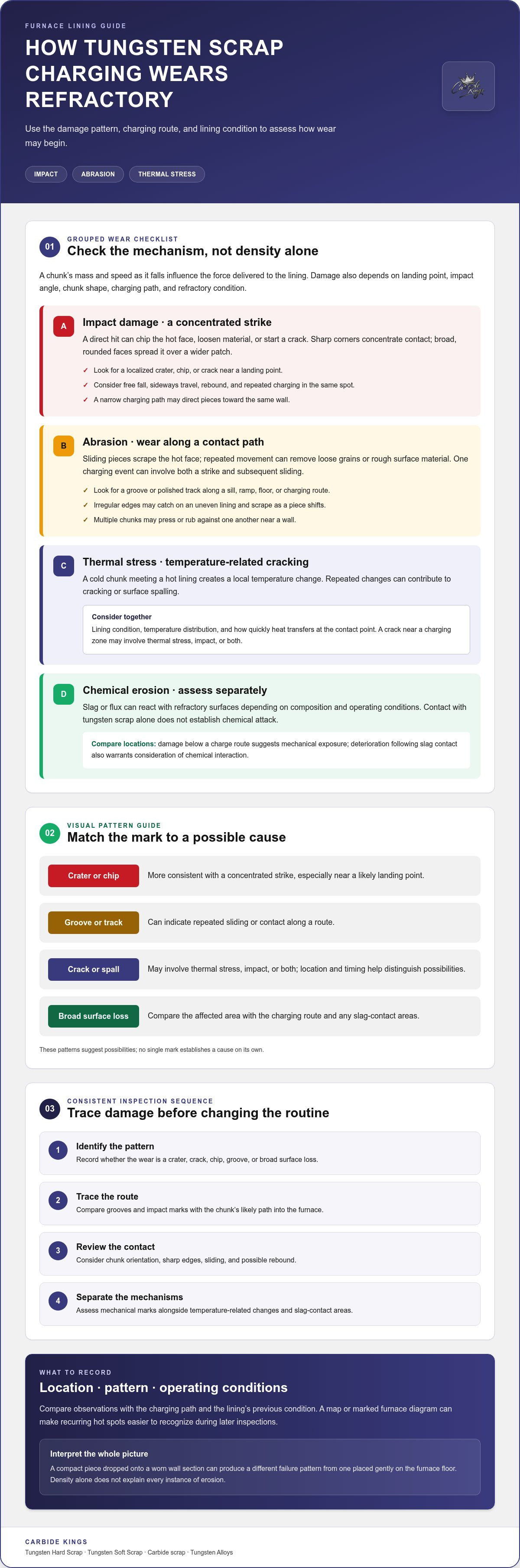
The refractory erosion mechanisms when charging dense tungsten scrap chunks begin with mechanical contact. A chunk’s mass and speed as it falls influence the force delivered to the furnace lining, but density alone does not determine the damage. The landing point, impact angle, chunk shape, and refractory condition also matter. A compact piece dropped onto a worn wall section can cause a different failure pattern from one placed gently on the furnace floor.
Impact damage at the landing point
A direct strike can chip the hot face, loosen material, or start a crack. Sharp corners concentrate contact over a smaller area than broad, rounded faces. For example, a block striking a wall corner may break away a fragment, while a flat face may spread contact across a wider patch. Repeated charging in the same spot can enlarge the damaged area. The initial chip leaves an uneven surface that is more exposed to later impacts and abrasion.
Impact severity increases when a chunk falls freely, travels sideways, or rebounds after hitting the floor. Guided placement reduces uncontrolled motion but cannot eliminate contact risk. Furnace geometry also shapes the outcome: a narrow charging path may direct pieces toward the same wall, while a clear path can help them reach the intended landing zone. Inspect the likely impact area, not just the total charge.
Abrasion from sliding and repeated contact
A chunk can wear refractory without a severe blow. Sliding pieces scrape the hot face, and repeated movement can remove loose grains or rough surface material. Abrasion is more likely along a route where chunks drag across a sill, ramp, or floor before settling. A visible groove or polished track can indicate repeated contact, while an isolated crater is more consistent with a concentrated strike.
Shape and arrangement also matter. Irregular edges can catch on an uneven lining and scrape it as a piece shifts. Multiple chunks can press or rub against one another near a wall. Impact creates a localized force; abrasion removes material along a contact path. Both may occur during one charging event, especially when a piece strikes first and then slides.
Thermal stress and chemical wear
Temperature differences can stress refractory material during charging. A cold chunk meeting a hot lining creates a local temperature change; repeated changes can contribute to cracking or surface spalling. The effect depends on the lining’s condition, temperature distribution, and how quickly heat transfers at the contact point. A crack near a charging zone may therefore involve thermal stress, impact, or both. Location and timing help distinguish these possibilities.
Chemical erosion is a separate process. Slag or flux can react with refractory surfaces, depending on composition and operating conditions. Contact with tungsten scrap alone does not establish that chemical attack is occurring. If wear appears where slag contacts the lining, compare that area with the chunk’s landing path. Damage below a charge route suggests mechanical exposure; deterioration following slag contact also warrants consideration of chemical interaction.
Trace the damage before changing the charge routine
After charging-related wear, use a consistent inspection sequence. Record the damaged location, pattern, and nearby operating conditions, then compare those observations with the charging path and the lining’s previous condition. A map or marked furnace diagram makes recurring hot spots easier to recognize during later inspections.
- Identify the pattern: note whether the wear is a crater, crack, chip, groove, or broad surface loss.
- Trace the route: compare grooves and impact marks with the chunk’s likely path into the furnace.
- Review the contact: consider chunk orientation, sharp edges, sliding, and possible rebound.
- Separate mechanisms: assess mechanical marks alongside thermal changes and slag-contact areas.
These checks help connect damage to a plausible mechanism instead of treating every worn patch alike. A crater near a landing point, a groove along a ramp, and cracking around a hot-face defect suggest different causes. Charging records and repeat inspections can show whether the same route repeatedly exposes one area. This evidence supports a focused review of placement and lining condition without assuming density alone explains the erosion.
Carbide Kings: Tungsten Hard Scrap
Carbide Kings supplies Tungsten Hard Scrap for industrial users seeking tungsten-bearing material. It may suit operations that use hard scrap as a raw material in manufacturing or metallurgical processes. Refractory wear depends on charging conditions and lining contact, while sourcing scrap is a separate decision. Choose material that fits your process needs.
Carbide Kings also supplies Tungsten Soft Scrap, Carbide scrap, and Tungsten Alloys. Consider which material category aligns with your application. For Tungsten Hard Scrap, contact Carbide Kings to discuss your needs.
Turn Wear Observations Into Better Decisions
Use each lining inspection to inform the next operating review. A consistent record of wear locations and charging conditions can help your team spot recurring patterns, prioritize maintenance discussions, and make better-informed process decisions. Assign responsibility for documenting observations and sharing them with the people who review furnace operation.
Understanding refractory erosion mechanisms when charging dense tungsten scrap chunks also helps separate equipment concerns from material-sourcing decisions. If your operation is evaluating tungsten scrap, Carbide Kings supplies Tungsten Hard Scrap, Tungsten Soft Scrap, and Carbide scrap. Match the material category to your operational needs, then contact Carbide Kings to discuss sourcing.
Contact Carbide Kings to discuss tungsten scrap. A clear conversation can help move your sourcing plans forward.


