

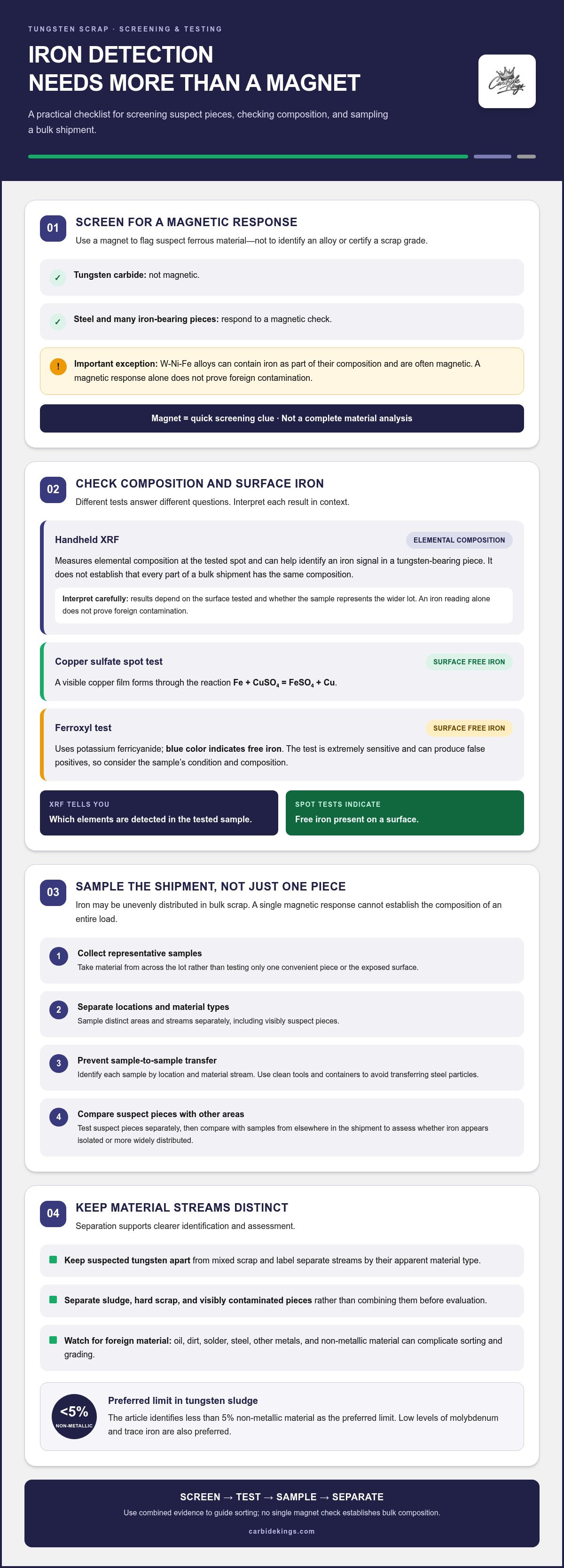
A magnet can flag ferrous material in a tungsten shipment, but it cannot identify every alloy or confirm a scrap grade. Reliable unalloyed iron contamination detection in bulk tungsten scrap shipments combines magnetic screening with composition analysis: tungsten carbide is not magnetic, while W-Ni-Fe alloys are often magnetic.
Treat steel, iron, and other foreign material as more than a visual nuisance. Contaminants can complicate testing, sorting, and grading, while oil, dirt, solder, and other metals can affect how a lot is evaluated.
This guide explains how magnetic checks can help identify suspect material, where they can mislead, and how XRF analysis can help assess composition. You’ll also learn why keeping tungsten scrap separate from steel and other materials supports clearer grading, and how iron and other contaminants can affect the next step in evaluating a shipment.
Key Takeaways
- Keep tungsten scrap clean and separated; foreign material can complicate grading and reduce its value.
- Use magnetic screening to flag suspect ferrous pieces, but don’t treat it as proof of material composition.
- Learn how composition testing can help distinguish tungsten-bearing material from mixed or contaminated scrap.
- Recognize common iron and non-metal contaminants so you can spot issues before they affect shipment evaluation.
Cleanliness and contamination effects on scrap grading
Cleanliness affects whether a tungsten lot can be assessed as a consistent material stream. Oil, dirt, solder, steel, and other metals add foreign matter that can complicate sorting and reduce scrap value. In tungsten sludge, less than 5% non-metallic material is the preferred limit. Low levels of molybdenum and trace iron are also preferred, so contamination can matter even when it isn’t obvious by sight.
Grading depends on the shipment’s full contents, not just its tungsten-bearing pieces. A clean, separated lot is easier to characterize than material mixed with unrelated metals or debris. Keep sludge, hard scrap, and visibly contaminated pieces apart, for example. This helps prevent a small amount of foreign material from complicating the assessment of a larger batch.
Radioactive contamination is a different and more serious concern than ordinary dirt or iron. The incident shows why suspect material must be treated as a safety issue, not simply a grading problem. Radiation monitors at scrap yards and metal-processing facilities can miss sources shielded by scrap or their casings.
Chemical cleaning and electropolishing have specific roles, but they aren’t shortcuts for sorting bulk scrap. ASTM A380 solution D for stainless-steel pickling uses 6-25% nitric acid and ½-8% hydrofluoric acid in water. Its stated operating range is 70-140 F (21-60 C) for about 30 minutes. This is a stainless-steel treatment reference, not a general tungsten-scrap cleaning recipe. Electropolishing treats a metal surface electrochemically; it doesn’t separate mixed materials within a shipment.
For recycling, identify and isolate visible contaminants before combining or processing a lot. Abrasive blasting alone does not remove free-iron residue from stainless-steel surfaces. Surface cleaning addresses residue on a part; sorting addresses mixed materials. Keeping these tasks distinct supports meaningful grading and helps preserve the identity of clean tungsten scrap.
Keeping tungsten scrap separated from steel and other materials
Separating materials makes each stream easier to identify and assess. Density can flag suspect pieces, but composition testing is needed to confirm what they contain.
Density and Material Identification
Density is a material’s mass relative to its volume, and it offers a useful clue when comparing tungsten-bearing scrap with steel. Tungsten carbide has a density of approximately 15.63 g/cm³ and is described as 1.5-2 times heavier than steel. A piece that feels unusually heavy for its size may deserve closer inspection. Treat weight as a screening clue, not proof of composition, especially when scrap includes attached material or mixed pieces.
Material Identification Concerns
Material identification means determining which metals and non-metallic substances are present in a shipment. This matters because steel, solder, oil, dirt, and other materials can complicate sorting and grading. Keep suspected tungsten pieces apart from mixed scrap, and label separate streams by their apparent material type.
For U.S. shipments, shipping and import requirements depend on the cargo’s actual composition, origin, destination, and transport mode. Hazardous-material handling depends on the material’s classification, not simply on its being scrap. Assay costs and turnaround depend on sample preparation, analytical method, and lab workflow; price depends on the case and is given after a quote request.
Handheld XRF for Iron Detection
Handheld XRF measures elemental composition at the tested spot, so it can help identify an iron signal in a tungsten-bearing piece. It cannot establish that every part of a bulk shipment has the same composition. Results depend on the surface tested and whether the sample represents the wider lot.
Interpret the iron result alongside alloy identification: W-Ni-Fe alloys can contain iron as part of their composition, so an iron reading alone doesn’t prove foreign contamination. Use XRF to guide sorting, then keep distinct material streams separate for evaluation. If you’re reviewing tungsten hard scrap, preserving its separation from mixed metals helps maintain a clearer material identity.
Magnetic identification of ferrous contamination
A magnet is a quick screening tool, not a complete material analysis. Tungsten carbide is not magnetic, while steel and many iron-bearing pieces respond to a magnetic check.
Laboratory Tests for Iron
Laboratory testing can identify iron by measuring composition or detecting free iron on a surface. XRF assesses a sample’s elemental composition and can help distinguish iron-bearing material from tungsten-rich scrap. It can support grading decisions when visual inspection or magnetic screening leaves uncertainty.
Spot tests can target free iron on a surface. Copper sulfate produces a visible copper film through the reaction Fe + CuSO4 = FeSO4 + Cu. A ferroxyl test uses potassium ferricyanide, and blue color indicates free iron. Ferroxyl testing is extremely sensitive and can produce false positives, so interpret its result alongside the sample’s condition and composition. These tests provide different information: XRF assesses elements, while spot tests indicate surface free iron.
Sampling Bulk Shipments
Representative shipment sampling means collecting material from across the lot, rather than testing one convenient piece. This matters because iron may be unevenly distributed in bulk scrap. Sample distinct areas and material types separately, including visibly suspect pieces, instead of relying only on the exposed surface.
Identify each sample by location and material stream. Use clean tools and containers to avoid transferring steel particles between samples. Test suspect pieces separately from the main lot, then compare results with samples from other areas. This can show whether iron is isolated or appears throughout the shipment. A single magnetic response cannot establish the composition of an entire load.
For an informed grading decision, pair representative sampling with composition analysis. Record which pieces attract a magnet, but do not treat that response as a measure of iron content. W-Ni-Fe tungsten alloys are often magnetic, so magnetic attraction alone cannot distinguish an alloy constituent from foreign steel. Set magnetic pieces aside for closer identification, then use test results to guide sorting and lot evaluation.
Iron and other contaminants in tungsten scrap
Iron contamination matters because its form can affect how a tungsten-bearing lot is identified and processed. Distinguish foreign iron from iron that is part of a tungsten alloy before interpreting test results. For unalloyed iron contamination detection in bulk tungsten scrap shipments, that distinction is essential to accurate classification.
Iron Impurity Limits
Iron impurity limits are grade-specific criteria for assessing a scrap lot. A single iron reading can mean different things in different material streams.
There is no universal iron limit for every tungsten scrap grade or buyer. Assessment depends on the declared material, its intended processing, and the buyer’s grading criteria. Keep alloy pieces separate from suspected steel contamination so test results are not treated as interchangeable.
For example, W-Ni-Fe tungsten alloys typically contain 88-98% tungsten, 2-8% nickel, and up to 3% iron. Iron in this alloy is part of its composition, not automatically foreign contamination. Compare composition results with the material’s identity, then record which pieces appear to be alloy and which may contain unrelated iron or steel.
Iron Contamination Risks in Processing
Iron contamination can lead to misclassification, extra sorting, and a less consistent recycling feed. A steel fragment mixed into tungsten carbide, for example, can make the lot’s composition harder to assess and affect its grading.
Other contaminants create different issues. Oil and dirt add non-metallic material, while solder introduces another metal. Keep these materials separate from tungsten scrap rather than assuming one cleaning or sorting step will resolve every issue. The appropriate response depends on whether contamination is attached to a piece or mixed throughout the lot.
A reliable approach to unalloyed iron contamination detection in bulk tungsten scrap shipments combines material identification with careful lot segregation. This helps prevent alloy iron from being confused with foreign steel and keeps each lot’s identity clear. For a next step with separated tungsten materials, review tungsten scrap options.
Carbide Kings: Tungsten Hard Scrap
Carbide Kings is a natural next step when you’re sourcing tungsten hard scrap for industrial use. Clear separation and material identification help you distinguish the scrap stream you have from mixed or suspect material before selecting the right category.
Carbide Kings offers tungsten hard scrap, tungsten soft scrap, carbide scrap, and tungsten alloys. These categories help industrial buyers source tungsten and carbide scrap for manufacturing and metallurgical needs. If your material is hard scrap, start with that category; if it belongs to another stream, choose the corresponding offering.
Have your material details and sorting notes ready when deciding which category fits. Contact Carbide Kings to discuss your tungsten scrap requirements and request a same-day quote.
Make Material Separation Part of Your Next Shipment
Before assembling a shipment, establish a clear method for identifying and separating material streams. Record how each lot is sorted, note pieces set aside for review, and keep those records with the shipment details. This gives your team a practical reference when evaluating grading results or investigating an unexpected composition finding.
A consistent approach to unalloyed iron contamination detection in bulk tungsten scrap shipments also supports better sourcing decisions. Match each lot to its material category, and do not combine pieces with different identities simply to simplify handling. Clear sorting helps you discuss the material you have and the material you need.
Carbide Kings offers Tungsten Hard Scrap, Tungsten Soft Scrap, and Carbide scrap for industrial use. If you’re sourcing these materials, contact Carbide Kings about tungsten scrap. Take the next step with a clearer plan for your material requirements.
Frequently Asked Questions
How can unalloyed iron contamination be detected in bulk tungsten scrap?
Combine magnetic screening with composition analysis and, where appropriate, a targeted surface test. For example, check a suspect piece with a magnet, then use XRF to assess its elemental composition. A copper sulfate test can indicate free iron through a visible copper film. A blue ferroxyl test indicates free iron, but its sensitivity means results need context. Compare findings across separately identified pieces.
How do iron contamination levels affect tungsten scrap value and pricing?
Iron can affect grading if it changes a lot’s composition or makes its material identity less clear. Iron within a W-Ni-Fe alloy differs from an unrelated steel fragment, so the distinction matters during evaluation. Scrap pricing depends on material type, grade, tungsten content, weight, condition, and market rates. Carbide Kings does not publish a fixed price list; request a same-day quote based on your material.
What equipment and procedures are used for magnetic separation of iron from tungsten scrap?
Magnetic separation uses a hand magnet for small batches or magnetic separation equipment for larger, controlled material flows. Feed scrap in manageable layers, collect attracted pieces separately, and inspect that fraction rather than returning it to the main lot. This method separates magnetic material, not iron alone: W-Ni-Fe tungsten alloys may also respond. Assess the separated fraction’s composition before classifying it as contamination.


