

Keeping scrap in-house isn’t automatically the better supply decision. The choice between captive manufacturing revert recycling and purchasing merchant tungsten scrap depends on whether you want to recover material from your own production stream or supplement it with externally sourced scrap. Tungsten carbide recycling typically involves sorting and grading scrap, removing contaminants, processing the carbide, and recovering tungsten-bearing material for reuse.
Valuing material your operation already generates makes sense, but outside scrap can also supplement your supply. Each route has different implications for material flow, market availability, and environmental impact.
This article explains how carbide scrap recycling works, compares captive revert with merchant scrap, and shows how supply and demand shape the decision. It also considers potential environmental benefits to help you assess which approach fits your manufacturing needs.
Key Takeaways
- Follow the main steps in carbide scrap recycling, from sorting and cleaning through material processing and tungsten recovery.
- Weigh captive manufacturing revert against merchant scrap by considering your own scrap stream and the supply available to your operation.
- Understand how market shifts can affect the availability of tungsten scrap and why recovered material matters to manufacturers.
- See how recycling can reduce reliance on newly mined tungsten, and which scrap types may suit in-house recovery.
Tungsten carbide scrap value and recycling benefits
Tungsten carbide combines tungsten and carbon. Manufacturers often add cobalt or nickel to make cemented carbide for cutting and wear applications. Because carbide is hard and durable, it remains valuable as a recoverable material after a tool or component reaches the end of its working life. Examples include CNC inserts, drill bits, mining tools, end mills, saw tips, and oil and gas drilling components.
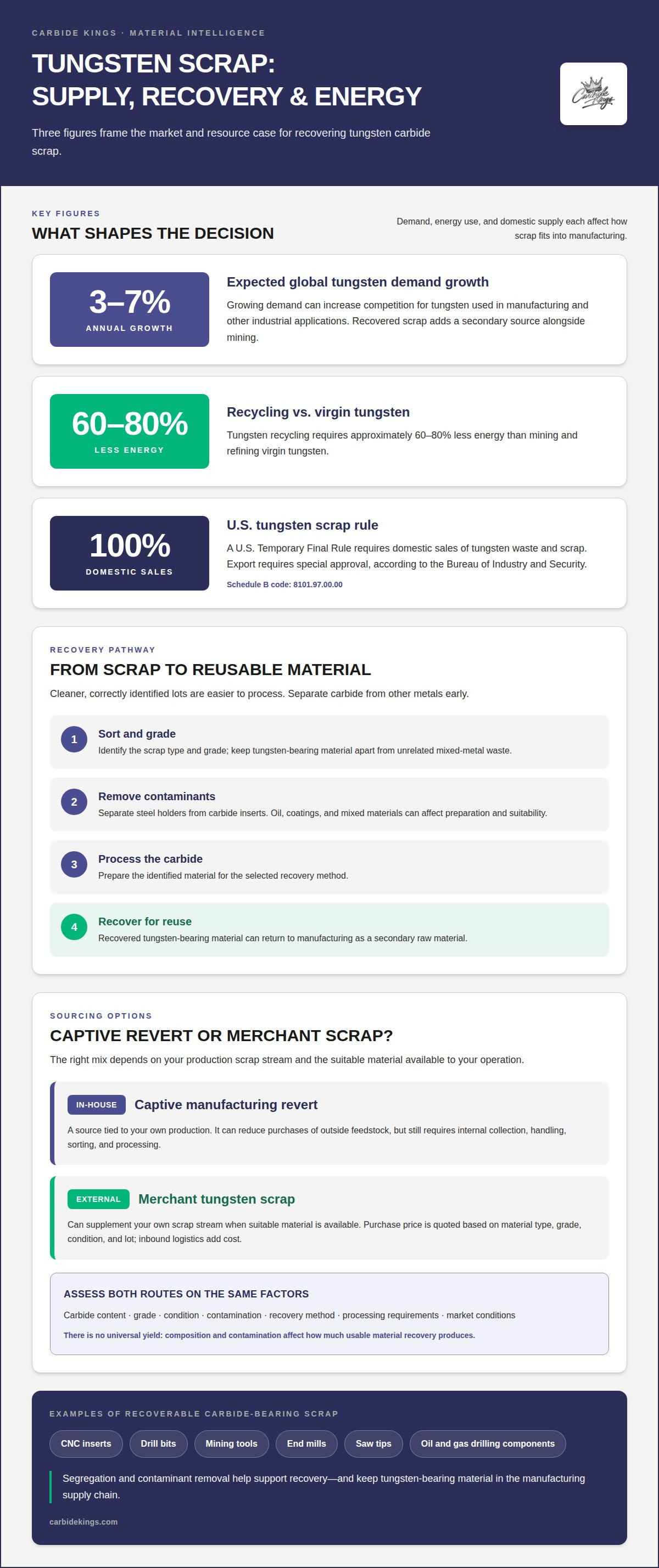
Recycling generally follows a clear sequence: sort and grade the scrap, remove contaminants, process the carbide, and recover tungsten-bearing material for reuse. A steel holder attached to a carbide insert, for example, must be separated before the carbide is processed. Oil, coatings, and mixed materials can also affect preparation and the suitability of the recovered material. Cleaner, correctly identified lots are easier to process.
What are the costs and yields of captive tungsten revert recycling versus buying merchant scrap? Captive revert can reduce purchases of outside feedstock, but it still requires internal handling and processing. Merchant scrap adds material and inbound logistics costs. Yield depends on carbide content, contamination, and recovery method, while value also reflects grade and market conditions.
For merchant material, the purchase price is provided after a quote request and depends on the material type, grade, condition, and lot. Captive operations should weigh those same characteristics against the costs of collecting, sorting, and processing their revert. Neither route has a universal yield: carbide composition and contamination levels affect how much usable material recovery produces.
A recycling portal can help organize intake when it is part of a recycling program. Access typically begins with the program’s account invitation or sign-in process. Users enter material details, such as scrap type and grade, then follow the portal’s instructions for submitting a lot. Portal access does not replace physical sorting or contaminant removal, which still determine how the carbide is prepared for processing.
Recovered tungsten can return to manufacturing as a secondary raw material. Recycling tungsten carbide also requires far less energy than mining and refining new tungsten. Scrap recovery therefore matters for material planning and resource use, especially when manufacturers separate carbide from other metals early in the process.
Tungsten scrap market supply and demand
Global tungsten demand is expected to grow 3% to 7% annually. That growth can increase competition for material used in manufacturing and other industrial applications. Mining supplies primary tungsten, while scrap recovery adds a secondary source. For manufacturers, the balance between those sources affects how merchant scrap fits into procurement planning and how much supply remains available domestically.
Merchant tungsten scrap prices per pound vary by grade, tungsten content, condition, contamination, and lot. The price is provided after a quote request. A clean, well-sorted batch can differ in value from mixed material that requires more preparation. Compare material specifications and processing needs alongside the quoted price, rather than treating a per-pound figure as the full purchasing cost.
U.S. scrap availability has also been shaped by export restrictions. The Recycled Materials Association (ReMA) alerted the industry on August 5, 2026, to a new U.S. export rule for tungsten waste and scrap. A U.S. Temporary Final Rule under the Defense Production Act requires 100% domestic sales of tungsten waste and scrap starting August 27. The rule identifies this material with Schedule B code 8101.97.00.00. According to the Bureau of Industry and Security, U.S. companies cannot export tungsten scrap without special approval.
Research Alloys says the U.S. tungsten scrap market became oversupplied after exports were restricted, leaving domestic buyers overwhelmed. This illustrates how increased supply can coexist with growing demand: scrap may be available, yet buyers and processors still need to sort, assess, and move it through domestic channels. Availability alone does not show whether a particular grade suits a manufacturer’s needs.
Use this market context to compare captive revert with merchant purchasing. Revert offers a source tied to your own production; merchant scrap can supplement that stream when suitable material is available. Assess grade, condition, contamination, and processing requirements before deciding how each source supports procurement. For a practical look at domestic tungsten scrap sourcing, consider how merchant material could fit your supply plan.
Environmental impact
Recovering tungsten from scrap can reduce manufacturers’ reliance on newly mined tungsten and keep industrial waste out of landfills. That benefit depends on scrap reaching a recovery process rather than being discarded or mixed with materials that complicate processing. For example, separating carbide-bearing production scrap from unrelated waste supports clearer sorting and handling. Recovery also returns tungsten-bearing material to manufacturing supply chains instead of relying solely on newly mined feedstock.
Tungsten recycling requires approximately 60-80% less energy than mining and refining virgin tungsten. This comparison makes recovery relevant to environmental planning, not only material purchasing. A manufacturer can assess the pathway by considering how much scrap it captures, how cleanly it is sorted, and whether the material is suitable for recovery. Those steps help connect scrap handling decisions with resource use.
For a U.S. operation, assess permits and environmental controls in relation to the facility, processing steps, and waste stream. Tungsten scrap alone does not determine the requirements that apply. Material handling, processing, and disposal practices are also relevant.
Start with segregation. Keep tungsten-bearing scrap apart from mixed metal waste, and identify obvious contaminants before processing. A batch of carbide inserts mixed with steel holders, for example, needs separation so each material can follow an appropriate route. Sorting can also limit rejected material and make the recovery stream easier to manage.
Next, consider the full material path: collection, preparation, recovery, and reuse. Each step affects whether tungsten-bearing scrap becomes a usable secondary resource. Track the types of scrap generated and where they go, including carbide production offcuts and worn components. This gives manufacturing teams a practical basis for improving material capture and reducing disposal. Environmental value comes from successful recovery, not simply labeling material recyclable.
What types of tungsten scrap can be recycled as revert in-house?
In-house revert is tungsten-bearing material generated by a manufacturer’s own production. It can include rejected carbide components, worn production tooling, and unused material left over from manufacturing. The key distinction is origin: revert comes from the facility’s process, while merchant scrap comes from outside sources. Separating these streams helps teams understand what their operation generates and whether it suits an existing recovery route.
Common sources of tungsten carbide scrap include CNC inserts, drill bits, mining tools, wear parts, router bits, end mills, saw tips, and oil and gas drilling components. A tool removed from service may count as revert in a manufacturing setting if it comes from the company’s own operation. Production rejects and scrap generated during toolmaking can also be evaluated as separate material streams.
Keep unlike materials apart. A carbide insert with a steel holder differs from a loose carbide piece, and a tungsten alloy component is not the same material as cemented carbide. Sorting by material type and condition gives each batch a clearer identity. It also helps reveal where mixed attachments or contaminants may need to be removed before processing.
Build the in-house workflow around collection, identification, segregation, and storage. For example, place used carbide tooling in a designated container rather than mixing it with general metal waste. Record whether each batch contains tooling, production rejects, or alloy scrap. Consistent labels make it easier to trace material to its production source and assess its suitability for the next processing step.
Not every tungsten-bearing item follows the same recovery path. Carbide composition, attached materials, contamination, and batch consistency all affect preparation and potential yield. A plant with distinct streams can assess captive manufacturing revert recycling against merchant scrap purchases, then use outside material to supplement gaps in its own supply. Explore tungsten scrap purchasing options when your operation needs an additional source of material.
Carbide Kings
Carbide Kings can support manufacturers weighing in-house revert against purchasing merchant tungsten scrap. If your own production stream doesn’t cover your material needs, outside scrap can supplement it. Carbide Kings supplies tungsten hard scrap, tungsten soft scrap, carbide scrap, and tungsten alloys for industrial use.
Choose material according to your manufacturing or metallurgical requirements. Hard scrap, soft scrap, carbide, and alloys are distinct material types, and their condition affects how they fit your process. Merchant supply gives procurement teams an additional option to consider alongside material recovered from their own operations.
For a discussion about tungsten or carbide scrap for your operation, contact Carbide Kings.
Make Your Next Scrap Decision with Confidence
Turn the comparison into a procurement plan your production team can use. Evaluate captive manufacturing revert recycling vs purchasing merchant tungsten scrap against your operation’s material needs, production schedule, and ability to keep scrap streams consistent. A simple internal scorecard can help purchasing and manufacturing teams apply the same criteria when reviewing supply options.
Set a clear point for revisiting the plan. Changes in production can alter the type or amount of revert available, while market conditions can affect merchant supply. Base decisions on current operating needs rather than assumptions from an earlier purchasing cycle. This helps your team make deliberate sourcing choices as requirements shift.
When outside tungsten material could support your manufacturing or metallurgical needs, take the next step with Carbide Kings. Share what type of material your operation is seeking and start a focused conversation about your sourcing needs. A clear plan makes it easier to move forward with confidence.
Frequently Asked Questions
How Does Tungsten Carbide Recycling Work?
Tungsten carbide recycling converts suitable scrap into material that can re-enter manufacturing. A recycler separates material streams, removes attachments or contaminants, processes the carbide, and recovers tungsten-bearing material. Separating steel holders from carbide inserts, for example, helps keep the recovered stream consistent. Clear batch identification also helps manufacturers track material through the recovery process.
What is captive manufacturing revert recycling for tungsten scrap?
Captive revert recycling uses tungsten-bearing scrap generated within a manufacturer’s own operation. A toolmaker, for example, might collect production offcuts and worn tooling separately from purchased feedstock. The material remains traceable to that facility’s manufacturing stream. Merchant scrap differs because it enters procurement from an external source rather than arising from the buyer’s own production.
How does tungsten revert recycling compare with purchasing merchant tungsten scrap?
The comparison of captive manufacturing revert recycling vs purchasing merchant tungsten scrap centers on supply, material suitability, and processing needs. Revert comes from a manufacturer’s own production, while merchant purchases add material from outside. A manufacturer can use both sources, relying on suitable revert and purchasing merchant material when the internal stream does not meet production requirements.
What equipment and processing steps are required for captive tungsten scrap recycling?
Required equipment depends on the scrap form and recovery route. A workflow needs a way to keep batches separate, sort material, and remove contaminants; further processing may involve crushing or other carbide-processing equipment. Attached steel parts, for example, need separating from carbide before processing. Manufacturers can plan each step around their material streams and intended recovery process.
How do tungsten scrap grade, contamination, and alloy chemistry affect recycling value?
Grade, contamination, and chemistry affect how a batch is classified, processed, and suited to reuse. Clean carbide differs from mixed scrap containing steel attachments or unrelated metals. Cobalt or nickel in cemented carbide also distinguishes its composition from other tungsten materials. Identifying each stream helps prevent unlike materials from being treated as interchangeable during evaluation and processing.
What are the supply, quality, and operational risks of relying on captive tungsten revert?
For captive manufacturing revert recycling vs purchasing merchant tungsten scrap, a key risk is supply consistency: revert depends on production volume, tooling changes, and scrap generation. Batch composition and cleanliness can also vary, affecting preparation and recovery. Collection, segregation, storage, and processing all require coordination. If internal revert falls short of production needs, merchant scrap can provide an additional source.


