
Why does a 500-pound drum of tungsten sludge often return less than half the value of a single bucket of worn-out carbide inserts? It's a question that plagues machine shops and industrial manufacturers when they see their settlement sheets. You've likely felt the sting of unexpected deductions for moisture or oil, watching your gross weight evaporate during the refining process. Understanding the tungsten hard scrap vs soft scrap price gap is more critical than ever in 2026. As global supply gaps hit 17 percent and tungsten is reclassified as a strategic asset, every pound counts toward your bottom line.
You deserve a transparent look at how your material is valued. We agree that the process should be straightforward and lucrative, not a series of confusing logistical hurdles. This guide explains the technical and market factors that create the pricing divide between solid carbide and grinding sludge. You'll learn exactly how to sort your materials for higher payouts and how to navigate the volatile 2026 market with confidence. We will break down the "yield" vs "gross weight" confusion and provide a clear roadmap for maximizing your returns through a reliable liquidation partner.
Key Takeaways
- Learn why recoverable tungsten content, rather than gross weight, is the primary driver of your scrap valuation.
- Discover how 2026 geopolitical shifts and Chinese export controls impact the tungsten hard scrap vs soft scrap price gap.
- Identify common deductions in carbide sludge, such as moisture and oil, to better predict your final settlement.
- Master sorting techniques for solid carbide inserts and end mills to maximize your return on high-yield hard scrap.
- Streamline your liquidation process with 24-hour processing and national logistics support for faster revenue generation.
The Pricing Divide: Why Hard Scrap Commands a Premium
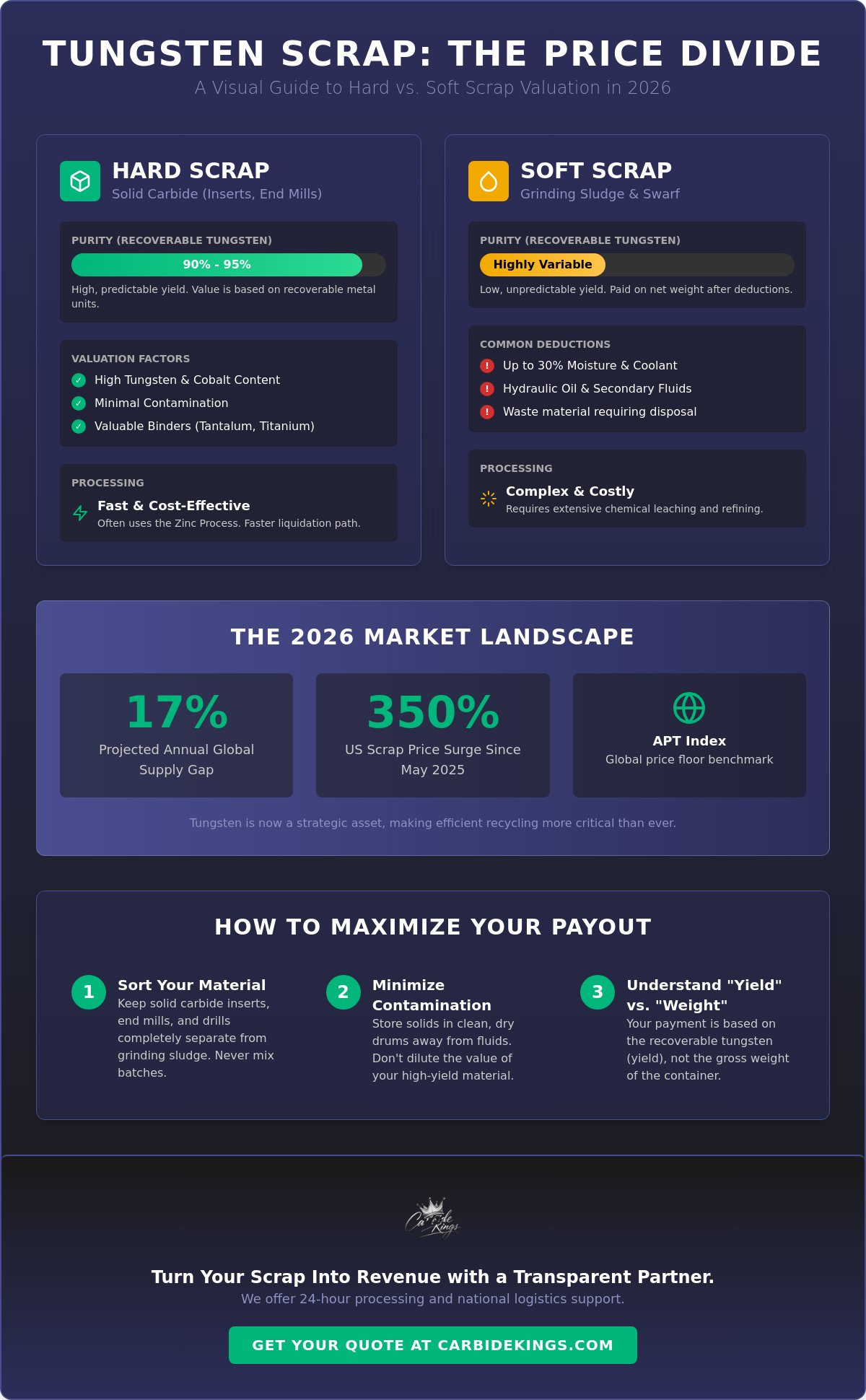
The 2026 industrial market is witnessing a structural repricing of tungsten. It's no longer just an alloy input; it's a strategic mineral with a projected 17 percent annual supply gap through 2028. This scarcity directly impacts the tungsten hard scrap vs soft scrap price spread. Since May 2025, US tungsten scrap prices have surged roughly 350 percent. This volatility makes it essential to understand why refiners prefer high-density solids. Refiners want materials that require the least energy and chemical intervention to return to a usable state. When you sell scrap, you aren't just selling weight; you're selling recoverable metal units.
The global price floor is dictated by the Ammonium Paratungstate (APT) index. In June 2026, spot transactions for APT in China remained around 800,000 yuan per metric ton. This benchmark sets the pace for what refiners can afford to pay for scrap. Hard scrap stays closer to this index because its yield is predictable. Soft scrap faces steep discounts because a large portion of its gross weight is actually waste material that refiners must pay to remove. If your material requires extensive chemical leaching to separate the tungsten from contaminants, that cost is reflected in your final quote.
Defining Hard vs. Soft Scrap
Hard scrap consists of solid, sintered components. This includes worn-out carbide inserts, end mills, drills, and large wear parts used in mining or road milling. These items retain the original Tungsten carbide properties that make the material so valuable: extreme hardness and high density. Soft scrap refers to the industrial by-products of the manufacturing process. This category includes grinding sludge, also known as swarf, as well as powders and floor sweepings. These materials are physically degraded and often saturated with secondary fluids like hydraulic oil or coolant.
Comparison of Valuation Factors
Purity is the primary driver of the value gap. Solid carbide tools typically maintain a purity level between 90 percent and 95 percent tungsten carbide. In contrast, the tungsten content in sludge varies wildly based on the shop's filtration system. You might ship 100 pounds of sludge, but if it contains 30 percent moisture and coolant, you're only being paid for the 70 pounds of actual solids. This is why "yield" is the most important word in your settlement report.
Processing speed also favors solids. Refiners can often use the zinc process for hard scrap. This method is faster and more cost-effective than the complex chemical refining required for contaminated powders. Because solids are easier to verify and process, they command a premium and offer a much faster path to liquidation. By keeping your solids separate from your grinding waste, you ensure you aren't diluting the value of your high-yield material. This simple sorting step is the fastest way to increase your industrial scrap revenue.
Tungsten Hard Scrap: Maximizing Value from Solid Carbide
Solid carbide is the gold standard for industrial scrap sellers. In the 2026 market, where supply constraints have pushed prices to historic highs, these materials represent the most efficient path to high-volume liquidation. Understanding the tungsten hard scrap vs soft scrap price gap starts with recognizing the inherent value of solid pieces. Because these items don't require the complex dewatering or filtration processes associated with sludge, they retain a much higher percentage of their market value. Refiners prioritize solids because they offer immediate, high-yield recovery with minimal environmental overhead.
The valuation of hard scrap isn't just about the tungsten. Most industrial carbide tools use cobalt as a binder, typically ranging from 6 percent to 12 percent of the total weight. Cobalt is a critical and expensive metal in its own right. When you sell solid carbide, the presence of these binders and other premium alloy additions, like tantalum or titanium, can significantly influence the final quote. These elements enhance the performance of the tool and add layers of value that are often lost or diluted in contaminated soft scrap batches. Recent USGS tungsten data highlights the increasing reliance on domestic recycling to meet these high-performance material needs.
Primary Sources of Hard Scrap
Most high-value hard scrap originates from the tool crib. Worn indexable inserts from CNC machining operations are the most common source. These small, dense pieces are easy to collect and transport. Broken or end-of-life solid carbide end mills and drill bits also command premium rates. Beyond the machine shop, industrial wear parts such as nozzles, dies, and mining compacts provide significant weight. To get the best return, you must differentiate carbide from steel. Carbide is roughly twice as dense as steel; if a small tool feels unexpectedly heavy and is non-magnetic, it's likely high-value carbide.
Preparation for Payout
Preparation is the difference between a standard quote and a premium payout. You must remove steel shanks, brazed attachments, or plastic packaging to ensure a "clean" carbide quote. Mixed loads often trigger "downgrades" because the refiner must spend labor hours sorting the material. It's also a best practice to separate coated tools, such as those with TiN or TiAlN coatings, from uncoated ones to maintain batch purity. For a deeper dive into current trends, see our Tungsten Carbide Scrap Price Guide: Market Drivers and Valuation in 2026.
Clean material moves through our facility faster. When your bins are sorted and free of steel contamination, we can verify the weight and issue payment within 24 hours. If you're ready to clear out your bins and capitalize on current market highs, start your liquidation at Carbide Kings today. Accuracy in your sorting process ensures you capture every cent of the current price surge without unnecessary deductions.
Tungsten Soft Scrap: Understanding Sludge and Grinding Valuations
While solid carbide is prized for its density, tungsten soft scrap presents a unique set of challenges and opportunities for industrial sellers. The most significant barrier for sellers is the "Yield Problem." When you ship 500 pounds of grinding sludge, you aren't shipping 500 pounds of metal. You're shipping a mixture of tungsten carbide particles, coolant, hydraulic oil, and moisture. This discrepancy is the primary reason for the tungsten hard scrap vs soft scrap price gap. Refiners must first strip away these fluids to find the true "dry weight" of the material. This process adds labor and energy costs that are automatically deducted from your final settlement.
Refining soft scrap is a chemically intensive process. Unlike the relatively simple zinc recovery used for solids, sludge often requires complex chemical leaching to isolate the tungsten. This complexity, combined with the 2026 tungsten market landscape of tightening export controls, makes it vital to work with specialized tungsten soft scrap buyers. These experts have the filtration and assay technology necessary to accurately assess your material's value without over-deducting for manageable contamination. If you treat your sludge like trash, you'll get trash prices. If you treat it like a chemical asset, you'll maximize your return.
Evaluating Sludge and Swarf
The role of "dry weight" analysis is the most critical factor in determining your final check. Refiners take a sample of your material and heat it to evaporate all liquids. If your sludge is "wet," you're paying to ship liquid that has zero metal value. This creates a double loss: higher freight costs and lower net returns. You should also watch for contamination from non-carbide grinding wheels. Aluminum oxide or silicon carbide grit from your wheels can dilute the tungsten concentration, further lowering the price per pound.
Best Practices for Soft Scrap Collection
Improving your payout starts at the machine. Use dedicated, leak-proof containers to prevent coolant loss and environmental hazards on your shop floor. Clearly label every drum by the type of material being ground, such as "90% Carbide Grinding." This transparency builds trust with your buyer and speeds up the assay process. Before you call for a pickup, allow the sludge to settle in the drum and decant any excess fluids from the top. Reducing this dead weight ensures you are only paying to ship recoverable metal, not waste water.
Global Benchmarks and the 2026 Market Landscape
The 2026 geopolitical environment has fundamentally altered how machine shops value their waste. China currently controls approximately 80 percent of global tungsten production, and recent export controls have tightened the market significantly. Between February and April 2026, China's exports of tungsten carbide and powder to Japan fell to zero. This total halt in supply from the world's largest producer has created a massive vacuum in the Western industrial sector. Consequently, the tungsten hard scrap vs soft scrap price is no longer just a matter of local demand; it's a reflection of a 17 percent annual global supply-demand gap projected through 2028.
Tungsten's reclassification as a strategic mineral by the United States and the European Commission has changed the game for domestic sellers. Aerospace and defense production cycles are currently at a peak, requiring massive quantities of high-density alloys for shielding, projectiles, and high-performance tooling. Because primary ore is difficult to source, domestic recycling has become a critical supply buffer. This makes your shop's scrap bin a vital part of the national industrial supply chain. When primary supply is constrained, the value of high-purity recycled material often tracks even closer to the Ammonium Paratungstate (APT) spot price.
Supply Chain Volatility
Scarcity in raw ore has forced a shift in how refiners approach "buy-back" rates. High-purity hard scrap is now treated as a ready-to-use asset rather than a secondary resource. However, rising energy costs in 2026 have increased the overhead for chemical refining. This means that while the floor price for all tungsten is rising, the gap between solids and sludge is widening. Refiners are willing to pay a premium for solids to avoid the energy-intensive leaching processes required for low-grade powders and contaminated swarf.
Market Timing Strategies
Timing your sale is about more than just watching a ticker. You should track the APT index, which has hovered around 800,000 yuan per metric ton in the first half of 2026. When this benchmark spikes, scrap prices follow within days. National dealers often provide more stability during these volatile swings than local general scrap yards, which may not understand the strategic nuances of the carbide market. For a complete look at how your material moves through this system, check out The Industrial Carbide Scrap Recycling Process.
You don't have to navigate these market shifts alone. We provide the transparency and speed you need to capitalize on these historic highs before the next market correction. If you want to lock in today's rates and turn your bins into immediate cash flow, request a quote from Carbide Kings today. Our streamlined process ensures you get a fair, fast transaction based on the most current global benchmarks.
Turning Scrap into Revenue: The Carbide Kings National Advantage
Maximizing your industrial revenue requires more than just knowing the current market rates. It requires a partner who eliminates the logistical friction and administrative hurdles that often stall the liquidation process. At Carbide Kings, we've refined our operations to match the fast-paced needs of modern machine shops. We understand that the tungsten hard scrap vs soft scrap price gap can be frustrating. Our goal is to provide a transparent, high-speed bridge between your scrap bin and your bank account. By utilizing direct-to-refinery pricing, we bypass the traditional middlemen who dilute your profits with unnecessary handling fees.
Transparency is the foundation of our grading process. Whether you're shipping solid end mills or buckets of grinding sludge, we use precision analysis to verify your material's purity. You'll receive a detailed breakdown of your shipment, ensuring you understand exactly how your settlement was calculated. This no-nonsense approach is why industrial professionals across the country trust us to handle their strategic mineral assets. We don't just buy scrap; we provide a streamlined recovery service that turns your manufacturing waste into a predictable revenue stream.
Simplified National Logistics
Tungsten's extreme density makes shipping a significant logistical challenge. A small container can easily exceed standard weight limits, leading to high freight costs and safety concerns. We handle the heavy lifting for you. Our team provides the right containers for safe, compliant transport of both solids and sludge. We offer national coverage, picking up material from shops and manufacturers across the entire country. By optimizing the transport process, we minimize the impact of material density on your bottom line, ensuring more of the market value stays in your pocket.
Fast, Reliable Payment Options
In a volatile market, speed is your best protection. Prices can shift rapidly, and waiting weeks for a check exposes your business to unnecessary risk. We offer a streamlined 24-hour processing window. Once your material is received and verified at our facility, we initiate payment immediately. You can choose between wire transfers or traditional checks based on your internal accounting needs. This rapid turnaround ensures you capitalize on the 2026 market highs without delay. It's time to stop letting your bins sit idle. Sell your tungsten carbide scrap for top dollar today and experience the efficiency of a professional liquidation partner.
Capitalize on the 2026 Tungsten Market Surge
The 2026 industrial landscape has turned your scrap bin into a high-value strategic asset. Mastering the tungsten hard scrap vs soft scrap price spread allows you to sort smarter and negotiate with total confidence. By separating high-yield solids from grinding sludge and decanting excess fluids before shipping, you ensure your settlement reflects the true value of your metal. Global supply constraints mean the time to liquidate is now. Don't let your material lose value while sitting on the shop floor.
Working with specialized tungsten carbide experts removes the logistical burden from your team. We provide full national logistics support and a transparent grading process that eliminates guesswork. Our streamlined system ensures 24-hour processing and payment once your material is verified. This speed protects your revenue from market shifts and keeps your operation moving forward without administrative delays. Get your custom carbide scrap quote today and discover how straightforward industrial recycling can be. We're ready to help you maximize your return right now.
Frequently Asked Questions
Why is the price of carbide scrap higher than regular steel?
Tungsten carbide is a rare, strategic mineral with nearly double the density of iron-based steel. Its production requires a complex sintering process rather than simple smelting. Because tungsten is essential for high-performance defense and aerospace applications, its market value remains significantly higher than common industrial metals. Global scarcity and 2026 export controls further elevate this price gap.
How often do tungsten scrap prices change?
Prices fluctuate daily in response to the Ammonium Paratungstate (APT) index and international supply shifts. While minor movements occur every 24 hours, major structural changes often follow monthly geopolitical updates. We track these benchmarks in real-time. This ensures your quote reflects the most current market reality the moment your material is verified.
Can I get a better price if I sort my carbide inserts by grade?
Sorting by grade often leads to higher payouts for your shop. High-performance inserts containing tantalum or titanium are more valuable than standard industrial grades. When you present a clean, sorted batch, refiners spend less time on chemical analysis. We pass those labor savings directly back to you in the form of a higher per-pound rate.
Does the presence of coatings (like TiN or TiAlN) affect the scrap price?
Coatings generally don't negatively impact the tungsten hard scrap vs soft scrap price you receive. While these thin layers add negligible weight, the high-quality carbide substrate is what refiners actually want. You don't need to strip coatings before shipping. Just focus on ensuring the tools are free of steel shanks and brazed attachments.
What is the minimum amount of tungsten scrap I can sell for a good price?
Shipments of 50 pounds or more typically offer the best return on investment. Tungsten's extreme density makes shipping expensive if you only send a few pieces. Consolidating your scrap into larger batches reduces the freight cost per pound. This strategy ensures you keep a larger percentage of the gross value as net profit.
How do I know if my scrap is actually tungsten carbide and not just heavy steel?
Use the density and magnet tests for quick shop-floor verification. Tungsten carbide is nearly twice as heavy as steel; a small piece will feel unexpectedly dense in your hand. It's also generally non-magnetic. If a tool is non-magnetic and doesn't produce the same bright sparks as steel when touched to a grinder, it's likely carbide.
Are there any environmental fees that affect the final price of sludge?
Deductions for sludge are based on "recoverable yield" rather than flat environmental fees. Because soft scrap contains oils and coolants, refiners must manage these fluids during the chemical leaching process. The cost of separating and disposing of these secondary fluids is factored into your final settlement based on the dry weight of the tungsten.
What payment methods are fastest for high-value scrap shipments?
Wire transfers are the fastest way to receive your funds once material verification is complete. We initiate these transfers within our 24-hour processing window to provide immediate liquidity for your operation. This speed reduces your exposure to market volatility. Traditional checks are also available if your accounting department requires physical documentation for their records.


