
Treating your scrap pile as a simple collection of metal is a mistake that drains your bottom line. Identification is not just about physics; it is a high-stakes financial audit of your scrap bin. You likely know the frustration of watching high-value carbide disappear into a common steel bin because the two materials look identical. Mastering tungsten carbide vs steel scrap identification is the only way to ensure you aren't leaving money on the shop floor. This confusion between High-Speed Steel and carbide leads to missed revenue and lower payouts during every transaction.
We understand that you need a fast and reliable way to protect your profits without investing in expensive laboratory equipment. This professional guide provides the definitive field tests and visual cues you need to distinguish your materials with total accuracy. You'll learn how to use density, spark patterns, and magnetism to separate high-value tungsten hard scrap from basic steel alloys. We've outlined a streamlined sorting process that builds your confidence in material grading. Follow these steps to create a repeatable workflow that ensures every shipment earns the maximum possible return.
Key Takeaways
- Stop losing money by mixing premium carbide into steel bins; high 2026 demand in aerospace makes accurate sorting more lucrative than ever.
- Use a systematic sequence of field tests to master tungsten carbide vs steel scrap identification without needing specialized lab equipment.
- Distinguish High-Speed Steel from pure carbide by analyzing spark patterns and density to ensure you aren't underpaid for high-tungsten alloys.
- Identify hidden revenue streams by correctly categorizing hard scrap tools and soft scrap sludge before they leave your shop.
- Streamline your workflow with a "sort as you go" policy and basic cleaning to guarantee the fastest processing and highest possible payout.
The Financial Stakes of Tungsten Carbide vs Steel Scrap Identification
Misidentifying your metal costs you money every time you visit a scale. Tungsten carbide is a premium industrial commodity, yet it often looks like common carbon steel to the untrained eye. In 2026, market demand for recycled tungsten is surging. This growth is driven by aggressive expansion in the aerospace and defense sectors. These industries require the extreme hardness and heat resistance found in Tungsten carbide properties. If you treat these materials as the same, you're essentially throwing away high-value assets. Accurate tungsten carbide vs steel scrap identification ensures you capture the full value of your industrial waste.
General scrap yards often lack the specialized knowledge to distinguish these materials. They see weight and volume, but they don't always see the chemical value. This leads to the common problem of "downgrading," where your high-value carbide is mixed with low-grade steel. Carbide Kings solves this by providing a direct-to-refinery channel. We offer specialized tungsten carbide scrap prices that reflect current global demand rather than local scrap averages. We help you turn a logistical burden into a streamlined revenue stream.
Why General Scrap Yards Misquote Carbide
Most local yards aren't equipped to handle high-performance alloys. They frequently lack the XRF analyzers required for precision testing at the gate. When a yard manager encounters a heavy grey tool they can't immediately verify, they default to "heavy melt" steel pricing. This is a safe bet for them but a financial disaster for you. You lose the premium value because they can't guarantee the alloy content. Specialized buyers offer higher margins by cutting out these local middlemen. We handle the heavy lifting of logistics and testing so you get paid for what you actually have.
The 2026 Value Gap: Carbide vs Steel
The price difference between these two metals is staggering. Carbon steel is a high-volume, low-margin material used for structural components. To see how these materials are transformed into high-quality custom features, read more. Tungsten hard scrap is a critical resource for precision machining. While steel prices fluctuate by the cent, carbide is valued much higher due to the scarcity of tungsten. Sorting just one 50lb bucket of carbide inserts instead of tossing them in the steel bin can net a difference of hundreds of dollars. Tungsten carbide is a composite of tungsten and carbon bonded with cobalt. This unique chemical makeup is exactly why it commands such a significant premium over standard iron-based alloys in the 2026 market.
Four Field Tests to Identify Tungsten Carbide from Steel
Speed is essential in a busy shop. You don't have time for laboratory analysis, so you need a systematic testing order to minimize time spent per piece. Start with visual cues and weight before moving to invasive tests. Always keep a known piece of carbon steel nearby as a control. This baseline helps you calibrate your senses for accurate tungsten carbide vs steel scrap identification. By following a logical sequence, you can sort through large bins without second-guessing your results.
The Weight and Density Test
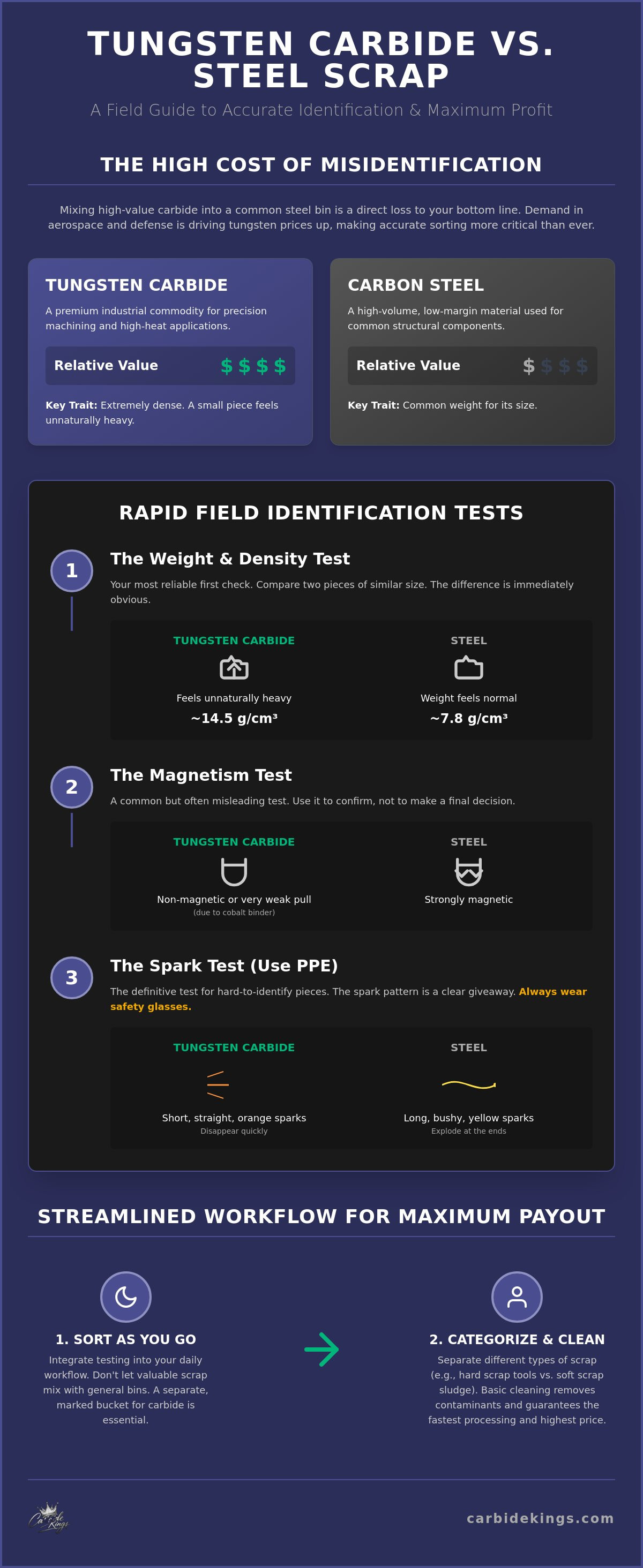
Density is your most reliable field indicator. Tungsten carbide is nearly twice as dense as lead and significantly heavier than steel. While carbon steel has a density of approximately 7.8 g/cm³, carbide sits at roughly 14.5 g/cm³. Perform a "heft test" by comparing two objects of similar size. If the tool feels unnaturally heavy for its dimensions, it's likely carbide. This is a primary method for quickly sorting large drills, boring bars, and industrial rods. If the weight doesn't immediately give it away, the physics of the material will show up in the next steps.
The Magnetism and Spark Tests
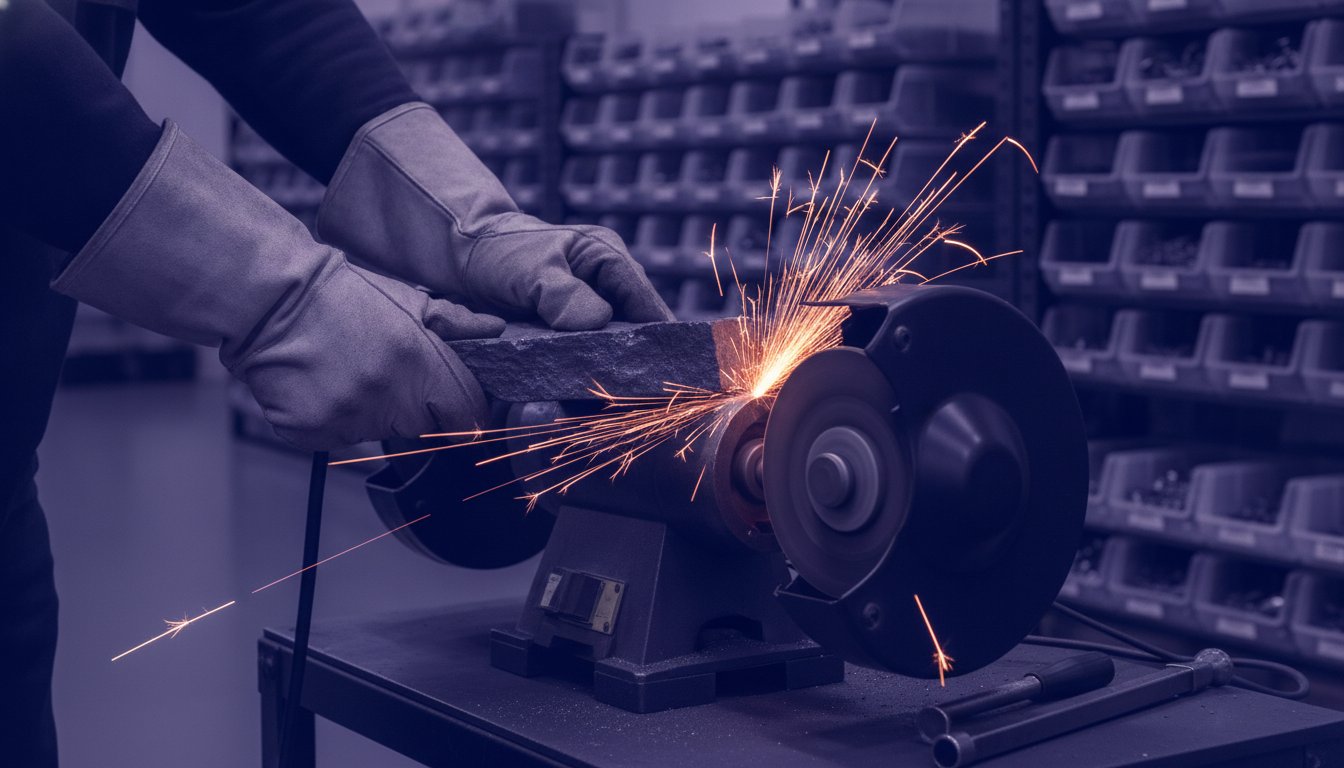
Many general scrap dealers rely solely on magnets, but this is a mistake. Most carbide is non-magnetic, yet many grades contain cobalt binders that create a very weak pull. If a magnet barely sticks, don't assume it's low-grade steel. Move to the spark test on a grinding wheel. Steel produces long, yellow, bushy sparks that explode at the ends. Carbide produces short, orange, straight sparks that disappear quickly. Always wear proper PPE, including eye protection and gloves, when performing these tests. Understanding these differences is vital because of the critical industrial uses of tungsten in high-heat environments where steel would fail.
The Scratch and Hardness Test
Hardness is the defining characteristic of this material. Tungsten carbide will easily scratch any common steel tool. Grab a standard steel file and try to "bite" into the material. The file will dig into carbon steel but will simply slide off a carbide surface without leaving a mark. You can also use a known carbide insert as a scratch-testing tool. If the insert leaves a visible groove in your mystery metal, you're holding steel. If neither scratches the other, you've likely found more high-value scrap. Once you've verified your materials, organizing your tungsten hard scrap separately ensures you get the highest possible payout during your next transaction.
Distinguishing Tungsten Carbide from High-Speed Steel (HSS)
High-Speed Steel (HSS) acts as a bridge between common carbon steel and tungsten carbide. It's a high-performance alloy designed to withstand heat, but it doesn't reach the extreme hardness of carbide. While HSS contains tungsten, the concentration is significantly lower, usually ranging from 6% to 18%. This chemical difference creates a massive price gap. HSS is the number one contaminant in carbide scrap shipments today. If you mix these materials, you're essentially diluting your high-value lot with a lower-grade metal. Accurate carbide scrap recycling requires total HSS removal to secure the highest possible payout from a refinery.
The core of tungsten carbide vs steel scrap identification often comes down to this specific comparison. General scrap yards might treat HSS as a premium steel, but they won't pay carbide prices for it. You must be the expert in your own shop. Separating these two ensures your shipments are clean, professional, and ready for immediate 24-hour processing. Don't let a few HSS drill bits lower the average value of your entire carbide bin.
Visual Cues: HSS vs Carbide
Start your inspection by looking for stamped markings. Manufacturers almost always stamp "HSS" or "HS" directly onto the shank of steel tools. Tungsten carbide is too hard for traditional stamping, so these tools are rarely marked this way. If they have markings, they're typically laser-etched or ground into the surface—a level of precision in custom design also found at kretsdesign.se. Look at the finish of the metal. Carbide tools usually have a darker, duller grey appearance compared to the brighter, polished look of HSS. Also, check for brazed joints. Many large industrial tools use a carbide tip brazed onto a steel shank. If you see a visible seam where two different metals meet, you're holding a composite tool that needs further sorting.
Technical Comparison Table
Use the following data to calibrate your sorting process. Carbide Kings buys both materials, but they must be separated to ensure you receive the top dollar for each category.
| Feature | High-Speed Steel (HSS) | Tungsten Carbide |
|---|---|---|
| Density | ~8.0 g/cm³ | ~14.5 g/cm³ |
| Spark Color | Long, Yellow/Orange | Short, Deep Orange/Red |
| Magnetism | Strong Pull | Weak to No Pull |
| Hardness (HRC) | 60 - 67 HRC | 75 - 90+ HRC |
| Relative Value | Moderate | High |
This table highlights why HSS is often mistaken for carbide. Both are magnetic to some degree and both are harder than standard steel. However, the density and spark patterns remain your most reliable field indicators for successful tungsten carbide vs steel scrap identification.
Common Industrial Sources: Where High-Value Carbide Hides
High-value material often hides in plain sight within your facility. Many operators overlook the potential revenue sitting in their wear parts because they assume everything is standard iron or steel. To maximize your returns, you must know exactly where to look. We categorize these sources into two main types: hard scrap and soft scrap. Hard scrap consists of solid items like broken drills, spent inserts, or large industrial dies. Soft scrap refers to the sludge, grindings, or powders generated during manufacturing or sharpening. Both carry significant value, but they require different handling to ensure a fast, accurate payout.
Successful tungsten carbide vs steel scrap identification depends on recognizing industry-specific forms and shapes. While machine shops are the most obvious source, heavy industries like mining and road construction often yield the heaviest individual pieces. These large components are frequently overlooked because their sheer size suggests common structural steel. However, selling tungsten carbide wear parts from heavy equipment can drastically increase your recycling returns. Recognizing these high-density components allows you to sort your bins with professional precision.
Machine Shop Tooling
Machine shops are gold mines for high-value scrap. Indexable inserts are the most common form of carbide you'll encounter. They usually come in distinct geometric shapes like triangles, squares, and diamonds. Don't assume a dull or chipped tool is worthless steel; if it's an insert, it's almost certainly carbide. Solid carbide end mills, drills, and reamers are also prime targets. Watch for brazed joints on large circular saws or router bits. In these cases, only the tiny grey tip is the carbide. The rest of the tool is usually steel. You must separate these or identify them clearly to get the best price for the carbide content.
Mining and Construction Wear Parts
These industries use massive amounts of tungsten to handle extreme abrasion. Road milling teeth and pavement bits take a beating and are often discarded in bulk. These are high-density items that add up quickly in weight. Tricone drill bits used in oil and gas exploration contain heavy carbide buttons embedded in steel heads. Even snow plow blades and specialized industrial nozzles often feature carbide inserts to prevent premature wear. These parts are heavy and often dirty, but their value is undeniable. Once you've identified these sources, sell your tungsten hard scrap directly to us for 24-hour processing and competitive pricing.
Maximizing Your Payout: Sorting and Shipping Your Carbide Scrap
Implement a "Sort as You Go" policy across your entire shop floor. This is the most effective way to prevent high-value alloys from getting lost in common steel bins. When a tool breaks or reaches the end of its life, it should go directly into its designated container. Waiting until the end of the month to sort a massive, mixed pile is a recipe for error. It increases the chance of contamination and forces you to spend hours on tungsten carbide vs steel scrap identification when you could be focusing on production. A proactive approach ensures your scrap remains a clean, high-margin asset.
Clean your material before you pack it for shipment. Heavy oils, thick grease, and floor debris don't just make a mess; they interfere with accurate weighing. Refineries require clean material to provide a precise valuation. A quick wipe or a simple degreasing step ensures your shipment is professional and ready for immediate processing. Once your material is clean and categorized, knowing where to recycle tungsten carbide becomes the final step in securing your return. You need a partner that moves as fast as your business does.
The Professional Sorting Workflow
Follow this four-step sequence to maintain a high-purity scrap stream:
- Step 1: Visual Inspection. Check for "HSS" stamps or laser-etched markings. If it's stamped, it's steel.
- Step 2: Magnet and Heft Check. Feel the weight. If it's unexpectedly heavy and the magnet pull is weak or non-existent, it's likely carbide.
- Step 3: Verification. Use a spark test on any questionable pieces. Look for the short, orange sparks that characterize tungsten.
- Step 4: Separation. Place the verified material into separate bins for Tungsten Hard Scrap, Tungsten Soft Scrap, and HSS.
Shipping Logistics with Carbide Kings
Packing is critical because tungsten is incredibly dense. A small box can easily exceed weight limits or burst during transit. Use double-walled corrugated boxes or heavy-duty plastic buckets for your loads. Secure the lids with reinforced tape to prevent shifting. We provide national shipping logistics support to make this process as smooth as possible. Request a quote online to lock in current market rates before you ship. Once we receive your material, we provide 24-hour processing. You can expect immediate payment via wire or check, ensuring your cash flow remains strong and your shop remains clear of clutter.
Turn Your Sorted Scrap into Immediate Revenue
Mastering tungsten carbide vs steel scrap identification is the most direct way to increase your shop's profitability. You've seen that density and spark tests are far more reliable than simple visual checks. You also understand that separating High-Speed Steel is critical to preventing lot contamination and securing premium pricing. These small adjustments to your daily workflow transform industrial waste into a high-value commodity. Don't let your premium alloys sit in a low-value steel bin when they could be working for your bottom line.
Once your material is sorted and cleaned, you need an efficient partner to handle the final steps. Get a fast, competitive quote for your sorted carbide scrap today from Carbide Kings. We provide a 24-hour processing guarantee upon receipt and offer national shipping assistance to simplify your logistics. You can receive your payment via wire transfer or check for total professional flexibility. Start your sorting process today and take full control of your recycling returns.
Frequently Asked Questions
Is all carbide non-magnetic?
No, not all carbide is completely non-magnetic. Most industrial carbide uses cobalt as a binder, which can cause a subtle magnetic pull. While carbon steel will snap to a magnet with force, carbide will only exhibit a faint attraction. This is a critical distinction in tungsten carbide vs steel scrap identification. Always use a strong neodymium magnet to detect these slight differences during your sorting process.
How much more is tungsten carbide worth than high-speed steel?
Tungsten carbide is worth substantially more than high-speed steel due to its higher tungsten concentration. HSS typically contains between 6% and 18% tungsten, whereas carbide tools are often over 80% tungsten. This chemical density translates directly into higher market value. Sorting these materials correctly ensures you aren't losing the premium margin that pure carbide commands in the 2026 market.
Can I sell carbide tools that are still attached to steel shanks?
You can sell carbide tools with steel shanks, but they are categorized differently than solid hard scrap. These are known as brazed tools. While we accept them, the payout reflects the combined weight of the steel and the carbide. For the highest return, many professionals choose to shear the carbide tips off the steel shanks before shipping their lot for processing.
What is the easiest way to identify a carbide insert?
The fastest way to identify a carbide insert is by its geometric shape and its weight. Most inserts are manufactured in standard triangle, square, or diamond shapes and lack the stamped markings found on steel tools. Because carbide is nearly twice as dense as steel, the insert will feel remarkably heavy for its small size. This heft test is a reliable first step in any shop.
Does the color of the spark really tell the difference between steel and carbide?
Spark color is a definitive field indicator for distinguishing these metals. When held against a grinding wheel, tungsten carbide produces short, straight, deep orange sparks. In contrast, carbon steel and HSS produce long, bushy, white or bright yellow sparks that explode at the ends. This visual test is one of the most reliable methods for tungsten carbide vs steel scrap identification in a high-volume environment.
What happens if I mix steel in with my carbide scrap shipment?
Mixing steel into your carbide shipment leads to a lot downgrade and slower processing times. Refineries must separate contaminants before they can process the tungsten, which adds labor and administrative hurdles. This results in a lower average price per pound for your entire shipment. Keeping your bins pure is the simplest way to guarantee the fastest 24-hour processing and maximum payout.
Is used or broken carbide worth less than "new" scrap?
The physical condition of the carbide does not affect its recycling value. Whether the tool is a brand-new overstock item or a shattered piece of hard scrap, the value is determined strictly by its weight and chemical composition. We focus on the tungsten content, so broken drills and chipped inserts are worth just as much per pound as intact tools. Focus on weight, not appearance.
How do I ship 100+ lbs of carbide scrap safely?
Shipping heavy loads requires reinforced packaging like double-walled corrugated boxes or industrial plastic buckets. Because carbide is so dense, a small volume can quickly exceed standard shipping weight limits. Secure your containers with heavy-duty reinforced tape and ensure there is no internal movement. We provide national shipping logistics support to help you move these heavy loads safely and efficiently to our facility.


