

A larger pool of scrap won’t strengthen supply if the material can’t meet your alloy and process requirements. That’s the challenge behind secondary raw material procurement strategies for tungsten alloy producers: recycled feedstocks can broaden sourcing options, but their composition and consistency need to be verified before they enter production. A supplier’s material category alone isn’t enough to confirm fit.
It’s reasonable to want more sourcing flexibility without risking product quality or production continuity. The answer isn’t to replace primary materials with secondary feedstocks across the board. Instead, assess each option against your specifications, define clear qualification steps, and understand supplier and continuity risks before committing.
This article provides a practical framework for evaluating tungsten secondary materials, comparing them with primary feedstocks, qualifying suppliers, and setting incoming-material checks. It also explains how to match feedstock to product needs and build a balanced sourcing plan that accounts for variability without assuming every recycled material is suitable.
Key Takeaways
- Match each secondary feedstock to your alloy specifications and production process. Material category alone doesn’t confirm composition or suitability.
- Use the same scorecard to compare suppliers on specification transparency, lot communication, supply continuity, and responsiveness.
- Make secondary raw material procurement strategies for tungsten alloy producers repeatable by defining demand, issuing specifications, screening suppliers, validating samples, approving sources, and monitoring results.
- Assign clear responsibilities across procurement, production, engineering, and quality so supplier decisions align with manufacturing needs.
- Evaluate Carbide Kings’ tungsten hard scrap, soft scrap, carbide scrap, and tungsten alloys against your requirements, and confirm current availability and specifications.
Why tungsten alloy producers should evaluate secondary raw material procurement
Every tungsten alloy producer faces the same starting task: secure feedstock that meets production requirements without putting product quality or schedules at risk. Secondary raw materials are recovered materials considered for reuse in manufacturing. They are potential inputs, not approved inputs. Suitability depends on qualification against the producer’s specifications and process.
Secondary sourcing can complement primary tungsten supply by adding options to a procurement plan. It shouldn’t be treated as an automatic replacement. Material form, condition, and composition can vary, so producers need to establish acceptable requirements before making sourcing decisions. The Tungsten recycling overview provides context on scrap’s role in the broader tungsten supply chain, but producers still need to assess materials for their own applications.
A sound sourcing strategy is a controlled decision about fit, risk, and continuity, not simply a purchase from the lowest-cost source. The distinction keeps procurement connected to production realities. An option that looks promising on paper may not be suitable if the material cannot be qualified or its supply cannot support the production plan.
What secondary tungsten feedstocks can enter a procurement review?
Start by identifying the material category, then gather the details needed to judge its fit. Tungsten hard scrap, tungsten soft scrap, carbide scrap, and tungsten alloys are distinct categories to consider. Form and condition can affect handling and potential downstream use. Composition and cleanliness also need to be checked against the intended alloy and process. A category name alone doesn’t establish any of these characteristics.
For a feedstock being considered for a specific alloy, first define the material characteristics required and the evidence needed to verify them. Don’t assume that material suitable for one product or process will work for another. Confirm current specifications and availability with the supplier, then follow your internal qualification requirements.
Which procurement goals should guide the sourcing decision?
Set priorities before contacting suppliers. Ask production and quality teams to rank these goals:
- Continuity: Can the source support planned production needs?
- Specification fit: Can the material be evaluated against defined product and process requirements?
- Supplier diversity: Would another qualified source reduce dependence on a single supplier?
- Resource efficiency: Can the role of secondary feedstock be tracked in a practical, meaningful way?
Turn each priority into a measurable procurement objective, such as qualifying an additional source or documenting acceptance criteria. Keep broad sustainability claims separate from operating evidence. Clear targets and repeatable assessments make secondary raw material procurement strategies for tungsten alloy producers easier to compare, review, and improve.
Match secondary tungsten materials to alloy specifications and production processes
A feedstock is only a candidate until it fits the alloy and the process that will use it. Start with the material’s physical form and condition, then confirm what is known about its composition, cleanliness, and handling. Hard scrap, soft scrap, carbide scrap, and tungsten alloys are distinct categories, but none of those labels confirms whether a lot meets a producer’s requirements.
- Tungsten hard scrap: Ask what form the material is in, whether its condition is consistent across the lot, and what composition information is available.
- Tungsten soft scrap: Clarify its physical form, packaging, handling needs, and any known contamination or mixed-material concerns.
- Carbide scrap: Verify the material description and composition evidence, then determine whether its characteristics suit the intended downstream route.
- Tungsten alloys: Request available composition and lot details. Alloy material isn’t automatically interchangeable with the alloy being produced.
Downstream requirements determine what matters most. A process with strict composition limits may require different evidence from one focused on physical form or handling. Consider the entire route from receipt through production, including any preparation steps your facility requires. The USGS tungsten statistics page provides official information on tungsten, while acceptance criteria should come from your own product and process requirements.
Assess every lot against documented production requirements, not assumptions attached to its material category.
How should producers write a secondary-material specification?
Create one specification that suppliers can answer and internal teams can enforce. Include required composition and acceptable evidence, physical form, contamination limits, packaging and handling requirements, and documentation fields such as lot identification and available material records. Mark each item as mandatory or negotiable before requesting quotations. Have engineering, quality, and procurement approve the same version to prevent conflicting expectations.
How can feedstock fit be validated before routine purchasing?
Agree on sampling, testing, and acceptance procedures before treating a shipment as production-ready. Use qualified internal resources or a third party selected by your organization. Where appropriate, run a controlled trial and record results, deviations, and any process adjustments. Approval should apply only within the limits your teams have verified. One successful trial doesn’t establish universal acceptance across other materials or lots.
For a specification-led review, producers can discuss relevant tungsten hard scrap, soft scrap, carbide scrap, or tungsten alloy material categories with Carbide Kings’ tungsten materials team. Confirm current availability and specifications against your requirements before proceeding.
Compare secondary tungsten sourcing options without overlooking supply risk
Supplier type is only a starting point. A direct producer or material originator may offer clearer information about a material’s origin, while a specialized secondary-material supplier may focus on recovered tungsten and carbide categories. A broader intermediary may connect buyers with multiple sources. None is automatically the best fit. Compare documented capabilities against the material, qualification, and continuity needs established by your production team.
Use the same questions for every prospective and current supplier. This prevents a familiar source from receiving a pass that a new supplier wouldn’t, and helps identify where more information is needed. The International Tungsten Industry Association provides industry context, but supplier approval should rely on your own documented criteria and validation process.
What should a tungsten supplier scorecard measure?
Keep the scorecard practical. Record which material categories a supplier offers, how available information aligns with your specification, what lot documentation can be provided, and how communication works before and after an order. Ask how the supplier will notify you if material condition or supply changes. Apply the same criteria to all sources, and record unverified answers as open questions rather than assumptions.
- Material and specifications: Are the relevant categories and available details clearly described?
- Lot communication: Can the supplier explain how lots are identified and how changes are reported?
- Continuity: What information can the supplier provide about supply planning and potential interruptions?
- Responsiveness: Are questions about requirements, documentation, or changes answered clearly?
Track evidence, not impressions. A prompt response is useful, but it doesn’t establish technical fit. Likewise, a broad catalog doesn’t demonstrate continuity for a specific feedstock. Keep technical approval separate from commercial and communication assessments.
How can buyers manage concentration and continuity risks?
First, identify feedstocks with only one approved source, uncertain replenishment, or a lengthy qualification path. Set review triggers before a disruption occurs, such as a late delivery, a specification deviation, a change in material condition, or a shift in demand. Define who reviews each trigger and what information procurement needs from production and quality.
Supplier diversification can reduce dependence, but every added source brings qualification work, coordination, and potentially different lot characteristics or logistics. Match the approach to the material and process. A qualified backup can improve resilience, but it shouldn’t lower acceptance standards or bypass lot checks.
There’s no universal ranking of direct producers, specialized secondary-material suppliers, and intermediaries. The right mix depends on the feedstock and your operating requirements. Strong secondary raw material procurement strategies for tungsten alloy producers use consistent supplier criteria, preserve technical controls, and review supply risks before they disrupt production.
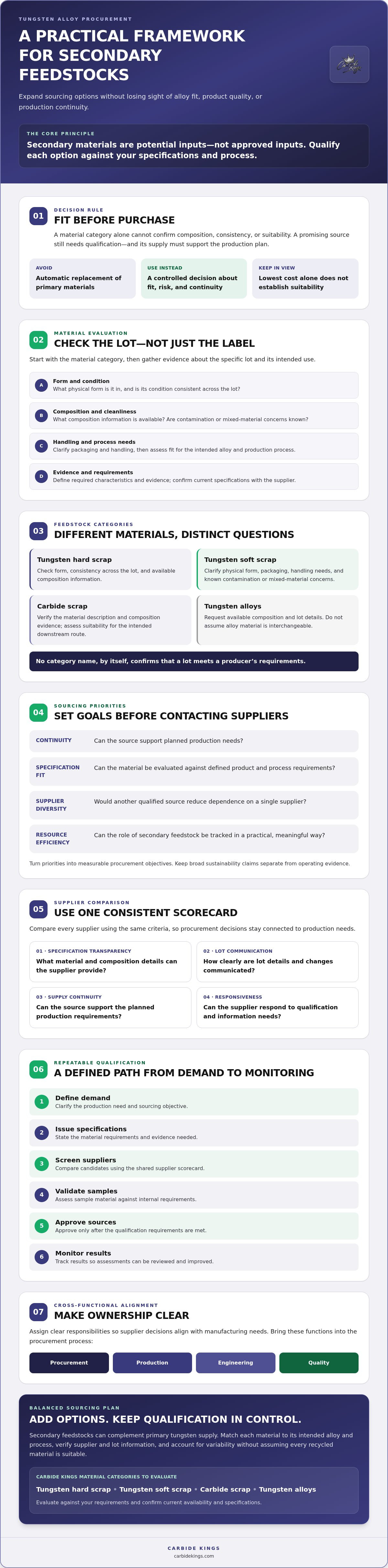
Build a repeatable qualification and purchasing workflow for secondary feedstocks
Secondary feedstock isn’t inherently inconsistent. It does require controls suited to its form, your production process, and the risks you need to manage. A repeatable workflow helps teams make decisions using documented requirements and incoming-lot evidence, rather than relying on assumptions or supplier statements alone.
Use a shared process with clear ownership at each stage:
- 1. Define demand. Production identifies the material need, timing, and intended use. Procurement confirms the purchasing requirements.
- 2. Issue specifications. Engineering and quality define acceptable characteristics, required documentation, and evaluation criteria. Procurement sends the approved specification to potential suppliers.
- 3. Screen suppliers. Procurement gathers material descriptions, available composition information, lot details, and supply communication practices. Quality and engineering identify gaps requiring follow-up.
- 4. Validate samples. Quality coordinates sampling and testing through qualified internal or third-party resources. Engineering and production assess whether results support the intended application.
- 5. Approve the source and use. The responsible teams document the approved supplier, material, specification, and any limits on use. Keep conditional approvals distinct from routine production approval.
- 6. Monitor performance. Procurement tracks delivery and supplier communication. Quality compares incoming lots with approved requirements and records acceptance decisions and deviations.
Keep the workflow aligned with the principles behind secondary raw material procurement strategies for tungsten alloy producers: technical fit comes first, followed by supplier and continuity considerations. Approval should identify exactly what was reviewed. Don’t treat one accepted lot as automatic approval for every future lot or material category.
What information should buyers request before approval?
Request a clear material description, available composition information, lot identification, and handling details. Agree on which documents should accompany each shipment and which claims need independent verification. Supplier-provided information helps guide evaluation, but it doesn’t replace your own acceptance criteria or testing. Quality should define the evidence needed before a material can move from review to approved use.
How should teams monitor approved suppliers and incoming lots?
Retain the specification version, supplier records, lot identifiers, test and acceptance results, delivery performance, deviations, and corrective actions. Review these records across procurement, production, engineering, and quality. Revisit approval when requirements, processes, or supplier circumstances change. A concise scorecard helps teams spot patterns without confusing a single issue with a recurring risk.
To discuss tungsten hard scrap, soft scrap, carbide scrap, or tungsten alloys as potential sourcing categories, contact Carbide Kings about tungsten material options. Confirm current availability and specifications against your approved requirements.
Choose a secondary tungsten supply partner that fits your procurement plan
A suitable supply partner supports the system your team has built. Approved specifications define what can be considered. Validation confirms whether a material fits its intended use. Supplier diversity can provide additional options, while lot controls help ensure each received shipment is checked against requirements. Keep these steps connected, but don’t treat a supplier relationship as a substitute for qualification or incoming-material review.
Specialized suppliers are worth evaluating when their material categories align with documented production needs. Carbide Kings is a US-based supplier of tungsten hard scrap, tungsten soft scrap, carbide scrap, and tungsten alloys for industrial buyers. These are potential sourcing options to assess, not a claim that every category will suit every alloy or process. Confirm current availability and specifications directly, then apply the same qualification criteria used for other sources.
When is a specialized secondary-material supplier worth evaluating?
Consider a specialist when it offers a relevant material category and information your team can review against its requirements. Use your established scorecard to assess specification details, lot communication, and supply information. Start this review before a material shortage makes the decision urgent. That gives engineering, quality, production, and procurement time to evaluate fit without bypassing technical approval.
Supplier diversity helps only when additional sources can be qualified and managed. A second supplier may add coordination and lot variation, so balance continuity goals with the work needed to approve each source. Keep acceptance requirements consistent across suppliers. A potential backup should meet the same technical controls as an established source.
What should the first supplier conversation cover?
Make the discussion specific. Share the material category, intended application, and approved specification. Ask what lot-level information and shipment documents are available, how changes in material condition or supply are communicated, and which details require buyer-side verification. Keep the conversation focused on whether there’s a basis for formal qualification, rather than assuming fit or availability.
Strong secondary raw material procurement strategies for tungsten alloy producers make partner selection one part of a broader procurement plan. Define the need, communicate requirements, validate material through your own process, and maintain lot controls after approval. This creates a consistent way to consider secondary feedstocks alongside other supply options without relaxing production standards.
To discuss your tungsten material needs and confirm current category availability, Explore tungsten materials from Carbide Kings.
Put a More Resilient Tungsten Sourcing Plan into Practice
Strong secondary sourcing starts with fit, not assumptions. Define feedstock requirements around your alloy and production process, then qualify each supplier and lot against those requirements. Keep primary and secondary sources balanced, and use clear records and review triggers to help protect continuity without weakening quality controls.
That repeatable approach is the foundation of secondary raw material procurement strategies for tungsten alloy producers. It helps procurement, production, engineering, and quality teams assess sourcing options consistently and make informed decisions as requirements change.
Carbide Kings is a US-based specialist supplier of industrial tungsten and carbide scrap. Its material categories include tungsten hard scrap, tungsten soft scrap, carbide scrap, and tungsten alloys. Evaluate these options against your specifications, and confirm current availability and material details before proceeding.
Explore tungsten materials from Carbide Kings and discuss which categories may fit your procurement needs. With clear requirements and a disciplined qualification process, your team can build a more resilient supply plan with confidence.
Frequently Asked Questions
Can tungsten alloy producers use secondary raw materials in production?
Yes, producers can use secondary raw materials when the material is qualified for the intended alloy and process. Recovered feedstock should be reviewed against documented requirements for composition, form, condition, and cleanliness. A supplier’s material description can help guide that review, but it doesn’t establish acceptance by itself. Define sampling, testing, and approval steps with your production and quality teams before introducing a secondary material into routine manufacturing.
How should a producer qualify a secondary tungsten supplier?
Qualify a supplier against consistent technical and supply criteria. First, share your material specification and ask what lot identification, composition information, handling details, and shipment documents are available. Then verify relevant claims through buyer-side testing or other qualified resources, as needed. Record the results, approve only the material and use that meet your requirements, and monitor incoming lots and supplier communication over time.
What information should a tungsten feedstock specification include?
A feedstock specification should state the required composition and acceptable supporting evidence, physical form, contamination limits, packaging and handling requirements, and documentation expected for each lot. Identify which requirements are mandatory and which may be negotiable before requesting supplier quotations. Procurement, engineering, and quality should approve one shared specification so suppliers receive consistent expectations and incoming material can be assessed against the same criteria.
Are tungsten hard scrap and soft scrap interchangeable?
No. Tungsten hard scrap and tungsten soft scrap are distinct material categories, and their labels alone don’t establish composition, condition, cleanliness, or suitability. Their physical form and the producer’s downstream process can affect whether a material is a candidate for a particular use. Review available lot information against your specification, then qualify each material for its intended application instead of assuming approval transfers between categories.
How can manufacturers reduce the risk of inconsistent secondary feedstock?
Set clear acceptance requirements and apply them to each lot. Request consistent lot identification and available material documentation, define sampling and testing procedures, and retain results alongside purchase and delivery records. Track acceptance outcomes, deviations, and supplier communication so patterns can be reviewed across shipments. If a lot differs from approved requirements, follow your established review process rather than assuming a previously accepted shipment proves the new lot is suitable.
Should secondary tungsten replace primary material in a procurement plan?
Not automatically. Secondary tungsten can complement primary supply when a specific material has been qualified for the product and process. The right balance depends on production requirements, supplier options, continuity needs, and your ability to validate incoming lots. Keep technical acceptance standards consistent across sources, and avoid relying on any feedstock solely because it is secondary. A balanced plan preserves options while protecting product quality and production schedules.
How much secondary tungsten material should a producer qualify?
There’s no universal quantity or share that suits every producer. Set the qualification scope based on planned demand, intended application, process capability, and the resources available for sampling, testing, and monitoring. Begin with the material and use case that matter most to production, then document what the evaluation supports. Expand only when your team has evidence that additional material or use cases meet defined requirements.


