
Virgin ammonium paratungstate isn’t the only route to a tungsten feedstock. Replacing virgin ammonium paratungstate with secondary carbide hard scrap means recovering tungsten from scrap and processing it into ammonium paratungstate, rather than using scrap as a direct substitute for APT. Tungsten carbide scrap typically contains 70% to 95% tungsten by weight.
Using secondary tungsten can make sense when the material fits your process and its recovery costs are competitive. Compare the recovered output and processing costs with those of tungsten ore and APT before choosing a feedstock.
This article explains how indirect recovery can convert cemented-carbide scrap into APT, how that route compares with direct and semi-direct recycling, and why sorting and contamination controls matter. It also outlines the recovery steps and the factors that determine whether secondary scrap is a practical feedstock.
Key Takeaways
- Understand how indirect recovery converts cemented-carbide scrap into ammonium paratungstate through multiple processing stages.
- See why APT matters as a precursor in tungsten carbide production and how it fits into the manufacturing chain.
- Learn how magnetic response can help distinguish carbide tooling with a cobalt binder from likely steel or iron contamination.
- Explore how processing route and feedstock control affect recycled tungsten’s suitability for carbide production, and where tungsten hard scrap fits as a material source.
Recycling waste cemented-carbide scrap into ammonium paratungstate
Converting cemented-carbide scrap into ammonium paratungstate (APT) requires recovering tungsten through a suitable processing route. The route affects the recovered product, energy use, processing time, and equipment needs. When replacing virgin ammonium paratungstate with secondary carbide hard scrap, first determine whether your process needs scrap to be converted into APT or recovered as carbide powder.
Tungsten Carbide Recycling Routes
Direct, indirect, and semi-direct recycling use different methods to recover tungsten or carbide from scrap. Physical sorting separates identifiable material; chemical methods change its composition. Direct recycling can produce carbide powder with controlled grain size. Electrolytic recovery dissolves the cobalt binder from cutting tools. Indirect recycling uses several conversion stages, while semi-direct methods take an intermediate approach. The output your production requires helps determine which route fits.
Environmental and Economic Trade-Offs
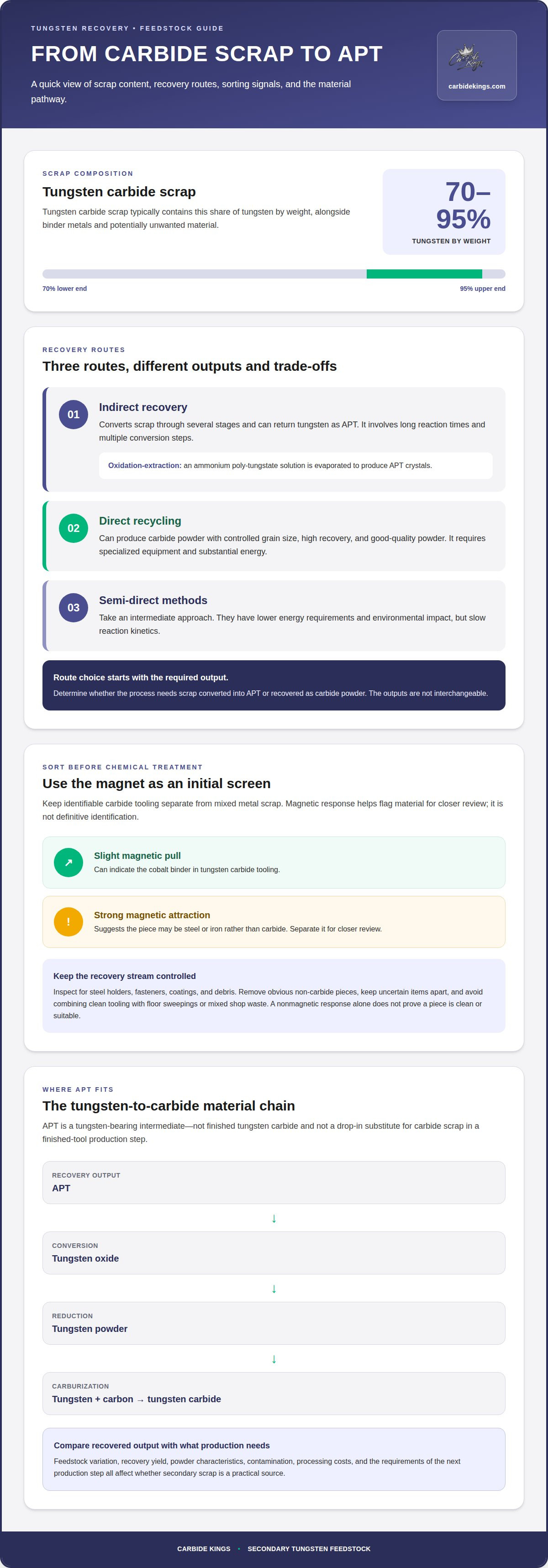
Indirect recovery can yield APT, but it involves long reaction times and several conversion steps. In oxidation-extraction, an ammonium poly-tungstate solution is evaporated to produce APT crystals. Direct methods can yield high recovery and good-quality powder, but require specialized equipment and substantial energy. Semi-direct methods have lower energy requirements and environmental impact, though their reaction kinetics are slow. Compare these trade-offs with the costs of tungsten ore and APT.
Feedstock Quality and Scrap Controls
Scrap composition influences processing and recovered feedstock. Tungsten carbide scrap typically contains 70% to 95% tungsten by weight, alongside binder metals and potentially unwanted material. Sorting separates identifiable pieces before chemical treatment. A slight magnetic pull can indicate cobalt binder in carbide tooling; strong attraction suggests steel or iron instead. Separating these materials helps reduce contamination entering the recovery stream.
Supply, Yield, and Quality Risks
Replacing virgin ammonium paratungstate with secondary carbide hard scrap means accounting for variation in feedstock, recovery yield, and powder characteristics. Mixed grades or contaminants can complicate conversion, and indirect processing adds stages where material can be lost. In the United States, requirements for transport, processing, and imports depend on scrap classification, composition, contamination, and shipment route. For a reliable sourcing plan, compare recovered output and processing costs with the tungsten feedstock your production requires.
Ammonium Paratungstate in Tungsten Carbide Production
Ammonium paratungstate (APT) is a tungsten-bearing intermediate, not finished tungsten carbide. Manufacturers convert it into tungsten oxide, then reduce that oxide to tungsten powder. The powder is combined with carbon and processed to form tungsten carbide. Each stage changes the material, so APT cannot simply replace carbide scrap inside a finished-tool production step.
APT provides a route to tungsten powder before carbide formation. Powder quality matters because later stages depend on its properties and controlled carbon addition. When assessing secondary scrap, distinguish between scrap used as recovery feedstock and APT used as an intermediate input.
In the conventional route, oxide reduction produces tungsten powder; carburization then combines tungsten and carbon to form tungsten carbide. The resulting material can undergo further processing into carbide products. Each conversion stage has its own requirements, and feedstock composition and condition can affect how consistently it moves through them.
Recovered tungsten can re-enter this chain after scrap has been processed into a suitable intermediate. Indirect recycling can return tungsten to APT, while some direct routes recover carbide powder instead. The outputs are not interchangeable: APT supports the oxide-to-powder route, while recovered carbide powder may suit a different manufacturing pathway. Choose the recovery route according to the product your process requires.
That distinction helps frame replacing virgin APT with secondary carbide hard scrap: scrap is an upstream source of tungsten, not a drop-in chemical equivalent to APT. The recovered material must meet the needs of the next process step. Manufacturers can assess secondary carbide scrap feedstock as a potential input to tungsten recovery, then consider whether the resulting material matches their production route.
What scrap sorting and contamination controls are required for recycling carbide hard scrap?
Start sorting by separating identifiable tungsten carbide tooling from mixed metal scrap. Keep carbide inserts, worn cutting tools, and loose steel parts in distinct groups. A mixed load can introduce iron or steel into the recovery process, complicating the feedstock. Record each group’s source and visible condition to keep material from different equipment or production areas traceable. This separation also makes the next inspection more useful.
Use a magnet for initial screening, not as a definitive identification method. A slight magnetic pull can indicate the cobalt binder in tungsten carbide tooling. Strong attraction suggests the piece may be steel or iron rather than carbide. Separate strongly magnetic pieces from the carbide lot for closer review. A nonmagnetic response alone does not prove a piece is clean or suitable, so combine the check with visual sorting and knowledge of the tool type.
Inspect each batch for attached or mixed materials before recovery. Look for steel holders, fasteners, coatings, and debris that could travel with the carbide. Remove obvious non-carbide pieces and keep uncertain items separate from the identified lot. Avoid combining clean tooling with floor sweepings or mixed shop waste, which can introduce unknown metals and make the scrap composition less consistent.
Keep sorted lots separate during collection, storage, and transfer. Label each container clearly with its material group and source, and preserve the labels as the batch moves. If mixed material enters a container by mistake, isolate it rather than blending it into a clean lot. These controls help clarify feedstock composition before chemical processing and help processors select a recovery route suited to the material, rather than treating every carbide-bearing item as identical.
For example, keep identifiable carbide cutting inserts separate from steel holders and mixed maintenance debris. Magnetic screening can flag likely steel or iron, while visual inspection and lot separation reduce the chance of those pieces entering the same recovery stream.
Recycled vs Virgin Tungsten in Carbide Quality
Recycled tungsten is not one uniform material. Its properties depend on the recovery route and the condition of the carbide scrap. Virgin APT enters production as a defined chemical intermediate, while secondary scrap must first be processed into a suitable tungsten-bearing product. To compare them, look beyond origin: consider the recovered material’s form and whether it suits the next manufacturing stage.
Direct recycling can produce good-quality powder with controlled grain size and high recovery. Zinc recovery offers another route, with reclaimed powder described as nearly the same as virgin powder in proportion. Electrolytic recovery dissolves the cobalt binder from tungsten carbide cutting tools, and the recovered carbide is described as uncontaminated. These descriptions are specific to the processes and do not establish identical performance across every scrap batch or finished carbide application.
For production decisions, distinguish recovered tungsten powder from recovered tungsten carbide. APT supports a conversion route through tungsten oxide and powder before carbide formation. Recovered carbide powder may enter a different route. Evaluate whether the recovered material’s composition and physical form suit the intended process, not just whether it came from scrap.
Grain-size control is a key consideration for direct recycling, while the quality of indirect recovery depends on its conversion stages. Scrap composition matters too: cemented carbide combines hard carbide phases with a binder metal, often cobalt. A process designed for one feedstock can produce a different result with another. Keep recovered lots separate, then assess their characteristics against the requirements of the planned carbide product.
Replacing virgin APT with secondary carbide scrap therefore means qualifying the recovery output for its role, rather than assuming recycled and virgin inputs behave identically. Explore carbide scrap materials as a potential secondary feedstock for tungsten recovery.
Carbide Kings: Tungsten Hard Scrap
Carbide Kings supplies Tungsten Hard Scrap to industrial buyers evaluating secondary material for tungsten recovery. Its product range also includes Tungsten Soft Scrap, Carbide scrap, and Tungsten Alloys, giving manufacturers material categories to consider against their production needs.
Consider these materials when assessing scrap as a potential feedstock or sourcing tungsten and carbide scrap for industrial use. The right category depends on your recovery route and the feedstock form your process requires. Keep those requirements in view as you compare options.
For a process that converts carbide scrap into an intermediate such as ammonium paratungstate, Tungsten Hard Scrap or Carbide scrap may be relevant starting points. Tungsten Soft Scrap and Tungsten Alloys are additional categories for other industrial requirements.
Contact Carbide Kings to discuss its tungsten and carbide scrap materials.
Set a Clear Next Step for Secondary Feedstock
A practical plan for replacing virgin ammonium paratungstate with secondary carbide hard scrap starts by defining the recovered material’s role in production. Specify the feedstock requirements, recovery route, and quality measures that matter to the finished carbide. This gives procurement and production teams a shared basis for assessing secondary material without treating it as a direct, one-for-one substitute.
Then align material sourcing with the intended recovery pathway. Clear requirements make it easier to assess which scrap categories fit your operation and what further processing is needed. Carbide Kings supplies Tungsten Hard Scrap, Tungsten Soft Scrap, and Carbide scrap to industrial buyers considering secondary materials.
Contact Carbide Kings to discuss your tungsten and carbide scrap requirements. A focused conversation can help move your material sourcing plans forward.
Frequently Asked Questions
What qualifies as secondary carbide hard scrap and what are its tungsten and cobalt contents?
Secondary carbide hard scrap is used or leftover cemented-carbide material collected for recovery, such as worn tooling or manufacturing offcuts. Tungsten carbide scrap typically contains 70% to 95% tungsten by weight. Cobalt is commonly used as the binder in cemented carbide, but its content varies by material; there isn’t one fixed cobalt percentage for every scrap lot. Composition affects how the material can be processed.
Can recycled tungsten carbide scrap replace virgin ammonium paratungstate in carbide production?
Scrap can provide a secondary tungsten source, but it is not a direct chemical substitute for ammonium paratungstate (APT). It must be processed into a feedstock suited to the manufacturer’s chosen production route. For example, recovery may produce APT for conversion into tungsten powder, or carbide powder for a different production pathway. The recovered product’s form and characteristics determine its role.
What processing steps convert carbide hard scrap into tungsten powder or tungsten carbide powder?
For an indirect route, scrap is prepared and chemically processed to recover tungsten into an ammonium poly-tungstate solution. Evaporating the solution forms APT crystals; further processing converts APT through tungsten oxide into tungsten powder. Adding carbon and processing the mixture produces tungsten carbide. Direct recovery follows a different route and can produce carbide powder. The chosen pathway determines the intermediate product and equipment required.
What are the current US prices for ammonium paratungstate and carbide hard scrap?
There is no single fixed U.S. price for either material across all transactions. APT values move with market conditions, while scrap quotes depend on material type, grade, tungsten content, weight, condition, and current market rates. Carbide Kings does not publish a fixed price list. Its quotes are based on the actual material offered, not a universal per-pound rate.
What are the cost savings and break-even economics of using recycled hard scrap instead of virgin APT?
Break-even depends on the cost of usable recovered tungsten, not simply on how much scrap you buy. Compare the costs of scrap acquisition and transport, sorting, processing, energy, and quality control with the cost of APT that delivers equivalent usable tungsten. Recovery yield matters: lower output per batch raises the effective cost per unit of recovered material. Specialized equipment and longer processing stages also affect the calculation.
What are the environmental impacts and energy savings of recycling carbide scrap versus producing tungsten from ore?
Recycling returns tungsten from carbide scrap to the supply chain, reducing reliance on extracting tungsten from ore. Energy use and environmental effects vary by recovery route. Direct methods can require substantial energy and specialized equipment, while semi-direct methods have lower energy requirements and environmental impact but slower reaction kinetics. Indirect recovery involves several conversion stages. The chosen process determines the balance among resource recovery, energy use, and processing time.


