

The obvious choice isn't always the right one: the choice between secondary tungsten hard scrap and ferrotungsten additions in tool steel production comes down to material form and how tungsten enters the steel. Ferrotungsten is an iron-tungsten alloy used as a tungsten addition, with a tungsten content of 75-82%. Secondary hard scrap is a different kind of tungsten-bearing material, not the same alloy in another form.
Both materials contribute tungsten, but they play different roles in production. This article explains what ferrotungsten is, how it adds tungsten to tool steel, and what to consider when comparing it with secondary hard scrap. It also covers why ferrotungsten is used in high-speed and hot-work steels, and how material form and process suitability affect the choice.
Key Takeaways
- Distinguish alloying additions from secondary hard scrap by considering how each material fits into the steelmaking process.
- Understand why tungsten’s contribution matters in high-speed and hot-work tool steels.
- Compare potential usable yield by looking at material composition, form, and suitability for the intended melt.
- Learn which tungsten-bearing materials can support manufacturing and metallurgical needs, including hard scrap, soft scrap, carbide scrap, and tungsten alloys.
Ferrotungsten as a tungsten alloying addition to steel
Ferrotungsten adds tungsten to a steel melt as an iron-tungsten alloy. Its composition and form help mills plan the melt chemistry, addition process, and quality controls.
Chemistry, Impurities, and Steel Properties
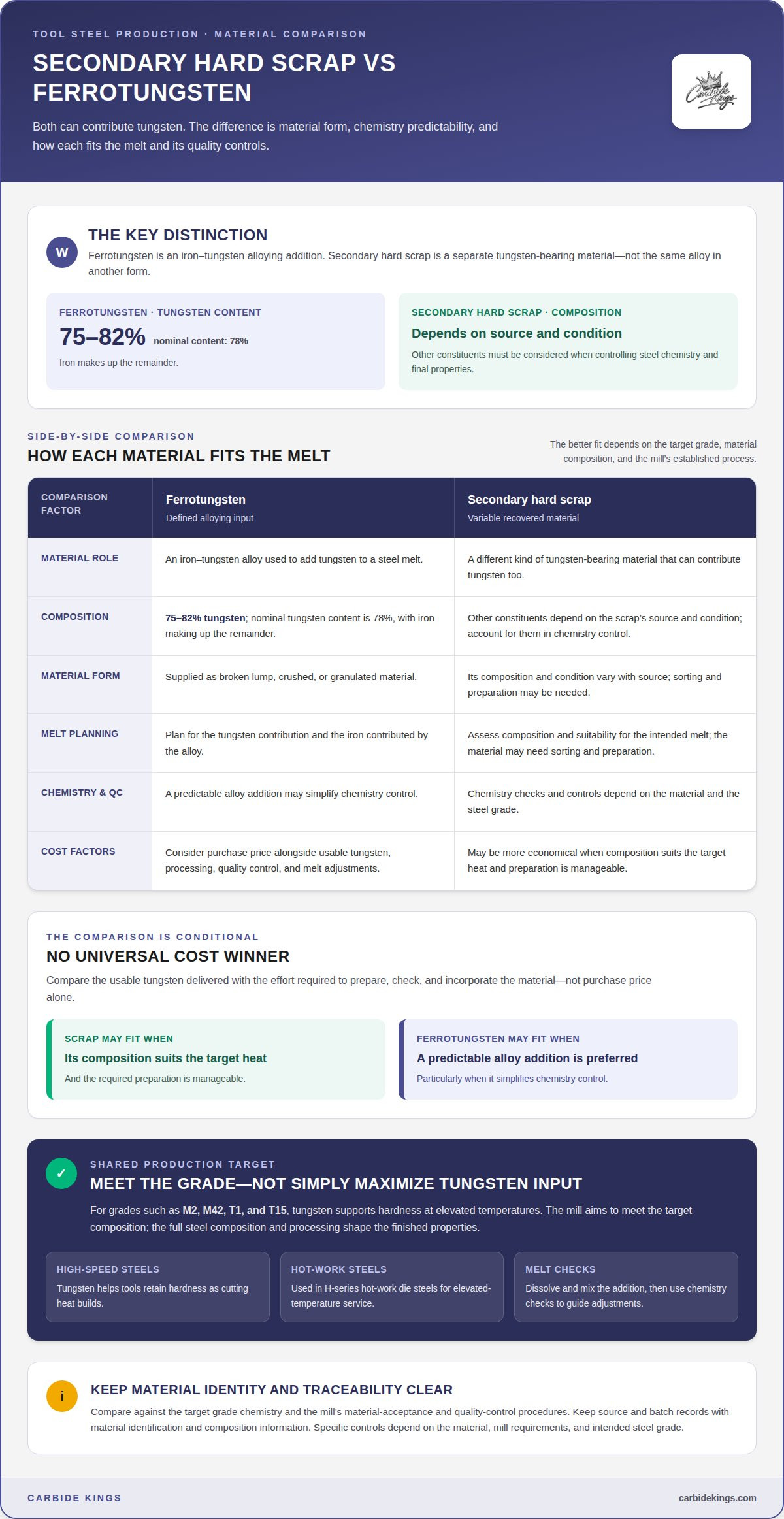
This comparison focuses on how the feed material affects the finished heat. Ferrotungsten contains 75-82% tungsten, with iron making up the remainder; its nominal tungsten content is 78%. Secondary hard scrap can contribute tungsten too, but its other constituents depend on the scrap’s source and condition. Mills account for those constituents when controlling the steel’s chemistry and final properties.
For grades such as M2, M42, T1, and T15, tungsten supports hardness at elevated temperatures. The mill’s aim is to meet the target composition, not simply maximize tungsten input. Sorting and processing scrap help manage potential impurities; the required controls depend on the material and the steel grade.
Melting, Processing, and Quality-Control Costs
A cost comparison should consider more than the purchase price. Ferrotungsten provides a defined alloying input, while scrap may need sorting, preparation, and chemistry checks. Melting behavior and the mill’s established process also affect the work required to incorporate either source.
There is no universal cost winner. Compare the usable tungsten delivered with the processing, quality-control, and melt-adjustment requirements. Scrap may be more economical when its composition suits the target heat and preparation is manageable. Ferrotungsten may be a better fit when a predictable alloy addition simplifies chemistry control.
For U.S. tool steel production, the relevant requirements are the target grade chemistry and the mill’s material-acceptance and quality-control procedures. Keep source and batch records alongside material identification and composition information. These records support traceability, while the specific controls depend on the mill’s requirements and the intended steel grade.
The EU Conflict Minerals Regulation came into effect in January 2021 and applies due diligence requirements to importers of tungsten and other covered minerals, according to the European Union. This applies to covered importers, not as a tool steel chemistry specification.
Tungsten-bearing materials vary in form: hard scrap, soft scrap, carbide scrap, and tungsten alloys each present different processing considerations. Pure tungsten is another form, while ferrotungsten is primarily used as an alloy addition. Choose according to the melt, chemistry target, and quality controls.
Tungsten-containing materials and compounds
Tungsten is found in alloys, compounds, electrodes, and reclaimed industrial materials. Their chemistry and physical form affect how they enter processing. A steelmaking addition is not interchangeable with a tungsten electrode or carbide component. Identify the material first, then assess its composition and intended use.
Ferrotungsten combines tungsten with iron and is supplied as broken lump, crushed, or granulated material. Its density is 14-15.5 g/cm3, and its melting-temperature range is 2400 to 2800 degrees C. Those properties distinguish this alloying material from pure tungsten, which melts at about 3420 °C. The right form and composition determine how the material fits the production process.
Tungsten electrodes also contain different elements depending on their type. Pure tungsten electrodes contain at least 99.50% tungsten. Other examples include:
- Thoriated electrodes, with approximately 1.70 to 2.20% thorium oxide.
- Ceriated electrodes, with 1.8-2.20% cerium oxide.
- Lanthanated electrodes, with approximately 1.30-1.70% lanthanum oxide.
- Zirconated electrodes, with about 0.15 to 0.40% zirconium oxide.
These compositions serve distinct electrode applications. They are not equivalent to ferrotungsten additions for steelmaking.
Tungsten carbide is another distinct material, with a density of approximately 15.63 g/cm³. In cemented carbide, tungsten carbide works with a binder, commonly cobalt or nickel. Tungsten powder can also arise during compaction, grinding, or chemical conversion of scrap. These forms differ in composition and physical condition, so their suitability depends on the receiving process and its material controls.
Separate tungsten-bearing materials during handling to reduce cross-contamination. Match each material to its intended processing route, whether alloy production, electrode use, or steelmaking. For industrial context on tungsten alloys, explore tungsten material categories.
Ferrotungsten additions to steel
Tool steelmakers use ferrotungsten to add tungsten during melting. This helps control steel chemistry and supports hardness in demanding applications. Tungsten is useful in high-speed cutting tools because it helps them retain hardness as heat builds. It is also used in H-series hot-work die steels, where tools face elevated temperatures in service.
The process starts with the steel grade and its target composition. The melt plan accounts for the tungsten already present and the contribution expected from ferrotungsten. Because ferrotungsten contains iron as well as tungsten, it contributes both elements. Operators add it to the melt, allow it to dissolve and mix, then use chemistry checks to guide further adjustments.
That approach differs from treating tungsten as pure metal. Tungsten has a melting point of about 3420 °C, the highest melting point among metals. Ferrotungsten provides an alloying route suited to steelmaking, rather than requiring pure tungsten to be added as the charge. The selected addition and melt practice should support the grade’s chemistry and the finished tool’s intended use.
In service, tungsten helps tool steel resist softening as cutting generates heat. The balance of hardness and other properties depends on the steel’s full composition and processing, not tungsten alone. Toolmakers select grades for specific applications, including high-speed machining and hot-work tooling. Those requirements shape the melt target and addition plan.
Practical melt control follows a clear sequence:
- Set the target chemistry for the intended tool steel grade.
- Account for the tungsten contribution from the planned ferrotungsten addition.
- Add and mix the alloy during melting.
- Use chemistry results to assess whether the melt meets its target.
Demand for tool steels reflects their use in cutting tools and industrial components exposed to heat. Ferrotungsten gives steelmakers a direct way to introduce tungsten into these alloys. Its role is specific: to support the required composition so the finished steel can deliver the properties needed for its application.
Hard Scrap vs Ferrotungsten: Recovery and Yield
Usable yield depends on how much tungsten reaches the intended product. Comparing secondary tungsten hard scrap vs ferrotungsten additions in tool steel production therefore means focusing on recoverable tungsten, not just total input weight. Ferrotungsten enters steelmaking as an alloying material with a known tungsten content. Hard scrap has a different composition and processing history, so its recoverable content depends on its condition and processing route.
For ferrotungsten, the mill plans the addition around the melt’s chemistry target and accounts for the alloy’s iron contribution. For scrap, identify and segregate the material before selecting a suitable route. Tungsten carbide scrap, swarf, and reclaim can be recycled into tungsten oxide and pure tungsten powder at dedicated recycling facilities. Each conversion step affects the material available for later use.
Assess recovery through a consistent sequence:
- Identify the scrap type and available composition information.
- Separate unlike materials to limit cross-contamination.
- Choose a route suited to the material’s form and condition.
- Compare the tungsten entering processing with usable output.
A practical comparison of secondary tungsten hard scrap vs ferrotungsten additions in tool steel production also considers preparation. Swarf mixed with coolant or lubricant, for example, needs different handling from solid scrap. Ferrotungsten avoids some scrap-sorting steps, but the melt still requires chemistry control. The better fit depends on usable tungsten after preparation and process losses, not on an assumption that one source always yields more.
For a potential scrap recovery pathway, explore tungsten scrap material options and match the material form to its intended use.
Carbide Kings: Tungsten Hard Scrap
Carbide Kings supplies tungsten hard scrap to industrial buyers evaluating secondary tungsten-bearing material. It may be relevant when assessing scrap as a potential input or managing tungsten-bearing materials alongside ferrotungsten additions. The right choice depends on the material’s composition, condition, and suitability for your processing route.
Carbide Kings also supplies tungsten soft scrap, carbide scrap, and tungsten alloys. Keeping these material categories distinct clarifies what you are sourcing and how it may fit your manufacturing or metallurgical needs. Select the category that matches the requirement rather than treating every tungsten-bearing form as interchangeable.
If you’re considering tungsten hard scrap for your material needs, contact Carbide Kings.
Make Your Next Tungsten Decision with Clarity
Choosing between secondary tungsten hard scrap and ferrotungsten additions in tool steel production starts with the material requirement. Identify the intended application, the chemistry your process needs, and the role each input can play. This gives your production team a practical basis for evaluating material fit without assuming one source suits every heat.
For operations considering secondary tungsten-bearing material, keep the next step straightforward: connect the material category to your manufacturing or metallurgical needs. Carbide Kings offers tungsten scrap materials for industrial use. Contact the team to discuss your tungsten scrap needs and take the next step with a clear purpose.
Contact Carbide Kings about tungsten scrap. A focused conversation can help move your material decision forward.
Frequently Asked Questions
What is Ferrotungsten?
Ferrotungsten is an iron-tungsten alloy used to add tungsten to steel during production. It is an alloying input, not a finished tool steel grade. Steelmakers may receive it as broken lump, crushed, or granulated material, then incorporate it according to their melt practice. Its purpose is to contribute tungsten to the steel chemistry required for the intended application.
What is ferrotungsten and what tungsten content and grades are commonly sold?
Ferrotungsten commonly contains 75-82% tungsten, with a nominal tungsten content of 78%. The identified product types are high-carbon and low-carbon ferrotungsten. M2, M42, T1, and T15 are tool-steel grades that use tungsten additions, not ferrotungsten product grades. The steel grade and the ferrotungsten type are separate specifications used for different decisions.
What preparation and processing steps are needed to use tungsten hard scrap in steelmaking?
Start by separating scrap by material type and keeping it in sealed, labeled containers to limit cross-contamination. Remove or manage oil and water where present; high-pressure filtration and water washing can be used for these contaminants. Gravity concentration and magnetic separation can reduce non-metallic content. The receiving process determines which preparation steps suit each scrap form.
How are ferrotungsten and tungsten scrap added during tool steel production?
Ferrotungsten is added to the steel melt as an alloying input, with the charge planned around the target steel chemistry. Tungsten scrap that meets the producer’s quality requirements may be added directly to the furnace as part of a feed-material blend. The mill’s melt plan accounts for each input’s composition and form, then controls the resulting chemistry for the intended grade.
What risks do phosphorus, sulfur, cobalt, or other contaminants in tungsten scrap pose?
Contaminants can shift the melt away from its target chemistry and affect the finished steel’s properties. In tungsten sludge, preferred phosphorus content is below 0.03%, and preferred non-metallic content is below 5%. Sulfur and cobalt also need to be considered as part of the material’s composition; their effect depends on the amount present and the steel grade being produced.


