

A generic “carbide scrap” label isn’t enough to guide a production purchase. Industrial carbide scrap procurement for hardfacing electrode production should start with the downstream processing route, then work back to the feedstock that route can accept. This helps prevent a mismatched or inconsistent lot from disrupting formulation and production planning.
To compare scrap categories and lots, build an incoming-material specification around your production requirements instead of relying on assumptions. Define what information is needed to assess each lot, and use the same criteria throughout the purchasing process.
This guide explains how to translate electrode requirements into procurement criteria, compare carbide scrap with relevant tungsten materials, and address sourcing risks before buying. Carbide Kings supplies industrial buyers with carbide scrap, tungsten hard scrap, tungsten soft scrap, and tungsten alloys. Use the framework to clarify what your production route needs and make a more informed sourcing decision.
Key Takeaways
- Anchor industrial carbide scrap procurement for hardfacing electrode production to the downstream processing route, not a generic material label.
- Build an incoming-material specification around scrap form, source, condition, sorting, and intended use.
- Separate documented lot details from assumptions about chemistry, binder, contamination, and production suitability.
- Compare material categories and lots using consistent criteria, then align procurement, engineering, and production teams on acceptance requirements.
- Assess carbide scrap, tungsten hard scrap, tungsten soft scrap, and tungsten alloys against buyer-defined needs.
How hardfacing electrode production shapes industrial carbide scrap procurement
Hardfacing electrodes are welding consumables used to deposit a wear-resistant layer onto a component’s surface. The goal is to help protect parts exposed to wear, rather than simply join two pieces of metal. The application and manufacturing method shape the required deposit and its formulation. Because the hardfacing metalworking process can involve different materials and application methods, buyers should start with the production route, not a broad scrap label.
Tungsten carbide is relevant to some wear-resistant applications, but carbide scrap is a potential industrial feedstock, not automatically a ready-to-use electrode ingredient. Its form, source, condition, and processing history may affect whether it can be prepared for a particular manufacturing route. A material name alone doesn’t establish composition, consistency, or compatibility.
What role can carbide-bearing material play in hardfacing?
Hardfacing deposits are designed around a component’s wear-related demands. Carbide-bearing material may be considered for some formulations, but that doesn’t guarantee a particular performance outcome. The electrode recipe and production route determine which material characteristics matter and how feedstock must be prepared. Treat the intended use as the starting point for procurement, not as proof that a scrap category is suitable.
Why does the production route matter before sourcing?
Electrode formulation requirements are narrower than the general category of industrial carbide scrap. A manufacturing process may require preparation, such as sorting or sizing, before a scrap material can enter production. The necessary steps depend on the buyer’s process, so don’t assume every lot can be used in the same way.
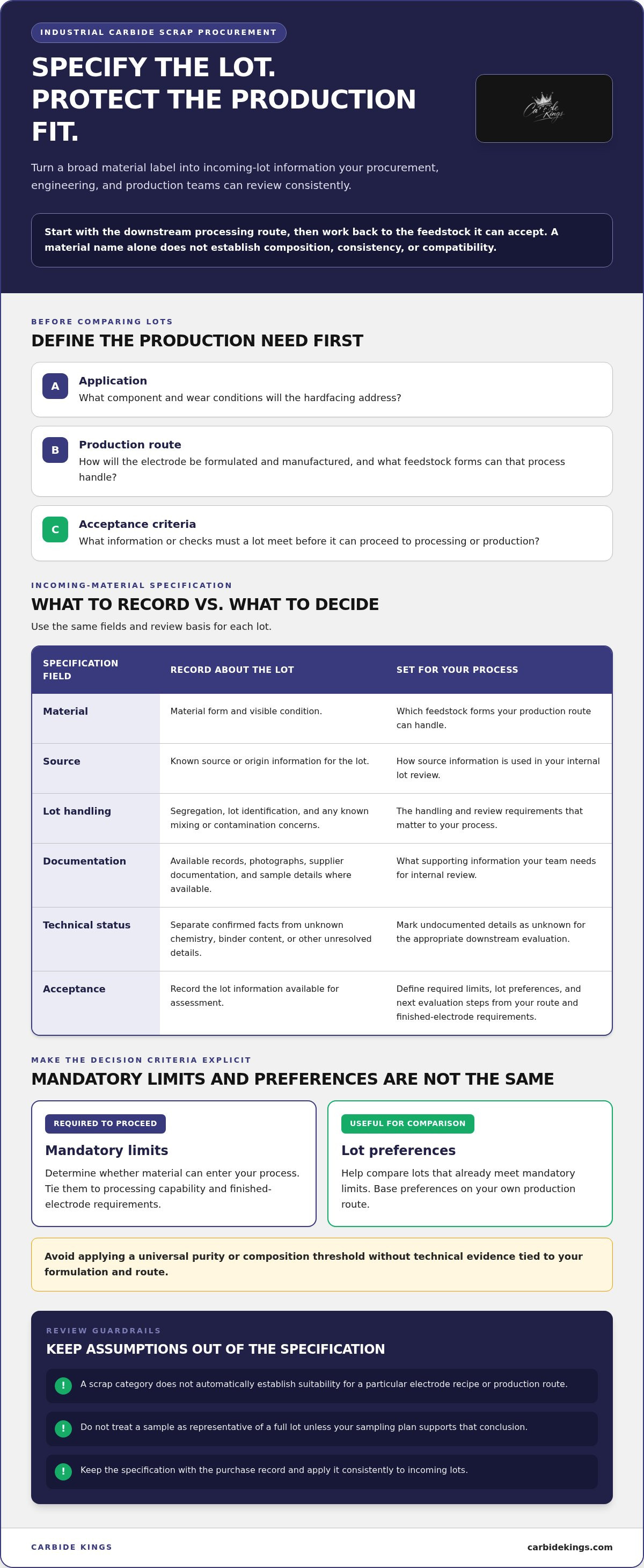
Before requesting or comparing material, document three things:
- Application: What component and wear conditions will the hardfacing address?
- Production route: How will the electrode be formulated and manufactured, and what feedstock forms can that process handle?
- Acceptance criteria: What information or checks must a lot meet before it can proceed to processing or production?
Use these details to make industrial carbide scrap procurement for hardfacing electrode production a defined purchasing decision. Procurement suitability means a material category and its available lot information appear relevant to the buyer’s stated process and acceptance criteria. It does not guarantee chemical compatibility, successful processing, or finished-electrode performance. Keep documented facts separate from assumptions, and carry unresolved technical questions into the next evaluation step.
Which carbide scrap characteristics should buyers specify before procurement?
A useful specification turns “carbide scrap” into a lot that procurement, engineering, and production can evaluate on the same basis. Describe the material’s form and visible condition, what is known about its source, how it is segregated, and what your process can accept. Keep confirmed lot details separate from assumptions about chemistry, binder content, or contamination.
Set technical requirements from your own production route. If your electrode qualification or internal process uses welding standards, refer to the relevant documents. The American Welding Society (AWS) standards resource provides a starting point for finding AWS codes and standards. A general standards reference is not evidence of a scrap lot’s composition or a universal feedstock threshold.
What lot information helps assess carbide scrap?
Capture the material form and visible condition, whether the lot is segregated, and any source or origin information available for that lot. Record supporting documents and label unknowns plainly. If chemistry or binder content isn’t documented, mark it as unknown for the appropriate downstream evaluation rather than filling the gap with an assumed value.
For internal review, define what supporting information your team needs, such as lot identification, photographs, supplier-provided documentation, and sample details where available. Set the sampling and evaluation method through your own technical process. Don’t imply that a sample represents a full lot unless your sampling plan supports that conclusion.
How should buyers define acceptance criteria?
Separate mandatory limits from preferences. Mandatory criteria determine whether material can enter your process; preferences help compare lots that already meet those limits. Base both on processing capability and finished-electrode requirements. Avoid applying a universal purity or composition threshold without technical evidence tied to your formulation and route.
Use this checklist to align teams before procurement:
- Material: Form, visible condition, and known source or origin.
- Lot handling: Segregation, identification, and any known mixing or contamination concerns.
- Documentation: Available records, photographs, and sample information required for internal review.
- Technical status: Confirmed facts separated from unknown chemistry, binder content, or other unresolved details.
- Acceptance: Required limits, lot preferences, and next evaluation steps tied to the intended processing route.
Keep this specification with the purchase record and apply it consistently to incoming lots. To review industrial carbide scrap categories, start with your defined material and documentation needs, then carry those criteria into the next procurement step.
How to compare industrial carbide scrap sources for electrode production
A source comparison is useful only when each lot is described on the same basis. Record what is identified about the material, what your production team requires, and what remains unknown. A label such as “carbide scrap,” “hard scrap,” or “soft scrap” names a material category; it doesn’t establish a grade, chemistry, or suitability for electrode production.
Compare procurement fit separately from price. A lower-priced lot may require additional evaluation or processing, while another may better match your handling and acceptance requirements. Without comparable lot information, price alone can create the false impression that two materials are equivalent.
What belongs in a scrap-source comparison table?
Use a shared worksheet for every lot. Keep documented details distinct from your acceptance criteria and unresolved technical questions. Mark missing information as “unknown,” not as an assumed value.
| Comparison field | Record |
|---|---|
| Material category and form | The material description and its observable form. |
| Lot description | Available details on source, condition, segregation, and lot identification. |
| Documentation | Records available for that specific lot; mark unavailable items as unknown. |
| Buyer requirements | Your required process fit, acceptance limits, and internal review steps. |
| Open technical questions | Unresolved chemistry, binder, contamination, or other details requiring evaluation. |
| Procurement fit | How documented details align with your requirements, considered separately from price. |
Clear descriptions make comparisons more useful. Identify the material category and available lot details without treating a scrap label as proof of composition or quality. For industrial carbide scrap procurement for hardfacing electrode production, use the same comparison fields across lots, then route technical unknowns through your own acceptance process.
When is hard scrap, soft scrap, or an alloy relevant?
Tungsten hard scrap, tungsten soft scrap, carbide scrap, and tungsten alloys are distinct procurement categories, not interchangeable electrode feedstocks. Their relevance depends on the form your process can handle and the technical requirements established by your production team. Don’t infer electrode suitability from a category name alone.
Use the buyer-defined specification to decide which categories merit further evaluation. For broader context on tungsten carbide scrap value or the differences between hard and soft scrap, consult the relevant guides when comparing material categories. Keep general discussions separate from a lot-specific assessment: neither a category label nor a market comparison establishes the composition or production fit of an individual lot.
A practical procurement workflow from production requirements to receiving
Connect each procurement decision to the production need it serves. A shared workflow helps engineering define material requirements, procurement compare categories and lot details, and production apply its established receiving and acceptance procedures. The goal is a clear handoff, not an assumption that a purchase description alone determines technical suitability.
How should teams prepare a procurement request?
Start with the application and the route the material would follow. Engineering and production should identify the intended use, required material form, processing capability, and acceptance criteria. Procurement can then use those requirements to compare available material categories and lot details consistently.
Include the information purchasing needs to assess an offer: the material description, available lot details, supporting records, and any known limitations. Label unanswered technical questions as open items. This keeps the request specific without implying that a general scrap label proves chemistry, grade, or compatibility.
- Engineering: Define application requirements and technical acceptance criteria.
- Production: Identify process constraints, handling needs, and receiving checks.
- Procurement: Compare material-category and lot information in a consistent format, then document the agreed purchasing description.
Align these teams before requesting material. Procurement can then compare offers against shared requirements rather than filling in technical gaps independently. This also makes industrial carbide scrap procurement for hardfacing electrode production easier to manage from the initial request through internal review.
What should happen when material arrives?
Use established receiving, segregation, and inspection procedures before releasing material for production. Compare the received material and its accompanying records with the agreed purchasing description. Record discrepancies clearly, such as a difference in described form, condition, or lot identification.
Keep the roles distinct. Receiving staff document what arrived; procurement follows up on differences from the purchasing description; the responsible materials or production team makes technical acceptance decisions under internal procedures. If a lot needs further evaluation or processing, leave that decision with the team responsible for those controls. Receipt alone is not approval for production use.
For broader context on handling industrial scrap through the purchasing and logistics stages, consult your industrial scrap logistics guidance alongside this production-focused workflow. To apply your criteria, explore tungsten and carbide scrap categories and compare them against your defined requirements.
Source industrial tungsten and carbide scrap with Carbide Kings
A focused sourcing plan starts with production requirements, then identifies which material categories merit review. Carbide Kings supplies industrial buyers with tungsten hard scrap, tungsten soft scrap, carbide scrap, and tungsten alloys. These are distinct sourcing categories, not interchangeable feedstocks or guarantees of suitability for a particular electrode formulation.
Which Carbide Kings material categories may fit a sourcing brief?
Start with the material form your process can handle and the lot information your team needs to evaluate. Tungsten hard scrap may be relevant to one sourcing brief; tungsten soft scrap, carbide scrap, or tungsten alloys may be worth assessing for another. The category name is a starting point, not proof of chemistry, grade, or compatibility. Let the intended application, processing route, and acceptance criteria guide your team’s technical review.
For broader buyer context, consult Carbide Kings’ hard scrap procurement guide alongside your production-led criteria. Keep general purchasing guidance separate from the evaluation of a specific lot.
What should buyers prepare before moving forward?
Make the next step straightforward. Bring together the intended use, preferred material form, required acceptance criteria, and the lot documentation your team needs. Procurement can use that brief to compare categories consistently, while engineering or the responsible production team determines whether a material can enter the planned route.
- Intended use: State the application the electrode is designed to serve.
- Material needs: Describe the preferred form and relevant category, distinguishing requirements from preferences.
- Acceptance criteria: Record the limits and review steps established by your technical team.
- Lot information: Identify the supporting details and records needed for internal assessment.
This framework makes industrial carbide scrap procurement for hardfacing electrode production more organized without relying on unsupported assumptions about material properties. Carbide Kings’ industrial supply categories give buyers a direct place to begin once the sourcing brief is defined. Explore Carbide Kings’ industrial tungsten and carbide scrap offerings.
Turn your production requirements into a clear sourcing plan
Effective industrial carbide scrap procurement for hardfacing electrode production starts with the intended processing route, not a broad material label. Define the form and lot information your team needs, separate confirmed details from unknowns, and align procurement, engineering, and production on acceptance criteria before purchasing.
This framework helps you compare sourcing categories without assuming that a scrap label proves chemistry or production suitability. Carbide Kings supplies tungsten hard scrap, tungsten soft scrap, carbide scrap, and tungsten alloys to industrial and manufacturing buyers across the United States. Assess each category against your requirements and internal technical review.
Ready to put your sourcing criteria to work? Explore Carbide Kings’ industrial tungsten and carbide scrap offerings and identify the categories relevant to your procurement brief. A clear specification is a strong first step toward a more informed purchase.
Frequently Asked Questions
Can industrial carbide scrap be used directly to produce hardfacing electrodes?
Not automatically. Industrial carbide scrap is a potential feedstock, but it may need evaluation or processing before it can enter an electrode manufacturing route. Suitability depends on the material’s form and known characteristics, the buyer’s formulation, and the equipment and controls used downstream. Treat each lot as a candidate for technical review, not as ready-to-use electrode material based on its label alone.
What types of carbide scrap may be relevant to hardfacing electrode production?
Carbide scrap may be worth evaluating when its material form and available lot information align with the buyer’s intended process. Buyers may also compare separate sourcing categories such as tungsten hard scrap, tungsten soft scrap, and tungsten alloys. These labels identify broad categories, not interchangeable feedstocks or confirmed compositions. Start with the production route and acceptance criteria, then determine which categories warrant further review.
How do buyers evaluate carbide scrap for electrode manufacturing?
Evaluate each lot against the process requirements defined by your engineering and production teams. Record its described form, visible condition, segregation, available source information, and supporting documentation. Separate confirmed details from unknowns, including chemistry, binder content, or possible contamination. Industrial carbide scrap procurement for hardfacing electrode production works best when buyers compare lots using the same criteria and leave technical acceptance decisions to the responsible internal team.
What information should a procurement request include for industrial carbide scrap?
Include the intended application, processing route, preferred material form, required acceptance criteria, and documentation your team needs to assess an offer. Ask for a clear description of the specific lot and any supporting information available for it. Identify which requirements are mandatory and which are preferences. This gives procurement a consistent basis for comparing material categories while keeping unresolved technical questions visible for internal review.
Is tungsten carbide scrap the same as ready-to-use electrode feedstock?
No. Tungsten carbide scrap is a material category, while ready-to-use feedstock must meet the needs of a particular manufacturing route. A category name doesn’t establish a lot’s composition, condition, or compatibility with an electrode formulation. Buyers should assess available lot information and determine through their own technical process whether preparation or further evaluation is needed before the material can be considered for production.
Can hard scrap and soft scrap be evaluated using the same acceptance criteria?
Not necessarily. Tungsten hard scrap and tungsten soft scrap are separate sourcing categories, and a buyer’s handling and processing requirements may differ between them. Use shared documentation fields to compare offers, but set technical acceptance criteria according to the material category and intended route. Don’t assume that a threshold developed for one category applies to another unless your technical team has a sound basis for doing so.
How should manufacturers compare carbide scrap lots from different sources?
Use one comparison record for every lot. Capture the material description and form, visible condition, segregation, available documentation, and alignment with your buyer-defined requirements. Mark missing details as unknown rather than inferring quality or composition from a label. Assess procurement fit separately from price, since two lots with similar labels may differ in information, handling needs, or fit with your process.


