

A domestic source alone doesn’t make a tungsten lot defense-ready. Domestic secondary tungsten supply contracts for defense manufacturers need to connect material requirements with qualification and procurement controls from the start. That allows buyers to assess whether a supply option fits the project, rather than treating “domestic” as proof of suitability.
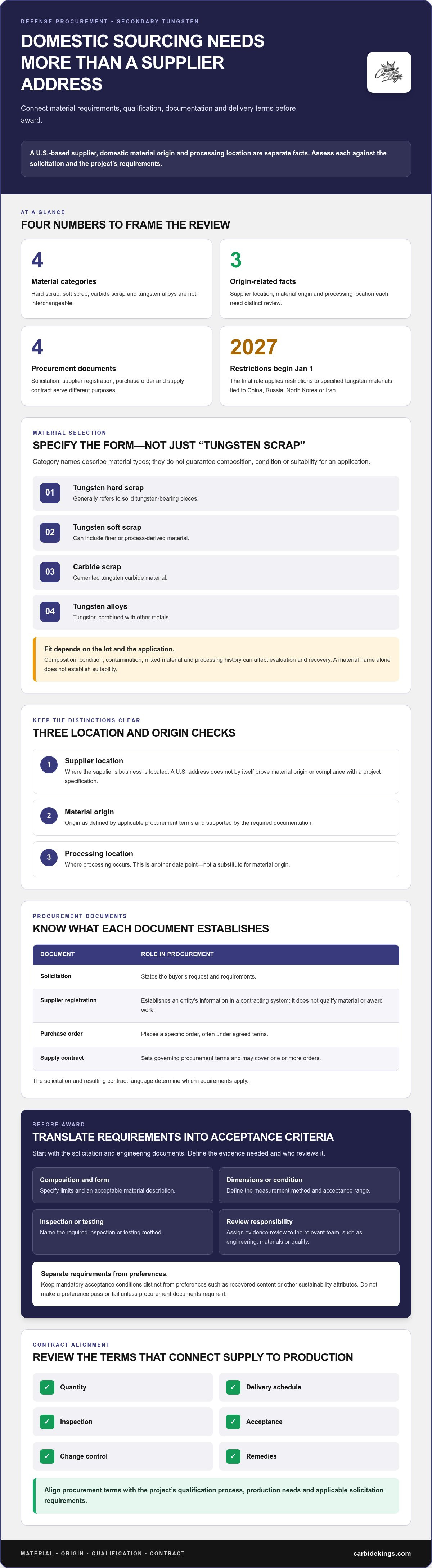
Origin, documentation, and lot consistency all matter, as does production continuity. Requirements can vary by solicitation and application. The Department of Defense’s final rule adds urgency: beginning January 1, 2027, restrictions apply to specified tungsten materials tied to China, Russia, North Korea, or Iran. A domestic secondary source still needs to meet the applicable project requirements.
This guide offers a practical framework for evaluating secondary tungsten supply, defining contract specifications, and aligning material qualification with purchasing terms. It covers material categories, documentation, lot controls, and continuity provisions without assuming every scrap stream fits every application. Carbide Kings supplies tungsten hard scrap, tungsten soft scrap, carbide scrap, and tungsten alloys for industrial material sourcing. Use the guidance to connect procurement questions with a contract approach based on your project’s requirements.
Key Takeaways
- Use contract specifications to distinguish material form, processing needs, and application requirements. A material name alone doesn’t establish composition or suitability.
- Assess recycled tungsten on the same application-specific basis as other material options. Neither secondary origin nor domestic sourcing automatically determines acceptance.
- Structure domestic secondary tungsten supply contracts for defense manufacturers around the solicitation’s requirements and the project’s qualification process.
- Review quantity, delivery schedule, inspection, acceptance, change control, and remedies before award to align procurement terms with production needs.
- Carbide Kings supplies tungsten hard scrap, tungsten soft scrap, carbide scrap, and tungsten alloys for buyers evaluating industrial material options.
Why Domestic Secondary Tungsten Supply Contracts Matter to Defense Manufacturers
Secondary tungsten supply contracts cover the purchase of recovered or reclaimed tungsten materials that may re-enter industrial supply chains. For defense manufacturers, the contract needs to connect the required material and its qualification process with quantities, inspection, acceptance, and delivery terms. Domestic sourcing, material suitability, and delivery planning are separate checks. A U.S.-based supplier does not, by itself, establish that a material meets an origin requirement or project specification.
Keep the procurement documents distinct. A solicitation states the buyer’s request and requirements. Supplier registration establishes an entity’s information in a contracting system, but doesn’t qualify a material or award work. A purchase order places a specific order, often under agreed terms. A supply contract sets the governing terms for procurement and may cover one or more orders. The solicitation and resulting contract language determine which requirements apply.
What Does Secondary Tungsten Mean in Industrial Procurement?
Secondary material is recovered material returning to industrial use, often after sorting or further processing. Material form matters: tungsten hard scrap generally refers to solid pieces, while soft scrap describes finer or process-derived material. Carbide scrap is tungsten carbide material, and tungsten alloys combine tungsten with other metals. These categories aren’t interchangeable. Composition, condition, and intended processing all affect whether a specific lot can meet an application’s requirements. For background on tungsten’s material characteristics, see Tungsten properties and applications.
Why Defense Buyers Need More Than a Domestic Supplier Address
Separate three facts during review: where the supplier is located, where the material is processed, and where it originated. “Domestic supplier” describes the business’s location. “Domestic material origin” refers to the material’s origin as defined by applicable procurement terms and supported by required documentation. Processing location is another data point, not a substitute for origin.
Start with the solicitation, then carry its applicable origin, qualification, and documentation requirements into the contract. Don’t treat a U.S. address as proof of origin or assume every recovered material is acceptable because it is domestic. A clear contract aligns the purchased material with the buyer’s evaluation and acceptance process. That’s the practical foundation of domestic secondary tungsten supply contracts for defense manufacturers.
Match Secondary Tungsten Material Forms to Contract Specifications
Start with the form the production process requires, not a broad label like “tungsten scrap.” Hard scrap, soft scrap, carbide scrap, and tungsten alloys are different material categories. Their composition, condition, and potential processing routes can differ, so they shouldn’t be treated as interchangeable contract inputs. For a broader overview of hard-scrap recovery, see the tungsten hard scrap recycling guide.
Compare Material Forms Before You Specify Them
Hard scrap generally refers to solid tungsten-bearing pieces; soft scrap can include finer or process-derived material. Carbide scrap is cemented tungsten carbide, while tungsten alloys contain tungsten combined with other metals. These descriptions identify categories, not guaranteed composition, condition, or end-use fit. Contamination, mixed material, and processing history can affect which evaluation or recovery steps are appropriate. Use USGS tungsten statistics for broader context on tungsten supply, then assess each material against the project’s engineering requirements.
For example, a requirement for a defined alloy form cannot be met simply by naming carbide scrap as the input. The material may need a particular composition or conversion pathway before it can meet the intended specification. Carbide Kings supplies tungsten hard scrap, tungsten soft scrap, carbide scrap, and tungsten alloys for industrial material discussions.
Turn Engineering Requirements into Acceptance Criteria
Before award, translate solicitation and engineering documents into measurable criteria. Record the required composition, material form, dimensions or size range, and any specified inspection or testing method. Separate mandatory acceptance conditions from preferences such as recovered content or other sustainability attributes. Don’t make a preference a pass-or-fail requirement unless the procurement documents require it.
Use a review matrix to assign the evidence needed and who is responsible for reviewing it. The evidence listed below is a planning field, not an assumption that every material stream comes with a particular record.
| Requirement | Evidence to define | Responsible reviewer |
|---|---|---|
| Composition and form | Specified limits and acceptable material description | Engineering or materials |
| Dimensions or condition | Measurement method and acceptance range | Quality |
| Inspection or testing | Required method, sampling, and acceptance threshold | Quality or receiving inspection |
| Origin or sustainability preference | Solicitation language and required supporting evidence | Procurement or compliance |
This alignment gives domestic secondary tungsten supply contracts for defense manufacturers a clear basis for evaluating material and resolving acceptance questions. Bring the target form and applicable specification together when exploring industrial tungsten and carbide materials.
Can Secondary Tungsten Meet Defense Procurement Requirements?
It can, when the material meets the application specification, completes the required qualification process, and satisfies the contract’s terms. Recycled origin alone doesn’t make tungsten unsuitable, but it doesn’t make it automatically acceptable either. The decision depends on the material’s demonstrated properties and the buyer’s documented acceptance criteria.
Keep three procurement questions separate: Does the material meet technical requirements? Is the supplier eligible for the procurement? Does the material meet applicable domestic sourcing obligations? Each requires its own review. A lot might be technically suitable but still require additional origin evidence. A supplier might meet an administrative requirement without the material being qualified for its intended use.
Separate Material Qualification from Supplier Eligibility
Material qualification concerns how the material measures against specified requirements. Supplier eligibility concerns the business and the solicitation’s participation conditions. Registration in SAM.gov supports federal entity and contracting tasks; it isn’t approval of a particular tungsten material, lot, or application.
Read the solicitation for required qualifications, representations, and supporting evidence. Assign each review to the appropriate team: engineering or materials staff assess technical fit, procurement reviews supplier and contract conditions, and qualified compliance or legal experts interpret sourcing clauses. Don’t assume one approval substitutes for another.
Assess Documentation and Traceability Requirements
Build the evidence package from the governing specification and solicitation, not from a generic checklist. Depending on those terms, reviewers may need to consider:
- Lot identification: Records that distinguish the supplied material lot.
- Test results: Results tied to specified tests and acceptance criteria.
- Origin evidence: Documentation relevant to the origin definition in the contract.
- Chain-of-custody records: Records showing material movement or handling, if required.
These are distinct evidence types. A lot identifier doesn’t prove composition, a test result doesn’t establish origin, and origin documentation doesn’t establish technical qualification. The applicable contract may require some, all, or different records. Don’t assume every defense procurement uses the same documentation package.
FAR, DFARS, and solicitation clauses can vary by procurement and may change. Have qualified procurement or legal experts verify the current language and its application to the specific award before making sourcing decisions. This review helps shape domestic secondary tungsten supply contracts for defense manufacturers around actual requirements, not assumptions about recycled materials, supplier registration, or domestic sourcing.
Build a Domestic Secondary Tungsten Contract Review Checklist
Use a staged review to move from solicitation requirements to award readiness. Assign owners early: procurement coordinates terms and schedule; engineering defines material needs; quality sets inspection and acceptance controls; legal reviews contract language and remedies. This keeps technical and commercial decisions aligned.
Review Solicitation Terms Before Negotiating Supply
- 1. Extract the requirements. Procurement records the required material form, quantity, origin terms, qualification steps, delivery schedule, inspection, and acceptance criteria from the solicitation and referenced documents.
- 2. Resolve sourcing language. Have qualified procurement or legal reviewers check applicable FAR and DFARS clauses against current authoritative sources. Record unclear or conflicting terms and request formal clarification through the procurement process before relying on an interpretation.
- 3. Align the specification. Engineering and quality compare the requested material and measurable acceptance criteria with the intended use. Identify required test methods, sampling approach, and evidence in the contract documents rather than leaving expectations implicit.
- 4. Set quantity and delivery terms. Procurement translates production demand into order quantities, forecast expectations, delivery windows, and ordering mechanisms. Set terms that support the manufacturing schedule without assuming unconfirmed volumes or delivery timing.
Material evaluation and contract pricing are separate matters. The tungsten carbide scrap valuation guide discusses factors that may affect material evaluation; use it for material context, not as a contract price or quote.
Plan for Lot Acceptance and Supply Continuity
- 5. Define acceptance and remedies. Quality specifies inspection, sampling, acceptance decisions, and how nonconforming material will be handled. Procurement and legal document notice periods, corrective-action expectations, rejection procedures, and any applicable remedies.
- 6. Control changes. Set a written process for reviewing changes to specifications, approved material, quantity, or schedule. Identify which stakeholders must assess and authorize each change before it affects an order.
- 7. Address disruptions. Define how the parties will communicate a supply interruption, assess its effect on scheduled deliveries, and agree on next steps under the contract. Link forecasts and ordering cadence to production needs, while keeping commitments specific to the negotiated terms.
- 8. Complete award readiness. Procurement checks that requirements, responsibilities, evidence, delivery terms, and acceptance provisions are consistent across the solicitation, contract, and purchase documents. Engineering, quality, and legal complete their reviews before award.
This sequence gives domestic secondary tungsten supply contracts for defense manufacturers a practical review path from requirements to controlled ordering. To discuss industrial tungsten and carbide material categories for your procurement pipeline, connect with Carbide Kings about material sourcing.
Source Industrial Tungsten Materials for Your Procurement Pipeline
A productive supplier discussion starts with a clear material requirement. Once procurement, engineering, and quality agree on the required form and acceptance criteria, buyers can compare relevant material categories and explain the project context without treating a material label as proof of qualification. This preparation gives domestic secondary tungsten supply contracts for defense manufacturers a practical starting point for sourcing discussions.
Carbide Kings is a U.S.-based supplier of industrial tungsten and carbide materials. Its categories include tungsten hard scrap, tungsten soft scrap, carbide scrap, and tungsten alloys. These are different starting points for material research, and the appropriate option depends on the buyer’s specification, intended use, and qualification process. Supplier location alone doesn’t establish material origin or application suitability.
Prepare a Clear Material Inquiry
Use the same specification language in internal reviews and supplier communications. A concise inquiry can include:
- Material category and form: Identify hard scrap, soft scrap, carbide scrap, or tungsten alloys, as relevant to the requirement.
- Intended use: Describe the production or evaluation context without assuming a material is already approved for that application.
- Governing requirements: Reference the applicable technical specification, solicitation language, and acceptance criteria.
- Quantity and timing: Share anticipated needs and the required schedule, subject to the terms and procurement process.
- Documentation needs: Identify records or evidence called for by the governing contract documents, rather than assuming a standard package applies.
This shared brief helps reduce avoidable back-and-forth. It also helps procurement, engineering, and quality reviewers assess the same material against the same requirements.
Move from Sourcing Research to a Supplier Conversation
Use sourcing research to narrow the material category, then bring the specification and procurement context into the discussion. Carbide Kings’ tungsten hard scrap, tungsten soft scrap, carbide scrap, and tungsten alloys serve different industrial material needs. The category is a starting point for evaluating options, not a statement of defense qualification or contract compliance.
For additional context on carbide material recovery, explore the industrial carbide recycling process. Then take the next step with a focused material inquiry: Explore tungsten materials from Carbide Kings.
Turn Your Tungsten Requirements into a Clear Sourcing Plan
A strong procurement plan brings material qualification and contract controls together. Define the required form and acceptance criteria, separate supplier eligibility from material approval, and align quantity, delivery, inspection, and change terms with production needs. These steps give domestic secondary tungsten supply contracts for defense manufacturers a practical foundation without assuming every recovered material fits every application.
Carbide Kings is a U.S.-based supplier serving customers nationally, with tungsten hard scrap, tungsten soft scrap, carbide scrap, and tungsten alloys. Its consistent inventory of industrial tungsten and carbide scrap materials gives buyers categories to consider as they develop a sourcing discussion around their requirements.
Start with your material specification and procurement context. Explore tungsten materials from Carbide Kings and take the next step toward a more organized supply review.
Frequently Asked Questions
Can secondary tungsten be used in defense manufacturing?
Yes, secondary tungsten may be suitable if it meets the application’s technical specifications and the contract’s qualification and acceptance requirements. Recycled origin alone neither proves suitability nor disqualifies the material. Review the solicitation, applicable engineering standards, and required evidence together. Assess each material form and lot against its stated requirements. Don’t treat hard scrap, soft scrap, carbide scrap, or alloys as interchangeable inputs.
Does a domestic tungsten supplier guarantee domestic material origin?
No. A supplier’s U.S. business location and a material’s country of origin are separate facts. Contract language may define origin, processing, or sourcing requirements in specific ways. Review the applicable solicitation and identify the evidence it calls for before making an origin representation. Don’t infer where material came from based only on the supplier’s address or assume processing location establishes origin.
How do defense manufacturers qualify a secondary tungsten supplier?
Start with the solicitation and your organization’s supplier-approval process. Identify required registrations, material specifications, qualification evidence, inspection criteria, and acceptance terms. Then coordinate procurement, engineering, quality, and legal reviews before award. Registration addresses an entity’s contracting information; it doesn’t qualify a material or lot. Requirements vary by application and contract, so use current official procurement documents and technical standards rather than applying one checklist to every purchase.
What information should a tungsten supply contract specify?
A contract should define the material form and applicable specifications, quantity or ordering method, delivery schedule, inspection and acceptance process, and procedures for changes or nonconforming lots. Include origin and documentation requirements where the solicitation requires them. For domestic secondary tungsten supply contracts for defense manufacturers, align these terms with the governing procurement documents and production needs. Have procurement and relevant compliance reviewers check the final language before award.
Can recycled tungsten meet a contract’s material specifications?
Recycled tungsten can be evaluated against the requirements for its intended application and purchase. Composition, material form, processing, testing, and lot acceptance may all affect the assessment. Recycled status alone doesn’t establish compliance, just as the word “tungsten” doesn’t establish composition or suitability. Compare evidence for the specific material lot with the contract’s technical criteria, and assess each material category separately.
What happens if a tungsten lot fails inspection or acceptance?
The contract should explain how a nonconforming lot is identified, documented, and handled. Depending on the governing agreement, its terms may address rejection, replacement, corrective action, or other remedies. Define these procedures before award, including applicable notice and review steps, then follow the contract if an issue occurs. Don’t assume every agreement provides the same remedy or timeline; use the terms negotiated for that procurement.


