

Industrial carbide scrap feedstock for powder metallurgy manufacturing starts with a question: does the material meet a processor’s requirements, or could it become a suitable input after evaluation and processing? Industrial carbide scrap is not ready-to-use powder by default. Its composition, form, condition, and preparation determine whether a processor can consider it for a specific manufacturing route.
This distinction matters when lots vary in form or may contain mixed materials, coatings, or other contaminants. A scrap description alone cannot confirm suitability. Before moving forward, clarify acceptance criteria, traceability, and what is known about the lot’s supply continuity.
This article explains how to assess tungsten carbide scrap as a potential manufacturing input. You’ll learn how scrap differs from finished powder feedstock, which material details and preparation questions to review, and how to build a practical supplier qualification checklist. It also outlines what buyers can gather before discussing material categories and lot requirements with a scrap supplier such as Carbide Kings. The goal is a clear, processor-led path from initial material review to an informed sourcing decision.
Key Takeaways
- Industrial carbide scrap feedstock for powder metallurgy manufacturing requires verification and, where needed, processing before it can meet a buyer’s requirements.
- Assess each lot by its form, declared material, condition, documentation, and details that still need independent verification.
- Map the potential route from material identification and lot segregation through characterization, processing, and output qualification.
- Separate commercial supplier screening from the receiving processor’s technical approval, then define the evidence needed for a trial.
- Carbide Kings supplies industrial scrap and tungsten alloys. Downstream processors determine whether a specific lot is suitable for their feedstock requirements.
What Industrial Carbide Scrap Means for Powder Metallurgy Manufacturing
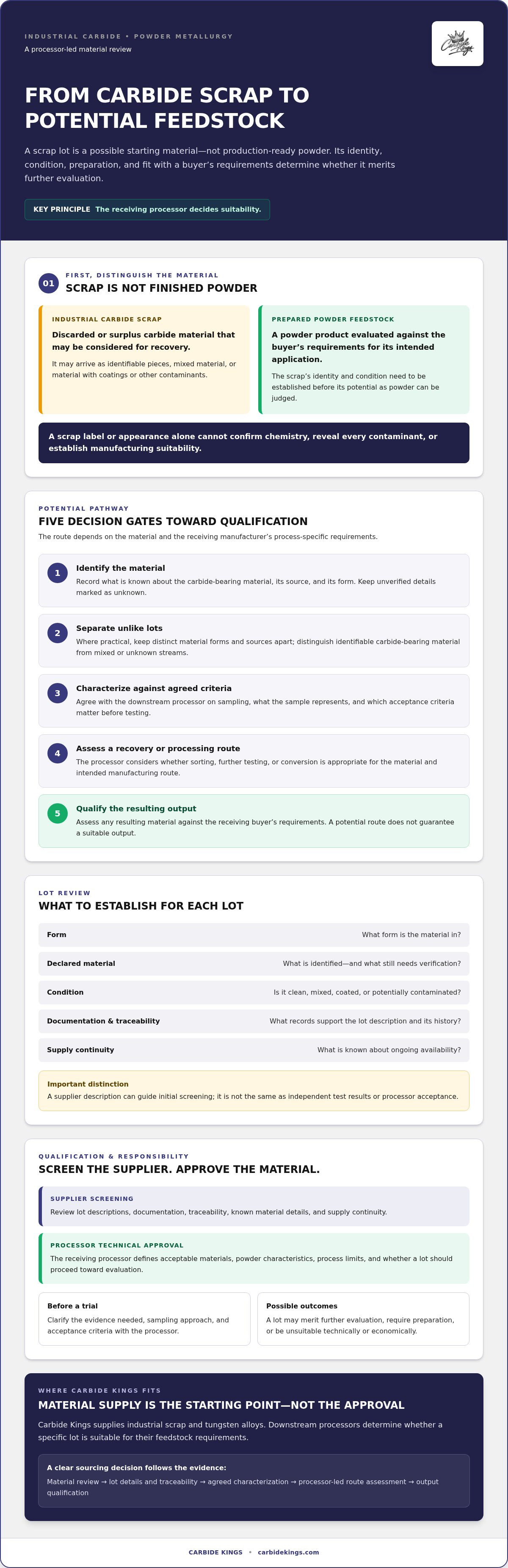
Industrial carbide scrap is discarded or surplus carbide material that may be considered for recovery. Finished powder metallurgy feedstock is different: it is a prepared powder product evaluated against a buyer’s requirements. A scrap lot may be a useful starting point, but its label or appearance alone cannot confirm that it suits a manufacturing process.
Scrap is a potential secondary material input, not automatically production-ready powder. Its form, composition, condition, and intended use shape the next decision. A clean, identifiable piece raises different questions from a mixed or contaminated lot. Sorting, testing, or further conversion may be needed before a manufacturer can assess the material as an input.
How carbide scrap differs from finished powder
Carbide scrap may arrive as identifiable pieces, such as worn or broken components. A powder product, by contrast, must meet the receiving buyer’s stated requirements for its intended application. The scrap’s identity and condition need to be established before anyone can determine whether processing could produce a suitable powder.
The route depends on both the material and the manufacturing process. One lot may warrant additional characterization; another may need sorting or processing. Some lots may not be technically or economically suitable. Do not assume every scrap lot can be converted. The receiving processor sets the criteria and decides whether a potential input merits further evaluation.
Where tungsten carbide fits in powder metallurgy
Tungsten carbide is a hard material used in industrial applications. Cemented carbide combines tungsten carbide particles with a metallic binder to create a consolidated material. Scrap from these materials is not equivalent to separated, prepared powder. A processor needs to understand its identity, condition, and any other materials present before judging its potential.
Powder metallurgy broadly makes components from prepared powders through steps such as blending, compaction, and sintering. The Powder metallurgy overview describes these foundational stages and tungsten carbide’s role in the field. Details vary by material and application, so a scrap-to-feedstock route must be assessed against the intended manufacturing process.
Start with the buyer’s requirements. Each manufacturer defines its own acceptable materials, powder characteristics, and process limits. Those requirements guide whether a lot needs sorting, further testing, or conversion, and whether it should move forward for qualification.
How Industrial Carbide Scrap Can Move Toward Manufacturing Feedstock
Moving industrial carbide scrap toward potential manufacturing use takes several decision gates: identify the material, separate unlike lots, characterize the material, select a suitable recovery route, and qualify the resulting output against the intended process. Each step depends on what the scrap is and what the receiving manufacturer needs.
Feedstock readiness is established against process-specific requirements, not the scrap label alone. A supplier’s description can guide initial screening, but it is not the same as independent test results or processor acceptance. The U.S. Geological Survey tungsten data provides background on tungsten. Lot-level decisions still require evidence about the material under review.
From identification and sorting to material characterization
Start by separating identifiable carbide-bearing materials from mixed or unknown scrap streams. Where practical, keep distinct material forms and sources in separate lots, and record what is known about each. Visual appearance can help with initial sorting, but it cannot establish complete chemistry, reveal every contaminant, or confirm suitability for a particular manufacturing route.
Before sampling or testing, agree with the downstream processor on the method, what the sample should represent, and which acceptance criteria matter. This helps avoid mismatched results: a test may answer a composition question without addressing the processor’s full requirements. Treat unverified details as unknown, not as confirmed material properties.
Processing routes and buyer qualification
Once the material is better understood, the processor can consider whether mechanical, chemical, or another recovery approach is appropriate. These are route categories, not universal recommendations. Processing can change the material’s form and requires technical controls suited to the specific feed and operation. Do not assume a particular route, recovery yield, or final powder quality without processor review.
Use a clear handoff between stages:
- Identify and segregate: Record the source and form, and keep distinct lots separate.
- Characterize: Agree on sampling and testing with the intended processor. Distinguish supplier-provided information from verified findings.
- Select a route: Have qualified technical personnel assess whether processing fits the material and application.
- Qualify the output: Confirm that the processed material meets the receiving manufacturer’s requirements before production use.
This staged approach helps buyers discuss industrial carbide scrap feedstock for powder metallurgy manufacturing with clear expectations. To start a sourcing conversation, share the material category and lot requirements with Carbide Kings’ industrial scrap team. The processor remains responsible for deciding whether a specific lot can become suitable feedstock.
How to Compare Carbide Scrap Lots for Powder Metallurgy Use
Compare each lot using the same buyer-defined criteria. Broad labels alone will not show whether two lots have matching material, condition, or process fit. Use a comparison record to separate what the supplier reports, what has been independently confirmed, and what still needs an answer.
The table below is a working template, not an acceptance specification. Complete it for each lot. The receiving manufacturer or processor must define acceptable values, tolerances, and verification methods for the intended application. Do not apply universal grades or assumed impurity limits.
| Field | Supplier-provided | Independently verified | Still unknown or to confirm |
|---|---|---|---|
| Lot form | Record the described form, such as pieces or another stated form. | Record what the agreed inspection confirms. | Clarify any mixed or unidentifiable material. |
| Declared material | Enter the supplier’s material description. | Enter test findings, if testing is completed. | Flag composition not supported by available evidence. |
| Condition | Note the reported state and known handling history. | Record condition confirmed through agreed review. | List concerns that could affect handling or processing. |
| Documentation | List records the supplier can provide, if any. | Mark records or claims checked against available evidence. | Identify missing records or details to request. |
What to request before comparing industrial lots
Ask for the available material description, estimated quantity, and current lot condition. Request supporting documentation only where it exists; do not assume a certificate or test report is available. Confirm whether the buyer or downstream processor controls sampling and testing, and agree on the method before treating results as comparable. Label supplier statements as reported information.
How to assess consistency and process fit
Compare lots against the same receiving-party criteria, not just similar-sounding grade labels. Check whether the material form and any handling needs fit the processor’s facility and proposed route. A lot can be commercially interesting and still fail technical screening.
Before committing material to a production qualification trial, close or document open questions about identity, condition, records, sampling, and processor requirements. This gives the buyer a clearer basis for evaluating industrial carbide scrap feedstock for powder metallurgy manufacturing, without mistaking an unverified description for approved input.
How to Qualify a Scrap-to-Feedstock Supply Route
Qualify the supply route in two stages. First, screen the supplier and commercial fit. Then have the receiving processor assess the material and approve any trial. A supplier can describe a lot and share available records, but only the processor can determine whether converted material meets its manufacturing requirements.
Use this sequence to keep decisions clear:
- Define the manufacturing requirement. Record the target material form, intended application, process constraints, and who has authority to accept the material.
- Agree on the evidence needed. Have engineering and procurement align on requested records, sampling, testing, and acceptance criteria before seeking quotes. Flag classification or composition questions for technical review.
- Screen the supplier and commercial fit. Review the available material description, lot information, estimated quantity, and communication. Clarify which details are documented and which are supplier-reported or unknown.
- Plan technical evaluation with the processor. Confirm who controls sampling and testing, how the lot will be identified through each step, and what information must accompany it. Check that proposed packaging and transport arrangements suit the material and receiving facility. Verify applicable handling and transport requirements rather than assuming them.
- Run and document a controlled trial. The responsible processor evaluates the converted material against agreed criteria. Record the outcome, unresolved issues, and what would need to remain consistent before considering repeat procurement.
Build traceability and repeatability into the review
Ask how the lot will be identified from initial review through processing and trial evaluation. Discuss whether separate lots will remain distinct, what records can be retained, and how changes in material form or condition will be communicated. For ongoing sourcing, ask what information the supplier can provide for future lots and how the buyer will check consistency. These are practical questions, not assumptions that every supplier has a particular certificate or tracking system.
For additional process context, consult The Industrial Carbide Scrap Recycling Process: A 2026 Complete Guide. Use it alongside your own processor’s requirements, not as a substitute for material-specific approval.
Keep commercial screening separate from technical sign-off. A suitable commercial discussion does not establish that a lot is approved for production, and a successful trial does not by itself confirm future lot consistency. Buyers assessing industrial carbide scrap feedstock for powder metallurgy manufacturing should document both decisions and the evidence behind them.
To discuss available material categories and lot requirements, contact Carbide Kings about industrial scrap. Carbide Kings supplies industrial scrap and tungsten alloys; the downstream processor determines whether a particular lot can become suitable feedstock.
Where Carbide Kings May Fit in an Industrial Feedstock Supply Chain
Carbide Kings can be a sourcing contact within a processor-led supply chain. The company is a US-based supplier of industrial scrap and tungsten alloys serving buyers nationally. Buyers can discuss whether its material categories may fit an initial sourcing review, but that conversation does not establish that a lot is suitable for powder metallurgy or ready for production.
The distinction is important: a scrap supplier provides material information for procurement decisions, while the downstream processor evaluates technical fit. That processor determines whether a specific lot can be converted into feedstock and whether the resulting material meets its documented requirements. Carbide Kings does not sell finished powder metallurgy feedstock, so buyers should plan evaluation and approval with the processor responsible for the intended manufacturing route.
Which Carbide Kings material categories may be relevant
Carbide Kings’ confirmed categories include tungsten hard scrap, tungsten soft scrap, carbide scrap, and tungsten alloys. These are category descriptions, not claims about a particular lot’s composition, grade, form, or suitability. Material details and availability can vary, so confirm them directly before planning testing, processing, or use.
For background on one category, buyers can also consult The Complete Guide to Tungsten Hard Scrap Recycling in 2026. Use that general process context alongside current lot information and the receiving processor’s own requirements. A guide cannot confirm the identity or condition of a specific supply lot.
The next steps for industrial procurement teams
Prepare a concise sourcing brief before opening a supplier discussion. Include the intended application, material category of interest, approximate procurement needs, and the information your processor requires to evaluate a lot. Note what evidence is mandatory, what can be confirmed later, and who has authority to approve a production trial.
- Share the requirement: Explain the intended use and any relevant process constraints.
- Ask about available lot information: Confirm what material descriptions, quantity estimates, and supporting records are currently available. Do not assume documentation or a particular lot is available.
- Confirm technical review: Have the receiving processor define sampling, testing, and acceptance criteria before committing material to a trial.
- Record the decision: Keep supplier-provided details separate from verified findings and processor approval.
For buyers evaluating industrial carbide scrap feedstock for powder metallurgy manufacturing, this division of responsibility keeps procurement grounded: discuss material categories and current lot information with Carbide Kings, then rely on the receiving processor’s documented approval criteria before production use.
Build a Clearer Path from Scrap to Supply
Evaluating industrial carbide scrap feedstock for powder metallurgy manufacturing starts with a practical distinction: scrap is a potential input, not approved production powder. Material identity, lot condition, documentation, and the receiving processor’s requirements determine whether a route is worth pursuing. Compare lots against the same criteria, separate reported details from verified findings, and let the processor define technical acceptance and trial approval.
Carbide Kings is a US-based supplier serving industrial buyers nationally, with tungsten hard scrap, tungsten soft scrap, carbide scrap, and tungsten alloys among its confirmed supply categories. Confirm current lot details and suitability for each sourcing discussion. The downstream processor remains responsible for deciding whether a specific lot can become suitable feedstock.
Ready to discuss material categories and your procurement requirements? Discuss your industrial tungsten and carbide scrap requirements with Carbide Kings. Start with the information you have, clarify what needs verification, and define the evaluation plan with your processor.
Frequently Asked Questions
Can industrial carbide scrap be used directly as powder metallurgy feedstock?
Scrap should not be treated as production-ready powder without evaluation. Industrial carbide scrap feedstock for powder metallurgy manufacturing must meet the receiving manufacturer’s requirements, and scrap may need identification, sorting, testing, or processing first. A supplier’s material description can help with initial screening, but it does not prove composition or suitability. The downstream processor determines whether a particular lot can be converted and whether the resulting material is acceptable for its process.
What types of carbide scrap may be considered for powder metallurgy?
Potential candidates may include identifiable carbide-bearing scrap, but the category name alone cannot establish suitability. Form, declared material, condition, and available documentation all affect whether a processor wants to evaluate a lot. Tungsten hard scrap, tungsten soft scrap, carbide scrap, and tungsten alloys are distinct supply categories. Confirm the details of a specific lot, then ask the receiving processor whether it fits the intended application and evaluation criteria.
How is tungsten carbide scrap converted into powder?
There is no universal conversion route for every scrap lot. Depending on material form, chemistry, condition, and intended application, a qualified processor may consider a mechanical, chemical, or another recovery approach. These are broad route categories, not a recommendation for a particular lot. Processing can change the material’s form and requires suitable technical controls. The processor must assess the feed and determine whether the resulting material can meet the buyer’s powder requirements.
What information should a buyer request about a carbide scrap lot?
Request the available material description, lot form, estimated quantity, current condition, and any supporting records that exist. Ask which details are supplier-reported and which have been independently verified. Before sampling, confirm whether the buyer or downstream processor controls the sample and testing method. Also provide the intended application and ask the processor what evidence it needs to evaluate the lot. Do not assume certificates, test reports, or specific material details are available.
Does carbide scrap need testing before powder metallurgy use?
Testing or other characterization may be needed, but the right evaluation depends on the material and the receiving processor’s requirements. Appearance and a broad scrap label cannot confirm complete composition or process suitability. Agree in advance on sampling, testing methods, and acceptance criteria with the processor responsible for technical approval. Treat unverified information as unknown, and do not assume a test result alone means the material or any converted output is approved for production.
Can Carbide Kings supply finished powder metallurgy feedstock?
No. Carbide Kings supplies industrial materials, including tungsten hard scrap, tungsten soft scrap, carbide scrap, and tungsten alloys. It does not sell finished powder metallurgy powders or ready-to-use feedstock. Buyers can discuss relevant material categories and available lot information with the company, then work with their downstream processor to evaluate whether a specific lot can be converted into material suitable for the intended manufacturing process.
How can manufacturers qualify a carbide scrap supplier?
Start by defining the intended application, required material information, and commercial needs. Review the supplier’s lot description, available records, communication, and ability to clarify what is known or unknown. Then separate commercial screening from technical approval: agree on traceability, sampling, packaging, transport, and evaluation questions, and have the receiving processor plan and approve any trial. Document results and unresolved issues before considering repeat sourcing. Supplier qualification does not replace processor approval of the material.


