

As of August 27, 2026, new federal mandates require that 100% of tungsten waste remains within domestic borders, turning your scrap pile into a high-stakes strategic asset. You’ve likely dealt with the typical industry headaches: opaque pricing, slow payments, and the logistical nightmare of shipping heavy loads. It’s frustrating when your recycling partner feels more like a middleman who slows down your operations. You deserve a process that’s as efficient as your own shop floor.
Choosing the right national carbide recycling company is about more than just finding a buyer. It’s about securing a partner that understands the 200% surge in tungsten value and the complexities of the current market. This 2026 comparison guide will teach you how to evaluate partners to maximize your ROI and eliminate administrative burdens. We’ll show you how to spot transparent pricing models and move from shipping to 24-hour payment terms without the usual friction. By the end of this guide, you’ll have a clear framework to streamline your scrap recovery and boost your bottom line immediately.
Key Takeaways
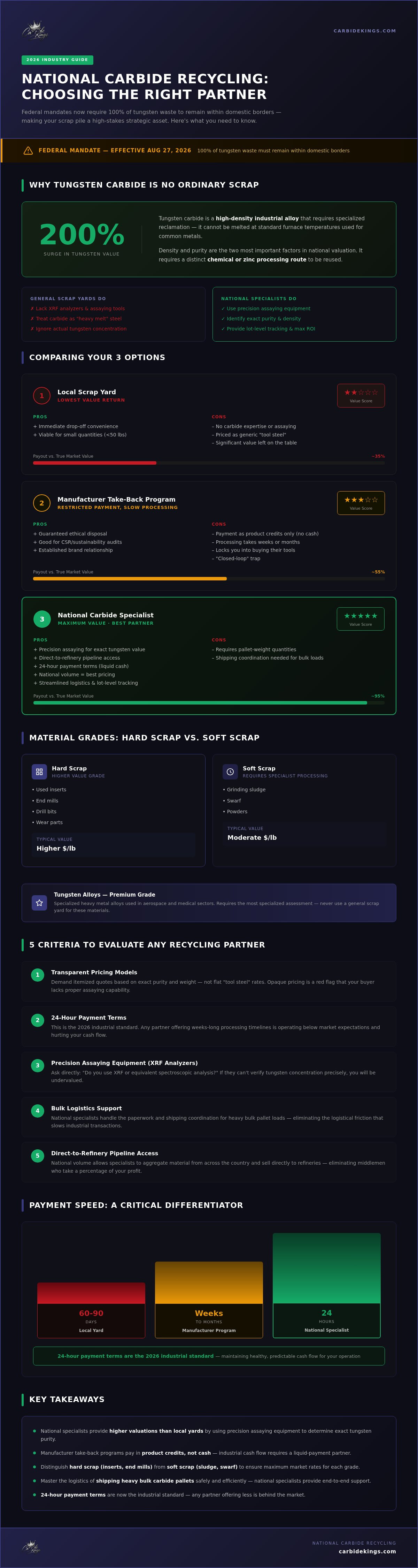
- Identify why a specialized national carbide recycling company provides higher valuations than local yards by using precise assaying equipment.
- Evaluate the trade-offs between manufacturer take-back credits and the immediate cash benefits of working with industrial recycling specialists.
- Distinguish between hard and soft scrap grades to ensure you receive the maximum market rate for your inserts and end mills.
- Master the logistical steps required to secure and ship heavy bulk carbide pallets safely and efficiently across the country.
- Recognize why 24-hour payment terms are now the industrial standard for maintaining a healthy and predictable cash flow.
What Defines a National Carbide Recycling Company?
A national carbide recycling company is a specialized firm focused exclusively on the procurement and processing of tungsten-based materials across the country. Unlike your local general scrap yard, these organizations don't deal in residential aluminum or copper. They operate as high-volume industrial partners that bridge the gap between machine shops and metallurgical refineries. In the 2026 market, they serve as the primary engine for the domestic circular economy, ensuring critical materials stay within U.S. borders as mandated by recent federal regulations.
Specialization is the key differentiator here. General scrap yards often undervalue tungsten because they lack the specific assaying equipment needed to determine exact purity. They might offer a flat "tool steel" rate that ignores the actual concentration of tungsten in your inserts or end mills. A national specialist uses precision technology to identify the specific value of your material, ensuring you receive a payout that reflects current market surges. Their service menu is targeted and includes:
- Tungsten Hard Scrap: Used inserts, end mills, drill bits, and wear parts.
- Tungsten Soft Scrap: Grinding sludge, swarf, and powders.
- Tungsten Alloys: Specialized heavy metal alloys used in aerospace and medical sectors.
Tungsten vs. General Metal Scrap
Recycling tungsten carbide isn't the same as tossing steel or aluminum into a bin. Tungsten carbide is a high-density industrial alloy requiring specialized reclamation. Because of its unique Tungsten carbide properties, it doesn't melt at standard furnace temperatures used for common metals. This means your material requires a distinct chemical or zinc processing route to be reused. Density and purity are the two most important factors in national valuation. If your buyer doesn't understand these nuances, you're leaving money on the table. Specialists look for lot-level tracking and material consistency to provide the highest possible ROI for your industrial waste.
The National Advantage in 2026
National reach allows for more competitive pricing through sheer volume. While a local buyer might struggle to move a single pallet, a national carbide recycling company aggregates tons of material from across the country. This scale grants them access to direct-to-refinery pipelines that local yards simply can't reach. They cut out the middlemen who typically take a percentage of your profit.
The administrative process is also built for speed. These companies have refined their logistics to handle the paperwork and shipping hurdles that usually stall industrial transactions. You get a streamlined workflow that moves your scrap out of the shop and puts cash into your accounts without the typical bureaucratic friction. It's a professional, peer-to-peer transaction designed for the modern industrial environment.
Comparing Your Options: Local Yards vs. Manufacturers vs. Specialists
Industrial professionals face a critical choice when clearing out scrap bins. You can prioritize local convenience, manufacturer loyalty, or maximum financial return. Each path impacts your bottom line differently. Reviewing national tungsten supply data reveals that carbide is a strategic commodity, not just waste. This means the buyer you choose should have the infrastructure to treat it as a high-value asset rather than a secondary byproduct.
Local Scrap Yard Pros and Cons
Local scrap yards offer the benefit of immediate drop-off. They're a viable option if you're dealing with small quantities under 50 lbs that don't justify a pallet shipment. The major drawback is their lack of carbide expertise. Most local yards don't own XRF analyzers or specialized assaying tools. They'll likely treat your high-value carbide as "heavy melt" steel or generic tool steel. You end up losing a significant percentage of the material's actual worth because the buyer can't verify its purity or density on-site. It's a fast solution, but it's rarely the most profitable one.
Manufacturer Recycling Programs
Manufacturer recycling programs focus heavily on sustainability and brand loyalty. They provide a guaranteed ethical disposal route, which looks good on corporate responsibility audits. However, they often fall into the "closed-loop" trap. Payment is frequently restricted to product credits rather than liquid cash. This forces you to buy more of their specific tools even if your production needs change. Processing is also notoriously slow. It can take weeks or even months to verify the weight and issue a credit note, which stalls your cash flow and complicates your accounting.
National Carbide Specialists (Carbide Kings)
A national carbide recycling company serves as the professional alternative for high-volume shops. Industrial managers are increasingly looking for tungsten scrap buyers usa that offer cash and expert logistics. These specialists provide market-leading prices because they sell directly to refineries, cutting out the local middleman. While shipping is required, the process is streamlined and often subsidized for bulk loads. You get 24-hour payment terms and a transparent valuation that local yards can't match. It's the most efficient way to turn heavy scrap into working capital without being tied to a single manufacturer's credit system. You can get a quote now to see how a specialist streamlines your recovery process.
Material Grades: Comparing Hard Scrap and Soft Scrap Value
Not all carbide waste carries the same weight in your bottom line. Understanding the industrial hierarchy of materials is the first step toward maximizing your scrap value. A professional national carbide recycling company categorizes your waste into two primary streams: hard scrap and soft scrap. While both contain valuable tungsten, the processing requirements and market demand for each differ significantly. Precise classification ensures that your shop receives a payout reflecting the material's actual metallurgical worth.
Maximizing Value from Hard Scrap
Hard scrap remains the gold standard for industrial recycling. This category includes common tooling such as end mills, drill bits, and wear parts. Recycling tungsten carbide inserts is particularly lucrative due to their high density and consistent material composition. To get the best quote, keep these items clean and unmixed.
Mixing carbide with high-speed steel or general shop trash forces the buyer to lower their offer to cover the cost of manual sorting. The cobalt content, which typically ranges from 6% to 12%, also plays a major role in valuation. Specialists use XRF technology to verify these levels instantly. This ensures you aren't underpaid for high-grade alloys that are in high demand for domestic manufacturing.
The Complexity of Soft Scrap and Sludge
Soft scrap is a different beast entirely. Finding reliable tungsten soft scrap buyers is more difficult because materials like grinding sludge, swarf, and fines require complex handling. These materials are often saturated with coolants or oils, making them messy and environmentally sensitive. They require specialized containers and specific shipping protocols to prevent leaks during transit.
Despite the mess, these materials are highly valuable assets. Because of the recent shift in federal regulations, domestic recycling capacity is under pressure to recover as much material as possible from these secondary streams. Proper reclamation of soft scrap isn't just a financial win. It's an environmental necessity for shops looking to maintain a clean, compliant operation. A national carbide recycling company has the infrastructure to process these difficult materials efficiently, turning your grinding waste into a predictable revenue stream.
The transition from waste to profit depends on the accuracy of the assay. National specialists utilize lot-level tracking to determine the exact tungsten content in every barrel. This transparent approach ensures that whether you’re shipping a crate of broken end mills or a drum of grinding swarf, your payout reflects the true market value of the metal. It’s a straightforward process that turns every ounce of industrial byproduct into liquid capital with zero administrative friction.
Logistics Check: How to Ship Bulk Carbide Nationally
Moving heavy industrial scrap across the country is the single biggest hurdle for most machine shops. Tungsten carbide is nearly twice as dense as lead. This extreme weight makes traditional shipping methods dangerous and cost-prohibitive. A national carbide recycling company removes this burden by providing a structured logistical framework designed for high-density loads. They transition your process from small, unmanageable buckets to streamlined palletized shipments that move quickly through national freight networks.
Packaging for Maximum Security
Standard cardboard boxes simply fail under the pressure of tungsten carbide. They tear, collapse, and lose material during transit. You must use 5-gallon buckets or reinforced wooden crates to secure your scrap. For larger volumes, these buckets should be shrink-wrapped and strapped to a heavy-duty pallet. This setup is essential for bulk carbide scrap shipping solutions. It prevents shifting and ensures the safety of freight handlers. Always double-check that your buckets are sealed tight to prevent leaks of swarf or sludge, as these can cause significant delays at transit hubs.
The Shipping and Pickup Process
The transition from shop floor to refinery shouldn't be your headache. Most national buyers utilize Less Than Truckload (LTL) carriers to manage transport efficiently. You schedule a pickup, and a national carrier arrives at your shop floor with the necessary equipment to load your pallets. You'll need to provide a Bill of Lading (BOL) and a material packing list to stay compliant with 2026 shipping regulations for industrial metal scrap. National buyers often offset shipping costs for bulk lots, which removes the overhead barrier for industrial sellers.
Insurance and tracking are non-negotiable for high-value assets. Every shipment of tungsten carbide represents a significant financial investment. A professional national carbide recycling company provides lot-level tracking so you can monitor your material from the moment it leaves your dock. This transparency builds trust and ensures that your payout is based on the exact weight that arrived at the facility. You don't have to manage these logistics alone. Schedule your pickup today and let the experts handle the heavy lifting while you focus on your core production.
The Carbide Kings Advantage: Streamlining Industrial Cash Flow
Managing a high-volume industrial facility in 2026 requires a sharp eye on overhead and material recovery. You can't afford to have thousands of dollars in capital sitting in a scrap bin while waiting for a manufacturer credit. A national carbide recycling company like Carbide Kings operates with the same urgency as your production line. We've refined our internal systems to remove the administrative friction that typically slows down industrial transactions. Our goal is to transform your tungsten hard scrap and soft scrap into liquid capital as quickly as possible, allowing you to reinvest in new tooling or operational upgrades without delay.
Speed and Transparency
Liquidity is the lifeblood of any machine shop. We've set 24-hour payment terms as our standard because we understand the importance of fast payment for scrap carbide for maintaining your shop's cash flow. You get a direct line to our valuation experts without navigating through layers of middlemen or distant corporate departments. Our pricing reflects real-time market indices, ensuring you receive a fair, transparent offer based on the most current tungsten values. You don't have to guess what your material is worth. We provide clear, data-driven assays that leave no room for ambiguity or opaque pricing models.
Getting Your First Quote
Transitioning from a local yard to a national specialist is a straightforward process. It only takes three steps to turn your waste into revenue. First, you provide us with basic details about your lot size and material type to receive an initial valuation. Second, we coordinate the national logistics and schedule a shop-floor pickup that fits your schedule. Third, we verify the material and issue payment within 24 hours of arrival at our facility. It's a methodical, linear workflow designed to keep you focused on your core operations while we handle the heavy lifting of reclamation and logistics.
To prepare your first lot for a national quote, simply separate your carbide inserts from other tool steels and ensure any soft scrap is secured in leak-proof containers. This simple organization maximizes your quote and speeds up the assay process. By choosing a specialized partner, you're building a long-term recycling strategy that protects your margins against global supply chain volatility and new domestic mandates. We're here to serve as your proactive partner, ensuring every pound of scrap contributes to your bottom line. Ready to maximize your returns? Contact Carbide Kings for a national scrap quote today.
Secure Your Industrial Scrap ROI for 2026
The 2026 industrial market has transformed tungsten scrap into a strategic financial asset. You now understand how specialized assaying outperforms local yards and why cash payments are superior to manufacturer credits. Choosing a professional national carbide recycling company ensures you capture the full value of your material. It removes the administrative friction that traditionally slows down industrial recovery. We've built our workflow to mirror the efficiency of your own shop floor.
We've refined our process to handle the heavy logistical burdens of shipping high-density alloys. Our team provides the specialized tungsten expertise and national logistics support necessary to move your materials with zero headaches. You deserve a partner that respects your time and your bottom line. With our 24-hour payment terms, you maintain maximum liquidity and keep your production lines moving forward. It’s a straightforward, lucrative process designed for industrial professionals who value clarity and speed.
Get a National Carbide Recycling Quote from Carbide Kings today. Let’s turn your shop's scrap into a streamlined revenue stream. Your business is ready for a more efficient recovery partner.
Frequently Asked Questions
What is the difference between a local scrap yard and a national carbide recycler?
The main difference lies in specialization and valuation accuracy. Local scrap yards typically lack the specialized assaying equipment needed to identify exact tungsten purity. They often pay a flat rate based on generic tool steel prices. A national carbide recycling company uses precision technology to ensure your payout reflects current market surges. This specialized approach ensures you aren't leaving money on the table for high-density industrial alloys.
How much carbide scrap do I need to sell to qualify for national shipping?
While you can ship small amounts, national logistics support is most efficient for bulk loads. Typically, shipments of 50 pounds or more justify the logistics process. For industrial shops, consolidating 500 pounds or more onto a pallet allows us to manage the freight and offset shipping costs. This bulk approach maximizes your return and simplifies the pickup process for your shop floor team.
How do national carbide recycling companies pay their clients?
Speed is our priority for every industrial transaction. We offer 24-hour payment terms once your material is verified at our facility. Most clients prefer direct electronic transfers for immediate liquidity, though traditional checks are also available. This fast turnaround keeps your cash flow healthy and removes the long wait times common with manufacturer credit programs or traditional scrap buyers who lack specialized liquid capital.
What types of tungsten carbide scrap are most valuable in 2026?
Hard scrap remains the gold standard for industrial recycling in 2026. This includes items like tungsten carbide inserts, end mills, and drill bits. Materials with higher cobalt concentrations often command better prices due to their high manufacturing demand. Because of current federal domestic mandates, all forms of tungsten are high-value assets. Keeping your lots clean and unmixed ensures you receive the highest possible market rate for these critical materials.
Can I sell grinding sludge or soft scrap to a national buyer?
Yes, specialized buyers are equipped to handle these difficult materials. While many local yards refuse grinding sludge or swarf due to their messy nature, we accept both tungsten hard scrap and soft scrap. These materials require specific leak-proof packaging and specialized processing. Turning your grinding waste into a revenue stream is a smart way to boost shop profitability while maintaining a clean, compliant industrial environment.
How long does the national carbide recycling process take from pickup to payment?
The entire process is designed for maximum speed. Once you schedule a pickup, a carrier typically arrives within 24 to 48 hours. After the material reaches our facility, we verify the weight and purity immediately. We then issue payment within 24 hours of that verification. Most industrial shops see their funds cleared within a business week of the initial shipment leaving their dock, ensuring no disruption to your liquidity.
Is it worth shipping carbide scrap if it is a heavy material?
It is absolutely worth it because the value per pound of tungsten carbide far exceeds the cost of freight. While the material is heavy, its high density means a single pallet carries significant financial value. A national carbide recycling company often manages the LTL logistics and offsets shipping costs for bulk lots. This ensures that the weight of the material never becomes a barrier to your shop's profitability.
Do I need to clean my carbide inserts before selling them for scrap?
You don't need to chemically clean your inserts, but sorting them is essential. Removing steel shanks or general shop trash from your carbide lot increases the accuracy of the assay. If your lot is clean and unmixed, it moves through the valuation process much faster. This simple organization ensures you get paid for the actual weight of the tungsten rather than losing value to waste contamination during processing.


