
High-quality tungsten scrap can fetch up to 80% of the ammonium paratungstate (APT) spot price, but scrap and synthetic concentrate additions aren’t valued as identical feedstocks. In bulk tungsten scrap purchasing versus synthetic tungsten concentrate additions, the comparison turns on recoverable tungsten, composition, contamination, and how much processing the material needs.
A cleaner, more consistent feedstock may be easier to value, but scrap can still play an important role in the supply chain. Its grade and condition determine how much usable tungsten it contributes and how it compares with concentrate-based inputs.
This article explains how recycled tungsten enters production, how moisture and contaminants can reduce payable material, and what grading reveals about scrap composition. It also explains how ammonium paratungstate (APT) pricing offers a benchmark, while the final comparison depends on the material rather than a simple like-for-like price.
Key Takeaways
- Assess scrap by its recoverable tungsten content, not its gross weight alone.
- Separate material by type and condition so grading reflects what the feedstock can yield.
- Use APT as a pricing reference, then account for composition and processing needs when comparing inputs.
- See how recycled material can complement concentrate in the tungsten supply chain, and where each feedstock may fit.
Supply-chain role of recycled tungsten
Recycled tungsten gives manufacturers a secondary source alongside mined concentrate and chemically processed feedstocks. The U.S. Geological Survey lists the world total (rounded) as 81,100 metric tons of tungsten content. Tungsten scrap also accounts for nearly 37% of total annual tungsten volume globally. Broken carbide inserts and end mills are common examples of material entering this recycling stream. Recovering their tungsten can return valuable input to production rather than relying only on newly mined ore.
Scrap reaches manufacturing through two main recycling routes. Closed-loop recycling returns production scrap, such as rejected tungsten carbide components, to a process that can reuse the recovered material. Indirect chemical recycling breaks scrap down through chemical processing and recovers tungsten for new products. Chemical treatment can process scrap using methods similar to those used for tungsten ore concentrate, allowing the two resources to serve as alternative inputs. This route can handle different scrap forms, including sludge and contaminated material, but requires energy and chemical reagents and produces environmental emissions.
Synthetic tungsten concentrate is a tungsten-rich feedstock created through processing, rather than collected as finished scrap. Its grade reflects tungsten content and impurities. In an ore-based route, concentration raises tungsten oxide content before further chemical processing. Scrap supply depends on the volume and type of manufacturing material generated and collected, while concentrate supply follows production and procurement cycles. Lead times for either depend on sourcing, processing, preparation, and shipping, not on a single fixed comparison.
For U.S. shipments, environmental, hazardous-material, export, and import requirements depend on the material’s classification, composition, and shipping route. Scrap and concentrate may require different handling or documentation, particularly when a shipment crosses a border. Before processing, separating grades and identifying contaminants helps determine the appropriate recovery route and prevents unlike feedstocks from being treated as equivalent.
Approximately 30% of the world’s tungsten supply is recycled. Plansee says tungsten can be recycled and reused for tungsten products any number of times from a technological standpoint. Of tungsten available for scrap purchasing, 66% had either been used in industries across the United States or reported for recycling purposes.
Contamination and scrap valuation
Scrap value depends on recoverable tungsten, not gross shipment weight alone. Moisture, contaminants, composition, and processing requirements all affect its comparison with concentrate.
Scrap Sourcing and Assay Steps
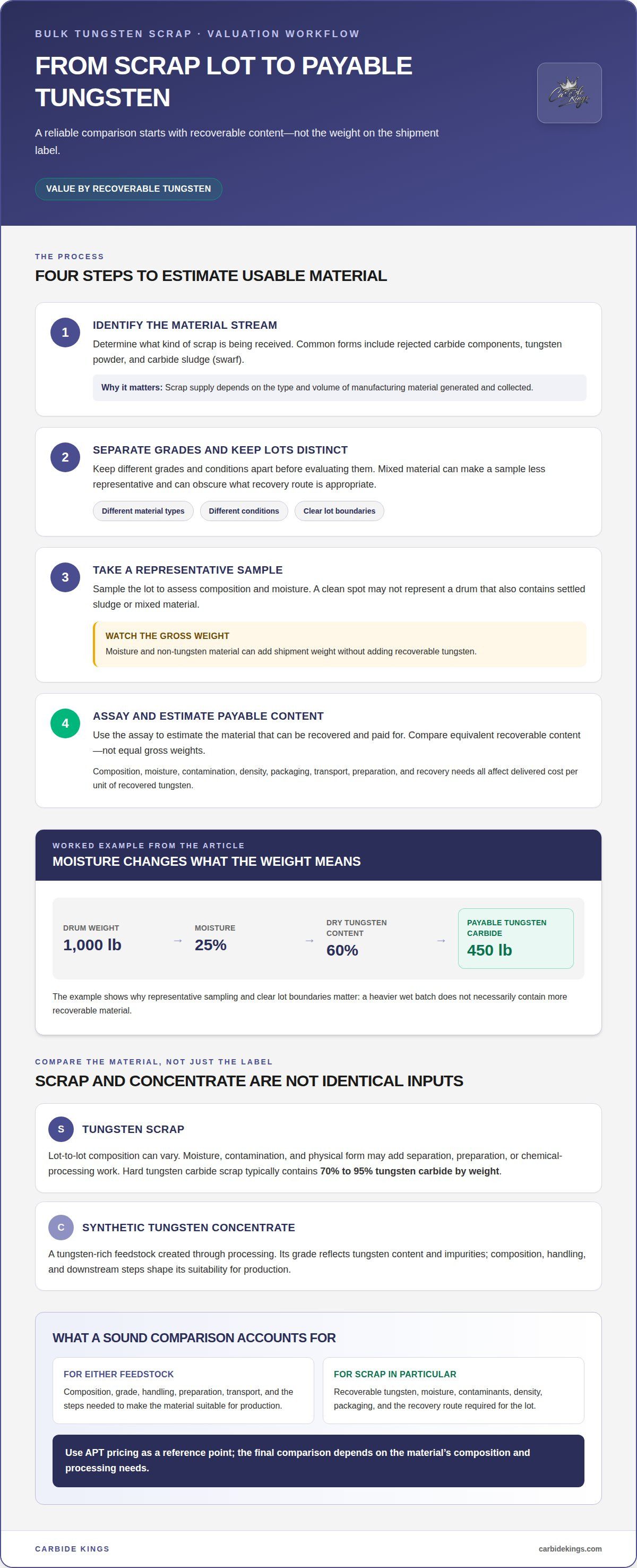
Sourcing, sampling, assaying, and purchasing bulk scrap are connected steps in estimating usable tungsten. First, identify the material stream and keep distinct grades separate. Then take a representative sample to assess composition and moisture, followed by an assay that supports the estimate of payable content. This matters because a wet or mixed batch can weigh more without containing more recoverable tungsten.
For example, a 1,000-lb drum of soft scrap with 25% moisture and 60% dry tungsten content yields 450 lbs of payable tungsten carbide. That calculation shows why sample quality and clear lot boundaries matter. A sample from one clean area may not represent a drum containing settled sludge or mixed material.
Delivered Cost of Recovered Tungsten
Delivered cost per unit of recovered tungsten includes material value, transport, preparation, and recovery requirements. For scrap, key factors include tungsten content, moisture, contamination, density, packaging, and the processing needed to produce usable material. For concentrate, composition, grade, handling, and the downstream steps needed to make it suitable for production shape the comparison.
Compare equivalent recoverable content, not equal gross weights. A high-density batch can still contain less payable tungsten if moisture or non-tungsten material increases its shipment weight. The same principle applies to alloys: their composition determines how they fit a buyer’s process and what recovery steps may follow.
Quality and Processing Risks
Quality, price, supply, and processing risks differ by feedstock. Scrap can vary between lots, and contamination may add separation or chemical-processing work. Hard tungsten carbide scrap typically contains 70% to 95% tungsten carbide by weight. Concentrate is also assessed by composition, but its origin and processing route shape the material delivered.
Scrap availability depends on the generation and collection of industrial material; concentrate supply follows production and procurement cycles. Either route can face delays related to preparation, transport, or processing. Buyers can reduce valuation uncertainty by separating grades and comparing assay results and recoverable content, rather than assuming the material is uniform.
For a closer look at scrap feedstocks, explore bulk tungsten scrap materials and consider how grade and condition fit your purchasing needs.
Scrap composition and grading
Composition and grade indicate how much tungsten a material can contribute and which processing route may suit it. Compare scrap and concentrate by usable content, impurities, and recovery method, not appearance alone.
Tungsten Content and Impurity Comparison
This comparison considers tungsten content alongside binders, moisture, and other material that can affect recovery. Gross weight alone doesn’t reveal how much tungsten is available for manufacturing.
Hard tungsten carbide scrap typically contains 70% to 95% tungsten carbide by weight. Common examples include carbide tri-cones, trencher tools, and fixed cutter matrix bits. Soft scrap includes tungsten powder and carbide sludge, also called carbide swarf. These forms differ in physical condition and may require different preparation.
Assess synthetic concentrate by its tungsten content and impurity profile. Scrap composition reflects its original use, including any binders or residues; concentrate composition reflects its production and upgrading steps. Actual recovery yield depends on the assay and processing route, so one assumed yield cannot fairly represent both inputs.
Lot Sizes and Assay Documentation
Lot size and assay documentation describe the quantity and composition offered in a transaction. Clear specifications help align a shipment with the buyer’s material-handling and recovery processes.
U.S. buyers don’t use one universal minimum lot size or assay format for every tungsten material. Requirements depend on the buyer, material form, and agreed specifications. Useful lot details include whether the material is hard scrap, powder, sludge, or concentrate, along with its composition, condition, and any known contamination.
Keep each distinct grade separate and link its assay information to the corresponding lot. This reduces uncertainty when comparing reported content with the material received. Buyers can then assess whether sample results represent the full shipment, rather than relying on a description that combines unlike forms.
Processing needs depend on composition. Chemical processing can recover tungsten from varied scrap forms, while the Zinc Process preserves carbide structure for direct reuse in manufacturing. The chosen route affects recovery yield and the material’s next use. A grade suitable for direct reuse may need a different pathway from mixed or contaminated scrap, so classification helps connect assay results with practical processing decisions.
Scrap prices tied to APT
Ammonium paratungstate (APT) is the main tungsten intermediate and the main tungsten raw material traded in the market. Its spot price offers a reference for comparing scrap with synthetic concentrate additions, but it doesn’t make them identical feedstocks. The bulk tungsten scrap purchasing vs synthetic tungsten concentrate additions comparison should account for each material’s tungsten content, composition, and route into production.
Scrap valuation starts by translating the lot’s assay into payable, recoverable tungsten. Moisture and contaminants can increase shipment weight without adding tungsten, while required processing affects the material’s value to a buyer. High-quality scrap may compare more favorably with concentrate than mixed or difficult-to-process material. APT provides a benchmark, but the grade and recovery characteristics of each lot determine how closely its value relates to that benchmark.
Assess concentrate additions by composition and suitability for the intended process as well. Compare equivalent recoverable tungsten, then account for the preparation and processing each feedstock requires. A quoted benchmark alone doesn’t capture these differences. The practical question in bulk tungsten scrap purchasing vs synthetic tungsten concentrate additions is the delivered cost per unit of tungsten that can enter production, rather than the nominal value of a tonne of material.
Physical clues can help classify material, but they don’t replace an assay. Tungsten carbide can show weak magnetic attraction because of its cobalt binder, while pure tungsten and most tungsten carbide alloys are not magnetic. This distinction may help identify mixed material, but magnetic response alone cannot establish tungsten content or determine value. Composition and condition remain central to assessment.
For a purchasing decision, separate material by grade, relate its assay to the APT reference, and account for processing needs. Scrap prices depend on the material and are provided after a quote request; composition, recoverable content, condition, and processing requirements shape the assessment. To explore tungsten scrap purchasing options, share the material type and available composition details.
Carbide Kings
Carbide Kings supplies tungsten and carbide scrap materials for industrial manufacturing and metallurgical use. When comparing recycled feedstock with concentrate additions, material type and condition are central to assessing suitability. Carbide Kings offers Tungsten Hard Scrap, Tungsten Soft Scrap, Carbide scrap, and Tungsten Alloys across distinct material categories.
Turn to Carbide Kings when your purchasing needs include these scrap materials. Share the material type and its condition to help frame your requirements and discuss the right category.
Contact Carbide Kings to discuss your tungsten scrap needs.
Put Your Next Tungsten Purchase in Motion
A sound decision about bulk tungsten scrap purchasing versus synthetic tungsten concentrate additions starts with a clear understanding of your production priorities. Consider which feedstock aligns with your procurement plan, internal material requirements, and sourcing approach. Use those priorities to guide a practical purchasing discussion.
Before moving forward, organize the information your team uses to evaluate material, including its intended application and relevant composition details. A focused discussion can connect those requirements with a suitable sourcing direction without overcomplicating the decision.
Carbide Kings offers industrial tungsten and carbide scrap materials for buyers assessing their options. If you’re ready to discuss your requirements, contact Carbide Kings about tungsten scrap. Take the next step with a clear brief and move your sourcing decision forward.
Frequently Asked Questions
What are current U.S. prices for bulk tungsten scrap versus synthetic tungsten concentrate?
There isn’t one fixed U.S. price that directly compares bulk scrap with synthetic concentrate. Scrap pricing depends on the lot’s grade, composition, condition, and recoverable tungsten; concentrate pricing also reflects its specification and delivery terms. Carbide Kings provides pricing based on the material after a quote request. Include the material type, approximate weight, and photos to support your request.


