

What if the material that reduces your exposure to primary tungsten supply creates a new risk on the melt floor? Secondary tungsten can strengthen resilience, but only when scrap recovery and melt-feed qualification are treated as separate decisions. That distinction is central to effective secondary tungsten supply risk management for industrial melt shops.
Concentrated supply routes and disruptions can put procurement plans under pressure. Yet adding secondary material without clear qualification gates can create uncertainty around chemistry, traceability, and production fit. The answer is not to treat every scrap stream as ready-to-melt feed. Build a sourcing process that protects specifications and keeps production schedules in view.
This article offers a practical framework for evaluating secondary tungsten, comparing primary and secondary options, and setting qualification steps before material enters the melt plan. It also explains how to assess carbide scrap as a recovery and residual-value opportunity without assuming it meets melt requirements. Use this approach to balance sources, reduce exposure, and make scrap recovery a deliberate part of your risk plan.
Key Takeaways
- Separate scrap recovery potential from qualification as a melt input. Assess composition, contamination, form, and process requirements before use.
- Use secondary tungsten, supplier diversification, inventory buffers, and process flexibility as complementary controls, and compare their trade-offs.
- Apply a repeatable five-step cycle to map exposure, segment materials, qualify candidates, test scenarios, and review results across teams.
- Effective secondary tungsten supply risk management for industrial melt shops balances sourcing resilience with specification and production requirements.
- Recovering carbide scrap can support material circularity and residual value, but it does not guarantee qualified melt feed.
Why secondary tungsten supply risk matters to industrial melt shops
Secondary tungsten is tungsten-bearing material recovered and returned to industrial use. Its potential role depends on the intended application: material recovered for recycling is not automatically suitable as a melt input. That distinction matters for secondary tungsten supply risk management for industrial melt shops. A sound plan considers whether material is available, whether it meets process requirements, and whether it can arrive when needed.
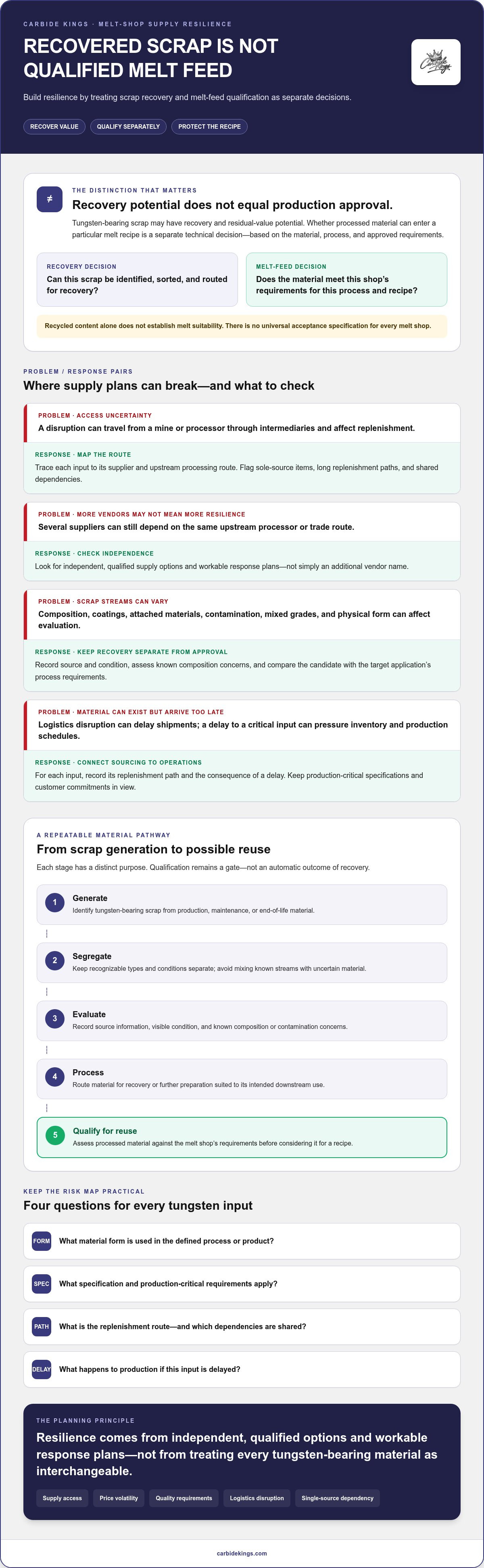
These are related but distinct risks. Supply risk is uncertainty about access to material. Price volatility affects budgets and purchasing decisions, while quality risk concerns whether material meets the required specification. Logistics disruption can delay shipments even when supply exists. Single-source dependency creates another vulnerability: several suppliers may rely on the same upstream processor or trade route, so adding a vendor does not necessarily create an independent supply path.
Upstream concentration can affect several links in the chain. A disruption at a mine or processor may affect intermediaries, alloy input availability, and ultimately a melt shop’s replenishment plan. The operational impact depends on the material, its route, and the plant’s production requirements. Supply-chain resilience comes from independent, qualified options and workable response plans, not simply from adding another supplier.
Start by mapping tungsten exposure to the products and processes that rely on it. For each input, record its form, required specification, replenishment path, and the consequence of a delay. Then identify dependencies shared across vendors. A useful map distinguishes:
- Tungsten metal used as an input for a defined process or product.
- Tungsten alloy inputs, with their own purchasing and specification requirements.
- Carbide scrap generated by operations, which has recovery potential but is not interchangeable with qualified metal or alloy feed.
For basic context on tungsten’s applications and recycling, see Tungsten properties and uses. Use that context to frame your inventory map, not to assume that different tungsten-bearing materials can substitute for one another.
Where tungsten exposure enters a melt shop
Trace each input from the product back through its supplier and upstream processing route. Flag sole-source items, long replenishment paths, and vendors that may depend on the same processor or transport channel. Note the production-critical specifications, too. This makes it easier to see where a disruption could constrain output, rather than treating every tungsten-bearing material as interchangeable.
How a disruption becomes an operational problem
A direct disruption can delay a shipment to the plant. An indirect one may begin upstream and reach the melt shop through a processor, intermediary, or trade route. Either can force rescheduling, put pressure on available inventory, and threaten customer commitments if the affected input has no qualified substitute. A Nature study analyzing historical international tungsten product-trade networks describes how risk can cascade across connected markets. It provides system-level context, not a forecast for any individual plant.
How secondary tungsten moves from recovery to potential melt-shop use
Recovered material has resource value, but that does not make it an approved production input. Scrap may be sorted, processed, and returned to an industrial supply chain for different uses. Whether it can enter a particular melt recipe is a separate technical decision. Recycled content alone does not establish melt suitability.
Suitability depends on the material and the job it must perform. Composition can vary by source or scrap stream. Coatings, attached materials, contamination, and mixed grades can affect evaluation. Physical form matters as well, because a process may require material that can be handled and introduced consistently. There is no universal acceptance specification for every melt shop. Requirements must match the product, process, and approved recipe.
The U.S. Government Accountability Office discusses tungsten’s strategic importance and supply vulnerabilities in its review of Tungsten as a critical defense material. That supply-chain context makes recovery worth considering, but it does not replace a plant’s technical approval process. Give each stage of the material flow a clear purpose and decision owner:
- Generate: Identify tungsten-bearing scrap from production, maintenance, or end-of-life material.
- Segregate: Keep recognizable types and conditions separate, and avoid mixing known streams with uncertain material.
- Evaluate: Record source information, visible condition, and any known composition or contamination concerns.
- Process: Route material for recovery or further preparation suited to its intended downstream use.
- Qualify for reuse: Assess processed material against the melt shop’s requirements before considering it for a recipe.
What makes secondary material a candidate, not an automatic substitute
Start with the target application. Compare the candidate’s known chemistry and physical form with the specific recipe and product requirements. Consider coatings, attached substances, mixed materials, and gaps in provenance where relevant. If a change could affect an approved input, follow documented internal qualification steps before introducing it. This makes the decision traceable and prevents a promising recovery stream from becoming an unplanned production risk.
Keep scrap recovery separate from feedstock qualification
Sort carbide scrap by recognizable type and condition, such as inserts, rods, drills, or mixed material. Separation can support a clearer recovery evaluation, but scrap valuation and production-input approval remain different commercial and technical decisions. A buyer’s assessment of scrap does not establish melt suitability. For a separate recovery pathway, manufacturers can submit carbide scrap for a quote. Carbide Kings buys and recycles tungsten carbide scrap; this is not a guarantee that the material is qualified melt feed.
This separation is a practical control in secondary tungsten supply risk management for industrial melt shops. Track recovered scrap as a material-recovery opportunity, and track candidate melt inputs through the plant’s own qualification process. Recovery can then support circular use without bypassing controls that protect product quality and production plans.
Compare secondary supply with other tungsten risk controls
Secondary material is one lever in a sourcing portfolio, not a universal fix. Its value depends on whether the stream can meet documented product and process requirements, how consistently it can be obtained, and whether qualification fits the operation’s risk tolerance. Compare it with other controls against the specific production exposure you need to reduce.
External market conditions can affect multiple supply routes at once. A second supplier may still rely on the same upstream processor, while inventory can bridge a timing gap but not resolve a lasting shortage. Assess the exposure behind each option, not just the number of vendors or the amount of material on hand.
| Risk control | Qualification burden | Lead-time exposure | Material consistency | Implementation effort |
|---|---|---|---|---|
| Secondary material | Can be substantial; assess each stream against approved requirements. | Depends on recovery, processing, and delivery pathways. | May vary by source, condition, and preparation. | Requires material evaluation and internal qualification. |
| Supplier diversification | Qualify each source and confirm its material meets requirements. | May reduce dependence on one route, but shared upstream links can remain. | Can differ between suppliers and batches. | Requires sourcing, qualification, and dependency review. |
| Inventory buffer | Uses existing approved material. | Can cover a timing gap, within the limits of available stock. | Follows the specification of the stocked material. | Requires inventory planning and carrying capacity. |
| Demand or process flexibility | Changes require approved engineering and quality review. | May help manage demand pressure, not supplier delays directly. | Depends on the approved alternative or process change. | Can require cross-functional review and production changes. |
When secondary tungsten can strengthen a sourcing portfolio
Consider secondary supply when a recovered stream can be evaluated against the operation’s documented process and product requirements. Include the effort needed to qualify it, the material’s expected variability, and the consequences of a fluctuating supply. If those factors fit the plant’s risk tolerance, secondary material can add a sourcing pathway alongside primary supply without replacing every other control.
When other controls should take priority
If one source or route dominates a critical input, prioritize supplier diversification and examine whether proposed sources have independent upstream dependencies. Use inventory planning when a near-term timing gap matters and qualification work cannot address it quickly. Consider demand changes or substitutions only through approved engineering and quality processes, so a procurement response does not create an unreviewed product or process risk.
Combine the controls where appropriate. A melt shop might qualify a secondary stream for a suitable application, maintain a buffer of approved material for immediate schedule protection, and develop an independent source for critical inputs. Review each measure against the same questions: What risk does it reduce? What exposure remains? What must happen before production can rely on it? This makes secondary tungsten supply risk management for industrial melt shops a practical portfolio decision, rather than a choice between recycled and primary material alone.
Build a practical secondary tungsten risk-management plan
Turn supply concerns into a repeatable plant-level process. A useful cycle links purchasing exposure to technical acceptance and production consequences, then revisits decisions as conditions change. This makes secondary tungsten supply risk management for industrial melt shops actionable without treating recovered material as an automatic substitute for an approved input.
- Map exposure: List tungsten-bearing inputs, their approved sources, replenishment routes, required specifications, and the production they support.
- Segment materials: Separate metal, alloy inputs, and scrap streams by type, condition, source, and intended use.
- Qualify candidates: Define the evidence, review, testing, and acceptance gates required before a candidate can enter production.
- Test scenarios: Model supplier delays, route disruption, material rejection, and demand changes. Record which controls could respond and where gaps remain.
- Review: Reassess exposures, actions, and assumptions on a planned cadence and whenever a defined trigger occurs.
Create a material-specific risk register
Make the register specific enough to support decisions. Record each input’s approved source and specification, operational criticality, replenishment path, and qualification status. Assess concentration, route dependence, replenishment uncertainty, and qualification separately. Combining them into one rating can hide a weak point. A useful risk register names the owner, exposure, control, and trigger, then tracks evidence, review dates, and unresolved actions.
Assign clear responsibilities so risks do not fall between departments. Procurement owns source and route information. Metallurgy assesses technical fit and candidate materials. Quality maintains approval requirements and evidence. Operations identifies schedule consequences and practical constraints. Finance evaluates the business impact of inventory and mitigation choices. Bring these roles together for reviews, with one person responsible for recording decisions and follow-up actions.
Qualify and stress-test secondary options
Set internal gates with technical stakeholders before a disruption occurs. Specify the source documentation needed, how samples will be handled, what testing applies, who reviews results, and who approves use. Requirements should reflect the actual material and process, not a generic recycled-content rule. Model scenarios that include delayed recovery, inconsistent lots, or a candidate that fails acceptance. Do not assume recovered material will be available or interchangeable on demand.
Trigger an out-of-cycle review after a supplier or route change, a specification revision, a significant disruption, or a performance finding that calls an assumption into question. Update the register, assign corrective actions, and record whether the control remains effective. For broader plant planning, map scrap generation and segregation alongside purchasing risks, while keeping scrap recovery separate from melt-input approval.
Keep carbide scrap recovery visible as its own action in the plan. If your operation has tungsten carbide scrap to sell, submit it for a quote as part of managing that recovery stream.
Turn carbide scrap recovery into a complementary resilience action
Recovering carbide scrap supports material reuse and helps your operation capture residual value. It does not, by itself, secure a qualified melt input or protect a production schedule. Keep these outcomes distinct: manage scrap as a recovery stream, and manage melt inputs through your plant’s technical qualification and sourcing controls. That separation is essential to practical secondary tungsten supply risk management for industrial melt shops.
Carbide Kings buys and recycles tungsten carbide scrap, including inserts, rods, end mills, drills, dies, rings, mixed scrap, grinding sludge, and powder. Carbide Kings is a scrap buyer, not a guaranteed supplier of melt-ready material. The service includes a same-day quote response, verification using calibrated scales, and prompt payment after verification. Offers are based on the actual material, with pricing depending on material type, grade, weight, condition, and current market conditions.
Prepare scrap for a straightforward evaluation
Clear material information helps make an evaluation more straightforward. Before arranging shipment or pickup, note the scrap form, approximate weight, visible condition, and whether the material is mixed. Keep distinct types separated where practical. If the grade or contents are uncertain, describe that uncertainty accurately rather than assuming the material is uniform. These details support scrap evaluation; they do not qualify material for use in a melt process.
Shipping options depend on the shipment. Free shipping labels are available for qualifying shipments, and large commercial quantities can use scheduled freight pickup. Share the material details and approximate quantity to help determine the next steps for the shipment. There are no minimums, and both individuals and businesses can sell.
Make the next step simple
Set up scrap collection so recovery is easy to repeat. Use practical, clearly identified containers for common streams such as inserts, rods, and mixed carbide. Keep records of where material came from and flag unusual or mixed contents. This gives your team a cleaner handoff for evaluation while keeping recovery documentation separate from any internal feedstock qualification records.
For industrial plants, the goal is a straightforward, documented route from accumulated scrap to material evaluation and verified payment, without confusing that transaction with procurement approval. No fixed price applies: offers reflect the actual material and current market conditions, and payment follows verification. This lets operations treat scrap recovery as a complementary value pathway while continuing to protect production inputs through established quality controls.
Have tungsten carbide scrap on hand? Submit the material details for a same-day quote response and put that recovery stream to work.
Put your next supply decision into motion
Make your next risk review tangible. Choose one production-critical tungsten input and one carbide scrap stream. Assign an owner to each, define the next decision, and set a date to revisit it. Small, documented actions help turn supply concerns into a working plan rather than an open-ended task.
Keep the two paths clear: evaluate potential melt inputs through your internal technical controls, and route carbide scrap through a separate recovery process. That distinction connects material circularity to secondary tungsten supply risk management for industrial melt shops without treating scrap as a substitute for approved feed.
For a practical next step on the recovery side, submit your tungsten carbide scrap for evaluation. Carbide Kings is a BBB Accredited Business with an A-rating. Start with the scrap you have identified and keep building a deliberate, resilient sourcing plan one decision at a time.
Frequently Asked Questions
What is secondary tungsten, and how is it different from primary tungsten?
Secondary tungsten is tungsten-bearing material recovered from manufacturing residues or end-of-life products and returned to industrial use. Primary tungsten originates from mined ore that is processed into usable forms. The distinction describes the material’s source, not whether it meets a particular application’s requirements. Recovered material may be suitable for further processing but still need assessment before a manufacturer uses it in a specific product or process.
Can tungsten carbide scrap be used directly in a melt shop?
Not automatically. Tungsten carbide scrap is a distinct material stream, and its composition, physical form, coatings, or mixed contents may not match a melt shop’s approved inputs. Treat scrap as a recovery candidate unless it has passed the plant’s technical review and qualification for the intended process. Collected inserts, for example, may have recovery value without being approved as a direct addition to a melt recipe.
How should a melt shop qualify secondary tungsten material?
Qualify it against the specific recipe and finished-product requirements, rather than a general recycled-material standard. Define the required documentation, sample handling, analysis, and acceptance approvals with metallurgy and quality teams. Record the source and lot identity so test results can be linked to the material under review. If chemistry, form, or provenance varies between lots, assess that variability before expanding use or changing an approved input.
What are the main risks of relying on recycled tungsten supply?
Key risks include inconsistent composition, contamination, changing availability, uncertain provenance, and processing or transport delays. A recovered stream may also require qualification before production can rely on it, limiting its usefulness during an immediate shortage. These risks are distinct from price volatility: even when material is commercially available, it may not meet plant requirements or arrive through a dependable route. Assess each exposure separately instead of treating recycled supply as one uniform option.
How can a melt shop reduce tungsten supply-chain concentration risk?
Map the sources and upstream routes behind each production-critical input, then identify dependencies shared across suppliers. Qualify alternative sources where practical, and use inventory planning to cover timing gaps for approved materials. Review whether proposed alternatives depend on the same processors or transport channels as current supply. Route demand changes or substitutions through engineering and quality approval so a procurement response does not create a separate product or process risk.
Does selling carbide scrap guarantee access to recycled tungsten feedstock?
No. Selling scrap supports recovery and returns material to a recycling pathway, but it does not reserve or secure material for the seller’s melt shop. A scrap transaction is separate from buying a production input, and recovered material is not automatically suitable for a particular recipe. If a plant wants to use secondary tungsten in production, it must manage sourcing and internal qualification separately from selling generated carbide scrap.
Can industrial plants sell tungsten carbide scrap without a minimum quantity?
Yes. Carbide Kings has no minimum quantity, and both businesses and individuals can sell tungsten carbide scrap. A plant can arrange an evaluation for an accumulated lot without waiting to reach a specified threshold. Useful details to organize include scrap type, approximate weight, condition, and whether the material is mixed. Clear descriptions help distinguish the recovery transaction from any internal decision about production-feed suitability.
How does Carbide Kings evaluate tungsten carbide scrap?
Carbide Kings evaluates the actual material, with offers based on material type, grade, weight, condition, and current market conditions. The transaction includes verification using calibrated scales to establish the verified material weight before payment. Tungsten carbide scrap can include inserts, rods, end mills, drills, dies, rings, grinding sludge, powder, and mixed scrap. This is a scrap-buying evaluation, not a determination that the material is qualified for a melt-shop process.


