

A supplier’s aerospace claim is not proof that a tungsten lot meets your foundry’s requirements. Qualified secondary tungsten scrap vendor audits for aerospace foundries should test the controls behind each lot: identity, segregation, condition, traceability, and supporting records. Set the audit scope against your documented material, quality-system, and customer requirements, not a broad promise of compliance.
Supplier records should show what the material is, where it came from, and how it was handled. A certificate or polished procedure matters only when objective evidence links it to the lot and the controls used to manage it. Align purchasing checks with your quality process so a sourcing decision does not get ahead of the evidence.
This checklist helps you build a risk-based audit, review material controls and lot records, and distinguish verified evidence from unsupported claims. Use it to document a qualification, conditional approval, or rejection against your requirements. The result is a consistent way to assess vendors and the tungsten scrap they supply.
Key Takeaways
- Set the audit scope around your foundry’s documented material, quality-system, and customer requirements before reviewing a supplier.
- Use a structured evidence table to connect audit questions with records, observations, and the responsible reviewer.
- Separate documented controls from verbal assurances, and classify findings using your foundry’s established definitions.
- Apply qualified secondary tungsten scrap vendor audits for aerospace foundries step by step, from scope definition through follow-up.
- Turn audit results into a recorded qualification, conditional approval, or rejection that fits your receiving and procurement requirements.
Why Aerospace Foundries Audit Secondary Tungsten Scrap Vendors
Begin with a decision: qualify the supplier, approve them conditionally, or reject them against requirements your foundry has documented. A supplier’s aerospace experience or marketing claims can help frame an audit, but they do not prove that its controls fit your process or that a particular shipment is suitable for use.
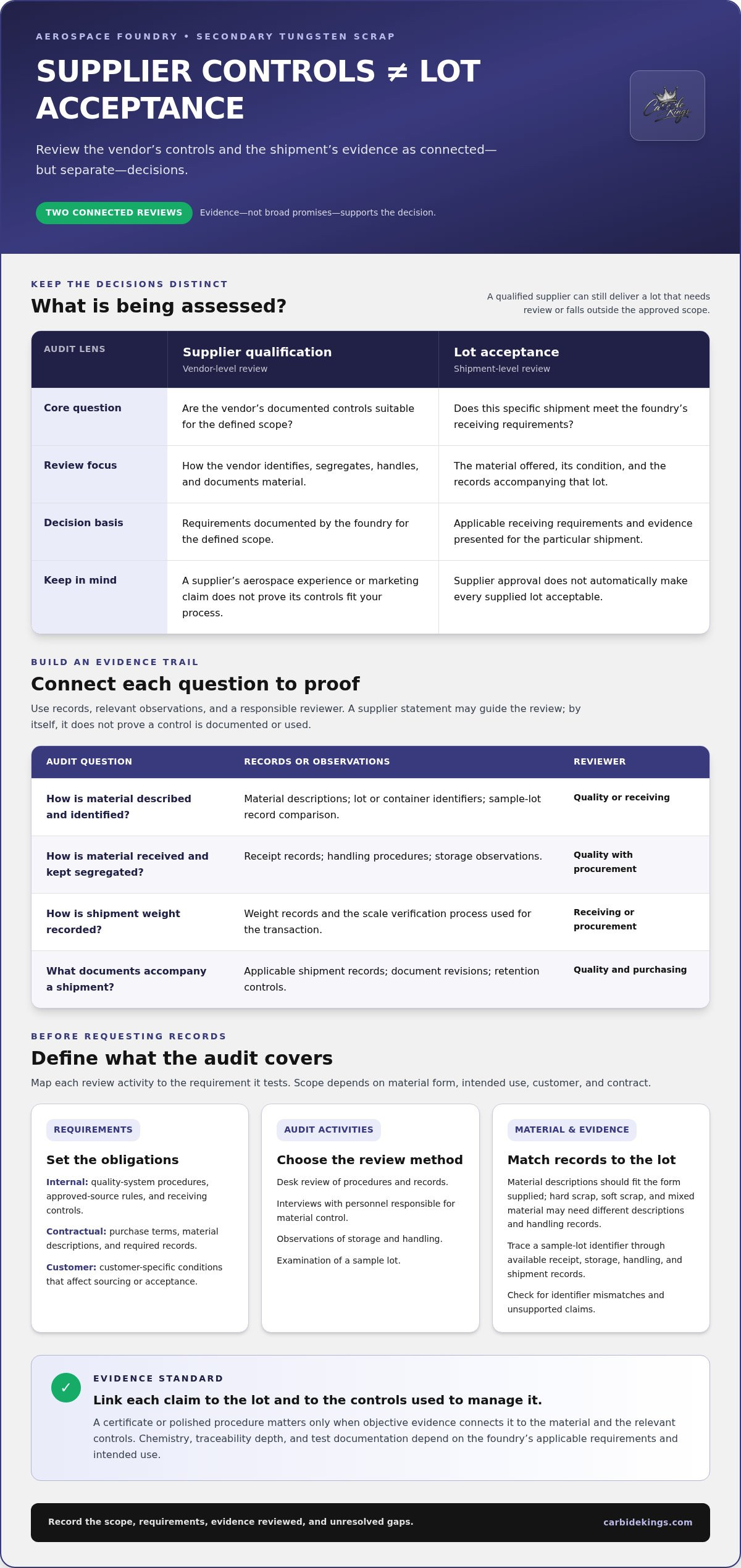
Secondary tungsten feedstock calls for two connected reviews. At the supplier level, assess how the vendor identifies, segregates, handles, and documents material. At the lot level, review the specific material offered, its condition, and the records that accompany it. Material form and intended use matter. The properties and uses of tungsten provide context, but your foundry’s requirements determine which evidence is relevant.
Define the audit scope before reviewing a supplier
Write down what the audit covers before requesting records or scheduling interviews. Identify the tungsten forms under review, the processes relevant to them, and how the material may enter your receiving or procurement flow. For example, scrap supplied for evaluation should not automatically be treated as approved feedstock for a production route.
Set practical boundaries for the review. Decide whether it includes a desk review of procedures and records, interviews with personnel responsible for material control, observations of storage and handling, or examination of a sample lot. Map each activity to the requirement it tests. This keeps the audit focused and makes gaps easier to explain.
- Internal requirements: Note applicable quality-system procedures, approved-source rules, and receiving controls.
- Contractual requirements: Identify purchase terms, material descriptions, and required records that apply to the supplier.
- Customer requirements: Capture customer-specific conditions that your foundry must flow into sourcing or acceptance decisions.
Requirements can differ by customer, contract, material form, and intended use. Do not treat a standard or supplier certificate as a universal substitute for checking which obligations apply to a specific sourcing decision.
Separate supplier qualification from material acceptance
Supplier qualification evaluates whether the vendor’s documented controls are suitable for the defined scope. Lot acceptance is a separate receiving decision based on the material and evidence presented for a particular shipment. A qualified supplier can still deliver a lot that needs review, fails an applicable requirement, or falls outside the approved scope.
Vendor qualification approves a supplier’s controls for a defined scope; lot acceptance determines whether a specific shipment meets the foundry’s receiving requirements.
Keep the evidence trail clear. A supplier may state that lots remain segregated, for instance. The auditor should distinguish that statement from a written procedure, records tied to the material, and observations that show how segregation works in practice. No single form of evidence answers every question, but together they help establish whether the claimed control operates as intended.
Use qualified secondary tungsten scrap vendor audits for aerospace foundries to connect these two levels without merging them. Record the scope, applicable requirements, evidence reviewed, and unresolved gaps. This gives procurement and quality a defensible basis for a supplier decision while preserving the separate checks required when material arrives.
What Evidence Should a Secondary Tungsten Scrap Vendor Provide?
Build the audit request around the material and your acceptance criteria. Qualified secondary tungsten scrap vendor audits for aerospace foundries should connect each audit question to evidence, a direct observation where useful, and the person responsible for reviewing it. A supplier’s statement can guide the review, but it does not prove that a control is documented or used.
Request material descriptions and lot identification records that fit the form supplied. Hard scrap, soft scrap, and mixed material may need different descriptions and handling records. Chemistry, traceability depth, and test documentation depend on the foundry’s applicable requirements and intended use. Do not assume every lot needs an identical document package.
Review material identity and lot records
Check whether descriptions distinguish relevant tungsten scrap forms and identify mixed material or exclusions. Then select a sample lot and trace its identifier through the available receipt, storage, handling, and shipment records. Record gaps or mismatches, such as an identifier that changes between a receipt record and a shipping document. Do not treat an unsupported claim as resolved evidence.
| Audit question | Records or observations | Reviewer |
|---|---|---|
| How is material described and identified? | Material descriptions, lot or container identifiers, and sample-lot record comparison | Quality or receiving |
| How is material received and kept segregated? | Receipt records, handling procedures, and storage observations | Quality with procurement |
| How is shipment weight recorded? | Weight records and the scale verification process used for the transaction | Receiving or procurement |
| What documents accompany a shipment? | Applicable shipment records, document revisions, and retention controls | Quality and purchasing |
Assess handling, weighing, and document controls
Review how the vendor records receipt, segregation, handling, weighing, and shipment. Compare written practices with personnel descriptions and what you observe. Look for a clear method to keep material identities distinct and manage possible contamination. Document any mismatch between procedure and observed practice.
Carbide Kings uses calibrated scales for weight verification. This supports weighing verification, not chemical analysis or proof of composition. Check document revisions, record retention, and access against your foundry’s requirements. If your criteria require chemistry or other test evidence, define which records are relevant and how they must link to the lot.
Evidence is sufficient only when it meets the foundry’s documented acceptance criteria for the material, use, and applicable customer or contractual requirements. Keep the decision traceable: note what was reviewed, who reviewed it, which requirement it addresses, and any open gap. For procurement context, Carbide Kings supplies tungsten scrap and alloys. Each foundry remains responsible for applying its own qualification and receiving criteria.
How to Judge Audit Findings, Standards, and Vendor Claims
An audit finding should identify the requirement assessed, the evidence reviewed, and how that evidence supports the conclusion. Keep the judgment anchored to the foundry’s established finding definitions. Do not import universal severity labels or treat an auditor’s concern as a confirmed failure before comparing it with the applicable requirement.
This discipline matters in qualified secondary tungsten scrap vendor audits for aerospace foundries. A vendor may describe strong traceability or material controls, but a verbal assurance or marketing statement is not equivalent to a record or observed process. Assess the claim against evidence relevant to the material and audit scope.
Distinguish a documented control from an unsupported claim
For each claim, identify what would demonstrate it. A statement that material is kept separate, for example, can be compared with the written procedure, relevant lot records, and facility observations. If the audit cannot verify a claim, record the evidence gap as a gap. Do not assume the control failed, and do not record the claim as verified.
Use the same short record for each issue: requirement, evidence reviewed, conclusion, and follow-up owner or action. This makes the audit trail clear and helps quality and procurement understand what remains unresolved.
- Requirement: Cite the internal, contractual, or customer requirement that applies.
- Evidence: Identify the record, interview, or observation reviewed, including its scope or lot reference where relevant.
- Conclusion: State what the evidence supports and what it does not establish.
- Follow-up: Document the next action under your foundry’s process, such as obtaining a record or assessing a corrective response.
Apply standards and customer requirements carefully
Start with controlled customer and contract documents. Confirm the applicable standard, revision, scope, and any flow-down requirements before using them as audit criteria. AS9100, ISO 9001, ASTM International, and SAE International references should be applied only where a verified requirement makes them relevant. Confirm the revision and scope in the controlling document. Not every requirement applies to every scrap vendor or purchase.
A certificate can support a claim about a defined management-system scope, but it does not establish that a specific tungsten scrap lot meets the foundry’s material criteria.
- Check scope: Confirm the supplier entity, activities, and locations covered by the evidence.
- Check status: Verify validity against the foundry’s documented process and applicable customer requirements.
- Check relevance: Link the reference to the audited control or purchasing condition it is meant to address.
Keep conclusions proportional to evidence. A certification, prior audit report, or supplier statement may inform the review, but none should replace the foundry’s own documented assessment or lot-specific acceptance process.
A Step-by-Step Checklist for Auditing a Tungsten Scrap Vendor
Use an ordered workflow to move from audit planning to a documented sourcing decision. In qualified secondary tungsten scrap vendor audits for aerospace foundries, assign an owner to each step and capture the requirement, evidence, conclusion, and any follow-up. Apply your own procedures for finding classifications, deadlines, and acceptance criteria.
Prepare, assess, and document the audit
Before the review begins, align quality, procurement, and any other responsible functions on scope. Gather evidence in a consistent sequence. Add a sample-lot review only if your foundry’s documented process requires it, and keep the lot review distinct from the broader supplier assessment.
- Set the scope. Owner: audit lead with quality and procurement. Evidence: defined material forms, intended use, applicable internal, contract, and customer requirements, plus review boundaries. Finding to record: scope confirmed or unresolved requirements requiring clarification.
- Request and review records. Owner: quality reviewer. Evidence: supplier procedures and records relevant to material description, identification, handling, and shipment, along with any required supporting documents. Finding to record: evidence that addresses each requirement, or a specific gap.
- Interview responsible personnel. Owner: assigned auditor. Evidence: notes showing how personnel describe their roles and the controls they perform. Finding to record: whether explanations align with applicable procedures and records, with discrepancies identified for follow-up.
- Observe relevant controls. Owner: auditor familiar with the process under review. Evidence: observations of applicable receiving, segregation, storage, weighing, or document-control practices. Finding to record: observed conditions and any difference from documented practice.
- Review a sample lot, if required. Owner: receiving or quality reviewer. Evidence: the lot’s material description and available identifiers linked across records your process requires. Finding to record: traceability demonstrated for the reviewed scope or a documented mismatch or evidence gap.
- Close findings and decide. Owner: designated approval authority. Evidence: completed audit record, responses to findings, and follow-up evidence required by your procedure. Finding to record: qualification, conditional approval, or rejection, including scope limits and any open actions.
Close findings and make a controlled decision
Set corrective-action expectations and deadlines through the foundry’s existing process. Assign each action to a responsible owner, define what evidence will close it, and record the reviewer’s disposition. Do not create a new threshold just to complete the checklist.
Document approval status and its boundaries. A conditional decision should state the conditions and what must happen before further approval or use, according to your procedure. Schedule reassessment based on risk, relevant changes, or the established review cycle. Define the scope, check the evidence, record the gaps, then make and monitor the sourcing decision.
| Audit record field | Entry |
|---|---|
| Requirement and reference | ____________________________ |
| Evidence reviewed and reviewer | ____________________________ |
| Finding and follow-up owner | ____________________________ |
| Decision, limits, and review trigger | ____________________________ |
For industrial tungsten scrap and alloy sourcing, explore tungsten scrap and alloy supply. Evaluate any supplier against your foundry’s defined requirements and approval process.
Turning Vendor Qualification into a Reliable Tungsten Procurement Decision
An audit report is useful only when it leads to a clear, controlled sourcing decision. Record the rationale, approved scope, evidence reviewed, open conditions, and decision owner. Keep the conclusion specific to the supplier and activities assessed. Qualification is not a blanket endorsement of every material description, shipment, or future transaction.
Compare the audit outcome with the foundry’s procurement and receiving requirements. A supplier may fit the sourcing need, while a particular form, shipment arrangement, or documentation package may still need separate review. Consider whether the stated logistics align with your receiving process, material identification needs, and customer or contract conditions. The goal is a workable decision supported by evidence, not a shortcut around incoming controls.
Record the decision and maintain supplier oversight
Make the decision traceable. Note who approved it, what the approval covers, which evidence informed it, and any limitations or conditions. Set review triggers through applicable customer, contract, and internal requirements. Relevant triggers may include a change that affects the approved scope, a concern identified through receiving, or a review date already established by your supplier-management process.
For broader procurement context, the secondary tungsten procurement framework for specialty steel foundries discusses sourcing considerations beyond this aerospace audit checklist. Use that perspective to inform planning, while keeping your aerospace foundry’s documented requirements in control of approval and purchasing decisions.
Move from a sourcing requirement to a material quote
Once the material need is defined, describe it clearly for sourcing: material type, relevant grade information, expected weight, and handling or delivery considerations. Offers depend on material type, grade, weight, and current market conditions. Carbide Kings supplies tungsten hard scrap, tungsten soft scrap, carbide scrap, and tungsten alloys to industrial buyers. Its product range or quote does not establish aerospace qualification; apply your own approval process.
Carbide Kings provides a same-day quote response, uses calibrated scales for weight verification, and issues prompt payment after verification. Nationwide shipping and scheduled pickups are available logistics options. These operational details can inform purchasing coordination, but they do not replace your audit or receiving criteria.
Match the sourcing request to your defined material and logistics needs, then handle qualification and lot acceptance under your own procedures. To discuss tungsten scrap and alloy requirements, discuss your material needs with Carbide Kings.
Put Your Audit Decision to Work
Turn the audit outcome into a practical sourcing plan. Identify the material need, the requirements that govern its use, and the internal steps that must be completed before purchasing. This keeps procurement moving while preserving the foundry’s control over supplier approval and incoming material decisions.
Qualified secondary tungsten scrap vendor audits for aerospace foundries are most useful when they support a defined next action, whether that means proceeding within an approved scope, resolving a condition, or holding a purchase until open questions are addressed. Keep the decision visible to the teams responsible for sourcing and receiving, and revisit it when requirements or circumstances change.
If you’re planning a tungsten scrap or alloy purchase, Carbide Kings can provide a same-day quote response. Discuss your tungsten scrap and alloy requirements to take the next step with a clear sourcing plan.
Frequently Asked Questions
What should an aerospace foundry include in a secondary tungsten scrap vendor audit?
Base the audit on the foundry’s defined scope and applicable customer, contract, and internal requirements. Review material identity and lot records, handling and segregation controls, weighing records, document control, and relevant logistics, such as shipment identification and receiving arrangements. For qualified secondary tungsten scrap vendor audits for aerospace foundries, capture the evidence supporting each conclusion and note unresolved gaps. Do not assume one checklist or acceptance threshold applies to every foundry or material use.
Does a secondary tungsten scrap vendor need AS9100 certification?
Not universally. The answer depends on the foundry’s applicable customer, contract, and internal requirements. Check controlled documents for the required scope, applicable revision, and any requirements flowed down to the vendor. An organization-level quality-system certification addresses a defined management-system scope. It does not establish that a specific tungsten scrap lot meets the foundry’s material acceptance criteria. Treat certification as relevant evidence only when it addresses an applicable requirement.
How can a foundry verify the identity of a tungsten scrap lot?
Compare the vendor’s material description and available lot records with the foundry’s defined requirements. For example, check that the same lot reference appears on the records used to identify and move the material through the vendor’s process. A visual check may support identification, but it is not chemical analysis. If chemistry or other testing is required, follow the controlled acceptance process and document the method used and the result.
What records should a foundry retain after a vendor audit?
Retain the audit scope, applicable requirements, evidence reviewed, interview and observation notes, findings, corrective-action records, and approval decision under your document-control rules. Include supplier and lot references where they help connect the record to the reviewed material or process. For example, make clear which procedure revision or sample-lot documentation informed a conclusion. Do not set a universal retention period; use the duration required by controlled procedures, customer requirements, or contract.
How often should an aerospace foundry re-audit a tungsten scrap vendor?
There is no single audit interval suitable for every supplier. Follow the foundry’s documented, risk-based review process and consider whether the material scope, vendor process, observed performance, customer requirements, or unresolved findings have changed. A change may warrant an earlier review than a routine cycle. Record why the timing was selected and what information informed the decision, so the review schedule remains connected to supplier risk and applicable requirements.
Can a vendor audit guarantee that every shipment will meet foundry requirements?
No. An audit evaluates supplier controls and available evidence within a defined scope; it cannot establish conformity for every future shipment. Keep qualification separate from incoming-lot acceptance, and apply the foundry’s receiving and testing procedures to each shipment as required. If new evidence, a supplier change, or a receiving issue arises, reassess whether the current supplier status still fits the approved scope and documented requirements.
What is the difference between supplier qualification and incoming inspection?
Supplier qualification assesses whether the vendor’s relevant processes and records meet the foundry’s defined requirements. Incoming inspection evaluates a specific shipment or lot using the foundry’s acceptance process. They work together, but neither replaces the other. A qualified vendor does not make every delivery automatically acceptable, while one lot passing inspection does not demonstrate that the vendor’s controls remain suitable for future sourcing. Keep both decisions documented and distinct.


