

Reliable secondary tungsten supply is built before material reaches the receiving dock. Sourcing secondary tungsten scrap feedstock for recycling plants becomes easier to manage when each stream is identified, separated, and tracked as its own inventory category.
Variable grades and forms can disrupt production plans. Uncertain arrival volumes make supply continuity harder, while incomplete lot records slow evaluation and routing. Treating every delivery as interchangeable adds friction. A consistent workflow shows what is available, what still needs verification, and what is ready for the next step.
This guide lays out a practical process, from stream segmentation to lot verification and supply planning. It explains how to distinguish hard scrap, soft scrap, carbide scrap, and tungsten alloys in inventory; set lot-level checks before material is counted as usable; and track the source, form, declared grade, weight, and expected arrival of each lot. The result is a repeatable sourcing system that can adapt to a changing feedstock mix.
Key Takeaways
- Make sourcing secondary tungsten scrap feedstock for recycling plants more predictable by organizing supply around distinct material streams.
- Compare potential sources using consistent records for material form, declared composition, condition, documentation, volume, and delivery pattern.
- Assess supplier reliability separately from whether an individual lot meets your plant’s requirements.
- Build a receiving workflow that moves material through verification, release, and inventory reconciliation before it is counted as usable stock.
- Use consumption, delivery history, and acceptable stock exposure to set reorder triggers, then refine plans using verified records.
Why secondary tungsten scrap feedstock sourcing needs an inventory strategy
Secondary tungsten feedstock is recovered tungsten-bearing material available for further processing. Unlike primary inputs produced from mined ore, secondary feedstock comes from material already used in tools, components, or manufacturing processes. That distinction helps when sourcing secondary tungsten scrap feedstock for recycling plants, but it does not mean every recovered lot is ready for production.
Usable inventory depends on more than whether a shipment contains tungsten. Record its source, physical form, declared grade or composition, condition, and expected arrival. Clean solid scrap, such as inserts or rods, is not automatically interchangeable with grinding sludge, powder, or tungsten alloys. Each form may need different evaluation and processing, depending on the plant’s capabilities and specifications.
Arrival timing matters too. A projected shipment is not stock on hand, and a delivered lot may still be awaiting review. Keep expected supply separate from material that has passed intake checks and been released for use. A general overview of tungsten properties and uses can help teams connect material applications with the different scrap streams they may encounter.
How secondary feedstock supports supply resilience
Recovered material can complement primary tungsten inputs and other supply channels. A mix of sources gives planners more options if one stream changes in volume, timing, or material profile. Treat that diversity as a planning objective, not a promise of uninterrupted supply. Recovered feedstock availability can vary, and each lot still needs to meet plant requirements.
Turn the goal into practical controls. Track expected quantities by source and material category, compare delivery history with forecasts, and identify where a change in one stream could affect production plans. Do not rely on a source’s past deliveries as a guarantee of future volume.
Why inventory records must reflect material condition
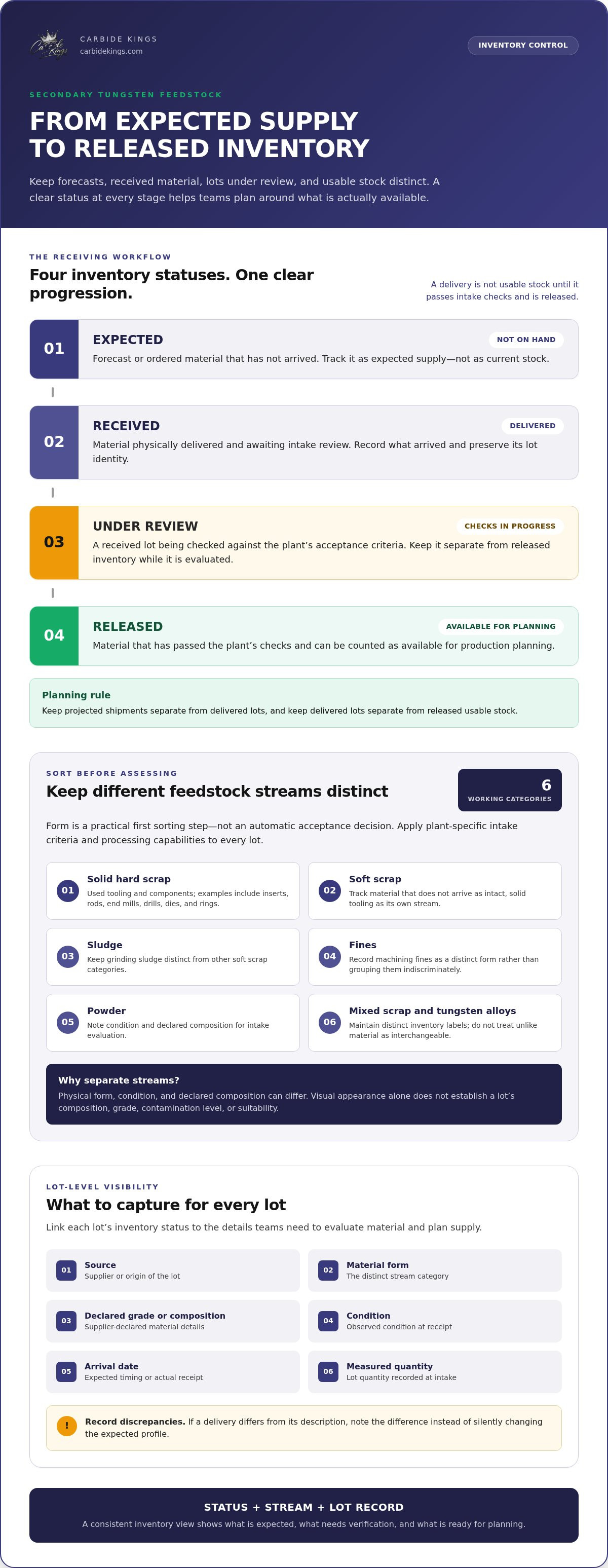
Use distinct inventory statuses so a forecast, a delivery, and usable stock are never counted as the same quantity. Record each lot’s form and observed condition. This prevents unlike materials from being grouped together simply because they contain tungsten, and helps teams see what is awaiting evaluation.
- Expected: Forecast or ordered material that has not arrived.
- Received: Material physically delivered and awaiting intake review.
- Under review: A received lot being checked against plant acceptance criteria.
- Released: Material that has passed the plant’s checks and is available for planning.
Keep a lot-level record that links status to source, form, declared composition, condition, arrival date, and measured quantity. If a delivery differs from its description, record the discrepancy rather than quietly changing the expected profile. Accurate records help production and procurement teams plan against available material and identify where forecasts need adjustment. They improve planning but cannot eliminate supply uncertainty.
Which secondary tungsten feedstock streams can recycling plants source?
Start with the material’s form and how it is presented. Form gives receiving teams a practical first sorting step before they assess composition, condition, or processing suitability. A useful working taxonomy is solid hard scrap, soft scrap and sludge, fines, powder, mixed scrap, and tungsten alloys. These labels define inventory groups, not automatic acceptance decisions. Each plant needs to apply its own intake criteria and processing capabilities.
When sourcing secondary tungsten scrap feedstock for recycling plants, keep each stream distinct in the purchasing record, shipment description, and receiving area. A broad label such as “tungsten scrap” can hide meaningful differences. Ask suppliers to identify the form and describe the lot’s condition so the plant can plan its review without treating unlike material as interchangeable.
Solid tungsten carbide and hard-scrap forms
Solid hard scrap commonly arrives as recognizable used tooling or components. Examples include inserts, rods, end mills, drills, dies, and rings. Their familiar shapes make initial sorting and visual identification more straightforward than with loose fines or wet residues. Appearance alone, however, does not establish composition, grade, contamination level, or suitability for a particular recovery route. Confirm those details during lot qualification. A complete tungsten carbide recycling process guide can provide further process-specific context.
For intake, group solid items by form, then note whether the lot is separated or mixed and whether visible attachments or other materials are present. Do not assume two bins of inserts are equivalent simply because they look alike. Supplier descriptions and plant checks still determine how each lot is evaluated and routed.
Soft scrap, fines, sludge, and powder
Soft scrap covers material that does not arrive as intact, solid tooling. Track grinding sludge, swarf, fines, and powder as distinct categories rather than combining them under one “soft” label. Their physical condition and declared composition can differ, so wet residue, loose machining fines, and dry powder may need different intake reviews and handling decisions. A tungsten soft scrap buyers guide offers a focused discussion of sludge and swarf.
Record practical observations at receipt, such as whether material is wet, loose, compacted, or mixed with visible foreign matter. These notes help evaluators compare the delivered lot with its description and assign the next review step. They do not replace technical testing or establish that a material can be processed at every facility.
Keep mixed scrap in its own inventory group until the plant has assessed its contents. List tungsten alloys separately from tungsten carbide scrap as well. Clear categories help procurement compare like with like, while operations can flag streams that need additional evaluation. If your plant has separated tungsten carbide lots it no longer needs, you can sell tungsten carbide scrap through Carbide Kings.
How to compare feedstock sources and qualify incoming tungsten lots
Compare supply sources using the same fields, but make decisions at two levels: assess a supplier’s delivery history, then qualify each arriving lot on its own evidence. A dependable source can still send a lot that differs from its description. Separating these reviews gives procurement a sound basis for planning and receiving staff a clear intake record.
Create a consistent source and lot scorecard
Use a shared scorecard to compare sources and capture each shipment. Keep supplier history separate from declared lot details and from results recorded during plant inspection. The fields below support consistent review without imposing universal scores or acceptance thresholds. Set limits through your plant’s own specifications and procedures.
| Field | What to record |
|---|---|
| Form | Declared stream, such as solid scrap, sludge, fines, powder, or mixed material. |
| Declared composition | Supplier-provided material or grade description, recorded as a declaration rather than a verified result. |
| Condition | Observed or reported state, including wetness, visible attachments, or mixed contents. |
| Documentation | Shipment description, lot identifier, source details, and supporting records received. |
| Volume | Expected quantity compared with the quantity received and recorded by the plant. |
| Delivery pattern | Planned timing and actual arrival history, including notable delays or variation. |
Source records can reveal whether descriptions are complete and deliveries follow expected patterns. Do not let a favorable history substitute for examining a new lot. Likewise, one discrepancy does not tell the whole story about a supplier’s performance. Log it and compare it with the broader record.
Verify material before releasing it to usable stock
Lot qualification is the documented verification of a shipment against plant criteria before the material is released into usable inventory. Make checks repeatable, while tailoring sampling and analysis to the material and the plant’s established procedures. A reported recovery rate for a process or group of materials cannot establish the composition, suitability, or recovery yield of a specific incoming lot.
- Match the shipment. Compare labels and lot identifiers with the purchase or delivery record. Note missing or conflicting descriptions.
- Record receipt and weight. Weigh the material using the plant’s established method, then record the measured quantity beside the supplier’s declared amount.
- Inspect and sample. Review visible condition and take samples according to plant procedures. Link sample identification to the lot.
- Analyze and decide. Compare results with the plant’s acceptance criteria. Record discrepancies and route the lot for review rather than assuming it meets specification.
Keep material under review, including lots with mismatched labels, unexplained weight differences, or pending results, separate from released stock. This makes sourcing secondary tungsten scrap feedstock for recycling plants more evidence-based: every usable quantity has a traceable record, while unresolved material remains visible without being counted as ready for production.
How to manage secondary tungsten feedstock inventory step by step
A practical inventory workflow connects purchasing forecasts to verified stock, rather than treating an order or delivery as immediately usable material. Keep each quantity tied to its material category and lot record. That gives procurement and operations a shared view of what is expected, what has arrived, and what is ready to support production.
Set inventory categories and replenishment triggers
Separate stock by feedstock form, condition, and verification status. For example, do not combine released solid carbide scrap with soft scrap still under review. Build replenishment triggers around plant data: consumption for each usable category, actual delivery patterns, and the level of stock exposure the plant considers acceptable. These are internal planning controls, not universal thresholds.
Review triggers when production demand changes, the feedstock mix shifts, or recent delivery patterns no longer reflect the assumptions behind the plan. A reorder point that works for one category may not work for another if consumption and arrival timing differ.
Track each lot from arrival to disposition
Give every delivery a record that follows it through intake and use. Include the receipt date, source, lot identifier, declared form, measured weight, and current review status. Link inspection results and any discrepancy to the same identifier. This keeps a received quantity traceable even if it is divided, transferred, or held for evaluation.
- Forecast demand. Estimate upcoming requirements by material category using production plans and recorded consumption. Keep expected deliveries visible, but separate them from stock already on hand.
- Check replenishment triggers. Compare released quantities with plant-defined reorder points and review expected arrivals against actual supplier delivery history.
- Prepare for receipt. Reserve a clear record and inventory location for the incoming lot. Keep categories and statuses distinct so new material can be identified without mixing it into usable stock prematurely.
- Receive and verify. Record delivery details and measured weight, then follow plant procedures for inspection, sampling, and evaluation. Document mismatches between shipment information and observed material.
- Release and reconcile. Update the lot’s status only after plant review. Compare recorded holdings with physical stock on a schedule that fits operations, and investigate differences before adjusting records.
Keep discrepant or unverified material separate until evaluation is complete. If a lot is reclassified or redirected, record the reason and update its inventory location and status. At reconciliation, investigate variances by lot instead of making a broad adjustment that hides which material changed. This helps teams plan from a more accurate view of released feedstock while accounting for stock still under review.
For plants with surplus carbide scrap, Carbide Kings buys scrap from businesses and individuals, with no minimum quantity. Get a same-day quote response for carbide scrap and have the material description and lot details ready for evaluation.
Turn sourcing records into a dependable tungsten scrap procurement loop
Sourcing records are most useful when they inform the next purchasing decision. Close the loop by comparing forecasts with actual arrivals, then checking how much received material was released, held for review, or found unsuitable for its intended use. This turns lot records into practical sourcing insights, not just a transaction history.
Review sourcing performance and adjust the plan
Set a regular review that fits plant operations. Compare expected and actual delivery dates, declared and received quantities, and changes in lot status. Look for recurring gaps. If descriptions regularly omit condition, update intake documentation requirements. If delivered lots often differ from their labels, strengthen receiving records and supplier instructions. Use plant-defined measures rather than assumed industry benchmarks.
Use verified history to refine forecasts and supplier plans, but do not treat past delivery patterns as guaranteed future supply. Note which streams have varied in volume or timing, and account for that uncertainty in replenishment decisions. Review what happened after each variance: Did stock cover demand? Was another material category substituted? Did a delayed release affect the plan? These outcomes can guide adjustments to forecasts, stock exposure, and sourcing mix.
Handle surplus tungsten carbide scrap transparently
Surplus or off-spec carbide scrap can be sent to a buyer for evaluation instead of remaining untracked in plant storage. Carbide Kings buys tungsten carbide scrap in forms including inserts, rods, end mills, drills, dies, rings, mixed scrap, grinding sludge, and powder. Keep the material description and lot details together when arranging a sale so the quote process starts with useful information.
Quotes depend on material type, grade, weight, and current market conditions. Carbide Kings provides a same-day quote response for carbide types. Nationwide shipping and scheduled pickups are available logistics options, and free shipping labels are available for qualifying shipments. Material is verified using calibrated scales, with prompt payment after verification. Keep the shipment record and final verified details together so the disposition of surplus material can be reflected accurately in plant records.
After a sale, update the lot’s status and inventory quantity, then include the outcome in the next sourcing review. That final record completes the loop: the plant can see what was diverted, what remains on hand, and whether its forecast reflected actual needs. A consistent process makes sourcing secondary tungsten scrap feedstock for recycling plants easier to adjust as demand and incoming material change.
Request a same-day quote for tungsten carbide scrap.
Put your next sourcing decision on a stronger footing
Make the next step manageable. Choose one feedstock category and review its recent forecast, lot records, and stock outcomes. Use what the records show to update the next purchasing decision, while keeping expected supply distinct from material that has been verified and released. Small, consistent reviews help turn sourcing secondary tungsten scrap feedstock for recycling plants into a practical operating discipline, not a one-time cleanup exercise.
If your plant has surplus tungsten carbide scrap, you can sell as a business or individual, with no minimum quantity. Carbide Kings is a BBB Accredited Business with an A-rating. Prepare the lot description and request a quote.
Request a same-day quote for tungsten carbide scrap. Use the verified outcome to keep your material records current. A steady review process helps your team make informed sourcing decisions as conditions change. Start with the lot you can document today, and build from there.
Frequently Asked Questions
How much of the global tungsten supply comes from recycling?
There is not one reliable percentage that applies across all measures of global tungsten recycling. A recycled share of supply, a recycling input rate, and the amount recovered from discarded products describe different things, and figures can vary by scope and year. For planning, use a published estimate only when its source, date, and definition are clear. At plant level, track recovered input and usable output separately.
Is recycled tungsten a dependable alternative to primary tungsten?
Recycled tungsten can be a useful supply source, but it should not automatically be treated as a complete replacement for primary material. Dependability depends on whether incoming volumes, material characteristics, and delivery timing align with plant requirements. Build a sourcing plan that can adjust when a stream changes, and evaluate each lot against relevant production needs. This makes sourcing secondary tungsten scrap feedstock for recycling plants more resilient without assuming a supplier’s past deliveries will continue unchanged.
Can mixed tungsten carbide scrap be used as recycling feedstock?
Yes, mixed tungsten carbide scrap may be usable, depending on its contents and the receiving facility’s acceptance criteria and processing capabilities. A mixed lot can combine different forms or include material that needs separate evaluation. Describe the mixture as accurately as possible, preserve lot identity, and avoid blending it with a clearly separated stream before review. The plant can then decide whether to process it together, sort it, or route it differently.
What happens if a shipment does not match its inventory record?
Keep the shipment under review and document the difference before changing the usable-stock balance. Compare the lot label, supplier description, recorded weight, and observed condition with the receiving record. Preserve relevant supporting documents and record the discrepancy against the lot identifier. Follow plant procedures to evaluate and resolve the mismatch; update the inventory record only when the disposition is clear. This creates an audit trail for later purchasing and reconciliation decisions.
Does recycled tungsten have a lower environmental footprint than primary tungsten?
It can, but a blanket comparison needs care. The result depends on what the assessment includes, such as collection and transport, the recycling route, energy use, material condition, and the primary production process used as a comparison. Without a named study and matching system boundaries, a specific environmental advantage cannot be stated confidently. Plants assessing impact should compare like-for-like data and identify which stages and assumptions the analysis covers.
How often should a recycling plant update its tungsten scrap inventory?
Update the record whenever a material event changes the stock picture, such as a delivery, verification decision, production issue, transfer, or shipment out. Set a separate physical reconciliation schedule that fits the plant’s operating pace and risk. Fast-moving or frequently adjusted categories may need closer review than stable stock. Use discrepancies and delayed updates to refine the schedule, and keep expected, received, and released quantities distinct in reports.


