

What makes a tungsten scrap lot suitable for your ferroalloy process? In bulk tungsten scrap procurement for ferroalloy manufacturing, labels such as hard scrap, soft scrap, carbide scrap, and tungsten alloys describe different material categories. A lot that does not match your process or acceptance criteria can complicate receiving, inspection, and production planning.
Define your requirements before requesting material. Clear criteria make it easier to compare lots, plan for consistency, and balance supply needs with purchasing flexibility. Start with the material form your process can use, then document the composition and acceptance details your team requires. Finally, compare lot size and purchasing cadence with your production plan, storage capacity, and inspection process. Carbide Kings supplies tungsten hard scrap, tungsten soft scrap, carbide scrap, and tungsten alloys for industrial buyers. Use the steps in this guide to identify the relevant category and prepare a practical sourcing request.
Key Takeaways
- Start with your ferroalloy process and document the feedstock requirements your purchasing brief must capture.
- Compare hard scrap, soft scrap, carbide scrap, and tungsten alloys as distinct material forms, then assess handling and process fit.
- Choose between planned bulk purchasing, staged purchasing, and spot sourcing by weighing consumption plans, storage capacity, quality controls, and flexibility.
- Use a consistent lot qualification process to distinguish your acceptance checks from supplier descriptions and shipment information.
- Build a practical plan for bulk tungsten scrap procurement for ferroalloy manufacturing, then match your requirements to the relevant Carbide Kings material category.
Bulk tungsten scrap procurement for ferroalloy manufacturing: define the feedstock need
Bulk tungsten scrap procurement for ferroalloy manufacturing means specifying and sourcing tungsten-bearing scrap in quantities suited to a producer’s planned input needs. It is feedstock sourcing, not the purchase of finished ferroalloys or processed tungsten products. Begin with the manufacturing process and intended use, then state what material the operation can accept. A request for “tungsten scrap” alone leaves the material form, lot requirements, and acceptance conditions unclear.
Buyer-defined criteria make a request specific and comparable: Acceptance criteria define the material, lot, and delivery conditions a buyer will approve for its process. Set those criteria before requesting material so your team can assess supplier descriptions and proposed lots against the same requirements.
Which tungsten-bearing material forms may enter the sourcing discussion?
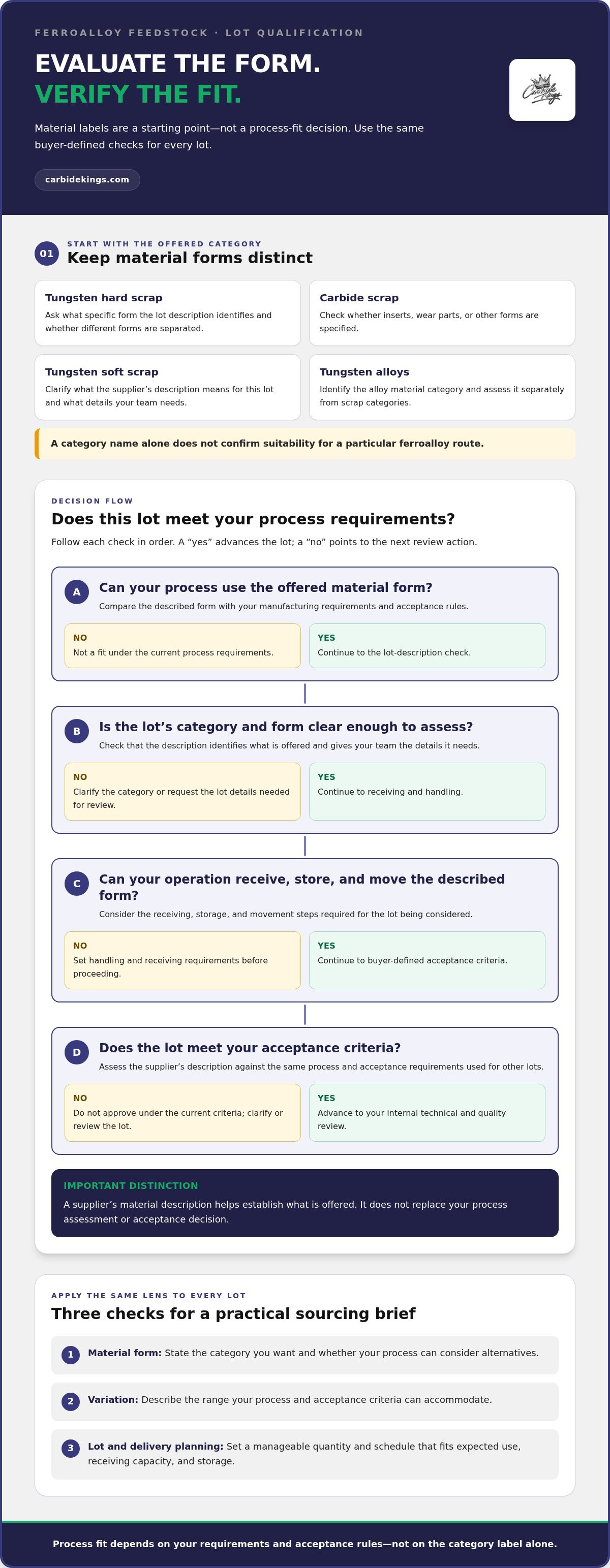
Keep the categories distinct from the start. Tungsten hard scrap is a hard-scrap category; tungsten soft scrap is a separate category; carbide scrap is identified by its carbide material type; and tungsten alloys are alloy materials. These labels identify different sourcing categories. None, by itself, confirms suitability for a particular ferroalloy route.
Category names do not establish process fit. Your team must identify which forms its process can use and define the applicable acceptance limits. For background on one category, the guide to tungsten hard scrap recycling explains hard scrap in its own context. For a broader elemental overview, Tungsten (W) is a chemical element with atomic number 74.
Translate the ferroalloy process into a procurement brief
Build the brief around your process and intended use, not just a supplier’s category label. Name the material form, describe acceptable variation, state the lot size your operation can manage, and outline a delivery plan that fits production and storage. For example, specify separate requirements for hard scrap and carbide scrap if your process evaluates them differently. Do not assume the two categories are interchangeable.
Make the brief useful for both purchasing and technical review. Identify which details are essential for an initial comparison and which your team must assess before acceptance. A supplier’s material description helps establish what is being offered, but it does not replace your process assessment or acceptance decision.
- Material form: State the category you want and whether your process can consider alternatives.
- Variation: Describe the range your process and acceptance criteria can accommodate.
- Lot and delivery planning: Set a manageable quantity and a delivery schedule that fits expected use, receiving capacity, and storage.
Assess technical suitability against your manufacturing requirements. A clear brief gives procurement, production, and quality teams a shared basis for reviewing each lot without assuming that a material category automatically fits the process.
Evaluate tungsten scrap forms against ferroalloy feedstock requirements
Material labels are a starting point, not a process-fit decision. For bulk tungsten scrap procurement for ferroalloy manufacturing, assess each category using the same buyer-defined questions: What form is offered? How will your team receive and handle it? What information or internal review is required before acceptance? Do not assume one category is universally better. Suitability depends on your process and acceptance rules.
Use the table below to turn category names into practical questions for your sourcing brief and internal review. The U.S. Geological Survey (USGS) provides comprehensive data on tungsten, including information on production, consumption, and recycling.
| Material form | Buyer questions | Handling considerations | Process-fit verification |
|---|---|---|---|
| Tungsten hard scrap | What specific form does the lot description identify? Are different forms separated? | Consider the receiving, storage, and movement steps required for the described solid material. | Compare the described form with your process requirements and acceptance rules. |
| Carbide scrap | Is the lot identified as carbide scrap, and are inserts, wear parts, or other forms specified? | Plan handling around the physical forms named in the lot description. | Assess the stated material category and form against your own technical criteria. |
| Tungsten soft scrap | What does the supplier’s description mean for this lot, and what details does your team need? | Set internal handling and receiving criteria for the form being considered. | Review the description against process and acceptance requirements before approval. |
| Tungsten alloys | Which alloy material category is offered, and what information does your process require? | Define storage and handling steps based on your internal requirements. | Evaluate the alloy category separately from scrap categories against process criteria. |
Hard scrap and carbide scrap: assess form and lot description
Keep hard scrap and carbide scrap distinct in your purchasing brief. Solids, inserts, and wear parts are examples of physical forms, not proof of a particular composition or process outcome. Ask for a lot description that identifies the category and form, then compare it with your acceptance rules. If your process treats forms differently, state that in the request rather than grouping everything under a general scrap label.
Soft scrap and tungsten alloys: identify different evaluation questions
Soft scrap and tungsten alloys are separate sourcing categories, not interchangeable labels. Define handling and process criteria for each category before procurement. A supplier description can clarify how a lot is presented, but your technical team determines whether it meets process requirements. Buyers evaluating soft scrap can use this guide to tungsten soft scrap buyers as additional context.
Specify category and physical form separately: the category names the material group, while the form clarifies what your team must handle and assess. Carbide Kings supplies hard scrap, soft scrap, carbide scrap, and tungsten alloys. Use your defined criteria to explore the tungsten material categories relevant to your sourcing brief.
Compare bulk tungsten procurement options without overlooking lot risk
Your purchasing approach affects more than order size. It influences delivery timing, storage needs, and the workload for inspection and acceptance. Planned bulk purchasing, staged purchasing, and spot sourcing are options to compare, not guarantees of price, quality, or supply. For bulk tungsten scrap procurement for ferroalloy manufacturing, weigh each approach against your production schedule and the lot requirements set by your team.
Lot risk can arise when a delivery’s description, form, or consistency differs from the expectations used to plan production. Apply a defined review process to every lot, including purchases made on a recurring schedule. For market-value context, the tungsten carbide scrap price guide discusses factors relevant to evaluating market conditions. Treat market context as one input, not a substitute for assessing material and process fit.
When a bulk commitment may fit a manufacturing plan
A larger planned purchase may align procurement volume with expected material use and scheduled production. The volume still needs to fit your operation. Consider available storage, cash-flow planning, incoming inspection capacity, and how the material will be scheduled for use. A bulk commitment does not guarantee lower costs, stable prices, or uninterrupted supply. Each lot must still meet your acceptance criteria.
When staged or spot purchases may offer more flexibility
Staged purchasing can divide a planned requirement into deliveries, which may suit limited storage or changing production needs. Spot sourcing can address a discrete requirement, but it may require close coordination with production and quality-control teams. For either approach, match the purchasing cadence to the time and capacity your team has to review each lot before acceptance.
| Approach | Potential benefit | Trade-off to manage | Buyer question |
|---|---|---|---|
| Planned bulk purchase | Can align a larger volume with forecast material use. | Requires storage, cash-flow planning, inspection capacity, and scheduling. | Can we store, inspect, and use the planned lot within our operating plan? |
| Staged purchase | Can divide procurement into deliveries that fit changing needs or storage limits. | Each stage requires coordination and its own lot review. | Can our production and quality teams manage the proposed delivery cadence? |
| Spot sourcing | Can address a discrete requirement without setting a longer purchasing cadence. | Timing and lot acceptance may be harder to align with production planning. | Does the available lot meet our criteria and fit the production schedule? |
Choose lot size and cadence based on operational requirements, not a general assumption that one approach is best. Before committing, compare expected use, storage space, incoming inspection capacity, process scheduling, and the flexibility your team needs. Apply the same acceptance rules to every delivery. Buyers building a sourcing plan can match defined material needs to Carbide Kings’ tungsten scrap and alloy categories.
Use a step-by-step checklist to qualify a tungsten scrap lot
A lot qualification process turns written requirements into checks before, during, and after delivery. For bulk tungsten scrap procurement for ferroalloy manufacturing, separate buyer-controlled requirements, such as acceptance rules and inspection procedures, from the supplier’s material description and shipment information. Keep both in view throughout the purchase. This makes discrepancies easier to identify and resolve without relying on a category label alone.
Define acceptance criteria before arranging a shipment
Document acceptable material forms, how a lot is identified, handling needs, and the conditions that would lead your team to reject or hold material. Set any chemistry or composition limits from your process specification. Use these requirements to assess the supplier’s description, not as a substitute for your own technical review. Establish them before coordinating delivery so receiving staff know what to check.
- Define the requirement. Buyer-controlled: document the intended use, acceptable form, lot identification, required quantity, handling needs, and rejection criteria. Keep material categories distinct.
- Request a clear lot description. Supplier-provided: review the material category and form, along with any lot or shipment information provided. Compare the description with your written request.
- Resolve gaps before shipment. Buyer-controlled: identify missing details that affect acceptance and decide whether the lot can proceed to review. Do not treat supplier-provided information alone as proof that the material meets your process requirements.
- Plan packaging and transportation. Coordinate arrangements suited to the material and planned delivery. Align the shipment plan with your receiving equipment, storage space, and internal handling procedures.
- Prepare the receiving team. Confirm who will receive the load, which inspection steps apply, where material will be held if there is a discrepancy, and who can make the acceptance decision.
- Inspect and record the outcome. At receipt, follow internal procedures to compare the delivered lot with the purchase requirements and available shipment information. Record acceptance, a hold, or a discrepancy through your established quality process.
Plan shipment, receiving, and lot records
Include delivery logistics in lot qualification. A suitable lot still needs packaging and transportation that your operation can receive and handle. Confirm receiving capacity and inspection timing before arrival. Then decide how your team will document differences between the request, shipment information, and material received. For process context, the industrial carbide scrap recycling process offers background on carbide material handling.
Clear lot records make procurement decisions easier to repeat, compare, and improve. Keep the brief, supplier description, shipment details, inspection result, and discrepancy resolution together under your internal recordkeeping process. These records give procurement and production teams a consistent reference for future decisions without assuming a later lot will match an earlier one.
Put your lot requirements into a clear sourcing brief, then explore tungsten scrap and alloy categories from Carbide Kings that match the material form you’re evaluating.
Source tungsten scrap for ferroalloy manufacturing with Carbide Kings
A useful sourcing request connects a clear procurement brief with the material category you want to evaluate. Carbide Kings is a U.S.-based industrial supplier serving buyers nationally, with tungsten hard scrap, tungsten soft scrap, carbide scrap, and tungsten alloys. These categories help ferroalloy buyers organize a request without treating every tungsten-bearing material as interchangeable.
Match a defined procurement brief to available material categories
Keep the brief concise and specific. Identify the category and form your team wants to consider, the lot size and purchasing cadence you are planning, and the acceptance criteria your process requires. Then match the request to a relevant category: hard scrap, soft scrap, carbide scrap, or tungsten alloys. This framework helps organize sourcing; your team still determines whether a particular category and lot fit the ferroalloy process.
For example, if your team is evaluating carbide scrap, name that category directly instead of sending a general request for tungsten material. If you are considering tungsten alloys, state that separately. Clear wording keeps the material discussion aligned with your brief and gives your team a consistent basis for reviewing descriptions and purchasing options. Carbide Kings supplies a consistent inventory of tungsten materials, while your technical and quality procedures remain the basis for acceptance.
Focus the request on the information purchasing and production need for the next decision. A practical brief can include:
- Material category: tungsten hard scrap, tungsten soft scrap, carbide scrap, or tungsten alloys.
- Requested form and lot size: describe the form your team intends to evaluate and the quantity that fits its plan.
- Procurement approach: indicate whether you are planning a bulk commitment, staged purchasing, or a discrete requirement.
- Acceptance framework: summarize the buyer-defined criteria that will guide internal review.
This structure keeps bulk tungsten scrap procurement for ferroalloy manufacturing anchored to your operation’s needs without making assumptions about material specifications or process outcomes. Carbide Kings supplies these four material categories for industrial buyers. Your team determines which category to evaluate and whether a particular lot meets its requirements.
Move from material requirements to a purchasing conversation
Turn your requirements into a clear next step: define process needs, specify the material form, set acceptance criteria, and plan lot size and timing around production and receiving capacity. With those details in place, purchasing and production can discuss material categories using a shared understanding of the operation’s needs. Keep technical acceptance within the manufacturer’s own review process.
Explore tungsten scrap and alloys from Carbide Kings to connect your industrial sourcing brief with the relevant material categories. A focused request moves the purchasing conversation forward, while your defined criteria keep the decision grounded in process requirements.
Turn your sourcing criteria into the next procurement step
A clear procurement brief can become a repeatable tool for future purchasing, helping your team carry process needs and acceptance expectations into each request. That is the practical value of bulk tungsten scrap procurement for ferroalloy manufacturing: a decision framework your production and procurement teams can use together.
Carbide Kings serves industrial buyers nationally across the United States with tungsten hard scrap, tungsten soft scrap, carbide scrap, and tungsten alloys. Match your defined material needs to the category you want to evaluate, then keep your process requirements at the center of the purchasing decision.
Take the next step with a focused sourcing request. Explore tungsten scrap and alloys from Carbide Kings and move your procurement plan forward with a clear set of requirements.
Frequently Asked Questions
Can tungsten scrap be used in ferroalloy manufacturing?
Yes, tungsten scrap may be used in ferroalloy manufacturing if the specific process can accept the material. A tungsten-bearing scrap category is a starting description, not confirmation that a lot qualifies as feedstock for a particular operation. For bulk tungsten scrap procurement for ferroalloy manufacturing, define chemistry limits and process controls from your own specification. Requirements for one production route may not apply to another, so review each proposed lot against internal criteria before use.
Is tungsten hard scrap better than soft scrap for ferroalloy production?
No category is universally better; process fit decides. Hard scrap and soft scrap are distinct forms, so evaluate them separately rather than ranking them by label. Compare how each described form fits your receiving and handling setup, then apply the same buyer-defined acceptance rules. Consider lot planning too: a form your team can review and manage may be a better operational fit than one that creates receiving or inspection bottlenecks.
What information should a bulk tungsten scrap purchasing specification include?
Include the intended process, acceptable material forms, buyer-defined composition limits, lot size, handling needs, and receiving criteria. Mark which conditions are mandatory and which are preferences, such as a preferred delivery cadence. This helps purchasing teams compare offers without treating a preference as a rejection condition. Base composition limits on the manufacturer’s process specification, not a generic template. The specification records buyer requirements; it does not imply supplier analysis or certification.
How should ferroalloy manufacturers compare bulk and spot tungsten scrap purchases?
Compare expected demand, purchasing cadence, storage space, receiving capacity, and internal quality controls. A bulk purchase may align with planned use, while staged or spot purchases can provide flexibility for changing requirements or limited storage. None of these approaches guarantees savings, stable pricing, or suitable material. Apply the same acceptance criteria to each option, then consider the work required to receive, inspect, store, and schedule each lot.
Can tungsten scrap categories be substituted for one another?
Do not assume hard scrap, soft scrap, carbide scrap, and tungsten alloys can be substituted for one another. They are distinct sourcing categories, and a shared tungsten-bearing description does not establish equivalence. The production route, material requirements, and acceptance controls determine whether another form can be considered. When evaluating an alternative, document any changes to handling or internal review, then assess it against the process specification before treating it as an acceptable substitute.
What should a manufacturer do if a delivered lot does not match its purchasing specification?
Follow your receiving procedure first. Segregate or hold the lot as your internal rules require, document the discrepancy, and compare the material received with the agreed purchasing requirements and available shipment description. Record the specific mismatch, such as a difference in stated form or lot identification, and route it through the appropriate internal review. Do not use or accept the material until your established controls determine the next step.


