

The fastest purchase isn’t always the safest choice for production. In commercial secondary tungsten scrap procurement vs spot market buying, the right approach depends less on chasing a market snapshot and more on how predictable your material needs are.
Flexibility matters when market conditions or production requirements shift. Spot buying can suit occasional or uncertain demand, while planned procurement can help align purchasing with recurring consumption. Neither approach removes the need to manage material fit, timing, and changing conditions. A mismatch between scrap type and process requirements can disrupt a plan, whatever the buying model.
This article compares planned sourcing with spot purchases so you can choose a model that fits your production schedule, risk tolerance, and purchasing workflow. It covers practical criteria for material category, order timing, and review points, along with ways to compare quoted terms without assuming a fixed market price. The goal is a clearer procurement decision, fewer avoidable surprises, and a sourcing plan built around your actual demand.
Key Takeaways
- Match your buying approach to demand certainty: recurring, defined needs may suit planned procurement, while spot buying offers flexibility for near-term requirements.
- In commercial secondary tungsten scrap procurement vs spot market buying, compare material fit, timing, and purchasing terms, not just the current market signal.
- Set acceptable material categories and application requirements before evaluating sourcing options to reduce specification mismatches.
- Use a simple worksheet to track expected volume, material category, timing, and the internal decision owner.
- Explore how tungsten hard scrap, tungsten soft scrap, carbide scrap, and tungsten alloys can fit an industrial purchasing plan.
Secondary Tungsten Scrap Procurement vs. Spot Buying: What Is the Difference?
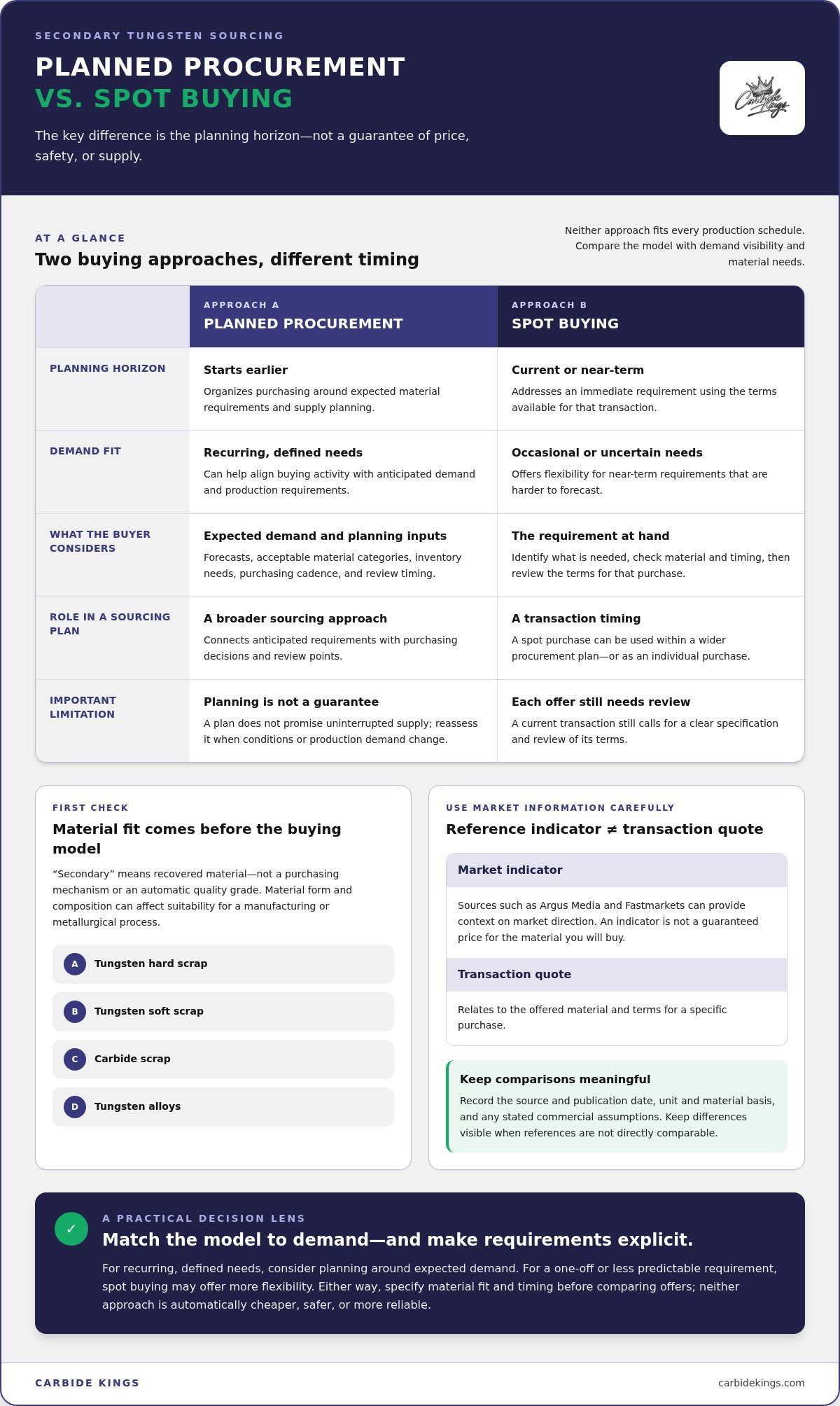
The main difference is the planning horizon. Planned procurement organizes purchasing around expected material requirements and supply planning. Spot buying addresses a current or near-term need using the terms available for that transaction. Procurement describes the broader sourcing approach; spot describes the timing of an individual purchase.
Procurement is the strategy for aligning purchases with anticipated demand, while spot buying is the timing of a transaction for an immediate requirement. A buyer can use spot purchases as part of a wider procurement plan, or rely on individual purchases when needs are harder to forecast. Neither approach is automatically cheaper, safer, or more reliable. The better fit depends on demand visibility, material requirements, and how much flexibility the operation needs.
What counts as secondary tungsten scrap?
“Secondary” describes recovered material, not a purchasing mechanism or an automatic quality grade. Industrial buyers may source tungsten hard scrap, tungsten soft scrap, carbide scrap, or tungsten alloys. These are distinct material categories, and their form and composition can affect whether they suit a particular manufacturing or metallurgical process.
Start with the intended use, then identify the material category and the requirements that matter to that process. Don’t assume all tungsten-bearing scrap is interchangeable simply because it contains tungsten. For context on the metal’s characteristics and applications, see Tungsten properties and uses. Buyers evaluating carbide material can also explore the tungsten carbide scrap recycling process to understand why material form matters in recovery.
How spot buying differs from planned sourcing
A spot purchase begins with a current requirement. The buyer identifies what’s needed, considers the material and timing, and makes a decision based on the terms available for that transaction. This approach can accommodate occasional or uncertain needs, but each purchase still calls for a clear specification and a review of the terms.
Planned sourcing starts earlier. A buyer considers expected demand, acceptable material categories, inventory needs, and when purchasing decisions should be reviewed. A plan can help connect buying activity to production requirements, but it doesn’t promise uninterrupted supply or remove the need to reassess as conditions change.
The distinction matters in commercial secondary tungsten scrap procurement vs spot market buying: compare the purchasing model against your operation, not just a single market signal. A recurring, defined need may support advance planning. A one-off or less predictable requirement may call for a more flexible transaction. In either case, make material fit and timing explicit before comparing offers. That gives purchasing teams a consistent basis for weighing current needs against future requirements without assuming one model suits every production schedule.
How Secondary Tungsten Procurement Handles Supply, Specifications, and Market Signals
A useful procurement plan connects three decisions: how much material production is expected to require, what material can meet the application, and when purchasing decisions should be reviewed. Forecasts help estimate requirements, while purchasing cadence and inventory needs help determine whether to plan ahead or respond to a near-term need. Keep these inputs visible in one process. If production demand changes, update the forecast and review the sourcing plan rather than relying on an outdated assumption.
Define material requirements before comparing offers. Otherwise, buyers may compare terms for materials that aren’t equivalent for their intended use. This is a practical distinction in commercial secondary tungsten scrap procurement vs spot market buying: planning can organize requirements and review points, but it doesn’t make different materials interchangeable or turn market reporting into a transaction quote.
Use market data without treating it as a guaranteed quote
Market assessments from sources such as Argus Media and Fastmarkets can provide context for evaluating market direction. They are references, not automatic transaction terms. Published indicators may describe a particular material basis, unit, specification, or set of commercial assumptions. A transaction quote, by contrast, relates to the offered material and terms for that specific purchase.
A market indicator is context for a purchasing decision, not a guaranteed price for the material you’ll buy. To make comparisons useful, record the source, publication date, unit, and material basis for every reference. If one source reports a different unit or material basis from another, keep those differences visible rather than treating the figures as directly comparable. Then compare transaction-specific offers against the requirements and terms that matter to your operation.
- Source and date: Record who published the reference and when.
- Unit and material basis: Note what the indicator describes and how it is measured.
- Commercial assumptions: Capture any stated conditions that affect how the reference should be interpreted.
Match material specifications to the intended use
Before sourcing, document the material form, known composition, and acceptable use for the application. Identify whether the requirement is for tungsten hard scrap, tungsten soft scrap, carbide scrap, or tungsten alloys. Keep tungsten carbide distinct from other tungsten-bearing materials: shared tungsten content alone doesn’t establish that materials will suit the same process.
Use the written requirement as a filter when reviewing market information and offers. For example, a reference for one material category shouldn’t be treated as a direct comparison for a different category without accounting for the difference. The tungsten carbide scrap price guide discusses factors that can influence valuation, helping buyers frame questions about the material basis behind a reference.
Clear forecasts and specifications make purchasing reviews more focused. Industrial buyers sourcing secondary tungsten-bearing materials can consider Carbide Kings’ material categories alongside their defined application and procurement plan.
When Does Spot Buying or Planned Procurement Fit Better?
Choose a model based on how clearly you can describe the need and how much purchasing flexibility your operation requires. Planned procurement may suit recurring consumption with defined material requirements. Spot buying may fit a one-time need or demand that’s still uncertain. Use the comparison below to weigh the workflow, not to assume one option will always provide better terms or supply.
| Decision factor | Planned procurement | Spot buying |
|---|---|---|
| Demand visibility | Useful when expected requirements can be described ahead of time. | Can address current needs when future demand is unclear. |
| Flexibility | Can use review points and updated forecasts to adjust the plan as needs change. | Allows a decision around each near-term requirement, subject to current availability and terms. |
| Administrative effort | Requires initial planning and periodic reviews; a defined process may help coordinate repeat decisions. | May require sourcing and evaluating offers each time a need arises. |
| Exposure to changing terms | Terms and timing depend on the specific arrangement, and may need review as conditions change. | Each purchase is considered under current transaction terms, which can differ from one purchase to the next. |
Planning doesn’t have to mean locking every forecast in place. Set review points to compare expected consumption with actual requirements. If production changes, revise the forecast and purchasing schedule. This preserves room to respond while giving the team a consistent planning framework. The comparison in commercial secondary tungsten scrap procurement vs spot market buying isn’t a choice between flexibility and rigidity; it’s a decision about how to organize purchasing while allowing for changing needs.
Situations that may favor planned procurement
Consider planned procurement when consumption recurs and the material category, application, and expected requirements are clear enough to guide purchasing. A schedule can help purchasing and production teams coordinate inventory decisions and review upcoming needs together. It doesn’t guarantee uninterrupted supply. The fit depends on your requirements and the transaction terms for each purchase.
Situations that may favor spot purchases
Spot buying may suit a one-time requirement, uncertain demand, or a need that changes before a plan is established. It lets the buyer assess each purchase against current requirements, but can mean repeating the sourcing and review work. Availability, timing, and terms may not align with production needs, so flexibility shouldn’t be mistaken for certainty.
For a recurring need, consider whether defined requirements and scheduled reviews would simplify coordination. For an unusual or shifting need, assess each spot opportunity against the immediate production requirement. Some operations may use both approaches for different needs. Keep the decision tied to material fit, demand visibility, and the capacity to adapt.
Build a Tungsten Scrap Sourcing Decision in Five Practical Steps
Turn production needs into a purchasing decision your team can review consistently. This five-step workflow connects demand, material fit, sourcing model, and market context without treating an indicator as a transaction term. Use it for an upcoming purchase, then revisit it when production assumptions or requirements change.
- Forecast the need. Estimate expected usage and note the period it covers. Separate confirmed requirements from forecasts so the team can see what is firm and what may change.
- Specify the material. Record the material form, known composition, acceptable category, and intended process. Keep hard scrap, soft scrap, carbide scrap, and alloys distinct rather than combining unlike materials.
- Compare sourcing models. Consider whether the requirement is recurring and defined or one-time and uncertain. Assess planned procurement and spot buying against the same production need.
- Review transaction terms. Compare offers using consistent material descriptions, quantity bases, timing, and stated terms. Note the dated market references used internally, but don’t treat them as substitutes for an offer’s actual terms.
- Reassess. Compare actual requirements with the forecast at planned review points. Update the plan when demand or application needs change, and record why the buying model still fits.
Create a buyer-side demand and material brief
Give purchasing and production teams one concise record to work from. Include expected usage, timing, acceptable material forms, and the process the material will serve. Mark assumptions as firm or forecast. This helps the team distinguish a confirmed requirement from a planning estimate and makes later revisions easier to follow.
Simple sourcing worksheet
- Expected volume: __________; period covered: __________
- Material category: hard scrap, soft scrap, carbide scrap, or alloys
- Timing: __________; requirement status: firm or forecast
- Intended process or use: __________
- Internal decision owner: __________
Compare offers on a like-for-like basis
Use the brief to make comparisons consistent. Record each offer’s material description, quantity basis, timing, and stated transaction terms. Then note how it relates to the dated market references used by your team. A reference may provide context, but it doesn’t establish that two different material descriptions or commercial assumptions are equivalent. For added context on hard-scrap sourcing, use this tungsten hard scrap buying guide.
Market-reference checklist: Record the source and publication date; capture the unit and material basis; note stated assumptions; and keep the reference separate from transaction-specific terms. These steps help prevent a broad market signal from being mistaken for a quote.
Use this process to clarify your requirements before comparing commercial secondary tungsten scrap procurement vs spot market buying. Carbide Kings’ secondary tungsten material categories are part of the options for an industrial sourcing plan.
Source Secondary Tungsten Materials for a More Deliberate Procurement Plan
The practical decision rule is straightforward: align the purchasing model with how certain your demand is, how well the material fits its intended use, and how much operational flexibility you need. A recurring, clearly defined requirement may support planned sourcing. A changing or one-time need may call for a spot purchase. In either case, keep the material description and transaction terms clear so the buying decision reflects your actual production requirements.
Carbide Kings supplies industrial buyers with tungsten hard scrap, tungsten soft scrap, carbide scrap, and tungsten alloys. Start with the category that matches your application, then organize the requirement before moving into a sourcing conversation. That preparation keeps procurement focused on the material and need at hand.
Match Carbide Kings materials to industrial requirements
Use your documented process needs to identify the relevant material category. Tungsten hard scrap, tungsten soft scrap, carbide scrap, and tungsten alloys are distinct offerings, not interchangeable labels. Keep the description tied to the material your operation requires, and avoid assuming a category alone establishes every detail of suitability. Carbide Kings supplies these secondary tungsten-bearing materials to industrial and manufacturing buyers.
A concise brief can make the next step more focused. Note the material category, intended application, expected need, and required timing. Keep assumptions visible so your team can distinguish established requirements from estimates. The brief gives purchasing and production a shared starting point without locking the operation into an unsupported forecast or a fixed buying model.
Turn the comparison into a sourcing next step
Before proceeding, bring together three essentials: the material category, expected need, and timing. Then use the same information to assess whether planned sourcing or a spot purchase better fits the requirement. For broader sourcing context, Carbide Kings’ tungsten scrap buying guide can help frame the material and purchasing considerations involved.
Keep your notes practical. Separate firm requirements from forecasts, identify the process the material will serve, and record when your team expects to review the need. This gives your sourcing discussion a clear scope while leaving room to respond if production plans change. The goal isn’t to predict every market movement. It’s to make the next purchase decision against consistent requirements.
Explore tungsten and carbide material offerings from Carbide Kings for your industrial purchasing needs.
Put Your Tungsten Sourcing Plan Into Motion
The next step is to make your approach repeatable. Set a review point for demand forecasts, material requirements, and purchasing assumptions, then update them as production needs change. This keeps your sourcing decision grounded in current operational priorities rather than habit or a single market signal. The right balance in commercial secondary tungsten scrap procurement vs spot market buying can evolve as your requirements do.
Carbide Kings offers a consistent inventory of secondary tungsten-bearing materials for industrial buyers. Bring your material category, expected need, and timing into focus, then use that brief to guide your sourcing plan.
Explore Carbide Kings’ tungsten and carbide materials and move forward with a purchasing approach built around your production needs.
Frequently Asked Questions
Is secondary tungsten scrap suitable for industrial manufacturing?
Yes, secondary tungsten scrap can be suitable when its characteristics fit the intended process. Treat suitability as an application decision, not a conclusion drawn from the word “tungsten.” Document the material form and intended process in the internal requirement, then use that same description during review. Keep hard scrap, soft scrap, carbide scrap, and tungsten alloys distinct so teams don’t assume one category can replace another.
Can a buyer combine planned procurement with spot market purchases?
Yes. A hybrid approach can use planned purchases for recurring requirements and spot purchases for one-time needs or changes outside the forecast. In commercial secondary tungsten scrap procurement vs spot market buying, the key is to document why a purchase is handled outside the plan. Review those exceptions periodically. If the same type of need recurs, consider whether it belongs in the regular purchasing process.
How often should procurement teams review tungsten market information?
Set a review cadence that fits your purchasing cycle and how quickly your requirements change. A team making purchasing decisions at regular planning meetings might review relevant market references at those points, then revisit sooner if assumptions shift. Record each source’s publication date and material basis. This creates a useful history for internal comparisons and helps prevent an older reference from being mistaken for current transaction terms.
Does planned procurement guarantee a stable tungsten scrap price?
No. A purchasing approach alone doesn’t guarantee a fixed price or prevent terms from changing. The specific terms established for a transaction determine what applies to that purchase. For each offer, keep a record of its material description, timing, and stated conditions. Use dated market references to frame internal discussions, but don’t treat an indicator as a promise of the price or terms available for a later purchase.
What information should a buyer prepare before requesting a tungsten scrap quote?
Prepare the material category, intended application, expected quantity, timing, and material description available to your team. Mark which details are confirmed and which are estimates, so the request doesn’t present a forecast as a firm requirement. It can also help to identify the internal person responsible for the purchasing decision. This gives your team a consistent basis for reviewing responses against the same requirement.
What happens if production demand changes after a procurement plan is set?
Revise the plan rather than treating the original forecast as fixed. Compare the new requirement with the current material need and purchasing options, then document any change in quantity or timing and who approved it. For example, if a production schedule shifts, update the timing in the sourcing record before evaluating an offer. This keeps procurement and operations aligned without assuming a supplier can meet every change.


