

What if a reported tonne of secondary tungsten isn’t a tonne your melt shop can use? For melt shop directors, secondary tungsten feedstock availability reports can point to potential supply, but a supply signal is not the same as confirmed, usable material. The distinction matters when the material’s form, status, or readiness is unclear.
Sourcing decisions need more than a headline quantity. This guide explains how to assess reported supply, compare material categories against operational needs, and decide what information is needed before moving forward. Treat indicative figures as planning inputs, not committed inventory.
To make a report useful, look at the details behind its availability signals. Distinguish hard scrap, soft scrap, carbide scrap, and tungsten alloys, then identify what remains unresolved before evaluating material for your process. Carbide Kings supplies industrial buyers with tungsten hard scrap, tungsten soft scrap, carbide scrap, and tungsten alloys, giving you clear material categories to use when organizing sourcing requirements.
Key Takeaways
- Use a report to organize supply signals, not to assume material is confirmed, qualified, or ready to purchase.
- For secondary tungsten feedstock availability reports for melt shop directors, distinguish indicative, expected, and confirmed supply before making sourcing decisions.
- Compare hard scrap, soft scrap, carbide scrap, and tungsten alloys by form, status, timing, and operational requirements rather than treating them as interchangeable.
- Follow a repeatable review process: define requirements, check the report date, screen the material, resolve gaps, and record the next action and owner.
- Map documented material needs to relevant categories, including tungsten hard scrap, tungsten soft scrap, carbide scrap, and tungsten alloys.
Why secondary tungsten feedstock availability reports matter to melt shop directors
A feedstock availability report organizes supply information and sourcing conditions as of a stated date. It can help a melt shop director understand what is known about a material’s category, form, timing, and transaction status. That is more useful than a broad statement that supply exists, but it still does not confirm a purchase.
For secondary tungsten feedstock availability reports for melt shop directors, separate three questions: Does the material exist? Is it ready for a transaction? Does it fit the shop’s requirements? A report may answer one question without answering the others. Tungsten’s properties and uses help explain why material identity matters; Tungsten on Wikipedia provides a general overview of the metal.
What does feedstock availability mean in a melt shop?
“Available” needs context. Material may be physically present but not ready for a transaction. It may be offered for a transaction but differ from the form, documentation, or other requirements the shop uses to qualify feedstock. A category alone also does not show whether timing fits an upcoming production need.
Hypothetical example: A report describes tungsten-bearing material as “expected.” That indicates possible future supply, not material ready to purchase today. If the status changes to “confirmed,” the director still needs to understand the material’s form and assess whether it fits the shop’s requirements. Treat each status as a specific statement, not a shortcut for the full sourcing decision.
Why directors need more than a general supply signal
A broad supply signal can create problems for scheduling and purchasing. If a planning team assumes reported supply is ready to use, it may build a schedule around material whose timing or qualification is unresolved. If procurement treats a possibility as a firm option, comparisons between suppliers or material categories may not be consistent. More rows will not fix the problem. The information needs clear labels and a shared basis for review.
Use consistent reporting periods so changes are visible, rather than comparing updates made at different times without context. Record the report date and any assumptions behind the status, including whether supply is described as indicative, expected, or confirmed. This helps the team distinguish a change in supply from a change in how the information was gathered or described.
A review process cannot promise supply, but it can improve the next decision: whether to keep monitoring, resolve an information gap, compare another material category, or proceed to purchase evaluation. Keep the distinction explicit in internal notes:
“Reported supply is a sourcing signal; material is confirmed for a specific purchase only when its status, timing, form, and fit have been established.”
This gives operations and procurement a shared standard. It helps directors plan with appropriate confidence without asking an early-stage signal to carry more weight than it can.
What a secondary tungsten feedstock availability report should include
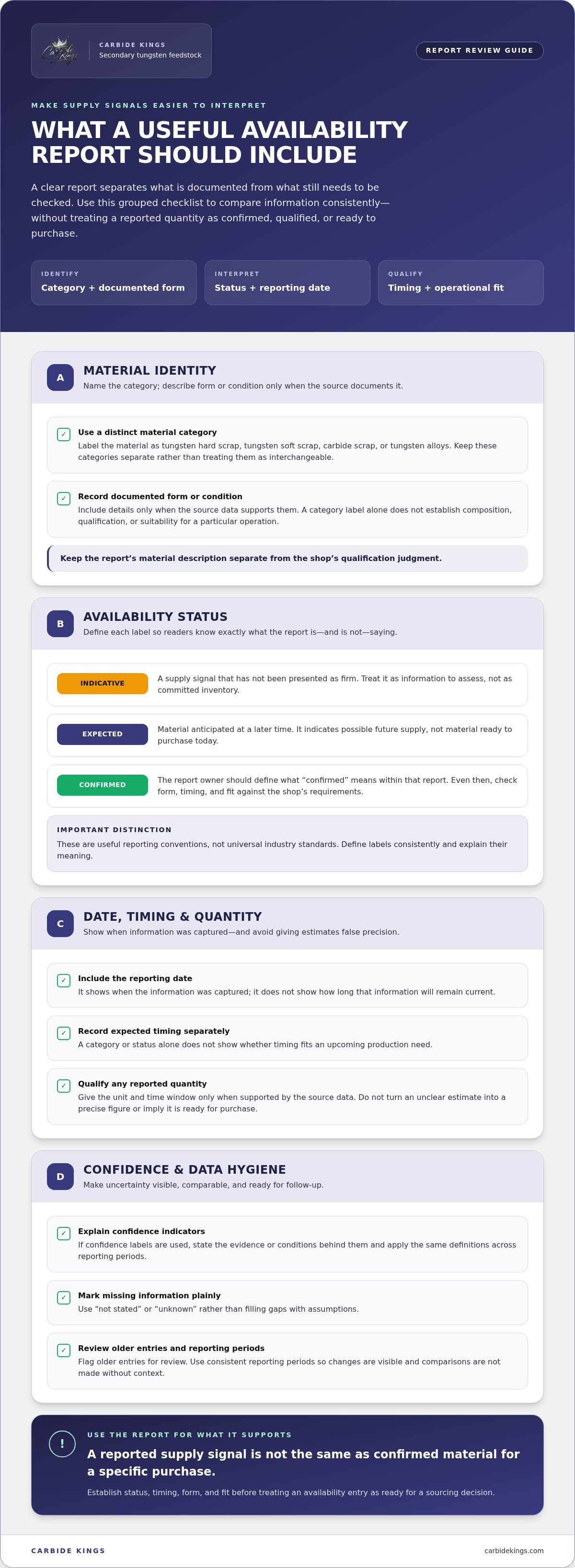
A useful report makes its information easy to interpret. At minimum, identify the material category, documented form, reporting date, and stated availability status. These fields support consistent comparisons and show where information is incomplete. For secondary tungsten feedstock availability reports for melt shop directors, clear definitions matter more than an impressive-looking total.
Material identity, form, and reporting status
Use separate category labels for tungsten hard scrap, tungsten soft scrap, carbide scrap, and tungsten alloys. Add a form or condition description only when the source data documents it. A category label alone does not establish composition, qualification, or suitability for a particular operation. Keep those judgments separate from the report’s description of the material.
Define status labels, too. “Indicative” can identify a supply signal that has not been presented as firm. “Expected” can flag material anticipated at a later time. The report owner should define what “confirmed” means so readers can interpret it consistently within that report. These are useful reporting conventions, not universal industry standards. The International Tungsten Industry Association offers broader tungsten industry context, while a sourcing report should define its own field labels.
Timing, volume, and confidence indicators
A reporting date shows when the information was captured, not how long it will remain current. Record expected timing separately. If the report includes quantity, give the unit and time window only when the source data supports them. Do not turn an unclear estimate into a precise figure, or imply that a quantity is ready for purchase simply because it appears in a report.
Confidence indicators can help teams prioritize follow-up when their meaning is clear. Explain the evidence or conditions behind each label, and use the same definitions across reporting periods. Mark missing fields as “not stated” or “unknown” instead of filling them with assumptions. Flag older entries for review so they are not mistaken for current information.
Every availability report should disclose its data date and define each status label, so readers can judge what the information supports.
- Identity: Material category and documented form or condition.
- Status: Clearly defined indicative, expected, or confirmed label.
- Timing: Report date and any source-supported expected time window.
- Quantity: Stated amount, unit, and period when documented.
- Gaps: Missing or outdated details marked for review, not assumed.
With these fields in place, directors can compare entries without confusing a category with a specification or a signal with a commitment. When documenting requirements, use the same category distinctions as those for industrial tungsten and carbide materials, including tungsten hard scrap, tungsten soft scrap, carbide scrap, and tungsten alloys.
How to compare availability across secondary tungsten feedstock categories
A side-by-side comparison helps procurement identify which reported materials merit further review. Use the same fields for each entry: category, documented form, availability status, timing, and qualification needs. This creates a screening tool, not an acceptance decision. A category match can narrow the options, but it cannot establish that material meets a melt shop’s technical or operational criteria.
Compare material categories without assuming they are interchangeable
Use category names consistently and describe only what the source documents. Hard scrap may include forms such as inserts or drill bits; soft scrap may include powder or swarf. Keep carbide scrap and tungsten alloys as distinct entries. The intended process and the shop’s acceptance criteria determine relevance. For additional category context, see this guide to hard scrap recycling and the discussion of tungsten soft scrap buyers.
| Material category | Form | Status | Timing | Qualification needs |
|---|---|---|---|---|
| Tungsten hard scrap | Record documented form, such as inserts or drill bits | Use the report’s defined label | Record stated timing | Compare with shop criteria |
| Tungsten soft scrap | Record documented form, such as powder or swarf | Use the report’s defined label | Record stated timing | Compare with shop criteria |
| Carbide scrap | Record source-described form | Use the report’s defined label | Record stated timing | Assess against intended use |
| Tungsten alloys | Record source-described form | Use the report’s defined label | Record stated timing | Assess against intended use |
Fill each cell from available documentation. If a field is missing, mark it as unstated rather than inferring it from the category. This prevents unlike materials from appearing equivalent simply because they share a status or timing label. Use the table for an initial comparison; technical acceptance still depends on the shop’s requirements and review process.
Separate supply suitability from market-price analysis
Keep three questions separate: Is supply reported? Does the material fit the operation? How should it be valued? Availability answers only the first. Qualification addresses fit, while valuation is a separate commercial assessment. A price signal does not establish suitability, and a suitable category does not prove that a lot is ready to purchase.
For secondary tungsten feedstock availability reports for melt shop directors, separating these questions makes comparisons more useful. Screen reported supply and operational fit first, then assess valuation separately. For that separate question, consult a tungsten carbide scrap price guide for valuation context. Keep the sourcing table focused on documented material, status, timing, and qualification needs.
A practical workflow for turning availability reports into sourcing decisions
Turn each report into a documented decision path. This keeps procurement and operations aligned, shows what still needs resolution, and prevents an incomplete signal from advancing by default. For secondary tungsten feedstock availability reports for melt shop directors, the goal is not to force every entry into a purchase decision. It is to choose a clear next action based on the shop’s requirements and the evidence available.
- Define the requirement. Record the needed material category, form, timing, and acceptance requirements before comparing supply. This gives the team a consistent reference point.
- Review the report date. Note when the information was recorded and whether its status definitions are clear. If the data is old or labels are undefined, pause before relying on it.
- Screen the material. Mark each requirement as aligned, unclear, or outside the stated requirement. Keep documented facts separate from assumptions.
- Resolve important gaps. Identify which missing details affect scheduling, technical review, or a purchasing decision. Assign each question to an owner.
- Choose the next action. Advance to the appropriate review, keep the signal under review, or close it as unsuitable for the stated need.
Screen a report against operational requirements
Start with the shop’s actual requirements, not the report’s broadest claim. A category may be relevant even when the documented form or timing is unclear. Keep technical approval separate from procurement approval: technical review addresses material acceptance, while procurement review addresses the sourcing decision. Neither approval should silently stand in for the other.
Keep a signal under review when a missing detail could change the decision. For example, if timing is essential to the production plan but the report does not say when supply may be ready, record that gap instead of treating the entry as actionable. This is a pause to resolve the information gap, not an automatic rejection.
Record decisions and update the sourcing view
For each entry, log the report date, status definitions, decision, decision owner, next review date, and unresolved information. Set a review cadence that matches your internal planning cycle; no single interval fits every shop. Update the record when new information changes the status or resolves a decision-critical gap.
Material-flow context can help teams frame what happens after a category enters the sourcing discussion. The industrial carbide scrap recycling process guide offers related context for carbide scrap. Keep that process background separate from the evidence needed to evaluate a specific supply signal.
Documented assumptions make sourcing decisions more defensible because the team can see what was known, what remained unresolved, and why it chose the next step. For industrial buyers moving from requirements to sourcing conversations, discuss tungsten and carbide material sourcing with Carbide Kings.
Connect feedstock planning with Carbide Kings’ tungsten material categories
Once a report has been screened, connect its documented material description to a sourcing requirement. A clear category helps focus the discussion, but it does not establish a particular lot’s specifications, quantity, timing, or suitability. Keep those details tied to the information available for the specific sourcing conversation.
Carbide Kings supplies industrial buyers across the United States with tungsten hard scrap, tungsten soft scrap, carbide scrap, and tungsten alloys. These categories help melt shop directors specify what they are seeking without treating an availability report as a statement of current inventory.
Match sourcing needs to the relevant material category
Start with the category named in the shop’s requirements. If the documented need is for tungsten hard scrap, use that term. If it concerns tungsten soft scrap, carbide scrap, or tungsten alloys, state that category directly. Include the requested form, timing need, and acceptance requirements so the discussion stays connected to the operation.
Category clarity is useful, but it is not a substitute for qualification. A report may identify a category without establishing the attributes needed for technical acceptance. Keep the sourcing conversation focused on documented requirements and distinguish them from details that remain unresolved.
- Material category: Identify the requested category using the shop’s terminology.
- Form and requirements: Include only the form and acceptance criteria documented by the shop or source.
- Timing need: State the planning window relevant to the operation without implying a delivery commitment.
- Open questions: Note what remains unresolved so assumptions do not become purchasing requirements.
Move from report review to a focused sourcing conversation
Before taking action, bring together the material category, timing need, documented requirements, and unresolved information. This concise summary gives everyone a shared starting point. It also keeps a supply signal distinct from a supplier’s inventory claim: a report can inform the conversation, but it does not by itself confirm a specific purchase opportunity.
That distinction matters for secondary tungsten feedstock availability reports for melt shop directors. Use the report to clarify what the shop needs and what information supports the next step, not to infer stock, specifications, or scheduling details that have not been stated.
Carbide Kings supplies industrial tungsten and carbide materials nationally. Use the material categories to frame a sourcing discussion around your requirements.
Explore Carbide Kings’ tungsten and carbide materials.
Make your next sourcing decision easier to act on
Turn the review into a working sourcing brief your team can carry forward. Keep the operational need, decision owner, open questions, and next review point together. When production priorities shift, update the brief rather than restarting the evaluation from scattered notes. This gives procurement and operations a shared reference for deciding whether a supply signal still deserves attention.
Use secondary tungsten feedstock availability reports for melt shop directors as one input to that process, not as a substitute for material review or purchase approval. Clear requirements make the next conversation more focused: the category under consideration, the timing that matters, and the information your team needs to move forward.
Carbide Kings serves industrial buyers across the United States with tungsten hard scrap, tungsten soft scrap, carbide scrap, and tungsten alloys. Explore the material categories that fit your sourcing requirements and take the next step with a clear brief.
Explore Carbide Kings’ tungsten and carbide materials and move your sourcing plan forward.
Frequently Asked Questions
What should a secondary tungsten feedstock availability report include?
It should give readers enough context to interpret each entry, including the material category, documented form, report date, and status meaning. Include quantity units and timing only when the source information supports them. For example, if a report lists a quantity but does not say whether it refers to a lot or a period, flag that limitation instead of comparing it directly with clearer entries. Make missing fields visible so the team knows what needs follow-up.
How can melt shop directors tell whether reported tungsten feedstock is confirmed?
Check what the report means by “confirmed” and what information supports that label. A status word alone does not establish that a specific lot is committed, technically accepted, or ready for purchase. In secondary tungsten feedstock availability reports for melt shop directors, record the source’s definition beside the status. If the definition or supporting information is unclear, keep the entry out of firm production assumptions until the gap is resolved.
Can different secondary tungsten feedstock categories be compared in one report?
Yes, if the report keeps each category distinct and applies the same comparison fields to each. A director might screen hard scrap and soft scrap separately against a documented requirement while retaining carbide scrap and tungsten alloys as their own categories. Use the comparison to identify entries for further review. Do not infer that materials have the same processing characteristics just because they appear in the same table.
How often should a melt shop update its feedstock availability report?
Set the update cadence around the shop’s planning cycle and the decisions the report supports. A report used for an upcoming production review may need attention sooner than one used for longer-range sourcing discussions. Revisit an entry when its stated timing changes, an assumption becomes outdated, or a decision deadline approaches. There is no universal interval; consistent updates and clear dates help the team recognize when information needs refreshing.
What happens if a report does not state material form or availability status?
Mark the entry incomplete and identify the missing field. For example, if the category is known but the form is absent, procurement can record that the entry may warrant follow-up while excluding it from comparisons that depend on form. Assign an owner and a next step if the gap affects a current decision. Until then, do not present the entry as equivalent to a better-documented option.
Does an availability report show whether secondary tungsten feedstock meets a melt shop’s requirements?
No. It can help organize information, but the shop still needs to assess the specific option against its technical and purchasing criteria. For instance, a category may fit the sourcing brief while documentation needed for technical review is still outstanding. Keep material review and the purchasing decision as separate checkpoints. This lets directors use reports to prioritize work without treating a listed entry as automatic approval.
How much detail should a feedstock availability report provide?
Include detail in proportion to the decision the report needs to support. A screening view may need clear categories, dates, and status definitions; a later-stage review may require additional source-supported information. Attribute details to their source and mark estimates or unknowns clearly. A useful test is whether another team member can understand what an entry means and what it does not establish without relying on assumptions or informal explanations.


