

Did you know that the LTL Producer Price Index surged by nearly 21% year-over-year by May 2026? For industrial professionals searching for bulk carbide scrap shipping solutions, those rising freight costs are often the difference between a profitable cleanup and a logistical nightmare. It's frustrating to watch your hard-earned margins disappear into fuel surcharges and broken boxes. You've spent weeks collecting valuable material, only to face the headache of complex LTL requirements and the constant risk of shipping damage due to extreme material density.
This guide provides the professional freight strategies you need to regain control of your bottom line. You'll master the logistics of moving high-density tungsten scrap while simplifying your entire workflow from the shop floor to the final payout. We'll walk you through the impact of the 2026 BIS export regulations, reveal how to dodge common accessorial fees, and show you how to package hard scrap so it survives the journey every time. Efficiency is the key to maximizing your return, and it starts with a smarter approach to logistics.
Key Takeaways
- Learn why the extreme density of tungsten carbide requires specialized handling and why standard logistics providers often struggle with high-value scrap.
- Identify the 500-pound threshold to determine when to transition from parcel services to cost-effective bulk carbide scrap shipping solutions.
- Implement industrial packaging standards using steel drums and heavy-duty palletization to prevent container failure and protect your margins.
- Master essential documentation like the Bill of Lading to ensure accurate weight declarations and maintain full regulatory compliance in 2026.
- Discover how a managed logistics partner can handle the heavy lifting of freight while providing fast, 24-hour payment upon material verification.
The Fundamentals of Industrial Metal Scrap Logistics
Shipping tungsten carbide isn't like moving standard aluminum or steel. It's an exercise in managing extreme density. Tungsten carbide is nearly twice as dense as steel; this means your material occupies very little space but exerts massive pressure on packaging and transport equipment. Most standard logistics providers are optimized for volume. They want light boxes that fill a truck. When they encounter high-value, high-density scrap, their systems often trigger red flags or inflated rates because the weight-to-volume ratio is so skewed.
Evaluating bulk carbide scrap shipping solutions requires a shift in mindset. You're no longer just moving waste; you're managing a high-value industrial asset where logistics costs can quickly erode your margins. In the current 2026 market, where the LTL Producer Price Index has climbed significantly, choosing a partner who understands these nuances is critical for your vendor selection process. You need a strategy that accounts for the physical reality of the material while protecting the financial integrity of the deal.
Understanding Material Density and Freight Class
The National Motor Freight Classification (NMFC) uses density as a primary metric to determine shipping costs. Because carbide scrap is so heavy for its size, it typically falls into a lower freight class. However, the high market value of tungsten alloys means you must balance low freight classes with adequate insurance coverage. Most Less-than-truckload (LTL) freight carriers limit their liability based on the weight of the shipment. If your material is lost or damaged, a standard per-pound payout won't come close to covering the actual value of your carbide.
- Weight Distribution: Dense materials must be centered on pallets to prevent trailer tipping or axle overloads during transit.
- Handling Requirements: Unlike lighter scrap, carbide requires forklifts with high lifting capacities even for small-looking crates.
- Packaging Integrity: Standard cardboard fails under carbide's weight. You need industrial-grade solutions to avoid transit spills and lost inventory.
The Role of Logistics in Scrap Profitability
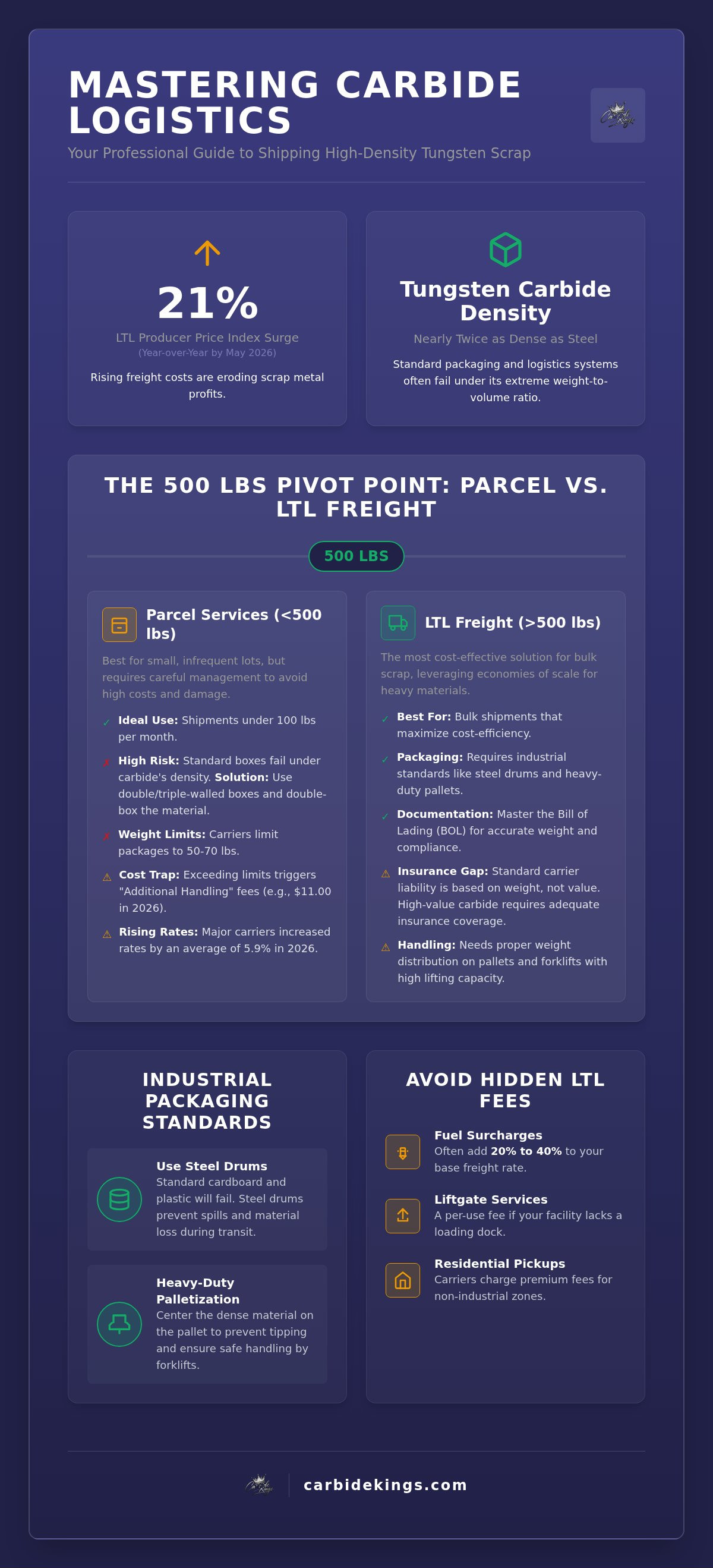
To calculate your true net ROI, you must look past the quoted price per pound. Logistics is often the largest variable expense in the transaction. By May 2026, LTL costs rose nearly 21% year-over-year, making efficient transport management more vital than ever. Hidden fees can devastate a small shop's profit if they aren't anticipated. Professional bulk carbide scrap shipping solutions account for these common accessorial charges before the truck arrives:
- Fuel Surcharges: These fluctuate weekly and often add 20% to 40% to your base rate.
- Liftgate Services: Essential if you don't have a loading dock, but they carry a specific per-use fee.
- Residential Pickups: Always confirm your zoning; carriers charge premiums for pickups in non-industrial areas.
Mastering these fundamentals ensures your scrap program remains a revenue driver rather than an administrative burden. When you streamline the movement of your material, you secure faster payments and more predictable returns. It's about removing the friction between your shop floor and the bank.
Evaluating Shipping Options: Parcel vs. LTL Freight
Choosing the right shipping mode is a math problem where weight and volume dictate your profitability. For most industrial facilities, the 500-pound threshold is the critical pivot point. Below this weight, parcel services offer convenience for small machine shop lots. Above it, you need bulk carbide scrap shipping solutions that leverage freight economies of scale. With UPS and FedEx implementing average 5.9% rate increases in early 2026, the cost of moving heavy material via parcel has never been higher. You must evaluate these options based on your current inventory to ensure you aren't overpaying for transport.
Maximizing Small Shipments with Parcel Services
Parcel shipping works best for shops generating less than 100 pounds of scrap per month. Flat-rate boxes are popular because they simplify cost forecasting, but they come with strict physical limits. Tungsten's density is a box-killer. Standard packaging will fail, leading to lost material and denied insurance claims. You must use double-walled or triple-walled boxes, and even then, double-boxing is a professional requirement. Most carriers limit individual parcel weights to 50 or 70 pounds. Exceeding these limits often triggers "Demand Additional Handling" fees, which reached $11.00 per package in late 2026. If you're consistently shipping multiple heavy boxes, it's time to scale up.
The Efficiency of LTL Freight for Bulk Carbide
Less-than-truckload (LTL) shipping is the engine of the industrial scrap industry. It allows you to consolidate your carbide scrap with other industrial loads, significantly reducing the cost per pound. When your lot exceeds 500 pounds, LTL becomes the most secure and cost-effective method. It requires more preparation, such as palletizing and securing drums, but the trade-off is a more professional and reliable workflow. Carriers operate under strict Federal transportation regulations, providing a level of oversight and insurance that parcel services cannot match for high-value alloys.
- Scheduled Pickups: Standardize your shipping schedule to once a month or once a quarter to maximize pallet density.
- Dock Management: Ensure your facility is ready for a 53-foot trailer or request a liftgate in advance to avoid high-cost redelivery fees.
- Cost Consolidation: LTL rates are more stable than parcel surcharges, especially when you manage your freight class correctly.
For massive plant cleanouts exceeding 10,000 pounds, full truckload (FTL) logistics provide the ultimate efficiency. This removes the "hub and spoke" handling of LTL, moving your material directly from your dock to the processing facility. This reduces handling risks and speeds up your payment cycle. If you aren't sure which mode fits your current lot size, the experts at Carbide Kings can help you determine the most profitable path forward. Managing these logistics effectively ensures your scrap program remains a streamlined revenue stream rather than a source of frustration.
Industrial Packaging Standards for Bulk Carbide
Packaging isn't just about containment; it's about structural survival. If your container fails, your profit literally spills onto the highway. For effective bulk carbide scrap shipping solutions, you must match the container's structural integrity to the material's extreme density. Steel drums are the industry standard for smaller parts and soft scrap, while reinforced wooden crates work better for larger, solid tungsten hard scrap. Don't cut corners on materials. A cheap box is a liability when you're moving thousands of dollars in industrial alloys.
Correct labeling is equally vital for a smooth transaction. Every pallet needs clear documentation on at least two sides. You should include the material type, the net weight of the scrap, and the gross weight of the entire pallet. This transparency helps carriers manage their axle weights and ensures your shipment moves through the network without being flagged for inspection or re-weighing fees. It's a simple step that prevents administrative delays at the dock and keeps your workflow moving forward.
Securing 500+ lbs for National Transit
Moving bulk lots requires a methodical approach to palletization. It's not enough to just set a drum on a pallet; you have to integrate them into a single, immovable unit. Follow these three steps to ensure your material arrives intact.
- Step 1: Inspect pallet integrity. Use only Grade A heat-treated wood or heavy-duty plastic pallets. Avoid "one-way" lightweight pallets. They'll crumble under the 1,000-pound loads common in the carbide industry.
- Step 2: Line containers. If you're shipping fines or soft scrap, use heavy-duty poly liners. This prevents leakage and protects the material from moisture. Even small losses add up quickly when dealing with high-value tungsten.
- Step 3: Triple-strap and shrink-wrap. Secure your containers to the pallet using at least three steel or heavy-duty polyester straps. Apply multiple layers of industrial shrink wrap. This prevents lateral shifting during sudden stops or turns.
Preventing Container Failure and Loss
Most shipping failures happen because the material moves inside the container. When high-density carbide shifts, it creates a "hammer effect" that can punch through even reinforced walls. This is why you must fill any voids with dunnage or cardboard. Over-packing is always cheaper than a burst container and the subsequent insurance headache. Burst strength refers to the maximum pressure a container wall can withstand before rupturing, typically measured in pounds per square inch (PSI) to ensure it can support the extreme density of tungsten alloys. Center your load directly over the pallet's stringers to maintain a balanced center of gravity. This small adjustment keeps the truck stable and your material secure.
Compliance and Documentation in 2026 Logistics
Precision in paperwork is just as important as the physical security of your load. In 2026, the regulatory environment for industrial metals has tightened significantly. The Bureau of Industry and Security (BIS) recently implemented a temporary final rule requiring all domestic tungsten scrap sales to be allocated to U.S. buyers. This makes accurate documentation essential for proving compliance and avoiding legal bottlenecks. Implementing robust bulk carbide scrap shipping solutions means having a paper trail that protects your business from audits and transport disputes.
Digital tracking has become the industry standard for high-value alloys. Real-time visibility allows you to monitor your shipment from the moment it leaves your dock until it reaches the processing facility. This level of transparency eliminates the guesswork and ensures that any transit delays are identified immediately. By integrating digital tracking into your logistics workflow, you gain peace of mind and maintain a professional, data-driven operation. It's about moving from reactive shipping to proactive asset management.
Mastering the Bill of Lading
The Bill of Lading (BOL) is the legal contract between you and the carrier. It dictates everything from the freight class to the liability limits. You must ensure that the piece count, total weight, and NMFC code are 100% accurate. For carbide scrap, using the correct classification prevents carriers from re-classifying your load at a higher rate during transit. Modern facilities now favor digital BOLs to streamline facility operations and reduce administrative errors. An accurate BOL doesn't just guide the truck; it's your primary defense if you ever need to file an insurance claim.
Insurance and Liability Management
Don't assume your carrier's standard liability covers the full value of your carbide. Standard LTL liability is often limited to a specific dollar amount per pound, which is a fraction of the market value for tungsten alloys. Always verify the coverage limits before the truck arrives. To see how these requirements fit into the broader sales process, review our How to Sell Tungsten Scrap in the USA: The 2026 Industrial Guide. Documenting your load with high-resolution photos before pickup is a mandatory step. These photos serve as proof that the material was properly packaged and secured, shifting the burden of proof to the carrier if damage occurs during transit.
Ready to simplify your next shipment? Contact the team at Carbide Kings to handle your logistics and documentation from start to finish.
Streamlining Your Strategy with Carbide Kings
You shouldn't have to be a logistics expert to get a fair price for your industrial material. Carbide Kings specializes in high-volume industrial procurement by taking the logistical weight off your shoulders. We provide comprehensive bulk carbide scrap shipping solutions that cover everything from the initial quote to the final pickup. Our national US coverage ensures that whether you're a large manufacturing plant or a specialized machine shop, you have access to a streamlined and transparent process. We've spent years refining our workflow so you don't have to worry about the complexities of freight management.
We handle the freight scheduling, the Bill of Lading, and the carrier coordination. This managed approach allows you to stay focused on your core operations while we manage the heavy lifting. Once your material is verified at our facility, we offer fast-track 24-hour payment terms. It's a no-nonsense system designed for industrial professionals who value speed, clarity, and reliability. We prioritize movement and progress, ensuring your shop floor stays clear and your capital remains liquid.
Why Industrial Partners Choose Carbide Kings
Industrial leaders partner with us because we eliminate the traditional barriers of the scrap industry. Transparency is our foundation; you won't find hidden logistics fees or administrative hurdles here. We provide expert support for complex freight requirements, including mixed lots of tungsten hard scrap, soft scrap, and various industrial alloys. Our team understands the 2026 regulatory environment and ensures every shipment is fully compliant with domestic allocation rules. Learn more about Selling Tungsten Hard Scrap: The 2026 Industrial Buying Guide to see how we categorize and value your material for maximum return.
Getting Started with Your Bulk Shipment
Initiating your shipment is a straightforward, logical process. First, request a quote for bulk carbide scrap shipping solutions through our digital platform. You'll be assigned a dedicated logistics account manager who serves as your single point of contact. This expert handles the technical details, from verifying NMFC codes to scheduling the truck for your specific dock requirements. They answer your questions before they're even fully formed, providing a level of service that standard scrap yards can't match.
Finalizing the deal is fast and efficient. From the moment the driver signs the BOL to the electronic payment hitting your account, we prioritize momentum. We've refined this process to perfection, leaving you with the impression that the work is already as good as done. Stop letting logistical headaches eat into your margins and start working with a partner that values your time as much as your material.
Maximize Your Scrap Revenue with Professional Logistics
Logistics shouldn't be the barrier between your industrial scrap and your profit. By mastering density-based packaging and navigating 2026 compliance standards, you transform a heavy burden into a streamlined revenue stream. You now have the strategies to choose between parcel and LTL effectively while protecting your margins from hidden fees. Implementing these professional bulk carbide scrap shipping solutions ensures your material moves safely and stays compliant with the latest domestic regulations.
Carbide Kings is ready to handle the heavy lifting for you. As specialists in industrial-grade tungsten scrap, we provide national US logistics support that simplifies your entire workflow. We remove the administrative hurdles and offer fast 24-hour payment terms once your material is verified at our facility. Our process is designed to make the transition from the shop floor to a final payout feel effortless and secure.
Streamline your bulk carbide shipping with Carbide Kings today. Let's turn your scrap inventory into liquid capital without the logistical headache. Your next successful shipment is just one click away.
Frequently Asked Questions
What is the best way to ship over 1,000 lbs of carbide scrap?
LTL freight is the most efficient method for shipments exceeding 1,000 pounds. You should secure your material in steel drums or reinforced crates and strap them to a heavy-duty pallet. This approach utilizes bulk carbide scrap shipping solutions that leverage industrial density for better rates. Always center the load to ensure trailer stability. Professional carriers prefer this method because it minimizes handling risks compared to shipping dozens of individual heavy parcels.
Do I need a loading dock to ship bulk carbide scrap?
You don't need a loading dock, but you must specify that you require a liftgate at the time of your quote. Carriers typically charge an accessorial fee for this service, which often ranges from $50 to $100 in the 2026 market. If your facility is in a non-industrial zone, you should also mention that a residential pickup fee might apply. Being transparent about your pickup location prevents redelivery delays and unexpected surcharges.
How do I calculate the freight class for tungsten carbide?
Freight class is determined by density, stowability, and value. Tungsten carbide is extremely dense, which often places it in a lower freight class like Class 50 or 60. However, the high market value of tungsten alloys can sometimes shift this classification. You should consult with your logistics manager to ensure the NMFC code on your Bill of Lading accurately reflects your scrap type. This prevents carriers from triggering expensive re-weighing fees during transit.
What happens if a box breaks during industrial scrap transit?
If a container fails during transit, the carrier may deny liability if they determine the packaging was insufficient for the material's weight. Tungsten's density creates a hammer effect that easily punctures standard cardboard. Use double-walled boxes for smaller lots and steel drums for bulk shipments. Documenting your packaging with photos before the driver arrives is your best defense. This evidence is critical when filing a claim for lost or damaged material.
Can I ship mixed loads of hard scrap and tungsten alloys together?
You can ship mixed loads of hard scrap and various tungsten alloys on a single pallet. The key is to keep the materials separated within the shipment using internal dividers or individual buckets inside a larger drum. Clear labeling for each material type helps the receiving facility verify your inventory quickly. This organization speeds up the processing time and ensures you receive your 24-hour payment without facing unnecessary sorting delays at the dock.
Is there a minimum weight requirement for LTL freight pickups?
Most LTL carriers require a minimum of 150 pounds, but it's generally not cost-effective until you reach the 500-pound threshold. For smaller amounts, parcel services are usually better, provided you follow strict weight limits. Once you hit bulk levels, bulk carbide scrap shipping solutions offer significantly lower costs per pound. Consolidating your shop's scrap over several months is a smart way to reach these more profitable freight brackets while simplifying your logistics.
How do I ensure my scrap shipment is fully insured?
Standard carrier liability for scrap metal is often limited to a few dollars per pound, which doesn't cover the full value of tungsten. You must declare the actual value of your shipment on the Bill of Lading to secure adequate coverage. In many cases, it's safer to work with a buyer who provides their own comprehensive cargo insurance. This protects your margins from the moment the truck leaves your facility until the final verification is complete.
What documentation is required for national industrial metal shipping?
The primary document you need is an accurate Bill of Lading that lists the piece count and total weight. In 2026, you must also ensure your shipment complies with the BIS temporary final rule regarding domestic tungsten scrap allocation. Keeping a copy of your material's weight certificate and high-resolution photos of the loaded pallet provides a complete audit trail. These records are essential for both legal compliance and ensuring your payment is processed without administrative hurdles.


