
A lot’s weight loss is not automatically a moisture reading. Moisture sampling and loss on ignition testing for tungsten soft scrap lots distinguish mass lost during drying from additional mass lost during ignition. The U.S. Geological Survey’s Mercury Research Laboratory defines loss on ignition as the percentage of a sample’s mass lost after heating.
That distinction matters when you need a clearer picture of a scrap lot’s contents. Measure moisture by weighing a sample, drying it, then cooling and weighing it again. LOI measures further mass loss after ignition. This loss can include water and carbon dioxide from carbonates, so it is not a direct measure of moisture alone.
This guide covers representative sampling, moisture measurement by drying and weighing, and controlled furnace heating and cooling for LOI. It explains how to keep the results distinct, calculate mass loss, and understand what each measurement can and cannot tell you about tungsten soft scrap.
Key Takeaways
- Plan sampling so the test portion reflects the soft scrap lot, not just the easiest material to reach.
- Keep the moisture result separate from later ignition loss to make the figures easier to interpret.
- Control furnace conditions and cooling before weighing to support consistent LOI results.
- Use the results to better understand the material, then explore whether Tungsten Soft Scrap from Carbide Kings fits your needs.
Loss-on-ignition test procedure
Tungsten soft scrap is tungsten-bearing material classified by its physical form and source, not as one uniform grade. Describe the material’s form, visible contamination, and any available composition information to make the lot description useful.
For sampling equipment and test portion size, use clean tools that can collect and contain representative material. Choose the portion based on the lot’s variability and the laboratory method; no single sample mass suits every lot.
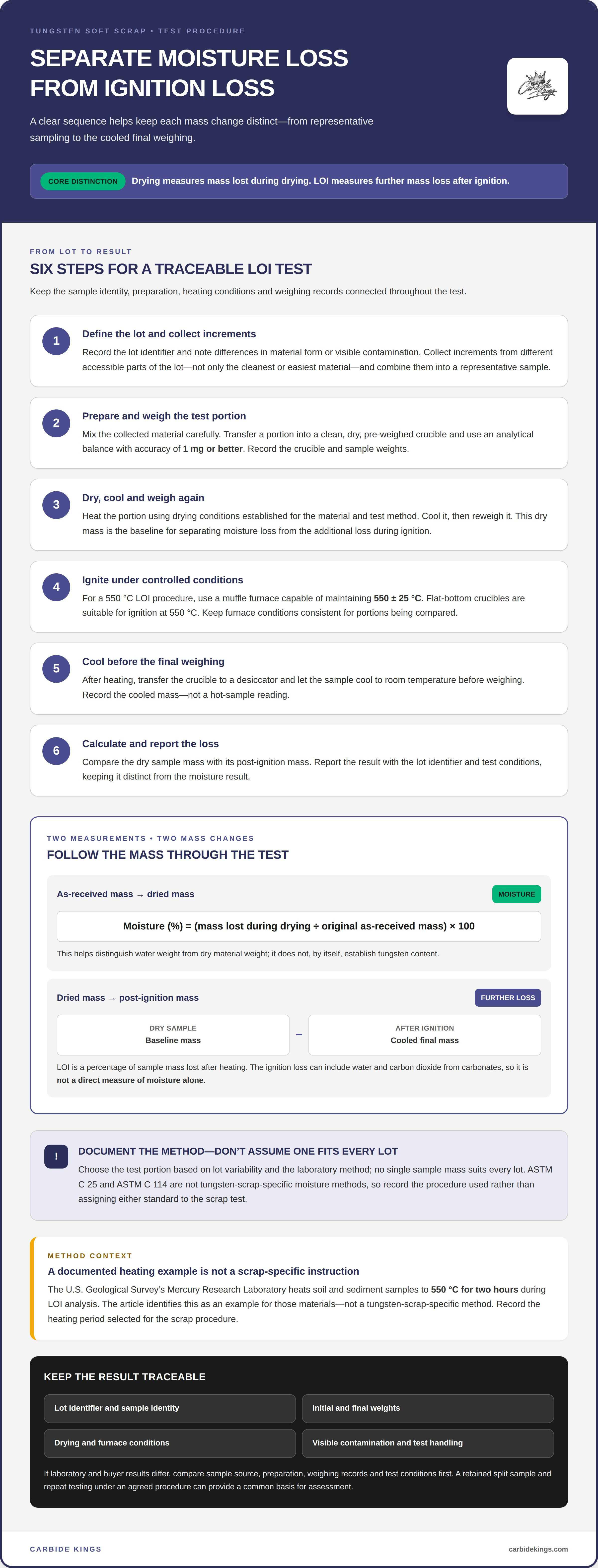
- Define the lot and collect increments. Record the lot identifier and note differences in form or visible contamination. Take increments from different accessible parts of the lot, rather than selecting only the cleanest or easiest material to reach. Combine them into a representative sample.
- Prepare and weigh the test portion. Mix the collected material carefully, then transfer a portion into a clean, dry, pre-weighed crucible. Use an analytical balance with an accuracy of 1 mg or better. Record the crucible and sample weights so the dry sample mass can be calculated.
- Dry the material before ignition. Heat the portion using the drying conditions established for the material and test method. Cool it, then weigh it again. This dry mass provides the baseline for distinguishing moisture loss from the additional loss during ignition.
- Ignite under controlled conditions. Use a muffle furnace capable of maintaining 550 ± 25 °C when following a 550 °C LOI procedure. Flat-bottom crucibles are suitable for ignition at 550 °C. Keep the furnace conditions consistent across portions being compared.
- Cool before the final weighing. After heating, transfer the crucible to a desiccator and let the sample cool to room temperature before weighing. This prevents a hot sample from becoming the final mass reading and supports consistent measurements.
- Calculate and report the loss. Compare the dry sample mass with its post-ignition mass. Their difference is used to determine organic content in the described LOI process. Report the result with the lot identifier and test conditions, keeping it distinct from moisture loss.
Moisture determination by drying and weighing
Use a representative test portion and compare its mass before and after drying. Keep the moisture calculation separate from LOI so each result describes a distinct change in mass.
Sample the Moisture Testing Lot
- Collect increments from different accessible areas and material forms, then combine and mix them before taking the moisture portion. Avoid sampling only exposed, dry-looking pieces; surface conditions may not represent the lot. ASTM C 25 covers chemical analysis of limestone, quicklime, and hydrated lime, while ASTM C 114 covers hydraulic cement. Neither is a tungsten-scrap-specific moisture method, so record the procedure used rather than assigning either standard to the scrap test.
Evaluate Weight and Payable Metal Effects
- Weigh the test portion as received, dry it, cool it, and reweigh it. Calculate moisture as the mass lost during drying divided by the original, as-received mass, multiplied by 100. The result helps distinguish water weight from dry material weight; it does not, by itself, establish tungsten content.
- Keep LOI separate. It measures further mass loss during ignition, which can include substances beyond moisture. Buyers may use the documented results when evaluating lot weight and payable metal content, but the calculation method and commercial terms determine how each result is applied.
Check for Test Errors and Contamination
- Use clean, dry sample containers and weighing equipment. Moisture can change if material is exposed before weighing, while residue or debris from a previous test can affect measured mass. Record the sample identity, initial and final weights, drying conditions, and any visible contamination to make the result traceable.
- If a laboratory result and buyer result differ, compare the sample source, preparation, weighing records, and test conditions first. Then discuss a retained split sample and repeat testing under an agreed procedure. This gives both parties a common basis for assessing whether sampling or test handling explains the difference.
Controlled furnace heating and cooling
- Set a safe, controlled work area. Follow the furnace operating instructions and established laboratory procedures. Keep hands clear of hot surfaces, and move crucibles with tools designed for hot laboratory ware. These precautions matter during both furnace loading and cooling.
- Confirm the furnace setpoint before loading. A muffle furnace capable of maintaining 550 ± 25 °C supports a controlled LOI procedure at 550 °C. Record the setpoint and actual furnace conditions with the sample identification, so later comparisons use documented conditions.
- Arrange the sample consistently. Place the prepared portion in a suitable crucible and position it securely inside the furnace. Use the same loading approach for portions being compared. Avoid changing sample depth or furnace placement between runs, since consistent handling helps make the resulting measurements comparable.
- Apply a defined heating period. The U.S. Geological Survey’s Mercury Research Laboratory heats soil and sediment samples to 550 °C for two hours during LOI analysis. Treat this as a documented example for those materials, not as a tungsten-scrap-specific method. Apply the procedure selected for the scrap and record its heating period.
- Cool the crucible before weighing. After heating, transfer the crucible using suitable hot-material handling tools. Let the sample reach room temperature in a desiccator before weighing. Record the cooled mass only after the sample and container have completed the specified cooling step.
- Keep every run traceable. Log the sample identifier, furnace setpoint, heating period, cooling method, and final mass. If results differ between runs, compare those recorded conditions before interpreting the difference. Consistent records help distinguish handling variation from a genuine change in sample mass.
The Franklin & Marshall LOI procedure calls for cooling heated samples to room temperature in a desiccator before weighing. The difference between the post-ignition weight and dry weight is then used to determine organic content.
Loss on ignition and volatile material
- Read LOI as a result tied to a specific heating method. According to the U.S. Geological Survey’s Mercury Research Laboratory, LOI is the percentage of sample mass lost after heating. For moisture sampling and loss on ignition testing for tungsten soft scrap lots, treat that figure as total measured loss under the test conditions, not as a direct measurement of tungsten content.
- Consider which volatile substances may contribute. Water and carbon dioxide from carbonates commonly leave during LOI. The balance can’t identify each substance by itself. For example, a result may reflect more than one source of mass loss, so don’t label the entire difference as organic material without supporting analysis.
- Keep the moisture and ignition results distinct. Use the dry mass as the baseline when calculating further loss during ignition. Recording both measurements separately helps clarify whether mass changed during drying, during ignition, or across both stages. This distinction makes the results more useful when reviewing a lot’s material characteristics.
- Record the atmosphere used. LOI is usually performed in air, but inert or reactive atmospheres can also be used. Include the atmosphere in the test record because it influences the conditions under which material is heated. Comparing tests across different atmospheres without noting the change can obscure why results differ.
- Choose conditions for the material and method. Cement LOI commonly uses 900-1000 °C until mass stabilizes; mining tests for total rock volatiles also use 900-1000 °C. These examples aren’t automatically suitable for tungsten scrap. The method selected for moisture sampling and loss on ignition testing for tungsten soft scrap lots should guide the reported temperature and duration.
- Apply method-specific corrections carefully. The Franklin & Marshall procedure corrects initial LOI by adding 0.111348 times the titrated weight percentage of FeO. That correction depends on titrated FeO data and applies within that procedure. Keep it distinct from a general scrap LOI calculation. Explore tungsten soft scrap options when considering material alongside test results.
Carbide Kings: Tungsten Soft Scrap
Carbide Kings supplies tungsten soft scrap for industrial buyers seeking material for manufacturing and metallurgical use. The sampling and testing steps above clarify moisture and ignition-related mass loss, but they do not replace choosing scrap that fits your needs.
Turn to Carbide Kings to source tungsten soft scrap or compare it with tungsten hard scrap, carbide scrap, or tungsten alloys. Clear lot information helps define your material requirements and focus the discussion on the scrap you need.
Contact Carbide Kings to discuss Tungsten Soft Scrap for your material needs.
Use Your Results to Plan the Next Lot
Use each test to inform future material decisions. Consistent records of moisture sampling and loss on ignition testing for tungsten soft scrap lots can help your team compare incoming material with its handling and purchasing priorities. Apply the findings to set practical acceptance criteria, identify questions for suppliers, and align lot evaluations with production needs.
Testing data is only part of the decision. The next step is matching the material to your requirements. Carbide Kings supplies tungsten scrap for industrial use, including tungsten hard scrap, tungsten soft scrap, and carbide scrap.
Ready to discuss material options? Contact Carbide Kings about tungsten scrap. A clear next step can make your sourcing decision easier.
Frequently Asked Questions
What is Loss on Ignition?
Loss on ignition (LOI) is the percentage of a sample’s mass lost during heating. The measured loss may combine different volatile substances, so LOI alone doesn’t identify what left the material. For example, water and carbon dioxide released from carbonates can contribute. Treat LOI as a result tied to specific test conditions, not as a direct measure of tungsten content or moisture alone.
What are standard moisture determination methods for tungsten soft scrap?
A gravimetric drying method determines moisture by comparing a sample’s mass before and after drying, cooling, and reweighing. A soil example uses 100 °C overnight, but that condition is for soil, not a universal tungsten scrap specification. For a scrap lot, the useful method is one that records the sample condition and drying procedure consistently, so results can be compared under the same approach.
How is loss on ignition testing performed on tungsten soft scrap?
Start with a prepared test portion and record its dry mass, then heat it using the selected LOI method. Cool the heated portion before weighing, and calculate the mass difference against the dry starting mass. Keep the lot identifier and test conditions with the result. To assess precision, the U.S. Geological Survey’s Mercury Research Laboratory weighs one sample out of every 14 analyzed in triplicate.
What furnace temperature, duration, and atmosphere are used for tungsten scrap LOI testing?
Use the temperature, duration, and atmosphere defined for the specific test method and material; these conditions affect what the sample loses. A 550 ± 25 °C furnace and a two-hour heating period are used in the U.S. Geological Survey’s Mercury Research Laboratory procedure for soil and sediment, not as a universal tungsten scrap setting. LOI is usually performed in air, though inert or reactive atmospheres are also possible.


